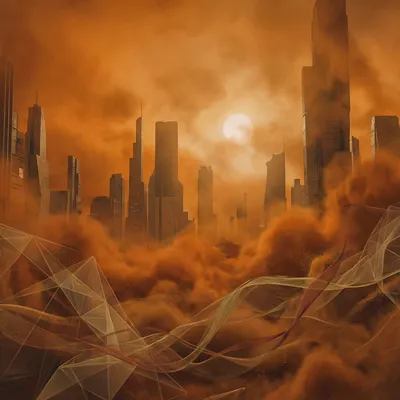
Did you see the sky yesterday morning? I mean, I woke up, looked out the window, and for a second, I genuinely thought I had accidentally slept through a few decades and woken up on a colony on Mars. It was that deep, eerie shade of orange-gold that just feels wrong for Jerusalem. It was beautiful in a terrifying way, like the world was viewed through a sepia filter that someone had turned up to eleven.

Oh, I definitely saw it. Herman Poppleberry here, and I was actually already up at five in the morning checking the sensors. It was a classic Khamsin, or a heavy dust storm coming in from the desert. Our housemate Daniel was feeling it too. He has been obsessively checking his new air quality app because his asthma has been acting up with all that dust and the mold situation we had in the house recently. It is funny how we live together and all breathe the same air, but it takes an orange sky or a flare-up of allergies for us to really stop and think about what is actually in every breath we take. We are currently sitting here on February tenth, twenty twenty-six, and even though the sky has cleared up significantly since yesterday, the data tells a much more complicated story than just what we can see with our eyes.
It is so true. Daniel sent us this prompt because he noticed that the air quality index on his phone went from one hundred fifty during the peak of that dust storm yesterday all the way down to fifty-three today. That is a massive swing in just twenty-four hours. It makes you realize that the air is not just this static thing. It is a shifting, breathing soup of chemicals and particles that changes based on the time of day, the season, and even the height of the clouds. It feels like we are living inside a giant chemical reactor that never turns off.
Exactly. And I love that he brought up the specific metrics like particulate matter two point five and particulate matter ten, along with ozone and pollen. Most people just see a single number on their weather app and think, okay, the air is good or the air is bad. But the reality is a lot more nuanced. Those different pollutants have completely different sources, they have different physical properties, and they behave differently depending on the weather. If you want to understand why you feel sluggish or why your eyes are itchy, you have to look past that single A Q I number and look at the components.
Well, let us start with the basics then, because I think a lot of people hear those terms and their eyes glaze over. When we talk about particulate matter ten versus particulate matter two point five, what are we actually talking about in terms of scale? I know the numbers refer to microns, but give me a sense of what that looks like in the real world.
Right, so a micron is a millionth of a meter. To give you a visual, think about a single human hair. A human hair is usually around fifty to seventy microns in diameter. So, particulate matter ten is about one-fifth the width of a hair. These are the larger particles like dust, pollen, and mold spores. They are big enough that your nose and throat can usually filter a lot of them out, which is why you might get a scratchy throat or start sneezing during a dust storm. They are essentially the "coarse" fraction of pollution.
But particulate matter two point five is the one that really worries the health experts, right? Because it is so much smaller.
Much smaller. We are talking about particles that are thirty times smaller than the width of a hair. These come from combustion, like car engines, power plants, and wood fires. Because they are so tiny, they do not get caught in your upper respiratory system. They go deep into the lungs, into the alveoli, and can even cross into your bloodstream. That is why when Daniel sees that number spike on his app, it is a much bigger deal for his long-term health than just some dust in the air. And there is even a smaller category we are starting to monitor more in twenty twenty-six, which is particulate matter zero point one, or ultrafine particles. These are so small they can actually travel along the olfactory nerve directly into the brain.
That is terrifying. It is fascinating because yesterday, when the sky was orange, that was mostly the larger particulate matter ten from the desert dust. But you can have a day where the sky looks perfectly blue and clear, yet the particulate matter two point five levels are dangerously high because of heavy traffic or industrial activity. It is the invisible stuff that gets you.
That is such a good point. And it leads perfectly into one of the things Daniel asked about, which is the time of day. Have you ever noticed how the air often feels heavier or more stagnant in the early morning right before the sun really gets high?
Yeah, and I always assumed that was just because of the morning rush hour. You have thousands of cars starting up and sitting in traffic, so of course the pollution goes up. But is there more to it than just the tailpipes?
There is a really cool meteorological phenomenon called the planetary boundary layer. Think of the atmosphere like a giant room. During the day, the sun heats the ground, which heats the air above it. That warm air rises and creates a lot of vertical mixing. It is like the ceiling of the room is being pushed way up, sometimes several kilometers high. All the pollution from cars and factories gets diluted in that huge volume of air. It is like taking a drop of ink and putting it in a swimming pool instead of a glass of water.
So the room gets bigger, so the concentration of smoke goes down. That makes sense. But what happens at night?
At night, the ground cools down quickly. The air near the ground gets colder than the air above it, which creates what we call a temperature inversion. This essentially puts a lid on the atmosphere. The boundary layer shrinks from maybe two thousand meters down to just a few hundred meters. So, all those pollutants that were being emitted in the evening and early morning are now trapped in a much smaller space. It is like everyone in the house decided to start smoking in a tiny closet instead of a big living room.
Wow, so even if the number of cars stayed the same, the air quality would naturally get worse just because the atmosphere is physically squishing the pollution closer to our noses.
Exactly. That is why you often see the highest concentrations of particulate matter right around eight or nine in the morning. You have the combination of the morning commute and a very low boundary layer that has not had a chance to expand yet. Then, by two in the afternoon, the air might feel much fresher even if there are still plenty of cars on the road, because the ceiling has lifted. It is a daily cycle of compression and expansion.
But wait, what about ozone? Because I have heard that ozone actually peaks in the afternoon, which seems to contradict what you just said about the air getting cleaner as the day goes on.
You are spot on. Ozone is the rebel of the air quality world. Unlike particulate matter, which is often emitted directly from a source, ground-level ozone is a secondary pollutant. It is created by a chemical reaction between nitrogen oxides and volatile organic compounds in the presence of sunlight.
So it is like a recipe. You need the ingredients from the cars, but you also need the oven, which is the sun.
Precisely. The nitrogen oxides come from traffic in the morning. Then the sun beats down on those chemicals all day. By mid-afternoon, around three or four o'clock, the chemical reaction has reached its peak, and that is when you get the highest ozone levels. This is why on hot, sunny summer days, the air quality alerts are often specifically for ozone, even if the air looks clear. It is also why it is usually better to go for a run in the early morning during the summer. You might deal with a bit more particulate matter, but you avoid the peak ozone which is very irritating to the lungs. Ozone is basically a gas that "sunburns" your lungs from the inside.
That is a great practical takeaway. I always thought, oh, it is a beautiful sunny day, I will go for a late afternoon jog. But I am actually breathing in the peak of that chemical reaction. It is interesting how these different pollutants are almost on opposite schedules.
They really are. And then you throw seasonality into the mix, and it gets even more complex. Think about where we are right now in February. In Jerusalem, we do not have as much ozone because the sun is not as intense and the temperatures are lower. But we have a different problem: heating and inversions.
Right, I can smell it when I walk through the neighborhood. A lot of people still use wood-burning stoves or those diesel-powered heaters.
Exactly. In the winter, you get those very strong temperature inversions I mentioned earlier. The cold air gets trapped in the valleys of Jerusalem, and everyone starts their wood fires. You can actually see the smoke just sitting there, not moving. On a cold, still winter night, the particulate matter two point five levels in a residential neighborhood can be higher than they are near a highway. This is what we call "winter smog," and it is driven by domestic heating and stagnant air.
It is a bit of a localized microclimate. You could be on one street and the air is fine, but you turn the corner into a valley where three people have wood stoves going, and suddenly you are in a pollution hotspot.
And then you have the spring, which is just around the corner for us. Daniel mentioned the pollen counts, and that is a huge factor this time of year. In fact, right now in early February, the Cypress trees—the Cupressaceae family—are starting to release their pollen in this part of the world. Spring is this weird tug-of-war. The weather gets nicer, the boundary layer gets higher, so the man-made pollution often drops. But then the trees and grasses go into overdrive. For someone like Daniel with allergies, the air quality might technically be "good" according to the government sensors which focus on industrial pollutants, but for his personal experience, the air is full of biological irritants.
I remember reading that climate change is actually making the pollen season longer and more intense. Because the winters are shorter and the carbon dioxide levels are higher, plants are producing more pollen and for more weeks out of the year. So that seasonal peak is just getting wider and wider.
It is. Higher carbon dioxide acts like a fertilizer for ragweed and other high-pollen plants. They have done studies showing that ragweed grown in current carbon dioxide levels produces significantly more pollen than it did fifty years ago. It is another one of those second-order effects that people do not often think about when they talk about the environment. We are literally supercharging the plants to be more irritating to our immune systems.
Let us go back to that orange sky for a minute, because that felt like a very specific event. We get these dust storms from the Sahara or the Arabian Peninsula. That is a natural source of pollution, right? Is that somehow better for us than the car exhaust?
Well, it is natural in the sense that it is dust, but your lungs do not really care if a particle came from a desert or a diesel engine if it is small enough to get in there. However, the chemical composition is very different. Desert dust is mostly minerals, like silica, calcium, and iron. Car exhaust is full of heavy metals, polycyclic aromatic hydrocarbons, and other toxic chemicals. So, while a dust storm can be very irritating and bad for asthma, the long-term carcinogenic risk of industrial pollution is generally much higher. But there is a catch.
There is always a catch with you, Herman. What is it?
These dust storms can carry things with them. It is not just sand. They pick up stuff along the way. Dust can act as a transport mechanism for bacteria, fungi, and even industrial pollutants from other regions. A dust storm starting in North Africa can pick up pollutants as it passes over Mediterranean cities and then dump them on us. It is a globalized air system. Nothing stays in one place. There have even been studies showing that dust storms can transport viruses across oceans.
That is a bit of an unsettling thought. The idea that a factory in one country could be contributing to the air quality in a completely different continent because of a dust storm. It really reinforces the idea that we are all breathing the same soup.
It really does. And since we are talking about what else influences the air, we have to mention humidity. Have you noticed how the air feels after a good rain?
It feels amazing. It is like the whole world has been scrubbed clean.
Because it literally has been. This is a process called wet deposition. Raindrops and snowflakes are incredibly efficient at grabbing onto those particulate matter particles and dragging them down to the ground. A heavy rainstorm is basically a giant air purifier. On the flip side, high humidity without rain can actually make things worse.
How so? I would think the moisture would make the particles heavy and drop them.
Sometimes, but high humidity can also cause some particles to swell up. This is called hygroscopic growth. They absorb water and grow in size. This can change how they interact with your lungs and also how they scatter light, which is why humid days often look so much hazier. Plus, humidity is a key ingredient for certain chemical reactions that create secondary particulates, like ammonium sulfate. So, humidity can actually "grow" more pollution out of the gases already in the air.
So, it is this incredibly delicate balance of temperature, sunlight, wind, and moisture. It makes me realize why those air quality forecasts are so hard to get right. It is not just about counting the number of cars on the road.
Exactly. You could have the exact same amount of traffic two days in a row, and on day one the air is great because it is windy and clear, and on day two the air is hazardous because there is a temperature inversion and high humidity. It is one of the most dynamic systems on the planet. And we have not even talked about the "Weekend Effect."
The Weekend Effect? Is that when the air gets better because people are not driving to work?
You would think so, right? But in many cities, ozone levels actually go up on the weekends. It sounds counter-intuitive, but it is because of the complex chemistry between nitrogen oxides and ozone. In very polluted areas, the high levels of nitrogen monoxide from heavy weekday traffic actually "quench" or destroy some of the ozone. When the traffic drops on the weekend, there is less nitrogen monoxide to eat the ozone, so the ozone levels can actually spike higher. It is a paradox of atmospheric chemistry.
That is wild. So you think you are getting a break from the pollution on your Saturday hike, but you might be walking right into an ozone spike. I want to dig a bit deeper into something you mentioned earlier. You said that the air quality index on Daniel's app went from one hundred fifty to fifty-three. Most people see those numbers, but they do not really know what the scale means. Is fifty-three actually good, or is it just less bad?
That is a great question. The Air Quality Index, or A Q I, is a standardized scale that usually goes from zero to five hundred. Zero to fifty is considered good. Fifty-one to one hundred is moderate. Once you get over one hundred, it is considered unhealthy for sensitive groups, like people with asthma like Daniel, or the elderly. Over one hundred fifty is unhealthy for everyone, and once you get into the two hundreds and three hundreds, you are in very dangerous territory.
So at fifty-three, Daniel is right on the edge of good and moderate. It is a huge improvement from yesterday, but it is still not perfectly clean air.
Right. And it is important to remember that these scales are often based on the most dominant pollutant at that moment. Yesterday, the A Q I was likely driven by particulate matter ten from the dust. Today, it might be driven by ozone or particulate matter two point five from local traffic. The app usually just shows you the highest number among all the different things it is measuring. It is a "worst-case scenario" indicator.
So you could have a day where the ozone is low, but the particulate matter is high, and the index will still look bad. It is like a weakest link in the chain situation.
Exactly. And speaking of the weakest link, we should probably talk about what people can actually do with this information. Because it is one thing to look at a widget on your phone and say, oh, the air is bad today, but it is another thing to actually change your behavior.
Well, the most obvious one is what we mentioned about exercise. If you see that ozone is going to peak at four in the afternoon, maybe move your run to seven in the morning. Or if there is a dust storm, maybe skip the outdoor workout entirely.
Definitely. And for people like Daniel, it is about knowing when to keep the windows closed. There is this common misconception that indoor air is always cleaner than outdoor air, but that is not always true. If the air outside is fifty-three like it is today, opening the windows might actually help flush out indoor pollutants like those volatile organic compounds from cleaning products or furniture. But if the air outside is one hundred fifty, you want those windows sealed tight.
I remember we talked about this a bit in a previous episode, but the whole indoor air quality thing is its own beast. You have cooking fumes, pet dander, and even the off-gassing from that new rug we got.
Oh, definitely. In many cases, indoor air can actually be worse than outdoor air because it is so confined. But during a major pollution event like a dust storm or a wildfire smoke event, your house becomes your filter. That is where things like H E P A filters come in. If you have a good air purifier, you can keep your indoor A Q I down in the double digits even when the outside is in the hundreds. In twenty twenty-six, we are seeing more integrated home systems that automatically close vents when the outdoor A Q I hits a certain threshold.
It is interesting that we are seeing more and more of these consumer-grade sensors. Daniel has that outdoor monitoring kit he wants to get, but even the little indoor ones are becoming more common. I wonder if having all this data is actually making us more anxious or if it is helping.
I think it is a bit of both, but overall it is a good thing. Before we had these apps and sensors, people with respiratory issues just knew they felt bad, but they did not always know why. Now, Daniel can look at his phone and say, okay, my chest feels tight because the particulate matter is high, I should take it easy today. It gives you a sense of agency. It allows you to manage your health in real-time.
It also makes the invisible visible. When you can see a graph of the pollution levels rising as the morning commute starts, it makes the environmental impact of our transportation system feel much more real. It is not just an abstract concept; it is something that is physically entering your body.
And that brings up a really important point about the second-order effects of air quality. We usually talk about lungs and asthma, but recent research—especially some major studies published in twenty twenty-four and twenty twenty-five—is showing that air quality affects almost everything. There are strong links between high particulate matter levels and decreased cognitive function. They have even looked at student test scores and found that they drop on days with poor air quality.
Wait, really? So if you are taking the bar exam or a big university final and it happens to be a high-pollution day, you might actually perform worse?
That is what the data suggests. It causes systemic inflammation, which can affect the brain. There is also a strong link between long-term exposure to poor air quality and neurodegenerative diseases like Alzheimer's and Parkinson's. It is not just a respiratory issue; it is a cardiovascular and neurological issue. When we talk about the variability of air quality, we are really talking about the variability of our own health and productivity.
That is a massive realization. It makes the stakes feel much higher. It is not just about whether you have a scratchy throat; it is about how well your brain is functioning today.
Exactly. And it also has these interesting economic implications. Poor air quality leads to more sick days, higher healthcare costs, and lower overall economic output. Some economists have estimated that the global cost of air pollution is in the trillions of dollars per year. When you realize that improving air quality by just ten percent could save billions in healthcare and boost G D P, the policy arguments become a lot more compelling.
It makes me think about how we design our cities. If we know that the morning commute creates this massive spike in pollution that gets trapped by the boundary layer, maybe we should be pushing for more flexible work hours to spread that traffic out. Or, obviously, more electric vehicles that do not emit those nitrogen oxides in the first place.
Electric vehicles are a huge part of the solution, especially for that morning peak. If you take the tailpipes out of the equation, the morning A Q I spike would be significantly smaller. You would still have some particulate matter from tire wear and brakes, which people often forget about, but the chemical soup that creates ozone would be much less potent.
That is a good point about tires and brakes. Even a perfectly clean electric car still produces some particulate matter just by driving on the road.
It does. It is called non-exhaust emissions. In fact, because electric cars are often heavier due to the batteries, they can sometimes produce more tire and brake wear than a light gasoline car. It is not a silver bullet, but it is a massive step in the right direction because it removes the primary ingredients for ozone and the most toxic parts of particulate matter two point five.
I want to go back to the seasonality for a second. We talked about winter heating and spring pollen, but what about summer? Beyond the ozone, is there anything else that shifts in the warmer months?
Summer is often when we see the most issues with wildfires, especially in places like North America or parts of Europe and Australia. Even if the fire is hundreds of miles away, the wind can carry that smoke into cities. Wildfire smoke is a particularly nasty mix of particulate matter two point five and various toxic gases. Because of the way the atmosphere moves in the summer, that smoke can stay aloft for a long time and travel huge distances.
We saw that a couple of years ago when the smoke from the fires in Canada was making the air in New York City look like that orange sky we saw yesterday. It was the same visual effect but a completely different source.
Exactly. And that is another example of how air quality is becoming more variable and more extreme. As the climate warms, we are seeing more frequent and more intense wildfires, which means those sudden, massive spikes in pollution are becoming a regular part of the seasonal cycle for many people. It is no longer just about the "smog" from factories; it is about the "smoke" from a changing climate.
It feels like we are moving into an era where we all have to be a bit more like Daniel—a bit more aware, checking the apps, understanding the patterns. It is no longer something you can just ignore.
I agree. And I think the more we understand the factors that influence the air, the better we can protect ourselves. Whether it is knowing to exercise in the morning to avoid ozone, or understanding that a cold, still night in the winter is the worst time to go for a walk in a neighborhood with lots of wood stoves. It is about making informed choices based on the invisible environment around us.
It is all about that situational awareness. I actually find it quite fascinating how much the atmosphere changes. It is like this invisible ocean that we are all swimming in, and it has its own tides and currents.
That is a perfect analogy. We are bottom-dwellers in an ocean of air. And just like the ocean, it has areas that are clean and clear and areas that are murky and turbulent. The more we know about the currents—the wind patterns, the temperature inversions, the chemical reactions—the better we can navigate it. We are essentially learning how to be better "air-swimmers."
So, looking ahead, do you think we are going to see a trend towards better air quality overall, or is the variability going to get worse?
It is a bit of a race. On one hand, we have better technology—cleaner cars, more renewable energy, better filters. On the other hand, we have the complicating factors of climate change—more dust storms, more wildfires, and longer pollen seasons. In many developed cities, the baseline air quality is actually much better than it was thirty or forty years ago. But the extreme events, the variability, those seem to be increasing.
So the "average" day might be better, but the "bad" days might be worse or more frequent.
That is exactly what we are seeing. It is that volatility that makes it so tricky for people with health conditions. Your body can adapt to a certain level of baseline pollution, but those sudden spikes to one hundred fifty or two hundred A Q I are what really cause the damage. It is the "shocks" to the system that are the most dangerous.
Well, I think we have covered a lot of ground here. From the scale of a human hair to the height of the planetary boundary layer, it is clear that the air is anything but simple. It is a dynamic, living system that we are intimately connected to with every single breath.
It really is. And I hope this gives Daniel—and all our listeners—a bit more context next time they look at that little number on their phone. It is not just a number; it is a snapshot of a complex global system. It is a reminder that we are part of the environment, not separate from it.
Absolutely. And hey, if you have been listening to My Weird Prompts for a while and you are finding these deep dives helpful, we would really appreciate it if you could leave us a review on your podcast app or on Spotify. It genuinely helps other people find the show and helps us keep doing this.
It really does make a difference. We love seeing the feedback and hearing what topics you want us to tackle next. Whether it is atmospheric chemistry or the secret life of mold, we are here for it.
You can find all our past episodes and a contact form at myweirdprompts.com. We are also on Spotify and most other podcast platforms.
Thanks for joining us in the air quality soup today. This has been My Weird Prompts.
Stay curious, and maybe keep an eye on that boundary layer tomorrow morning. Goodbye everyone!
Goodbye!