Hey everyone, welcome back to My Weird Prompts. I am Corn, and I have to say, today's topic feels particularly relevant because our housemate Daniel actually sent this one in while he was sitting in gridlock on the way to Tel Aviv. There is nothing like a two-hour commute for a forty-minute drive to make you question the entire foundation of modern civilization, right?

I can practically feel the frustration through the audio prompt. Herman Poppleberry here, and it is that classic urbanist realization: you are not stuck in traffic, you are the traffic. Daniel is hitting on a nerve that has been vibrating in urban planning circles for a while now. The idea that maybe the personal automobile, regardless of what is under the hood, is a failed experiment for high-density living.
It is a bold premise. Daniel is essentially asking if we can just quit cars cold turkey. Not just gas-guzzlers, but the whole concept of the individual vehicle. He is skeptical about electric vehicles being the ultimate savior, and I think he has a point there. But the logistics of a truly car-free society, especially when you get outside of a city center, those are some massive hurdles.
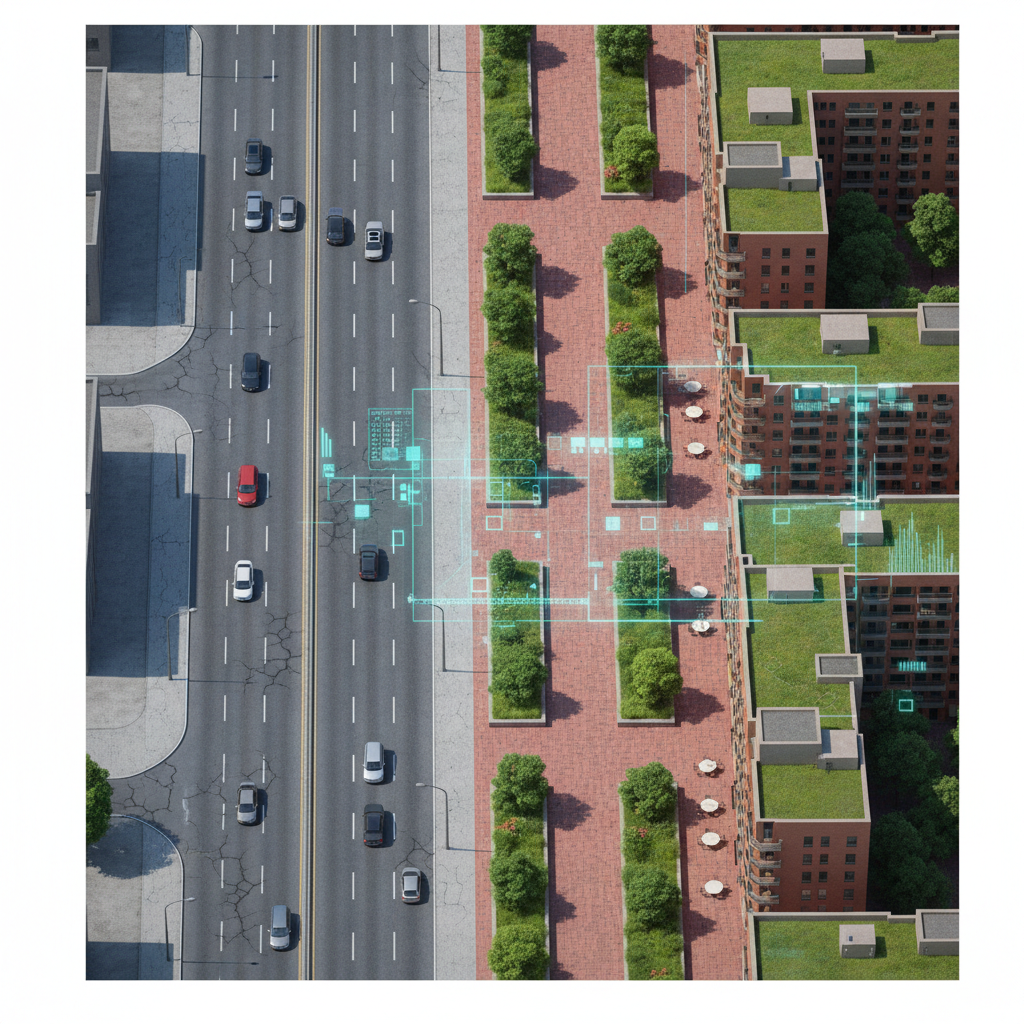
They are huge. But before we get to the hurdles, we have to look at why people like Daniel are reaching this breaking point. We have spent the last eighty years or so redesigning the entire world to accommodate a very specific type of machine. If you look at most modern cities, between thirty and fifty percent of the land area is dedicated to cars. That is roads, parking lots, driveways, and gas stations. We have basically built our habitats for cars and then invited humans to live in the gaps.
And that is what Daniel was mentioning about our previous discussion on Hermanville and the city of Vienna. This idea of a person-first space. But let us tackle his first point about electric vehicles. Why is it that even in twenty-six, with electric vehicle adoption higher than ever, we are still seeing this push to eliminate them entirely? If they are not emitting tailpipe C-O-two, what is the problem?
It is what urbanists call the geometry problem. An electric vehicle takes up the same amount of physical space as a combustion engine vehicle. If you have ten thousand people trying to get to the same city center at eight in the morning, and they are all in individual two-ton metal boxes, you have a traffic jam. It does not matter if those boxes are powered by gasoline, electricity, or fairy dust. The throughput of a standard traffic lane is only about two thousand people per hour if everyone is in a car. Compare that to a dedicated bus lane which can do ten thousand, or a rail line that can do fifty thousand.
Right, so it is a space efficiency issue. But there is also the sustainability side. I remember reading that the environmental impact of building a car, especially the battery components for electric vehicles, is massive.
That is the key thing. It is the embodied carbon. To build a single long-range electric vehicle battery, you are mining and processing tons of lithium, cobalt, and nickel. Then there is the tire wear. By twenty-six, data has shown that tire wear is actually the leading source of primary microplastics in our environment. Because electric vehicles are generally twenty to thirty percent heavier due to the batteries, they actually produce more tire-wear particles and road dust than internal combustion cars. So, while they solve the local air quality issue regarding exhaust, they do not solve the resource extraction problem, the microplastic problem, or the congestion problem.
So Daniel is right. Electric vehicles are a step, but they are not the finish line. But then we get to his big question. How do we actually scale up public transport to the point where a car becomes unnecessary? I mean, we live in Jerusalem. We have the light rail, we have buses, but people still cling to their cars because the reach is not always there.
Well, it requires a total shift in how we fund and perceive transit. For the last century, we have treated roads as a public good, funded by taxes, and transit as a business that needs to break even or at least justify its subsidies. To get to a car-free society, you have to flip that. You have to treat high-frequency, high-capacity transit as the primary infrastructure, like water or electricity.
But that brings up the cost issue Daniel mentioned. Building a subway system is astronomically expensive. Even light rail is a huge investment. If we are talking about a radical policy to eliminate private transport, are we talking about a world where every tiny village has a train station?
Probably not. And that is where the remote community challenge comes in. This is the hardest part of the car-free dream. If you live in a village of five hundred people in the Galilee or the mountains of Vermont, a train every fifteen minutes is a financial impossibility. The infrastructure cost per user would be tens of thousands of dollars.
So what is the solution there? Do those people just get left behind? Or do we force everyone to move into mega-cities?
That is the fear, right? The death of the rural lifestyle. But there are middle grounds that we are seeing explored more in twenty-five and twenty-six. It is called Mobility as a Service, or M-a-a-S. Instead of everyone owning a car that sits idle ninety-five percent of the time, you have a publicly managed fleet of smaller, modular, potentially autonomous shuttles. In a rural area, you might not have a bus route, but you have an on-demand service. You use an app, a shuttle arrives at your door within ten minutes, and it takes you to the nearest regional transit hub.
So it is like a public version of a ride-sharing app, but integrated into the larger transit network.
That is right. And because it is part of the public infrastructure, it is coordinated. The shuttle knows exactly when the regional train is arriving, so the transfer is seamless. You are not waiting an hour on a cold platform. This is what the Swiss do incredibly well with their PostBus and pulse system. Every train, bus, and boat in the country is timed to meet at specific intervals. It creates a virtual spiderweb of connectivity that makes a car feel like a burden rather than a freedom.
That word freedom is interesting. For a lot of people, the car is the ultimate symbol of autonomy. I can go anywhere, anytime. How do you overcome that psychological barrier?
You replace it with the freedom of not having to worry about it. Think about the freedom of being able to read a book, sleep, or work while you travel. Think about the freedom of not having a four-hundred-dollar monthly car payment, plus insurance, plus maintenance, plus the stress of finding parking. When the transit is frequent enough, say every five to seven minutes, you stop looking at a schedule. You just walk to the station. That is a different kind of freedom.
I want to go back to the emergency services point Daniel raised. This is a very practical concern. If you get rid of the traditional road network, how does the ambulance get to your house? How does the fire truck reach a burning building? He mentioned the ambulances in Venice, which are boats. But not every city has canals.
This is a common misconception about car-free cities. Car-free usually means car-lite or private-car-free. Even the most radical urban designs, like the Superblocks in Barcelona or the Houtman and Utrecht models in the Netherlands, still have a hierarchy of access. You do not tear up the asphalt and plant corn everywhere. You repurpose the space.
So the roads are still there, they just look different?
Yes, precisely. You might have a narrow paved strip for emergency vehicles and delivery vans, but it is surrounded by gardens, bike paths, and walking trails. In a truly car-free district, the only motorized vehicles allowed are ambulances, fire trucks, and essential services. Because there are no private cars clogging up the streets, these emergency vehicles can actually move much faster. Data from the Barcelona Superblocks shows that emergency response times actually improved because there is no traffic for them to fight through.
That is an interesting point. An ambulance in a car-free city is likely to have a much better response time because the road is always clear for them.
Precisely. And for logistics, like grocery deliveries, you use micro-hubs. Large trucks drop off goods at the edge of the car-free zone, and then small electric cargo bikes or automated delivery pods handle the last mile. We are already seeing this in places like Paris and London. It is quieter, safer, and remarkably efficient.
Speaking of Paris, Daniel asked if any countries are pursuing a radical policy to eliminate private transport entirely by twenty-six. We are here in February of twenty-six. What is the state of the world on this? Is anyone actually going all the way?
No country has banned private cars entirely on a national level yet, but the momentum at the city level is staggering. Paris is the poster child for this. As of early twenty-six, their Zone à Trafic Limité, or Z-T-L, is fully operational, banning most through-traffic from the city center. They have turned the banks of the Seine into a park and built hundreds of kilometers of protected bike lanes. They are aiming for a city where the majority of neighborhoods are car-free by twenty-thirty.
And Barcelona with the Superblocks. I remember we talked about that briefly before. They are taking clusters of nine city blocks and pushing all the through-traffic to the perimeter, right?
Yes, and the interior streets become shared spaces where pedestrians and cyclists have priority. They have found that in these Superblocks, noise levels drop by twenty percent, air quality improves significantly, and local business actually goes up because people are walking and lingering instead of driving past.
What about the Netherlands? They always seem to be decades ahead on this.
The Netherlands is the gold standard. Cities like Utrecht have built entire new districts, like Merwede, designed for twelve thousand people to live completely car-free. They have implemented circulation plans that make it physically impossible to drive across the city center. You can drive into a sector to park or drop something off, but if you want to get to the other side of town, you have to go back out to the ring road. Meanwhile, a cyclist or a bus can go straight through the middle. It makes the car the least convenient option for short trips.
So it is not necessarily about a legal ban, but about design that makes the car obsolete.
That is the most effective way to do it. If you make it easier, faster, and cheaper to take the train or a bike, people will choose that. In Amsterdam, the city is actively removing thousands of parking spaces every year and replacing them with trees and wider sidewalks. They are not saying you cannot own a car; they are just saying we are not going to provide you with a subsidized place to store your private property on public land anymore.
That is a powerful way to frame it. Street parking is essentially a massive subsidy for car owners.
It really is. In many cities, the land value of a single parking spot is worth tens of thousands of dollars, yet we give it away for a few dollars a day or for free. If we reclaimed that space for housing, parks, or transit, the math of the city changes completely.
Okay, let us get into the weeds of the remote community issue again, because I think that is where the skepticism is highest. If I live in a rural area, and I do not have a car, how do I get my groceries? How do I take my kid to a doctor's appointment twenty miles away? Even with on-demand shuttles, that feels like a lot of friction.
It is friction, but it is a different kind of friction. Right now, the friction is the cost and stress of maintaining a vehicle. In a car-free rural future, the friction is the planning. But here is the thing: as we move further into twenty-six, the technology for autonomous regional transport is finally starting to mature. We are seeing trials of autonomous pods that can travel on existing rural roads.
So it is like a driverless Uber that is part of the public transit system?
Yes. And because you do not have to pay a driver, the operating cost drops by sixty or seventy percent. That is what makes rural transit viable. You can afford to have a fleet of these pods roaming a rural county because the overhead is so much lower. It becomes a horizontal elevator for the countryside.
A horizontal elevator. I like that. It changes the perspective from a vehicle you own to a service you use. But what about heavy lifting? Farmers, construction workers, people who actually need a truck for their livelihood.
Those are the exceptions that prove the rule. A car-free society does not mean zero four-wheeled vehicles. It means the elimination of the default private commuter car. If you are a plumber, you obviously need your van. If you are a farmer, you need your tractor and your truck. The goal is to get the ninety percent of people who are just moving themselves from point A to point B out of those giant vehicles.
So it is about right-sizing the transport to the task.
That is it. We use a two-ton S-U-V to pick up a liter of milk. It is absurd when you think about it from an engineering perspective. It is like using a sledgehammer to crack a nut. If we can move those short, single-person trips to e-bikes, cargo bikes, or micro-transit, the entire system breathes.
I wonder about the economic implications. The car industry is a massive part of the global economy. Millions of jobs in manufacturing, sales, repair, insurance. If we actually succeeded in going car-free, wouldn't that cause a massive economic shock?
It would be a massive transition, certainly. But that labor and capital would shift. Instead of building cars, we are building high-speed rail, light rail vehicles, and e-bikes. Instead of gas stations, we have charging hubs and local cafes. Instead of car insurance, maybe we have more robust health insurance because people are more active and there are fewer accidents. Remember, car crashes are one of the leading causes of death worldwide. The economic cost of those deaths and injuries is trillions of dollars every year.
That is a huge factor. We have just accepted tens of thousands of deaths a year as the price of mobility. It is a pretty grim trade-off when you step back and look at it.
It is. If a new form of transport was introduced today and it killed forty thousand people a year in the United States alone, it would be banned tomorrow. But because it is the car, we have this collective blind spot. A car-free society is, more than anything, a much safer society.
So, let us look at the practical takeaways for someone like Daniel, who is currently fuming in his car on the way to Tel Aviv. What can he do? What can our listeners do to push this forward?
The first thing is to support local transit initiatives. In many cities, transit projects get killed by a vocal minority of residents who are worried about losing parking. We need to be the vocal majority that says, yes, take away the parking, give us a bus lane.
And I think there is a personal element too. Trying to replace even one car trip a week with a bike or a bus. It helps you see the city through a different lens. You notice things you never saw from behind a windshield.
Definitely. And if you are in a position to choose where you live, look for those fifteen-minute neighborhoods. These are areas where your daily needs—groceries, school, work, parks—are all within a fifteen-minute walk or bike ride. The more people who choose to live in these areas, the more demand there is for the infrastructure that supports them.
It feels like we are at a tipping point. The frustration Daniel is feeling is being felt by millions of people. The technology is there, the urban planning models are there. It is really a matter of political will and public imagination.
It really is. We have been told for a hundred years that the car is freedom. We need to start imagining a different kind of freedom. The freedom to walk down the street and hear birds instead of engines. The freedom for our kids to play outside without us worrying about them being hit by a car. The freedom to travel across the country on a high-speed train while looking at the scenery instead of the bumper in front of us.
That is a vision I can get behind. It is not about taking something away; it is about gaining a better way of living.
Well said, Corn. It is about reclaiming our cities for people. Daniel, I hope the traffic clears up soon, but I also hope that frustration fuels your passion for a better urban future. We really appreciate you sending that in.
Yeah, thanks Daniel. And to everyone listening, if you are enjoying these deep dives into the weird and wonderful prompts that come our way, we would really appreciate it if you could leave us a review on your podcast app or on Spotify. It genuinely helps more people find the show and join the conversation.
It really does. We love seeing this community grow. You can find all our past episodes, including that one on Vienna we mentioned, at myweirdprompts dot com. There is an R-S-S feed there if you want to subscribe directly, and a contact form if you have a prompt of your own you want us to tackle.
We are also on Spotify, so you can follow us there for the latest episodes. This has been My Weird Prompts. I am