Hey everyone, welcome back to My Weird Prompts. I am Corn, and I am joined as always by my brother, Herman.

Herman Poppleberry, at your service. It is a beautiful day here in Jerusalem, though maybe a little bit of a heavy one given the topic our housemate Daniel sent over this morning.
Yeah, Daniel was asking about something that I think every single person living in an old apartment building in this country thinks about at least once a year, usually when there is a small tremor or even just a heavy truck driving by that rattles the windows. We are talking about earthquake preparedness and specifically the Tama thirty-eight program.
It is one of those topics where technical engineering meets urban planning, which then meets national security. It is a fascinating intersection, but it is also deeply personal because, well, we live in one of those buildings that people often talk about when they discuss the need for retrofitting.
Right. And Daniel really hit on the core tension here. We have these two different types of threats in Israel. On one hand, you have the seismic risk because we are sitting right on the Dead Sea Transform, often called the Syrian African Rift. On the other hand, we have the security situation and the constant need for missile-proof safe rooms.
And the big question is, can one structure actually solve both problems? Or are we just slapping band-aids on old buildings and hoping for the best?
Let us start with the basics of the risk itself. I think a lot of people know we are in a seismic zone, but the scale of it is often misunderstood. Herman, you have been looking into the historical data on this. How real is the threat of a major earthquake here in the near future?
It is very real, Corn. The geological record shows a major, destructive earthquake occurs along the Dead Sea Fault roughly every eighty to one hundred years. The last big one was in July of nineteen twenty-seven. It was about a six point two magnitude and caused massive damage in Jerusalem, Jericho, and Nablus. If you do the math, as of today in February twenty twenty-six, we are ninety-eight years into that cycle. We are right in the middle of the statistical window. Geologists hate the word overdue because tectonic plates do not keep a strict calendar, but the strain is definitely building up.
Right, and the construction back in nineteen twenty-seven was very different. But even the construction in the nineteen fifties and sixties, which makes up a huge portion of the housing stock in cities like Tel Aviv, Haifa, and here in Jerusalem, was not built with modern seismic codes.
That is the key thing. Israel did not even have a formal seismic building code until nineteen seventy-five, and it was not really strictly enforced or modernized until the mid-nineteen eighties. So, any building constructed before, say, nineteen eighty-five is statistically likely to be at risk of significant structural failure or even collapse in a magnitude six point five or seven point zero earthquake.
That is where Tama thirty-eight comes in. For our listeners outside of Israel, Tama is an acronym for Tohnit Mit'ar Artzit, which means National Outline Plan. Number thirty-eight was specifically designed to incentivize homeowners and developers to strengthen these older buildings.
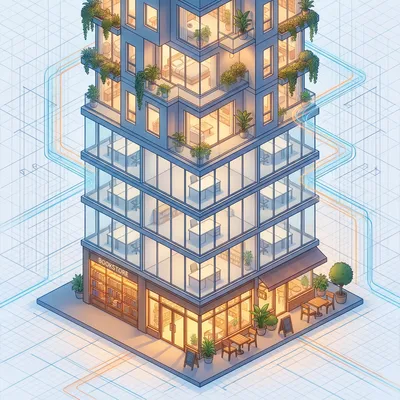
It is a clever economic mechanism, really. The government realized they did not have the billions of shekels needed to retroactively fix every private apartment building. So they told developers, if you reinforce this old building against earthquakes, we will let you build two or three extra floors on top and sell those apartments for a profit. The original residents get a stronger building, usually an elevator, and often a new safe room, and it costs them zero shekels out of pocket.
It sounds like a win-win, but Daniel’s question goes to the heart of the engineering. Is it actually feasible to engineer a building from scratch to withstand an earthquake, or are we always just talking about mitigation?
That is a great distinction. In engineering, we rarely use the word proof, as in earthquake-proof. We prefer earthquake-resistant. If you are building from scratch, you have incredible tools at your disposal that you simply cannot easily use in a retrofit.
Like base isolation? I have seen those videos of buildings on giant rubber pads.
Yes, exactly! Base isolation is the gold standard for new construction in high-risk zones. You essentially detach the building from the ground. You place it on these massive bearings made of layers of rubber and lead. When the ground shakes violently, the base isolators absorb the energy and the building itself moves much more slowly and gently. It is like the difference between being in a car with no suspension versus a luxury car with high-end shocks.
But you can't really do that to a five-story apartment block in the middle of a crowded neighborhood, can you?
You can, but it is incredibly expensive and technically difficult. It involves excavating around the entire foundation while the building is still standing. So for a program like Tama thirty-eight, we usually move away from base isolation and toward something called structural stiffening or energy dissipation.
So, instead of letting the building move independently of the ground, you are making the building so rigid that it moves as a single unit?
Partly. You are adding shear walls, which are thick, reinforced concrete walls that go from the foundation all the way to the roof. These are designed to resist the lateral, or sideways, forces of an earthquake. Most older buildings fail because they are essentially just a deck of cards. The vertical columns can hold the weight of the floors just fine, but once you push them sideways, they snap.
That leads perfectly into Daniel’s second question about the Richter scale. Is there a point up to which retrofitting reliably reduces structural damage? Like, does a Tama thirty-eight building survive a seven point zero but fail at an eight point zero?
It is a bit more nuanced than a single number on the Richter scale. Building codes generally aim for two things. First, for moderate earthquakes, the goal is minimal damage. The building should stay functional. Second, for a major earthquake, the goal is life safety.
Life safety. That means the building might be a total loss afterward, but it does not collapse on the people inside.
Correct. The goal of a retrofit like Tama thirty-eight is primarily to prevent total collapse. We want to ensure that even if the walls crack and the building becomes uninhabitable, the structural skeleton remains standing long enough for everyone to get out. Most retrofits in Israel are designed to handle the Maximum Credible Earthquake expected in this region, which is generally around a magnitude seven point zero to seven point five.
So if we had a massive nine point zero like the one in Japan in two thousand eleven, even a retrofitted building might not stand a chance?
A nine point zero is a completely different beast. That is thirty times more energy than an eight point zero and about nine hundred times more energy than a seven point zero. The good news is that the fault lines in our region are not physically long enough to produce a magnitude nine earthquake. The physics of the crust here just does not allow it. So, engineering for a seven point five is actually a very high level of protection for our specific geography.
That is actually quite a relief to hear. But let's get into the part that is very unique to Israel, the Mamad. For those who don't know, a Mamad is a Merkhav Mugan Dirati, or a residential secure room. It is a room made of thick, reinforced concrete with a heavy steel door and window, designed to protect against missile blasts and shrapnel.
And this is where the engineering gets really interesting. Daniel asked how these missile-proof safe rooms contribute to a building's earthquake stability. In a Tama thirty-eight project, when they add these safe rooms to an old building, they don't just stick them on like a backpack.
Right, they build them as a vertical stack, right? Like a tower of concrete rooms attached to the side of the original structure.
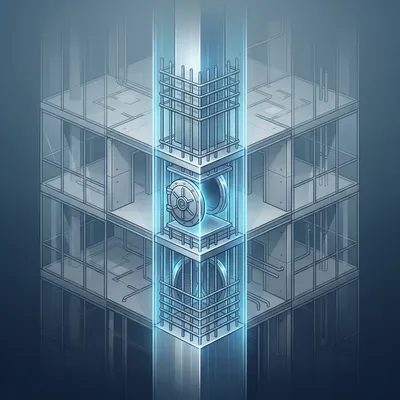
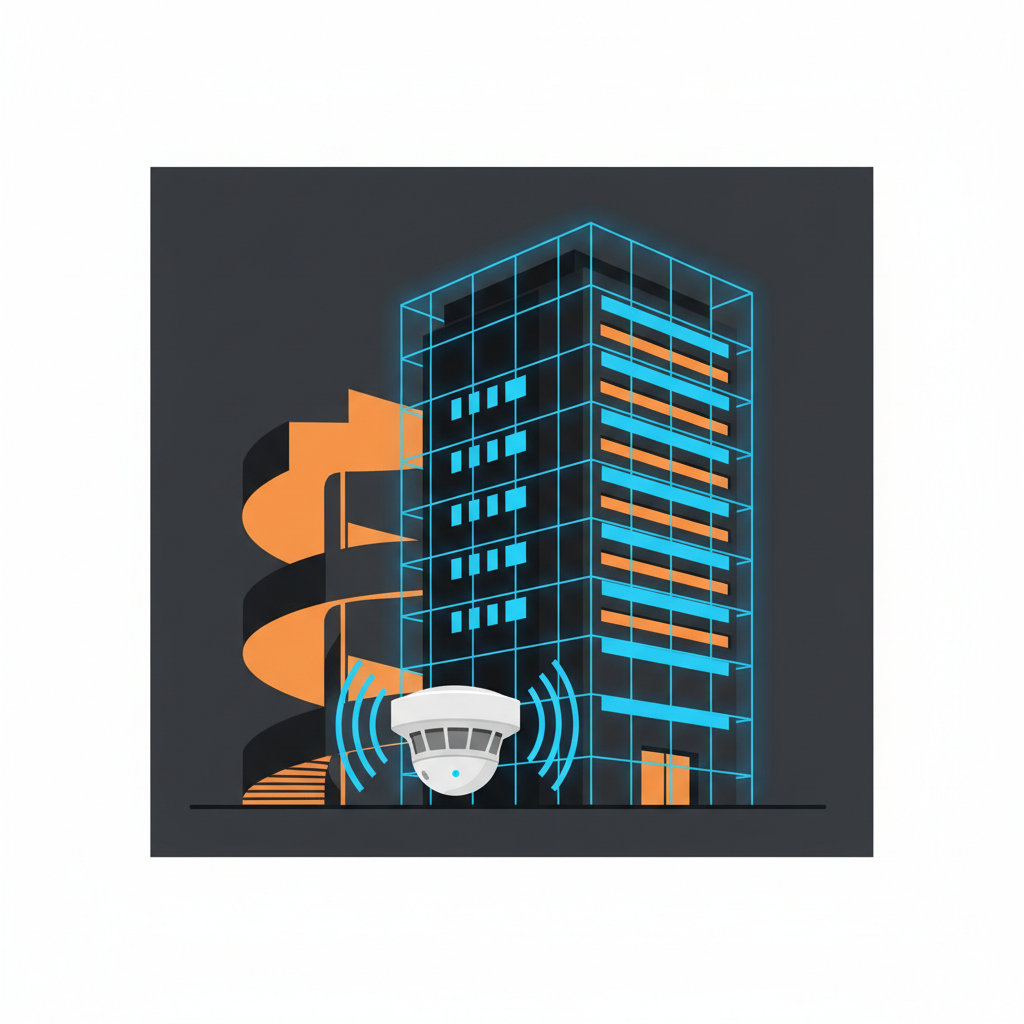
That is right. And because those rooms are made of high-strength, reinforced concrete and they are tied into a deep foundation, they act as a massive structural spine for the entire building. In engineering terms, we call this a concrete core.
So even though the room was designed to stop a rocket from coming through the wall, its most significant contribution during an earthquake is its stiffness.
You nailed it. Think about a tall, thin tree in the wind. It bends and might snap. But if you strap a solid steel pole to the side of that tree, it is not going anywhere. The Mamad tower acts as a shear wall on steroids. It provides a huge amount of lateral resistance. When the earthquake tries to shake the building sideways, that rigid concrete spine takes the brunt of the force.
But wait, is there a downside to that? If you have this incredibly rigid tower of safe rooms attached to an old, flexible building, doesn't that create a weird stress point where they meet?
That is the big challenge for engineers. It is called a stiffness irregularity. If the old building wants to sway four inches but the Mamad tower only wants to sway half an inch, the connections between them can experience enormous stress. If those connections aren't engineered correctly, the safe rooms could actually tear away from the building or cause the floors of the old building to collapse at the attachment points.
So you can't just slap a safe room on and call it a day. You have to essentially weave the two structures together.
Precisely. You use chemical anchors, steel rebar, and often additional carbon fiber wrapping on the old columns to make sure the entire assembly moves together. When done right, you are addressing both threats simultaneously. You get a blast-resistant room for security and a seismic spine for earthquakes.
It is amazing how the security needs of the country actually ended up providing a partial solution for the seismic needs. It is almost accidental, or at least a very fortunate overlap in engineering requirements.
Well, the Home Front Command, which sets the standards for these safe rooms, eventually realized this. They started working more closely with the seismic engineers to ensure that the Mamad standards were also helping the earthquake standards. Now, when a new building is designed, the safe room is a core part of the structural stability calculations from day one.
Daniel also asked if it is possible to address both of these threats simultaneously from scratch. I imagine that is much easier than a retrofit.
Oh, infinitely easier. In a new building, you can place your Mamad towers strategically, maybe one on each corner or one in the center, to create a perfectly balanced, symmetrical structure. Symmetry is your best friend in earthquake engineering. It prevents the building from twisting, which is what usually kills people.
Twisting? You mean torsion?
Yes. If a building is heavier or stiffer on one side, it will rotate when the ground shakes. That rotation puts massive stress on the corner columns, and that is often how you get a total pancake collapse. By using the safe rooms as symmetrical structural elements from the beginning, you create a building that is incredibly robust.
So, looking at the city around us, Herman, we see all these projects happening. But there has been a lot of news lately about Tama thirty-eight being phased out. What is the status of that?
You are right. As of late twenty twenty-four and twenty twenty-five, the original Tama thirty-eight has been largely replaced by what people call the Shaked Plan, or the Alternative to Tama thirty-eight. The main criticism of the old program was that it only worked in high-value areas like Tel Aviv or Jerusalem because that is where developers could make a profit. But the highest seismic risk is actually in the north and south, along the rift valley, in cities like Kiryat Shmona, Tiberias, and Beit She'an.
And those are exactly the places where property values are lower, so a developer has no incentive to do a project.
That is the problem. In those cities, the cost of the retrofit is higher than the value of the new apartments you could build. The Shaked Plan tries to fix this by giving local municipalities more power and increasing the building rights up to four hundred percent in some cases to make it economically viable in the periphery. It also moves toward more city-wide planning rather than building-by-building.
It is a classic example of how engineering solutions are only as good as the economic and political systems that implement them. You can have the best earthquake-resistant design in the world, but if nobody can afford to build it, it doesn't save anyone.
That is the hard truth. And it is why we see such a push now for what they call Pinui Binui, which means evacuate and rebuild. Instead of just retrofitting an old building, you knock the whole thing down and build a modern, high-rise tower from scratch.
Which goes back to Daniel’s first question. Engineering from scratch is always better. You get the base isolation, you get the symmetrical concrete cores, and you get modern materials.
Yes, and you get to solve the density problem at the same time. But for many people, especially the elderly, the idea of leaving their home for three years while a tower is built is terrifying. So we are stuck with this middle ground of retrofitting.
Let us talk about the practical side for a second. If you are a listener and you live in an older building, what are the actual signs that a building has been properly retrofitted? It is more than just a new coat of paint and some safe rooms, right?
Right. You want to see that the foundation was strengthened. Often, they will dig down and add new piles or a raft foundation. You should see that the existing columns were thickened. This is often done by wrapping them in a steel jacket or a high-strength carbon fiber polymer. If you just see a new room attached to the side but the old columns look exactly the same, that is a red flag.
And the safe room itself? If you are in an earthquake, is that actually the safest place to be? We are taught to go to the safe room during a missile siren, but is it the same for a tremor?
In Israel, the official instruction from the Home Front Command is that if you can get out of the building to an open space in a matter of seconds, do that. But if you are on a high floor and cannot get out immediately, the Mamad is indeed the safest place to be.
Because of that concrete spine we talked about.
Precisely. Even if the rest of the building suffers major damage, that vertical tower of safe rooms is the most likely part of the structure to remain standing. It is designed to be a life-safety pod. It has its own independent structural integrity to a large degree.
It is a bit of a grim thought, being in a concrete box while the rest of the building is potentially crumbling around you, but it beats the alternative.
It really does. And the engineering that goes into the doors and windows of those rooms is also relevant. They are designed to withstand massive pressure waves. While an earthquake is a different kind of force, that same robustness helps the room maintain its shape even if the building is leaning or shifting.
One thing that always fascinates me is the second-order effects of these programs. When you reinforce a building for earthquakes, you are also inadvertently improving its thermal mass and often its acoustic insulation because of all that extra concrete.
That is true! Although, most people complain that the Mamad is the room where the Wi-Fi signal goes to die.
The struggle is real. The Faraday cage effect of all that rebar.
It really is. But in all seriousness, the move toward more robust construction is a massive net positive for the country. We are essentially rebuilding the nation's foundations, one apartment block at a time. It is a slow, expensive, and often noisy process, but when you look at the seismic history of this region, it is a race against time.
I remember reading about the earthquake in Turkey and Syria in early twenty twenty-three. The images of those buildings collapsing like pancakes were a huge wake-up call for people here.
It was a horrific reminder of what happens when building codes are ignored or when old, unreinforced masonry is left as it is. A lot of those buildings were what we call soft-story buildings. They had open ground floors for parking or shops, with very few walls. When the shaking started, the ground floor just folded, and the rest of the building came down on top of it.
That is exactly what a lot of the older buildings in Tel Aviv look like. They are built on these thin concrete stilts to allow for parking underneath.
Yes, the classic Israeli building on pilotis. They are incredibly vulnerable to earthquakes. One of the main goals of the Tama thirty-eight retrofit is to fill in those open ground floors with reinforced walls or to significantly strengthen those stilts so they don't buckle.
It is amazing how much of our safety depends on things we never see, like the amount of rebar inside a concrete column or the depth of a foundation pile.
It really is a hidden world of engineering. And I think Daniel’s question about addressing both threats simultaneously is really the future of urban resilience. We can't afford to think about risks in isolation anymore. We have to design for the earthquake, the missile, the climate-driven flood, and the heatwave all at the same time.
It is a tall order for engineers.
It is, but it is also what makes modern engineering so exciting. We are moving away from just making things strong and toward making them resilient. A strong thing breaks when the force exceeds its limit. A resilient thing can take the hit, maybe sustain some damage, but keep the people inside safe and eventually be restored.
That is a great way to frame it. Strength versus resilience. I think that applies to a lot of things in life, not just buildings.
It certainly does. And you know, we have talked a lot about the technical side, but there is a social side to this too. These programs change the character of neighborhoods. They bring in new people, they increase density, and they can sometimes push out the original residents if the maintenance fees for the new, fancier building become too high.
Right, the gentrification aspect of seismic retrofitting. It is a complicated trade-off. Do you want a safe neighborhood that is more expensive, or an affordable neighborhood that is at risk of collapse?
It is a question that planners are struggling with every day. But from a pure life-safety perspective, the engineering is clear. We have the tools to make these buildings survive. It is just a matter of will and resources.
Well, Herman, I think we have covered a lot of ground here. From the Syrian African Rift to the concrete spines of our safe rooms