Hey everyone, welcome back to My Weird Prompts. I am Corn, and as always, I am joined by my brother and housemate here in Jerusalem.

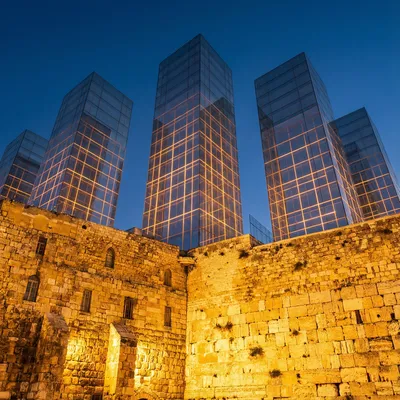
Herman Poppleberry at your service. And man, Corn, did you see the prompt Daniel sent us this morning? He was looking out the window at the skyline, just like we do every day, and it really got him thinking about the cranes and the glass towers that seem to be popping up like mushrooms after a rainstorm.
It is hard to miss. We are sitting here in a city that is thousands of years old, built on layers of history and tradition, and yet the physical landscape is changing faster than I think many of us can process. Daniel mentioned those high-rises where the lights never seem to be on. The ghost apartments. It is a haunting image, honestly. A city that is growing taller but feeling emptier in certain pockets.
It is a paradox, right? We are told there is a housing shortage, which there absolutely is in Israel, but then you see these massive developments like the Jerusalem Gateway project at the entrance to the city. We are talking about twenty towers, some reaching forty stories high. It is a massive business and residential district, but it feels disconnected from the people who actually live and work and pray in this city. Daniel was asking how we can even begin to formulate a housing policy that balances this drive for development with the actual needs of the residents. It is a heavy one, but it is something we see every time we walk down the street toward the center of town.
Well, before we dive into the policy weeds, I think we have to acknowledge the visual shift Daniel talked about. Jerusalem has this very specific aesthetic code. The Jerusalem stone requirement, which has been mandatory since nineteen eighteen. It is supposed to maintain a sense of continuity. But when you take that stone and wrap it around a thirty-story luxury tower that looks like it belongs in Miami or Dubai, something feels off. It is like the city is wearing a costume that does not quite fit.
Exactly. And the problem is not just aesthetic. It is deeply economic. As of early twenty twenty-six, Jerusalem remains the poorest major city in Israel. Recent reports show that about forty-one percent of families here suffer from poverty, compared to about twenty percent in the rest of the country. We have these massive populations—the ultra-orthodox and the Arab sectors—that have very high poverty rates and very large families. They need space. They need affordability. And yet, the market is producing these ultra-luxury condominiums. It is a classic case of market failure where the supply being created has almost zero overlap with the local demand.
So, why does it happen? If the locals cannot afford it, why do developers keep building it? I mean, they are not in the business of losing money.
That is where the foreign investment piece comes in. For a certain segment of the global Jewish diaspora, owning a piece of Jerusalem is the ultimate status symbol or a spiritual anchor. In twenty twenty-four and twenty twenty-five, we saw foreign residents buying about one hundred apartments per month in Jerusalem. To a developer, a wealthy buyer from New York or Paris who pays ten million shekels in cash and does not care about local school districts is the perfect customer. You can charge a massive premium, and you do not have to worry about the long-term wear and tear on the building because no one is ever there.
But that creates that dual-track society Daniel was worried about. You have these luxury bubbles that are essentially gated communities in the sky, while the actual life of the city—the markets, the small businesses, the young families—is being squeezed into smaller and smaller spaces or pushed out to the periphery. It is a different kind of opacity, but there is a lack of transparency in how these developments get approved and who they are actually serving.
It is a total lack of social urbanism. In many other global cities, if you want to build a massive luxury tower, the city says, okay, but twenty percent of these units have to be designated as affordable housing for local residents. In Jerusalem, we have seen some of that, but the enforcement is often weak. However, the twenty twenty-six state budget actually includes some interesting levers. For example, there is a push to require thirty percent of apartments in large, fast-tracked housing zones to be set aside for long-term rentals, some at reduced prices.
So, if we were looking for middle-ground solutions, where do we start? Daniel asked about preventing housing from being a speculative investment. Is there a way to tax the ghostness out of these apartments?
There have been attempts. There is the concept of the double Arnona, which is the municipal property tax. For twenty twenty-six, the national automatic increase is about one point six percent, but the city has the power to double that for apartments that are vacant for more than six months a year. The logic is that vacant homes do not contribute to the local economy. They do not buy groceries, they do not go to cafes, they do not pay for services. They are a drain on the city's vitality.
Does it work, though? I feel like if you can afford a five-million-dollar apartment in a high-rise, a few extra thousand shekels in property tax is just a rounding error. It is not going to change your behavior.
You are right. For the ultra-wealthy, it is a nuisance tax, not a deterrent. To actually move the needle, you would need a much more aggressive vacancy tax, maybe tied to the actual value of the property rather than just the municipal service fee. Interestingly, the Finance Ministry is reintroducing a tax of one point five percent on the value of undeveloped land in twenty twenty-six to target people holding land just for investment. But here is the catch, Corn. The city government loves these developments because they bring in a ton of money through those initial building fees and the ongoing taxes, even if the people are not there. It is a quick fix for a municipal budget, even if it is a long-term disaster for social cohesion.
It feels like a sugar high. You get the cash infusion now, but you are rotting the teeth of the city. If young professionals and families cannot afford to live here, who is going to run the hospitals? Who is going to teach in the schools? Who is going to start the next generation of businesses? If Jerusalem becomes a museum for the wealthy, it stops being a living city.
That is the big fear. And we are already seeing the brain drain. Young people grow up here, they love the vibe, they love the history, but then they look at the rent or the price of a three-bedroom apartment and they realize they would have to work three lifetimes to afford it. So they move to Haifa, or the suburbs, or even abroad. We are losing the very people who give the city its energy.
I want to go back to the idea of inclusionary zoning. You mentioned the thirty percent rule for rentals. What if we went further? What if the city mandated that these new high-rises had to include a mix of unit sizes? Right now, a lot of these luxury buildings are all massive penthouses or four-bedroom suites. What if they were required to build studios and one-bedroom apartments that are actually sized and priced for students or young couples?
That would be a huge step. But developers hate it because the profit margins on smaller units are lower. They would rather sell one giant apartment for ten million shekels than five small ones for two million each. To make that work, the city would have to offer significant incentives, like allowing them to build an extra two floors in exchange for a certain number of micro-units. The Planning Administration has actually been pushing for this, but the bottleneck is always in the execution.
But then you have the height issue. Jerusalem is famous for its hills and its low-slung profile. Every time a new tower goes up, people complain it is ruining the view of the Old City or the surrounding valleys. It is a constant tug-of-war between preservation and modernization.
It is, but we have to be honest. We cannot keep the city in amber. If we do not build up, we have to build out, and that means destroying the Jerusalem Forest or encroaching on the green belts. Dense, vertical growth is actually more environmentally sustainable, but only if it is functional density. If you build a thirty-story tower and only five people live in it, you have the visual impact of a skyscraper with the population density of a parking lot. That is the worst of both worlds.
That is such a good point. It is performative density. It looks like you are solving the housing crisis on a spreadsheet, but in reality, you are just creating vertical safety deposit boxes for international capital.
Exactly. So, another solution could be looking at the land itself. Most of the land in Israel is owned by the state or the Jewish National Fund. When the state tenders land to developers, they could set much stricter conditions. Instead of just selling it to the highest bidder—which naturally leads to luxury housing because the developer has to recoup that massive land cost—the state could sell it at a discount to developers who commit to long-term rental models with capped prices. The government actually allocated nearly one billion shekels in the twenty twenty-six budget to fast-track these kinds of tenders.
In Israel, the rental market is like the Wild West. Most leases are for one year, there are no rent controls, and tenants have very few rights. If we had institutionalized long-term rentals—where a company like the state-owned Apartment for Rent company owns the whole building and you can sign a ten-year lease with predictable increases—it would change the whole dynamic.
It would take the pressure off the purchase market. If people felt secure in their rentals, they would not be as desperate to buy, which might cool down the speculative fever. And those institutions would have a vested interest in the building being occupied. They want the cash flow from the rent. They do not want ghost apartments.
But how do you handle the poverty aspect? Daniel pointed out that Jerusalem is facing significant poverty. Even if you cool the market down, a lot of people are still going to be priced out. Does the city need to get back into the business of public housing?
That is a controversial one. Israel used to have a massive public housing sector in the nineteen fifties and sixties, but it has been systematically privatized and defunded. Now, the waiting list for public housing is years long. The twenty twenty-six budget does earmark two hundred fifty million shekels for renovating existing public housing units, but it is a drop in the bucket compared to the need. Rebuilding that sector would require a massive shift in national priority.
It feels like there is a middle ground between the old Soviet-style apartment blocks and the five-star luxury towers. What about community land trusts? Or housing cooperatives? We see those working in places like Berlin or Zurich.
I love the idea of land trusts. For those who do not know, a land trust is when a non-profit organization owns the land permanently, and individuals own the houses or apartments on top of it. Because the land cost is removed from the purchase price, the homes are much more affordable. And when you sell, you only get a portion of the appreciation, so the home stays affordable for the next person. It treats housing as a place to live, not a way to get rich.
That sounds like exactly what Daniel was asking for. A way to decouple the need for shelter from the desire for a speculative investment. But it requires a cultural shift. In Israel, there is such a deep-seated cultural drive toward property ownership. It is seen as the only real form of security.
And for good reason, historically. But that drive is being weaponized by the market right now. If we want to save the soul of Jerusalem, we have to start valuing the people who breathe life into the streets more than the capital that pours into the concrete. Think about the bad vibes Daniel mentioned. A neighborhood where most of the windows are dark at night feels unsafe. It feels abandoned. It lacks that eyes-on-the-street security that Jane Jacobs always talked about.
It is funny you mention the bad vibes. I was walking through one of those newer areas near the entrance to the city last week, and it felt like a ghost town in the middle of the afternoon. Huge, beautiful sidewalks, fancy streetlights, but no one was there. No kids playing, no old people sitting on benches. Just wind whistling between glass towers. It felt like a movie set for a world where humanity had disappeared but the architecture remained.
It is the architectural equivalent of a tax shelter. And that is what we have to fight against. The city needs to be for the citizens. If I were the mayor of Jerusalem—Herman Poppleberry for Mayor, can you imagine the campaign posters?—my first move would be a massive audit of these luxury projects. I would want to know exactly what percentage of these units are primary residences. And for every project that is being marketed primarily to foreign investors, I would slap on a social impact fee that goes directly into a fund for affordable housing in the poorer neighborhoods.
You have my vote, Herman. But let's look at the other side for a second. Developers would argue that they are providing jobs. Construction is a huge part of the Israeli economy. They would say that if you make it too hard or too expensive to build luxury, they will just stop building altogether, and then the housing shortage gets even worse.
That is the classic threat, but it is a bit of a bluff. Developers will build wherever there is profit. If you change the rules of the game, they will adapt. They might make less profit per unit, but they will still be making money. The problem is that right now, they have no reason to build anything else because the luxury market is so lucrative and so unregulated. We need to tilt the playing field.
What about the role of short-term rentals, like Airbnb? We see that in a lot of neighborhoods in Jerusalem too. It is not just the new high-rises. Old, beautiful apartments in places like Rehavia or the German Colony are being converted into full-time vacation rentals. That is another way locals are being pushed out.
Oh, do not get me started on the Airbnb-ification of Jerusalem. It is the same problem on a different scale. It turns neighborhoods into hotels. It drives up the rent for everyone else because a landlord can make more in a week of tourists than a month of a steady tenant. Some cities have started banning full-time Airbnbs in residential zones, or limiting them to a certain number of days per year. Jerusalem needs to be much more aggressive there. If you want to run a hotel, buy a hotel license and follow hotel regulations. Residential apartments should be for residents.
It feels like the common thread here is that we have stopped treating the city as a community and started treating it as a commodity. Whether it is a luxury high-rise or a short-term rental, the focus is on maximizing the return on investment rather than the quality of life for the people who actually live here.
That is exactly it. And it is a choice. Other cities have made different choices. Look at Vienna. Over sixty percent of the population there lives in some form of social or subsidized housing. It is one of the most livable cities in the world. They decided decades ago that housing was a basic right, not a speculative asset. Now, obviously, Jerusalem is not Vienna. We have different challenges, different demographics, and a lot more geopolitical stress. But the principle remains. You can choose to prioritize people over profits.
I wonder if there is a way to involve the diaspora in this. If these foreign investors love Jerusalem so much that they want to own a piece of it, could we channel that energy into something more productive? Instead of buying a ghost apartment, maybe there is a social impact bond where they can invest in building affordable housing for young Jerusalemites? They still get a return, and they are actually helping the city they claim to care about.
That is a brilliant idea, Corn. It is a way to harness that Zionism or that spiritual connection into something that actually strengthens the city's future. Imagine a building where the top floors are luxury units for investors, but the profits from those units fully subsidize the bottom ten floors for local teachers, nurses, and social workers. It creates a mixed-income environment and ensures the building is actually full.
That is the kind of middle-ground solution Daniel was looking for. It is not about stopping development; it is about steering it. It is about saying, yes, you can build, and yes, you can make a profit, but you have to contribute to the health of the whole ecosystem.
And it would solve the bad vibes. If the lights are on because the teacher and the nurse are home after a long day of work, the whole neighborhood feels different. It feels alive. It feels like a home, not a bank vault.
I think we should also mention the infrastructure. When you build these massive towers, you are putting a huge strain on the existing roads, the sewage system, the electricity grid. If these buildings are mostly empty, they are a very inefficient use of that infrastructure. The city is spending money to maintain services for people who are not there to use them or pay the sales taxes that fund them.
It is a massive hidden cost. And then when the investors do show up, all at once during the holidays, the city's infrastructure is overwhelmed. Traffic becomes a nightmare, the markets are packed, and the locals feel like they are being pushed out of their own space. It creates a lot of resentment. That jealousy and envy Daniel mentioned—it is not just about the money. It is about the feeling of being a second-class citizen in your own home.
It is the feeling of being a backdrop for someone else's vacation. That is a tough pill to swallow for people who are struggling to pay their bills in the poorest city in the country.
Exactly. So, to recap the Herman Poppleberry Plan for Jerusalem: step one, a real, aggressive vacancy tax based on property value. Step two, mandatory inclusionary zoning with a focus on micro-units for young people. Step three, a crackdown on short-term rentals in residential areas. Step four, state-backed long-term rental projects. And step five, social impact investment models for the diaspora.
It is a lot, but it feels necessary. If we just keep going the way we are, Jerusalem is going to lose its most valuable asset, which isn't the stone or the history—it's the people. Without the people, it's just a very expensive pile of rocks.
Well said, brother. And hey, I know we have been diving deep into the policy side today, but this is something that affects everyone who lives here. If you are listening and you have seen this happening in your own city—whether it is London, or New York, or Vancouver—we would love to hear how you are dealing with it. This is a global problem, even if it has a very specific flavor here in Jerusalem.
It really is. And if you are enjoying these deep dives into the weird and the nuanced, we would really appreciate it if you could leave us a review on your podcast app or on Spotify. It genuinely helps other people find the show, and we love reading your feedback.
Yeah, it makes a huge difference. We are up to episode three hundred forty-six now, and it is the support from you guys that keeps us going down these rabbit holes.
Absolutely. Daniel, thanks for the prompt. It definitely gave us a lot to chew on. I think I am going to look at those cranes a little differently next time I walk outside.
Me too. Just remember, the cranes are a tool. We just have to make sure the people holding the controls have the right priorities.
Well, on that note, I think we have covered a lot of ground today. From ghost apartments to land trusts to the soul of the city. It is a complex issue, but one that we cannot afford to ignore.
Definitely not. Alright, I am ready for a coffee. Maybe at one of those cafes that are actually full of people.
Sounds like a plan. This has been My Weird Prompts. You can find us on Spotify and at our website, myweirdprompts.com.
Thanks for listening, everyone. We will see you in the next one.
Until next time, keep asking those weird questions.
And stay curious. Bye!
Bye!
Wait, Corn, I just thought of one more thing. Do you think we could get the sloths and the donkeys involved in the urban planning? A little more slow living and a little more stubbornness might actually help the city council.
I think a sloth-paced permit process might actually be an improvement in some cases, Herman. But let's save that for the next episode.
Fair enough. Let's go get that coffee.
Lead the way, Mr. Mayor.
Stop it. But also, keep saying it. It has a nice ring to it.
Oh boy. Here we go.
Herman Poppleberry. The people's donkey.
And on that note, we are definitely out. Thanks again, everyone.
Bye!
See ya.