You know, Herman, I was looking at some old news clips from early twenty twenty the other day, and it is almost jarring to remember the sheer level of uncertainty we were all living through. There was this sense that we were waiting for a miracle, but miracles in science usually take a decade or more to arrive. Now, here we are in February of twenty twenty-six, and that miracle has become a standard platform for everything from the latest flu shots to personalized cancer treatments.

It is true, Corn. The typical timeline for vaccine development, historically speaking, is about ten to fifteen years. When people started talking about having a vaccine ready in twelve to eighteen months back in twenty twenty, the scientific community was hopeful but incredibly cautious. Some even called it a pipe dream. But looking back from twenty twenty-six, we can see that it was not just a lucky break. It was the culmination of forty years of work that almost nobody wanted to fund.
And yet, here we are, looking back at what was arguably the fastest and most successful mobilization of biological science in human history. Our housemate Daniel sent us a voice note about this today, specifically focusing on the messenger R.N.A. technology and the person behind it, Katalin Kariko. He was struck by the contrast between the global success of the vaccine and the decades of rejection Kariko faced before the world even knew her name. He wants to know how she kept going when the system was essentially designed to make her quit.
I am so glad Daniel brought this up. I am Herman Poppleberry, by the way, for anyone joining us for the first time, and I have been following Kariko's story for years. It is a quintessential story of scientific grit. It is not just about a clever idea; it is about a woman who was told No for forty years and decided she simply did not care what the bureaucracy thought. And remember, she did not just win the Nobel Prize in twenty twenty-three; she won the battle against a system that tried to bury her research.
That is what I want to dig into today. How does someone maintain that level of focus when the entire institutional structure around them is effectively trying to shut them down? We are talking about demotions, grant rejections, and being told her work was a dead end. It is not just a story of science; it is a story of psychological endurance.
It is a fascinating case study in institutional blindness versus individual vision. But before we get into the drama of her career, we should probably establish why messenger R.N.A. was such a hard sell in the first place. Why did everyone think she was chasing a ghost? To understand that, we have to look at the central dogma of biology.
Right, because it was not just mean-spiritedness on the part of the universities. There were real, seemingly insurmountable technical hurdles, right?
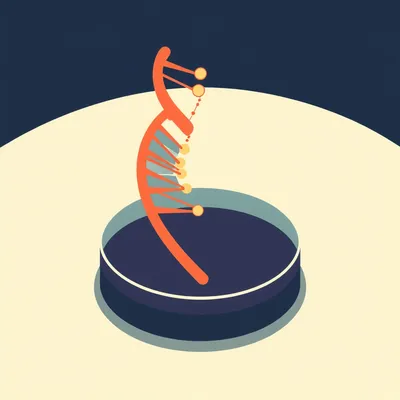
Exactly. The central dogma, as Francis Crick described it, is the flow of information: D.N.A. makes R.N.A., and R.N.A. makes protein. For decades, the holy grail was gene therapy using D.N.A. The idea was to fix the blueprint itself. But D.N.A. is permanent and it is hard to get into the nucleus of a cell without causing dangerous mutations. It is like trying to rewrite the foundation of a building while people are still living in it.
So the idea was, why not just send the messenger instead? Skip the foundation and just give the cell the instructions directly via messenger R.N.A.
Precisely. If you can deliver the messenger R.N.A., you can tell the body to produce any protein you want. You could tell it to produce a piece of a virus so the immune system learns to fight it, or you could tell it to produce a protein that a person with a genetic disease is missing. It is conceptually perfect. It is like sending a text message to a factory instead of trying to rewrite the entire company handbook. But there was a massive problem: the body's security system.
The immune system.
A very aggressive one. Whenever researchers tried to inject synthetic messenger R.N.A. into a living animal in the nineties, the immune system went into a full-blown panic. It recognized the R.N.A. as foreign, as a viral invader, and it triggered a massive inflammatory response. The animals would get very sick or even die before the R.N.A. could ever do its job. So the consensus by the mid-nineties was that messenger R.N.A. was too unstable and too inflammatory to ever be a viable medicine. It was considered a scientific dead end.
And this is where Katalin Kariko enters the picture. She is at the University of Pennsylvania, she is a bright researcher, and she is saying, No, I can fix this. But the university is looking at the failed experiments and the lack of funding and they are not convinced. And her personal life at the time was not exactly easy either, was it?
Not at all. She moved from Hungary to the United States in nineteen eighty-five with her husband and daughter. They famously hid nine hundred British pounds in a teddy bear because the Hungarian government only allowed them to take a tiny amount out of the country. That alone tells you something about her level of commitment. She gets to the University of Pennsylvania and starts working on messenger R.N.A., but she cannot get a single grant. Not one. And in nineteen ninety-five, things went from bad to worse.
Nineteen ninety-five was the year of the demotion, right?
Yes. She was on the path to becoming a full professor, and the university gave her an ultimatum: either stop working on messenger R.N.A. or face a demotion and a pay cut. At the same time, she was diagnosed with cancer, and her husband was stuck in Hungary for months due to a visa issue. Imagine that. You are battling cancer, you are alone with your young daughter, and your employer tells you that your life's work is a failure and they are cutting your salary.
Most people would have quit. I mean, that is a clear signal from the universe to update your resume and move into the private sector or find a different field of study. Why didn't she?
She said in interviews later that she thought about leaving, but she just could not let go of the idea. She knew the science was right. She just had to figure out why the body was rejecting it. And this is where the perseverance becomes legendary. She stayed at the university in this lower-tier position, basically as a researcher who was just tolerated rather than supported. She was a research assistant professor, a non-tenure track role where you are essentially invisible to the administration.
And then comes the chance encounter at the photocopy machine. This sounds like something out of a movie, but it actually happened in nineteen ninety-seven, didn't it?
It is one of my favorite stories in the history of science. She is standing at a Xerox machine, and she meets Drew Weissman, who was a new professor at the university. He was working on an H.I.V. vaccine and was frustrated with the existing methods. She tells him, I can make any R.N.A. you want. And he was skeptical, but he was also struggling. They started collaborating, combining her R.N.A. expertise with his knowledge of immunology.
This is the turning point because Weissman had the resources and the specific interest in the immune system that Kariko needed to bridge the gap. They were trying to figure out exactly which part of the R.N.A. was triggering the alarm bells.
Exactly. They spent years together trying to solve the inflammation problem. And they finally found the answer in two thousand five. It turned out that the body's immune system was reacting to one specific building block of the R.N.A. called uridine. Kariko realized that in our own natural R.N.A., some of these building blocks are chemically modified. So she tried replacing the synthetic uridine with a modified version called pseudouridine.
And the immune system just... ignored it?
It worked perfectly. The modified R.N.A. slipped past the body's defenses like a ghost. It did not trigger the inflammation, but it still delivered the instructions to the cell. It was the breakthrough. That was the moment the door to the future opened. They published their findings in a journal called Immunity in two thousand five.
But here is the crazy part, Herman. They published this in two thousand five. They thought, okay, now the world is going to notice. Now the funding will pour in. But it didn't, did it?
It was almost silence. They got very little interest. The big pharmaceutical companies were not knocking on their door. The university did not even seem to realize what they had. They eventually licensed the technology to a small company for a relatively small amount of money. Kariko and Weissman even started their own company to try and develop it, but they could not get enough investment to keep it going. For the next eight years, Kariko was still struggling to get her university to take her seriously.
It is amazing to think that the technology that would eventually save the world from a global pandemic was sitting in a peer-reviewed journal for fifteen years while the person who discovered it was still being told she was not faculty quality. She actually left Penn in twenty thirteen because they refused to reinstate her to a tenure track, right?
Precisely. They told her she was not faculty quality. So, at the age of fifty-eight, she took a job at a tiny startup in Mainz, Germany, called BioNTech. At the time, they did not even have a single product on the market. But the founders, Ugur Sahin and Ozlem Tureci, believed in messenger R.N.A. for cancer treatments. She became a senior vice president there, finally working in an environment that valued her vision.
And then January twenty twenty hits. The genetic sequence of the new coronavirus is published online on January tenth.
And the world changes. Because the technology was already there. It was like a loaded spring. The moment the genetic sequence was published, the scientists at BioNTech and Moderna were able to design the vaccine in literally two days. By January thirteenth, Moderna had their sequence ready. The rest of the year was just testing and manufacturing. It was the fastest vaccine development in history, but it was built on forty years of Kariko's refusal to give up.
It is such a powerful rebuttal to the idea that these vaccines were rushed. The testing was fast because the whole world was cooperating, but the science behind it had been simmering for decades. And now, in twenty twenty-six, we are seeing the second act of this technology. Herman, what is happening with those cancer vaccines we were promised?
That is the most exciting part of where we are today. Moderna and Merck have reported promising phase 2 data from their melanoma trials with mRNA-4157/V940 combined with immunotherapy, showing reduced risk of recurrence, with phase 3 trials underway. There are ongoing phase 2 trials for lung cancer and pancreatic cancer, and early clinical trials for other indications. It is turning medicine into a software problem.
A software problem. I love that. You just change the code in the messenger R.N.A. to match the specific mutations of a patient's tumor.
Exactly. And it is not just cancer. mRNA technology is advancing for other diseases like malaria in early trials, combination COVID-flu vaccines are in late-stage development, and early-stage trials for an M.R.N.A. H.I.V. vaccine are showing promise in guiding the immune system to produce broadly neutralizing antibodies. This is the golden age Kariko was working toward while she was being demoted in Philadelphia.
I want to go back to the idea of grit, though. Because it is a word that gets thrown around a lot in self-help books, but in Kariko's case, it was very literal. She has a daughter, Susan Francia, who is a two-time Olympic gold medalist in rowing. Susan has said in interviews that she learned her work ethic from watching her mother's grind in the lab. It seems like grit is the family business.
It really is. Susan won gold in two thousand eight and twenty twelve, and she tells stories of her mother yelling from the shore, not about winning, but about the effort. Kariko herself is famous for saying that she never focused on the rejections. She said that if she focused on the people who didn't believe in her, she wouldn't have had any energy left for the R.N.A. That is a level of emotional discipline that is almost as impressive as the science itself.
I think there is a huge lesson there for anyone working on anything innovative. Bureaucracy is almost designed to filter out the weird stuff. It is designed to minimize risk. But breakthrough science is, by definition, risky. If you are waiting for a committee to tell you that your revolutionary idea is good, you might be waiting for the rest of your life.
It is the difference between what I call the grant-industrial complex and true discovery. Most academic research today is focused on what is likely to get funded, which means it is focused on what the reviewers already understand. Kariko was working in a space that the reviewers did not understand, or rather, they thought they understood it and they thought it was a failure. She was failing for interesting reasons, which is often more valuable than succeeding for boring reasons.
Failing for interesting reasons. That should be a metric on every performance review. If you are only doing things you know will work, you are not actually doing innovative work. You are just doing production.
Precisely. And the pandemic was the ultimate stress test for scientific paradigms. The old way of making vaccines, which involves growing the virus in chicken eggs or huge vats of cells, was simply too slow. Messenger R.N.A. was the only technology that could be scaled at the speed of the virus. The very thing the bureaucracy called impractical turned out to be the only thing that was practical in a crisis.
So, looking at this through the lens of Daniel's question, what is the takeaway for someone today who feels like they are hitting a wall? Maybe they are in a corporate job or a different scientific field, and they are being told their ideas are not viable.
I think the first takeaway is to distinguish between technical failure and bureaucratic failure. If your experiments are telling you that you are wrong, you should listen to the experiments. But if the experiments are telling you that you are right and the people in suits are telling you that you are wrong, that is when you need to dig in. Kariko was constantly looking at the data. She was not just being stubborn; she was being right.
I also think we need to talk about the cost of that institutional resistance. We are celebrating her now, but how many other Katalin Karikos have we lost because they did not have the luck to meet a Drew Weissman at a photocopy machine? Or because they couldn't afford to take a pay cut? The fact that it took a global pandemic for her work to be recognized is a systemic failure.
It really is. We should be asking ourselves how many other revolutionary technologies are currently sitting in the demoted-researcher pile because they do not fit the current funding model. If the University of Pennsylvania had evaluated her based on the long-term potential of her ideas rather than her short-term grant income, we might have had this technology ready for other diseases a decade ago.
It is a reminder that the path of progress is rarely a straight line. It is more like a series of breakthroughs separated by long periods of institutional resistance. And it requires people who are willing to be the outliers. One of the things Kariko said after winning the Nobel was that she hoped her story would encourage people who feel like they do not belong in the elite circles. She said, I was not a genius, I was just a hard worker.
Although, to be fair, she is clearly a genius. But I think she means that the grit was the deciding factor. High intelligence is common. The ability to endure twenty years of being told you are a failure is incredibly rare. She took ownership of her career, even when the institutions around her were trying to take it away. She did not wait for permission to be a great scientist. She just did the science.
I think we should also mention the role of the public in this. There was a lot of skepticism about the vaccines because they were new. But if more people understood this history, that this was not a new invention but a forty-year marathon, maybe there would have been less fear. It makes the science feel more trustworthy when you realize it was forged in the fire of skepticism.
Exactly. It had the most rigorous peer review process imaginable, which was the refusal of the entire scientific community to believe it for three decades. By the time it reached the public, it had been vetted more thoroughly than almost any other medical technology in history. It had to be better than everything else just to survive.
It is a beautiful irony. The very bureaucracy that tried to kill the project ended up ensuring that it was incredibly robust. But I would still prefer a system that was a little more supportive. We got lucky this time. We might not get lucky next time.
That is a good point. We cannot rely on every great scientist being as stubborn as Katalin Kariko. We need to build systems that are a bit more hospitable to the outliers. But until then, we have her example to look to. Whenever I feel like a project is stalled or I am getting pushback on an idea, I think about that hidden money in the teddy bear. I think about the demotion at Penn. And I think, Okay, I can handle another week of this.
It is a high bar for perseverance, but it is an inspiring one. And it is a reminder that the world's biggest problems are often solved by the people the world tried its best to ignore. Well said, Herman. I think we have covered the arc of her career and the future of the technology pretty well here.
It really is a testament to the power of the individual. Institutions are important, but they are often just the containers for individual passion. And sometimes, the container is too small for the passion. I want to thank Daniel for sending this in. It is a story that everyone thinks they know because they know the vaccine, but the backstory is where the real lessons are.
Absolutely. If you are listening and you are working on something that feels like a dead end, or if you are facing those bureaucratic walls, remember Katalin Kariko. Remember that being demoted is not the same as being wrong. And remember that the people who say it cannot be done are usually interrupted by someone doing it.
Usually someone who was told to stop years ago. It has been a pleasure as always, Corn. I think I am going to go read that two thousand five paper again. There is something so satisfying about a breakthrough that everyone missed.
Enjoy the pseudouridine, Herman. Thanks for listening to My Weird Prompts. If you have enjoyed this deep dive into the history of messenger R.N.A. and the incredible career of Katalin Kariko, we would really appreciate it if you could leave us a review on your podcast app or on Spotify. It genuinely helps other people find the show.
Yeah, we love seeing the feedback and it helps the algorithm realize that people actually want this kind of deep-dive content. You can find all of our past episodes, nearly five hundred of them now, at myweirdprompts.com. We have a search bar there if you want to look for other topics we have covered, from emergent behaviors in A.I. to the physics of black holes.
And if you have a prompt of your own, like the one Daniel sent us today, there is a contact form on the website. We love hearing what is on your mind and what you want us to explore next. We will be back next time with another deep dive into the strange and wonderful world of ideas.
Until then, keep asking the weird questions.
See you next time.