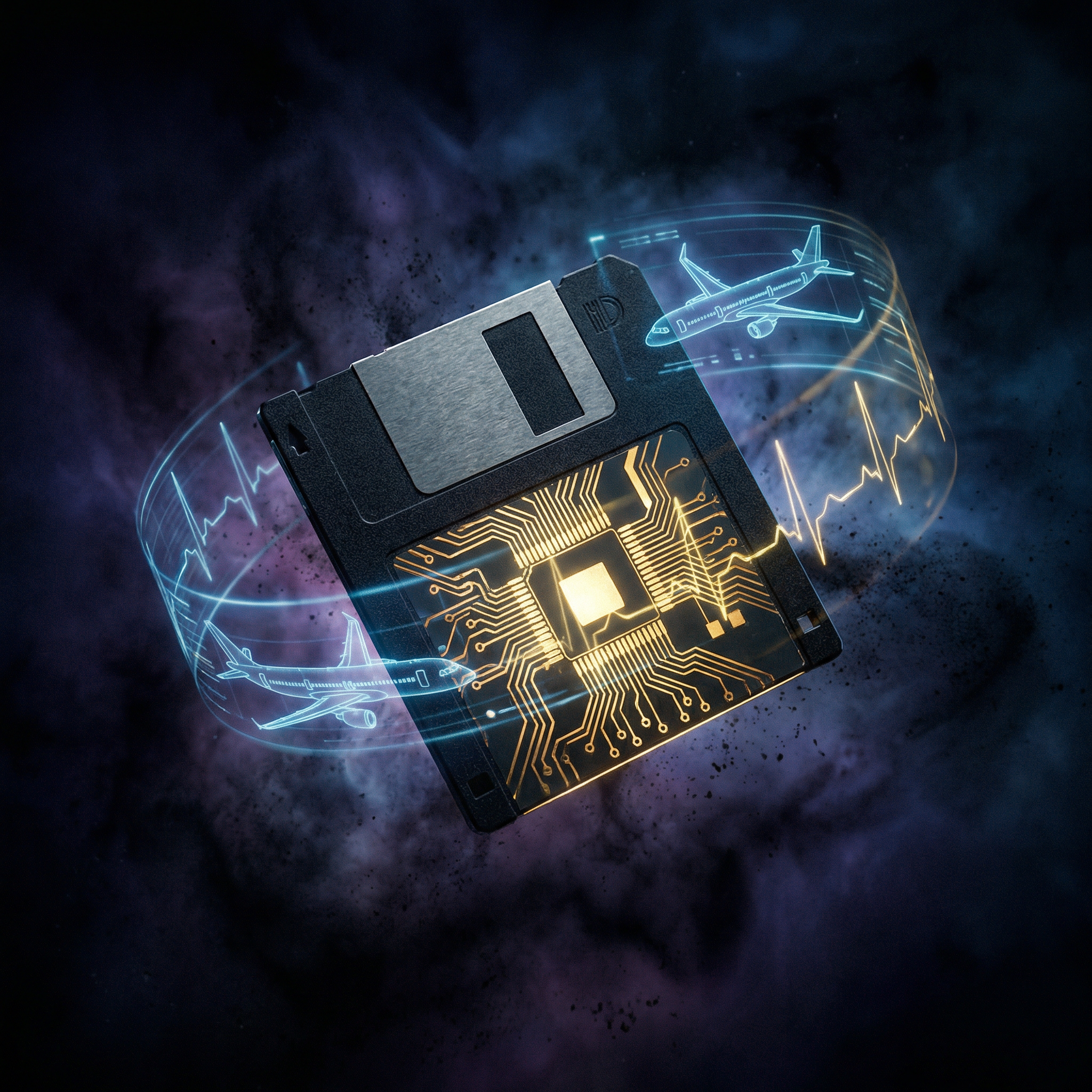
You know, Herman, it is funny how a simple afternoon of cleaning can turn into a deep dive into the history of human progress. Our housemate Daniel was going through some old boxes in the apartment earlier today, and he found this tangled mess of cables. There were old serial port connectors, those bulky V G A monitor cables with the thumb screws, and even a few proprietary chargers for phones that haven't existed in fifteen years. It really gets you thinking about how fast the arc of technology moves. But then, right at the bottom of the box, he found something that felt like a relic from another era: a single, black three and a half inch floppy disk. It had a handwritten label that just said, quote, tax records nineteen ninety-eight, unquote.

Herman Poppleberry, reporting for duty! And Corn, that is the perfect image to start with. Daniel sent us this prompt because he was struck by that exact contrast. We live in a world where we are constantly told that everything is moving at light speed. We have five G, we have generative artificial intelligence, we have quantum computing experiments. And yet, there are these strange, stubborn islands of old technology that simply refuse to sink. The floppy disk is the poster child for this, but it is far from alone. It is like finding a coelacanth in your bathtub.
It really is. I think most people assume that once a technology is deprecated, it just vanishes. We think of it like a light switch: on or off. But the reality is more like a very, very long sunset. Today, we are going to talk about the arc of deprecation. Why do things like the floppy disk, the telegram, and the fax machine still have a pulse in two thousand twenty-six? Is it just laziness, or is there a deeper, perhaps even logical, reason for their survival? We are going to look at the legal, security, and economic forces that keep these ghosts in the machine.
It is almost never just laziness, Corn. That is what I find so fascinating. When you look at the systems that still rely on these tools, you often find that they are the most critical systems we have. Let us take the floppy disk as our first case study. If you ask a teenager today what that icon is on their computer screen for saving a file, they might tell you it is just the save button. They have never seen the physical object it is based on. But if you walk onto a Boeing seven hundred forty-seven dash four hundred, a plane that is still flying cargo and occasionally passengers around the world in two thousand twenty-six, you might find a very familiar sight in the cockpit.
Wait, I remember reading about this. Are they really still using floppies for flight data? I mean, we are talking about a plane that can carry hundreds of tons of cargo.
Not just for data, but for critical software updates. Every twenty-eight days, those planes need their navigation databases updated. For many of those older seven forty-sevens, a technician literally walks onto the plane with a folder of three and a half inch floppy disks. They insert them one by one into a disk loader located under the cockpit floor or in the pedestal. We are talking about a machine that costs hundreds of millions of dollars, and its brain is being fed by technology from the nineteen eighties. And it is not just one disk; sometimes it takes a stack of eight or ten disks to complete a single update.
That sounds terrifying on one level, but I assume there is a reason they haven't just swapped it out for a U S B port or a wireless update system? Surely a ten dollar thumb drive is better than a stack of forty-year-old magnetic media?
Precisely. And this is where we get into the first big reason for tech survival: certification and safety. In the aviation industry, every single component has to be incredibly rigorously tested and certified. If you want to replace a floppy disk drive with a U S B port, you don't just go to the electronics store and buy a part. You have to prove that the new part won't interfere with the avionics, that it is shielded against electromagnetic interference, and that the software handling the U S B protocol is as stable as the old disk system. That process can cost millions of dollars and take years of testing. For an airline, the question is: does the floppy disk work? Yes. Is it reliable? Yes. So, why change it? The risk of the unknown is higher than the inconvenience of the known.
It is the ultimate version of if it ain't broke, don't fix it. But there is also a security angle here, right? We talked about this a bit back in episode two hundred one, about how fast hackers can find a server. A floppy disk is physically air-gapped. You can't hack a floppy disk from halfway across the world.
That is a huge point, Corn. The physical nature of old tech is actually a feature, not a bug, in high-security environments. Look at the United States nuclear silos. For decades, they were using eight-inch floppy disks. Not even the three and a half inch ones, but those giant, flexible ones from the nineteen seventies. The Air Force finally replaced the eight-inch disks in their Strategic Automated Command and Control System in late twenty-nineteen, but they didn't move to the cloud. They moved to highly secure, solid-state digital storage that still mimics the old architecture. The logic was that those systems are impossible to access via the internet. They are so old that they are essentially invisible to modern malicious software. There is a certain security in obsolescence. If a hacker doesn't even know how to write code for a sixteen-bit processor from nineteen seventy-five, they can't break in.
It is security through obscurity, but also through physical limitation. You have to be standing in the room to change the data. But Herman, what about the supply chain? If these things are so old, who is still making the disks? I can't imagine there is a massive factory in China churning out millions of floppies every month.
You would be surprised! There is actually a man named Tom Persky who runs a company called floppydisk dot com in California. He is often called the Floppy Disk King. He bought up massive amounts of inventory years ago, and he still sells thousands of disks every week. His biggest customers? The airline industry, medical device companies, and people running old industrial embroidery machines or C N C routers. It is a niche but incredibly stable market. However, even the King is seeing the end of the road. He has said that once his current stock is gone, that is probably it. There are no new factories being built.
So we are living on the fumes of the twentieth century. But let us move on to something even more surprising. Daniel mentioned the telegram. Now, I think most people would bet their life savings that the telegram died out decades ago. I mean, we have instant messaging, email, and video calls. Why on earth would anyone send a telegram today? It feels like something out of a black and white movie.
This one blew my mind when I started looking into it. While many countries have officially shut down their state-run telegram services, like India did in twenty-thirteen, which was a huge deal at the time, the technology hasn't actually vanished. It has just moved into niche markets. In fact, Germany only officially ended its domestic telegram service on December thirty-first, twenty-twenty-two. Up until that final day, people were still sending thousands of them. In certain legal systems, a telegram carries a different weight than an email. In some jurisdictions, a telegram is considered a legal document with a verified timestamp and a physical record of delivery that is much harder to dispute in court than a digital read receipt.
So it is about the paper trail. It is about having a physical piece of evidence that a specific message was delivered at a specific time. It is a way to prove you notified someone without relying on a server that might be wiped or an email that might go to spam.
Exactly. And then there is the ceremonial aspect. In the United Kingdom and some other Commonwealth countries, telegrams, or their modern equivalents called tele-messages, are still used for big milestones. When someone turns one hundred years old, they get a message from the monarch. People still send them for weddings or funerals because a physical message feels more significant than a text. It has weight, literally and figuratively. But there is also a very practical use in the maritime world. Until quite recently, the telegram system was part of the global maritime distress and safety system. If you are in the middle of the ocean and your high-tech satellite link fails, the old-school radio-based telegram systems are the ultimate backup.
It is that long tail again. The infrastructure was built to last a hundred years, so it does. But speaking of infrastructure that refuses to die, we have to talk about the fax machine. Living here in Jerusalem, we see this all the time. If you want to deal with a government office or a health fund, they often ask you to fax your documents. It feels like stepping into a time machine every time I walk into the post office.
Oh, the fax machine is the king of the undead technologies. And it is not just Israel. Japan is famously obsessed with the fax. In Japan, it is tied to the culture of the hanko, the personal seal. Many businesses require a document to be physically stamped with a hanko and then sent. A digital signature doesn't always cut it. So, you stamp the paper, you put it in the fax machine, and the person on the other end gets a physical copy of that stamp. Digital Minister Taro Kono has been trying to wage a war on the fax machine for years, but the bureaucracy is incredibly resilient. He managed to declare victory over the floppy disk in the Japanese government in June of twenty-twenty-four, but the fax machine? That is a much tougher boss fight.
But Herman, we have scanners! You can scan a document and email it as a P D F. It is faster, it is clearer, and you don't have that horrible screeching sound of the modem handshaking. Why is the fax still the standard in places like the United Kingdom's National Health Service?
This is where we get into the intersection of law and perceived security. In the United Kingdom, the N H S has been trying to quote, axe the fax, unquote, since twenty-eighteen. They set a deadline for twenty-twenty, but as of early twenty-twenty-five, the C E O of N H S England admitted there is still no set date for the health service to be completely paperless or fax-free. In many countries, including the United States and Israel, there are strict privacy laws regarding medical information. In the United States, it is H I P A A, the Health Insurance Portability and Accountability Act. For a long time, faxing was considered more secure than email because it was a point-to-point transmission over a telephone line. It wasn't sitting on a server somewhere or being routed through dozens of different nodes where it could be intercepted.
But is that actually true? I mean, modern faxes are often just digital anyway. They go through a fax-to-email server. If I send a fax from my computer, it is just an email with extra steps.
You are hitting the nail on the head. Most modern faxing is not actually analog anymore. It is just email with a very clunky interface. But the legal framework hasn't caught up. If the law says a fax is a secure way to transmit a medical record, then hospitals will keep using faxes because it protects them from liability. It is easier to keep using the old, inefficient system that is legally protected than to fight for a new system that might be technically superior but legally ambiguous. It is the path of least legal resistance.
That is such a frustrating reality of the arc of deprecation. It is not about the technology; it is about the bureaucracy surrounding the technology. I think about the electronic waste issue Daniel mentioned. When we keep these old systems on life support, we are also creating this demand for parts that are no longer in mass production. You end up with this strange secondary market for legacy hardware. And when we finally do switch, we have mountains of old machines that nobody knows how to recycle.
It is a massive problem, Corn. According to the Global E-waste Monitor, the world produced over sixty-two million tonnes of e-waste in twenty-twenty-two, and that number is projected to rise to eighty-two million tonnes by twenty-thirty. Only about twenty-two percent of that is formally collected and recycled. When we talk about the arc of deprecation, we have to talk about the cost of the transition. There are companies whose entire business model is just refurbished legacy tech. If you are running a factory that was built in the nineteen nineties and the computer controlling the assembly line breaks, you can't just plug in a new laptop. The software might only run on Windows ninety-five and require a specific type of motherboard with an I S A slot. So you go to eBay or a specialized dealer and pay five hundred dollars for a twenty-year-old part that should be in a landfill.
It is like the technology becomes a hostage to the system it built. We talk about technical debt in software development, but this is like physical technical debt. You are paying interest on your old decisions every single day. And that interest is paid in e-waste and energy inefficiency. Think about the power consumption of maintaining these old analog phone lines just for faxes.
And don't forget the human side of technical debt. Have you heard of the Cobol Cowboys? They are a group of veteran programmers, many of them in their seventies and eighties, who are the only ones left who know how to maintain the C O B O L code that runs the global banking infrastructure. C O B O L was developed in nineteen fifty-nine! Every time you use an A T M or transfer money, there is a high probability that your transaction is being processed by code written before the moon landing. These programmers are being called out of retirement for six-figure contracts because the banks are too afraid to migrate to a modern language. The risk of a system-wide crash during a migration is just too high.
It is a skyscraper built on a foundation of sand and punch cards. But Corn, I want to push back a little on the idea that this is all bad. There is a concept called Lindy's Law. Have you heard of it?
I have. It is the idea that the longer something has survived, the longer it is likely to survive in the future, right? If a book has been in print for fifty years, it is likely to be in print for another fifty.
Exactly. If a technology has survived for forty years despite every attempt to kill it, there is probably a very robust reason for its existence. The fax machine is incredibly resilient. It is simple. It is standardized. You don't have to worry about file formats, or software versions, or operating system compatibility. A fax from a machine made in nineteen ninety will still work with a machine made in two thousand twenty-six. There is a beauty in that kind of universal compatibility. It is the lowest common denominator of communication. It is the safety net. When the high-tech systems fail, the low-tech systems are often still standing. We saw this in some of the recent cyberattacks on hospital systems in twenty-twenty-four. When the digital records were locked by ransomware, the doctors went back to paper and faxes. It was the only thing that couldn't be encrypted by a hacker in another country.
I can appreciate that. We live in an era of walled gardens and proprietary ecosystems. If I send you a file from an Apple device, it might not look right on your Windows machine, or you might need a specific app to open it. But a fax is just a picture of a page. It is a physical confirmation in a digital world. But let us talk about the future. Daniel mentioned the U S B dash C standard as a sign of hope. Are we finally moving toward a world where we don't need a drawer full of proprietary junk?
U S B dash C is a huge step forward, especially with the European Union's mandate that all small electronics use it. It slows down the e-waste cycle because you don't need a new cable for every new phone. But even U S B dash C is part of the arc. One day, it too will be deprecated. We will have something faster, or maybe we will move entirely to wireless power and data. And twenty years after that, someone like Daniel will be cleaning out a drawer and find a U S B dash C cable and wonder what on earth we were thinking, carrying around these little copper-filled ropes.
It is inevitable. But let us look at the second-order effects of this deprecation. When a technology finally does die, what happens to the knowledge? There is a real risk that we are losing the ability to maintain the systems that our world still relies on. We talked about the Cobol Cowboys, but what about the hardware? There are fewer and fewer people who can repair a floppy disk drive or a telegram terminal. We are building a skyscraper of technology, but the foundation is made of stuff that no one knows how to fix anymore. If the foundation cracks, do we even have the tools to patch it?
That is why some people are advocating for what they call maintainable tech or small tech. Instead of constantly chasing the newest thing, we should focus on building things that are designed to last and designed to be repaired. It is the opposite of planned obsolescence. It is the idea that a tool should be useful for decades, not just years. We are seeing a bit of a resurgence in this with the Right to Repair movement. In twenty-twenty-five, we saw new legislation in several countries requiring manufacturers to provide parts and manuals for at least ten years. It is a slow shift, but it is a shift away from the disposable culture.
I love that idea, but it feels so at odds with the current economic model. Most tech companies want you to upgrade every two years. They don't want you using a twenty-year-old fax machine; they want you subscribing to a cloud-based document suite with a monthly fee. The arc of deprecation is often forced by the market, not by the utility of the tool. But the outliers, the ones Daniel pointed out, they are the ones that have escaped the market's gravity. They have become so essential or so deeply embedded that the market can't force them out. They only leave when they are truly ready, or when the last person who knows how to use them finally retires.
My bet is on anything that has a physical, tactile component. Humans are physical creatures. We like things we can touch and hold. That is why vinyl records made a comeback. That is why paper books are still outselling e-books in many markets. There is a certain reliability and a certain sensory satisfaction in old tech that digital versions struggle to replicate. The floppy disk had a very satisfying click when you pushed it in. The telegram had the texture of the paper and the weight of the history. Even the fax machine has that physical output that tells you, yes, the message has arrived. It is a physical confirmation in a digital world.
And let us not forget the environmental side of this. Every time we deprecate a technology, we create mountains of waste. But when we keep using old tech, we are actually being more sustainable in a weird way. That seven forty-seven using floppy disks isn't requiring the manufacture of new, high-tech components. It is using what it already has. The most sustainable device is the one you already own. Although, to be fair, a nineteen ninety fax machine is probably using a lot more electricity than a modern server. So it is a bit of a trade-off.
True, true. It is never simple. But the goal should be to move away from the disposable culture. If we can design tech that has the longevity of the fax machine but the efficiency of modern systems, that would be the dream. So, what is the takeaway for our listeners? If you are a business owner or a developer, should you be embracing these old tools or running away from them?
I think the lesson is to respect the legacy. Don't assume that because something is old, it is useless. Understand why it is still there. If it is there for a legal reason, or a security reason, or a certification reason, those are real constraints. You can't just wave a magic wand and make them go away. But also, be aware of the technical debt you are accruing. If you are still using a fax machine in two thousand twenty-six, you should probably have a plan for what happens when the last person who can fix it is gone. And for the rest of us, maybe next time you see a floppy disk or a fax machine, don't just laugh at it. Think about the incredible journey that technology has taken. It was once the cutting edge. It changed the world. And the fact that it is still here, decades later, is a testament to its design and its utility. It is an outlier in a world that is obsessed with the new.
Well said, Corn. It is about finding the balance between progress and preservation. We don't want to live in the past, but we don't want to lose the lessons of the past either. We are all just travelers on the arc of deprecation, trying to figure out what to pack for the journey and what to leave behind.
I think that is a great place to wrap up. This conversation really gave me a new perspective on that messy cable drawer. Maybe I won't throw everything away just yet. You never know when you might need a V G A cable to save the world, or at least to connect an old monitor to see what's on that floppy disk Daniel found! If you enjoyed this trip down memory lane, we would really appreciate it if you could leave us a review on your favorite podcast app or on Spotify. It really helps other curious people find the show.
It really does. And thank you to Daniel for sending in such a great prompt. It is always fun to dig into the weird corners of the tech world with you, Corn. You can find all our past episodes and a way to get in touch with us at our website, my weird prompts dot com. We are also on Spotify, so make sure to follow us there.
Until next time, keep asking the weird questions. This has been My Weird Prompts. Thanks for listening. See you next week!
See you next week! Wait, Corn, did you hear that? I think the fax machine in the other room just started printing something.
You're joking. We don't even have a phone line connected to that thing.
I'm not! I hear the screeching! It is that classic handshake sound. It sounds like a ghost trying to dial out.
Well, I guess someone still has our number. Let's go see who's sending us a message from the past. Maybe it is a pizza coupon from nineteen ninety-four.
I'll settle for a clear image of a hanko stamp! This is perfect. Talk about timing! Herman Poppleberry, signing off!
And Corn, too. Goodbye! Alright, let's see what it is. If it is a message from the future telling us not to deprecate the podcast, I'm going to be very relieved.
Lead the way! I'm right behind you. Peace out.
Peace. My Weird Prompts. Spotify. my weird prompts dot com. Review us. Okay, for real this time. Bye!
Bye!