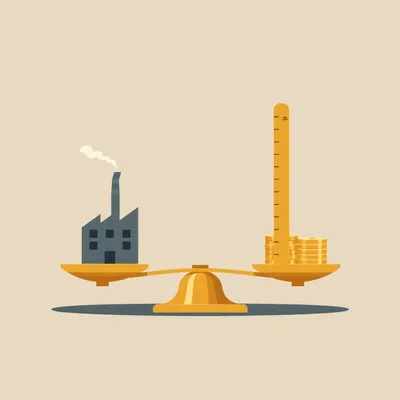
If you look at a modern balance sheet, you see a story of assets, liabilities, and equity. It looks solid. It looks objective. It looks like the final word on what a company is worth. But there is a massive ghost in the machine, a structural debt that every corporation carries but almost none of them report. We are talking about the invisible costs of doing business, the things that our current accounting language simply was not designed to hear. It is a silence that has become deafening in the year twenty twenty-six.

It is the ultimate blind spot, Corn. We have spent the last few years on this show talking about the rise of impact accounting and organizations like the International Foundation for Valuing Impacts, or the I-F-V-I, but today we are going deeper. We are looking at the foundation of the house itself. Our housemate Daniel sent us a fascinating prompt about where these rules actually came from. He wanted to know if the way we count money is a law of nature or just a very old, very flawed human invention. And honestly, it is a question that cuts to the core of why our global economy feels so disconnected from the reality of the planet.
And that is a great place to start. I am Corn Poppleberry, and I am here with my brother, Herman Poppleberry. We are coming to you from Jerusalem, where we have been thinking a lot about the architecture of value. Because if the language of business is accounting, then we need to realize that we are currently speaking a dialect that was frozen in time centuries ago. We are trying to manage a twenty-first-century climate crisis using a fourteenth-century tracking system.
And Daniel’s prompt really hits on a historical nerve. There is this common narrative that modern accounting was born out of the ashes of the nineteen twenty-nine Wall Street crash. The story goes that before the crash, it was the Wild West, and then the government stepped in and created transparency. But as we dig into this, we are going to find that the truth is much more complicated. The "blind spots" we see today, things like environmental damage or social costs, were not accidentally left out. They were structurally excluded from the very beginning. It was a choice, not a mistake.
Right, and we should clarify what we mean by "externalities" for a second. We touched on this back in episode one thousand three hundred thirty-eight when we talked about impact-weighted profits. An externality is basically a cost or a benefit that is not reflected in the price of a good or service. If a factory pollutes a river, the cost of cleaning that river is an externality. It does not show up on the factory’s profit and loss statement, but society pays for it. But Herman, I want to challenge the word "externality" itself. It implies that these things are outside the system. But they are only outside because we drew the circle too small. It is a failure of accounting taxonomy, not a law of physics.
That is a brilliant way to put it. It is a taxonomy failure. We decided what "counted" as a transaction and what was just "the background." To answer why we drew the circle that way, we have to go back way further than nineteen twenty-nine. We have to go back to fourteen ninety-four.
Fourteen ninety-four. That is the year Luca Pacioli published his book, Summa de arithmetica. He was a Franciscan friar and a collaborator of Leonardo da Vinci. He did not invent double-entry bookkeeping, but he was the first one to formalize it and write it down. And Herman, the context of that invention is everything. It was not designed to save the world; it was designed to solve a very specific problem of trust.
It really was. Think about what was happening in Venice in the fifteenth century. You had merchants engaging in long-distance trade. You had partnerships where one person provided the capital and another person did the traveling. Double-entry bookkeeping was a technology of trust. It was designed to do one thing very well: track the relationship between a creditor and a debtor. It was about making sure that if I gave you fifty gold ducats to buy spices in the East, I could see exactly what happened to every single one of those ducats. It was a closed loop.
So, from the very first line of the first ledger, the system was built for stewardship of private capital. It was an internal tool for merchants to keep from being cheated by their partners or their employees. It was never intended to measure the health of the commons or the impact on the community. And because it worked so well for that specific task, it became the global standard. But here is the thing, Herman, when you define "value" only as things that can be traded or owned by a specific person, everything else becomes invisible by definition. If I cannot own the air, the air does not go on the balance sheet.
That is the structural debt I was talking about. If you cannot put a fence around it and you cannot sue someone over it in a fifteenth-century court, it does not go in the ledger. For over five hundred years, we have been using a system that essentially treats the environment and society as an infinite, free backdrop for private transactions. But people have tried to change this before, Corn. It is not like we just woke up in twenty twenty-six and realized that pollution costs money. There was a massive, forgotten movement in the nineteen seventies that almost changed everything.
You are talking about the "social accounting" movement. I was looking into this guy, David Linowes. He was a very high-profile accountant, a partner at Laventhol and Horwath, and he was basically the rockstar of the accounting world in the seventies. He proposed something called the Socio-Economic Operating Statement.
Linowes was a visionary. This was right around the time the Environmental Protection Agency was being formed in the United States. There was a real movement to force companies to report on their social impact. Linowes wanted companies to list their "social improvements," like job training programs or pollution control, and subtract their "social actions," which were the negative impacts. He wanted a "social bottom line" that sat right next to the financial bottom line.
And it actually gained some traction for a minute. The American Institute of Certified Public Accountants, the A-I-C-P-A, even had a committee on social measurement. They published a book in nineteen seventy-seven called "The Measurement of Corporate Social Performance." It was a serious technical manual. But it failed. Why did it fail, Herman? Was it just too hard to measure back then?
That was the primary technical excuse. In the pre-computing era, quantifying the exact cost of a ton of carbon or the social value of an educated workforce was seen as "subjective" or "unreliable." Accountants pride themselves on being precise. They like things that can be verified with a receipt. If you could not produce a receipt for the "clean air" you used, the accounting profession did not want it on the balance sheet. They argued it would undermine the "integrity" of the financial statements.
But that feels like a convenient excuse. I mean, even in the nineteen seventies, we had sophisticated economic models. It feels more like a gatekeeping issue. If you allow "social value" into the ledger, you change the definition of what a "good" company is. You might have a company that is highly profitable in cash terms but bankrupt in social terms. That is a threat to the entire power structure of the market.
And the institutional resistance was massive. In nineteen seventy-three, the Natural Resources Defense Council, the N-R-D-C, actually petitioned the Securities and Exchange Commission, the S-E-C, to require companies to disclose their environmental impacts. The S-E-C spent years fighting it. They basically said that their mandate was to protect investors, not to save the world. They argued that investors only care about financial returns, so adding social metrics would just "clutter" the reports and confuse people. It is a very circular argument: investors only care about money, so we only report money, which ensures that investors continue to only care about money.
It is that "decision-usefulness" framework. I want to dig into that because it connects to the second part of Daniel’s prompt about the nineteen twenty-nine crash. The common story is that after the crash, the government had to step in because companies were just lying. They were making up their own rules, they did not have auditors, and it was total chaos. How much of that is actually true?
It is a bit of a myth, or at least a massive oversimplification. If you look at the research, many of the large, publicly traded companies before nineteen twenty-nine, like United States Steel, were already providing audited financial statements. They did it because the market demanded it. If you wanted to borrow money from a bank or sell stock to the public, you had to prove you were legitimate. There was a whole profession of "gentlemen auditors" who followed their own internal standards.
So the Securities Acts of nineteen thirty-three and nineteen thirty-four were not creating transparency out of thin air. They were just standardizing what was already happening?
Mostly, yes. They were codifying what the "best" companies were already doing. But here is the crucial part that most people miss: the government did not actually set the accounting standards. The S-E-C has the legal authority to do it, but from the very beginning, they delegated that power to the accounting profession itself. First to the American Institute of Accountants, and eventually to the Financial Accounting Standards Board, or F-A-S-B.
So you have a situation where the regulators essentially told the people being regulated, "You guys write the rules, and we will just make sure everyone follows them." That sounds like the definition of regulatory capture, Herman.
It is regulatory capture at the foundational level. And the rules they chose were designed to serve the needs of the capital markets as they existed in the nineteen thirties and forties. That is when we moved from "stewardship accounting" to "decision-usefulness." And Corn, that shift is the reason we are in this mess today.
Explain the difference there. That sounds like a technicality, but I bet it has huge implications for how a C-E-O thinks about their job.
It is the most important distinction in the history of the profession. Stewardship accounting, which was the old Venetian model, was about the past. It was about making sure the manager of a company had not stolen the assets. It was about conservation and honesty. Decision-usefulness, which became the dominant philosophy in the mid-twentieth century, is about the future. It is about providing information that helps an investor predict the future stock price.
Wow. So the goal of accounting shifted from "Is this money safe?" to "Will this stock go up next quarter?"
Precisely. And if your goal is just to help someone decide whether to buy or sell a stock today, then long-term externalities like climate change or the depletion of natural resources are seen as irrelevant. Unless those things are going to hit the bottom line in the next few quarters, they are "noise" according to the decision-usefulness framework. This is how we ended up with a system that systematically incentivizes companies to offload costs onto the public sector. If I can dump chemicals in a river and it doesn't result in a fine this year, my "earnings per share" look better, and the "decision-useful" data says I am a great company.
It is like we built a high-speed racing car but forgot to give it a fuel gauge that tells you when the forest you are driving through is on fire. You just see the speedometer. And because the accounting profession was given the power to set its own standards, they focused on what made life easiest for accountants and corporations. They wanted "comparability" and "verifiability." It is much easier to compare two companies based on their earnings per share than it is to compare them based on their impact on local water tables. So, they just ignored the water tables for eighty years.
And this brings us to the present day, twenty twenty-six. We are seeing a massive push for the International Sustainability Standards Board, or the I-S-S-B. They are trying to create a global baseline for climate disclosures. But if you look at the language they use, it is still framed through that "decision-usefulness" lens. They are not asking "How much damage is this company doing to the world?" They are asking "How much is the world’s changing climate going to damage this company’s profits?" It is still incredibly self-centered.
It is the fifteenth-century merchant in Venice all over again, just worried about whether his specific ship is going to sink, not whether the ocean is becoming toxic. This is where the conservative perspective gets really interesting to me, Herman. Often, people think that wanting to measure externalities is some kind of radical, left-wing agenda. But if you are a true fiscal conservative, you should hate externalities. They are a market failure. They are a form of subsidy. If a company is allowed to pollute for free, they are essentially taking a subsidy from every citizen who has to breathe that air or pay taxes to clean it up. It is a distortion of the free market.
I completely agree. A real market requires accurate prices. If the price of a product does not include the cost of the damage it does, then the price is a lie. We are making decisions based on false data. From a pro-market standpoint, we want our companies to be the most efficient in the world. But if they are only "efficient" because they are offloading their costs onto the taxpayer, that is not real efficiency. That is just clever bookkeeping. It is "crony accounting."
We talked about this a bit in episode four hundred thirty-nine when we looked at the new rules of impact investing. There is a reason the big players are finally moving toward these standards. They realize that these "externalities" are starting to become "internalities." If a government passes a carbon tax, suddenly that "invisible" cost shows up on the balance sheet as a very real tax bill. The risk is becoming too big to ignore. But we have to be careful about "impact washing." If we just allow the same accounting firms that helped hide these costs for decades to now "certify" the social impact, are we really changing anything?
That is the danger. If you just add a new, shiny column to the same broken spreadsheet, you haven't fixed the incentive structure. The incentive is still to maximize the financial column at the expense of the social column, as long as you can get away with it. This is why we need to look at the "Notes to the Financial Statements." For our listeners who want to be sophisticated investors, that is where the bodies are buried.
Tell them more about that. Most people stop reading after the first three pages of an annual report.
You have to go to the footnotes. That is where companies are forced to disclose "contingent liabilities." These are potential future costs that they don't want to put on the main balance sheet yet because they aren't "certain" enough. You will see things there about pending environmental lawsuits, or long-term obligations for cleaning up industrial sites. It is the "fine print" of the planet. Another thing to look at is the "Management Discussion and Analysis" section, the M-D-and-A. If you see a company talking a lot about "efficiency gains" without explaining where those gains are coming from, there is a good chance they are just squeezing their suppliers or their environment in a way that is not sustainable.
It is about becoming a more sophisticated reader of the language of business. We have to realize that accounting is not a law of physics. It is a social construct. It is a set of rules that we agreed upon, mostly in the nineteen thirties, based on ideas from the fourteen nineties. We have the power to change those rules. And Herman, I think the technology is finally making it impossible to keep the lights off in those corners of the ledger.
You are right. We are moving toward a world of "radical transparency." In the nineteen seventies, David Linowes was told it was "too hard to measure" social impact. But in twenty twenty-six, we have satellite imagery that can track methane leaks in real-time. We have A-I-driven auditing that can scrape millions of data points from supply chains to see if a company is using forced labor or illegal deforestation. The "it is too hard to measure" excuse has completely evaporated.
That is a fascinating point. If an A-I can calculate the environmental cost of a specific flight or a specific shipment in real-time, then the accounting profession is either going to lead that shift or be bypassed by it. If the official ledgers don't reflect reality, the market will find other ways to price that reality. We are already seeing "shadow prices" for carbon in the private sector. Companies are starting to use these internal metrics to make decisions because they know the official rules are lagging behind.
It is almost like we are seeing the return of the "stewardship" model, but on a global scale. We are realizing that we are all partners in this "spice voyage" called Earth, and we need a better way to make sure no one is cheating the rest of us. If we were re-engineering accounting today, Corn, would we even use money as the primary unit?
That is the trillion-dollar question. Money is a very poor proxy for a lot of the things that actually matter for long-term value. How do you put a dollar value on the trust a community has in a company? How do you put a price on the biodiversity of a rainforest? When we try to force these things into a monetary value, we often end up losing the very essence of what we are trying to measure. Some theorists are looking at "multi-capital" accounting, where you track natural capital, human capital, and social capital separately.
That would be a revolution. It would force a completely different kind of conversation in the boardroom. Instead of just "How do we maximize profit?", the question becomes "How do we balance these different forms of capital so the whole system remains viable?" It brings it all back to Pacioli. He was a friar, after all. He believed that accounting was a moral activity because it was about truth and honesty between people. We have lost that moral dimension and replaced it with a purely mechanical, "decision-useful" one.
Well, this has been a deep dive. I feel like I need to go read some fifteenth-century Italian math books now. But seriously, this is one of those topics that seems dry on the surface but is actually the secret code that runs the world. If you change the code, you change the world. We have to stop treating the nineteen twenty-nine crash as the "Big Bang" of accounting and realize it was just a consolidation of a very specific, limited worldview.
I couldn't agree more. Reclaiming the history of accounting is the first step toward building a system that actually counts what matters. And I think we are going to be talking a lot more about this as these new I-S-S-B standards start to go into effect over the next couple of years. We are in the middle of the biggest shift in accounting since the nineteen thirties, and most people don't even know it is happening.
Well, they do now. If you have been enjoying "My Weird Prompts," we would really appreciate it if you could leave us a review on your favorite podcast app. It really helps other people find the show and join these conversations. We are trying to build a community of people who want to look under the hood of the global economy.
Yeah, it genuinely makes a difference. And if you want to see our full archive of over thirteen hundred episodes, head over to myweirdprompts dot com. You can find our R-S-S feed there and all the different ways to subscribe. We have covered everything from the history of the salt trade to the future of quantum computing.
We are also on Telegram. Just search for "My Weird Prompts" to get notified every time a new episode drops. It is the best way to make sure you never miss a deep dive. Thanks to Daniel for sending in this prompt. It was a great excuse to nerd out on some history and challenge the narrative of the nineteen twenty-nine crash.
Definitely. Alright, I think that is a wrap for today. I am Herman Poppleberry.
And I am Corn Poppleberry. Thanks for listening to My Weird Prompts. We will see you next time.
Take care, everyone.
Accounting is a strange thing, isn't it? We spend our whole lives chasing these numbers, but we rarely stop to ask who decided what the numbers should represent.
It is the ultimate "invisible hand," Corn. But the hand is usually holding a pen, and it is usually writing in a ledger that was designed for a world that no longer exists.
Well, it is time we started writing some new ledgers.
I couldn't agree more.
Alright, let's get out of here. I think I hear Daniel starting dinner.
Hopefully he is not "externalizing" the cleanup onto us again.
Knowing him, he probably is. We will have to put that in the house ledger.
See you guys.
Bye.
One last thing, Corn. Did you know that Pacioli actually recommended that merchants should start their ledgers with the name of God?
Really? That is a far cry from "decision-usefulness."
It really is. It was a reminder that you were ultimately accountable to something higher than just your business partner.
Maybe that is what we are really missing today. That sense of ultimate accountability to the system we all live in.
I think you are right. Alright, now we are really going.
See ya.
Bye.
You know, I was just thinking about that nineteen seventy-four Social Audit movement again. It is crazy that it was almost fifty years ago.
It shows you how long these ideas have been bubbling under the surface. It takes a long time to change a five-hundred-year-old habit. But the planet doesn't have another five hundred years to wait for us to figure out how to count.
Amen to that.
Alright, for real this time. Bye everyone.
Bye.
I am serious, the review really helps.
We know, Herman. We know.
Just making sure.
Goodnight, Jerusalem.
Goodnight.