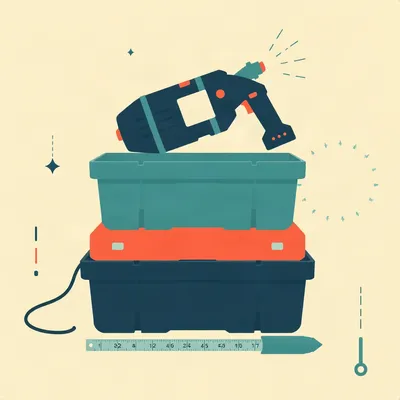
Daniel sent us this one — he's been using a modular loadout belt for everyday life, started out of necessity during a move while juggling childcare and DIY, but he's realized it solves a much bigger problem for him. He has ADHD and misplaces things constantly. Having frequently used items attached to his body in consistent locations has cut down the time he spends searching for them dramatically. He wants to make this permanent, but the challenge is that most modular belt systems come from military, law enforcement, or trades — they can look intimidating or just out of place in civilian settings. He's asking how experienced users balance utility with discretion, what separates an efficient everyday setup from an overloaded one, and what different communities can teach each other about solving this problem.

This is the kind of question that sounds like it's about gear and turns out to be about cognitive architecture. Daniel's essentially asking how to externalize his working memory onto a wearable platform without looking like he's about to clear a room. And he's right that the tools exist — they just weren't designed for this use case. The military and trades solved the mechanical problems decades ago. What they didn't solve was the social layer.
Because they didn't need to. An electrician on a job site doesn't care if their belt reads as "electrician." That's the point. Daniel's problem is the opposite — he needs the function without the semiotics.
So what separates a useful loadout from a costume is whether the observer's brain registers it as equipment at all. There's actual research on this — studies on observer perception show that pouches with visible MOLLE webbing and dark multicam patterns trigger security, law enforcement, or military associations almost instantly. It takes less than a second. Smooth fabrics, leather, earth tones — those don't trigger the same response. The brain files them under "clothing" or "accessory" instead of "gear.
The first design principle is: make it not register as gear at a glance. Which is harder than it sounds, because most of the products on the market are built for people who want to look like they're carrying equipment.
The EDC hobbyist community has a real problem with this. Scroll through any everyday carry forum and you'll see belts with eight pouches, a fixed-blade knife, a flashlight the size of a police baton, and everything in coyote brown Cordura. That setup screams "I am carrying equipment" to everyone in a thirty-foot radius. And for Daniel, who's trying to pick up his kid from daycare or stand in line at a coffee shop, that's exactly the wrong signal.
The daycare pickup tactical loadout. There's a genre of Instagram post that should not exist.
It's the aesthetic equivalent of wearing a hard hat to a restaurant. The function might technically be there but the context is all wrong. So let's talk about how you actually solve this. Material choice is the first filter. Cordura nylon in black or coyote — even if it's a simple pouch — still reads tactical because of the texture and sheen. Waxed canvas, bridle leather, heavy cotton duck in olive, brown, or grey — those read as workwear or heritage style. A leather multi-tool pouch on a leather belt looks like a craftsperson's tool. The exact same multi-tool in a black nylon pouch with MOLLE webbing looks like part of a duty belt.
The webbing is the real culprit. Even if the pouch is empty, visible PALS webbing is a semiotic shortcut for "military." It's the visual equivalent of a uniform patch. You can have all the function without the webbing on the outside.
Blue Force Gear's Ten-Speed pouches are a good example of doing this right — they use an elastic pocket that lies flat when empty, no external webbing, very low profile. Esstac Kywi pouches are another option, though they're more overt. The principle is the same: the pouch should sit as flat against the body as possible. No double-stack magazine pouches, nothing with shock cord retention visible, nothing that creates a silhouette that reads as "loaded.
Because bulk is the second thing people register, after color and texture. A belt that adds two inches to your waistline in every direction changes how you move and how you're perceived. You start walking differently, turning sideways through doorways — the body language telegraphs that you're carrying equipment even before anyone sees the belt.
Which brings us to weight distribution, and this is where I see beginners make the same mistake over and over. They load everything on the right side because they're right-handed, so three o'clock is stacked with pouches and nine o'clock is empty. Within two or three hours, that asymmetry causes hip pain and visibly alters their gait. The body compensates, the pelvis tilts, and by the end of the day you're limping.
What's the actual best practice?
Heaviest items at four and eight o'clock, not three and nine. Three and nine are the widest points of the hips — loading weight there creates maximum leverage against your spine with every step. Four and eight keep the weight closer to your center of mass and let your glutes carry it more naturally. You also need a stiff inner belt — at least one and a half to two millimeters thick — to prevent sagging. A floppy belt will roll outward under weight and dig into your hips. The inner belt is the foundation everything else depends on.
This is where the fixed versus modular question comes in, because the attachment method affects both bulk and stability.
Fixed pouches — sewn on, non-removable — are lighter, lower profile, and cheaper. They also fail less because there are fewer connection points. Modular systems using MOLLE, Velcro One-Wrap, or ClipTech let you reconfigure but add bulk and failure points. The trade-off is straightforward: if you rotate loadouts daily — parenting one day, DIY the next, office after that — modular wins because you can swap pouches in thirty seconds. If you have one consistent carry that never changes, fixed is better.
Daniel mentioned rotating between childcare, DIY, and moving house. That's a modular use case.
But here's the thing most people don't realize until they've been doing this for a while: you don't need as many pouches as you think. The classic beginner move is starting with eight to twelve pouches and carrying everything they own. After six to twelve months, they remove forty to sixty percent of what they started with. Common removals include the backup flashlight — your phone has a light — the multi-tool with full-size pliers, the fixed-blade knife that creates social friction everywhere you go, and the extra magazine that has no civilian application.
Phone, small knife or compact multi-tool, pen, small flashlight like a Streamlight Microstream, hand sanitizer, and some kind of slim wallet replacement — Ridge-style or similar. That's the core. Everything else is mission-specific.
There's a "year one purge" that seems to be almost universal.
It's so consistent you can practically set your watch by it. And the purge isn't a failure — it's the system maturing. The beginner is optimizing for preparedness. The experienced user is optimizing for what they actually encounter. Those are different inventories.
Daniel also mentioned the ADHD angle specifically, and I think that's worth digging into because it changes the design criteria in ways that most gear discussions miss entirely.
This is the part I find genuinely fascinating. For someone with ADHD, the belt isn't just about carrying items — it's about externalizing working memory. Working memory is the mental workspace where you hold things you need right now. ADHD means that workspace is smaller and items fall out of it more easily. If you put your keys on the kitchen counter, they stop existing the moment you leave the room. But if your keys are physically attached to your body in a consistent location, they never leave your awareness. The belt becomes a prosthetic for a cognitive function.
Which means the design requirements are different. It's not enough for the pouch to hold the item — the pouch has to make the item's location obvious without opening it, and returning the item has to be frictionless.
Transparent pouches — Maxpedition makes good clear zippered ones — let you see contents without opening them. Color-coding by category reduces the cognitive search cost: red for tools, blue for electronics, green for child supplies. And the "one-touch return" rule is critical. Every item must go back into its pouch with one hand, no fine motor fiddling. If returning an item requires two hands, unzipping, and careful alignment, an ADHD user will set the item on the nearest flat surface and lose it within sixty seconds.
The pouch has to be easier to use than the table. That's the design spec.
That's the spec. And most tactical pouches fail this test because they're designed for retention during dynamic movement — they have flaps, snaps, shock cord, Velcro — all of which create friction on the return. For a soldier who needs the item to stay put while sprinting, that friction is a feature. For Daniel trying to put his multi-tool away while holding a toddler, it's the reason the multi-tool ends up on top of the fridge.
Let's talk about how different communities solve these problems, because Daniel specifically asked about cross-pollination between trades, hobbies, and parenting.
Electricians are the group I'd point to first. They've been solving this problem for decades and they don't care about aesthetics at all, which means their solutions are purely functional. The key innovation from electricians is the belt drop — a strap that hangs pouches below the belt line to keep the waist uncluttered. This is directly adaptable for parents carrying diaper supplies or anyone who needs to keep the belt itself clean while still having access below.
Belt drops solve the problem of waist real estate. Your belt only has so many inches of circumference, and some of that is taken up by your actual body.
And bicycle mechanics use something completely different — magnetic pouches for small parts like screws and chain links. The magnet holds everything in place but retrieval is instantaneous, no flaps or zippers. That's applicable for anyone dealing with fasteners or small electronics. Event production crews use quick-release belt systems — Spider Holster for cameras is the famous one — that can be shed instantly when sitting down. If you're an office worker who needs to remove gear at a desk, that quick-release capability is worth more than any amount of tactical retention.
AV technicians have a specific constraint that shapes their whole approach: they need to climb ladders and sit in control booths. Their belts have to be light and low-profile enough that neither activity is impeded. So a typical AV tech loadout is a Leatherman Wave, a Streamlight Microstream, a pocket-sized cable tester, and a notepad. Everything else — laptops, cables, adapters — goes in a rolling case. The belt is for what you need while your hands are full and you can't reach the case.
Which brings us to the "three-touch rule," and this is probably the single most useful heuristic for deciding what goes on the belt versus in a bag. If you need an item more than three times per hour, it belongs on your body. Less frequent items go in a bag. This prevents belt overload better than any aesthetic guideline. An electrician touches wire strippers, a voltage tester, and a notepad dozens of times per hour — those go on the belt. Spare bits and larger tools go in the backpack. A photographer touches a spare battery and a lens cap frequently — those go on the belt. The body and extra lenses go in a sling.
The rule forces you to be honest about what you actually use versus what you imagine you might use.
That's the gap the year-one purge closes. You imagine you'll use the backup flashlight, the full-size multi-tool, the emergency fire starter. You don't. Your phone light works fine. The small knife handles ninety-five percent of cutting tasks. The fire starter is a fantasy object for a scenario that has never occurred in your actual life.
The fire starter is the EDC equivalent of a zombie apocalypse plan. Fun to think about, irrelevant to Tuesday.
Tuesday is the right frame. Design your loadout for Tuesday. Not for the one day in ten years when civilization collapses. For Tuesday, when you need to open a package, write something down, clean your hands, and find your phone.
Let's talk about the parenting loadout specifically, since Daniel mentioned childcare. What does that look like when it's done well?
The parenting loadout that actually works is surprisingly minimal. A fanny pack worn cross-body — and I want to be specific about this because the cross-body orientation is what makes it work — containing two diapers, a travel wipe pack, a small snack pouch, and a pacifier clip. The belt itself carries only a phone and hand sanitizer. This avoids the "tactical dad" look entirely while keeping hands free. The cross-body fanny pack reads as a normal accessory, not equipment. And it's accessible with one hand while holding a child with the other, which is the real test.
The cross-body orientation also distributes weight better than a waist-mounted pack, and you can swing it forward for access and back when you don't need it.
That leads to a broader point about social perception and context. A loadout belt in a coffee shop reads differently than at a maker space or on a construction site. The same belt that's invisible at Home Depot is conspicuous at a restaurant. So there are strategies to reduce friction across contexts. Wearing a long shirt or untucked button-down that partially covers the belt is the simplest one — it breaks up the silhouette and hides the most overt hardware. Matching belt and pouch colors to your pants reduces contrast, which is what the eye registers first. Dark jeans with black pouches — the belt nearly disappears.
The eye is drawn to contrast before it's drawn to shape. If your belt is the same color as your pants, people's gaze slides right past it.
This is basic camouflage theory applied to civilian clothing, and it works. The other approach is to use a hip pack worn cross-body as a "stealth" loadout that looks like normal luggage. A waxed canvas hip pack from a company like Trakke or Road Runner Bags reads as "person who likes nice bags," not "person carrying equipment." Inside, you can have all the organization you want — pouches, dividers, color coding — and nobody sees any of it.
You're essentially decoupling the organizational system from the public-facing exterior. The function lives inside, the exterior signals "bag" not "gear.
This is the design philosophy Daniel's really asking about. The efficient everyday carry setup is the one where the organizational logic is invisible to observers but completely legible to the user. Where every item has a home and returning it to that home is automatic. Where the belt doesn't announce itself.
Let's talk about rotating loadouts, because Daniel mentioned juggling multiple roles and that's where modularity actually earns its keep.
The system that experienced users converge on is a base belt — the inner belt plus buckle — that stays on your pants all the time, with outer pouches swapped via One-Wrap or MOLLE for different contexts. Monday might be office carry: pen, notebook, phone, AirPods. Tuesday is DIY day: measuring tape, utility knife, impact driver bit holder. The weekend is parenting: wipes, snack pouch, small toy, hand sanitizer. The base belt is constant. The mission-specific layer changes in under a minute.
The base belt itself — what's the current best option for something that's stiff enough to carry weight but doesn't look like a duty belt?
The AXL Eclipse and the GBRS Assaulter Belt are the high-end modular platforms that a lot of people end up with after trying cheaper options, but they're both overtly tactical in appearance. For Daniel's use case, I'd look at something like a thick leather belt from Hanks or Beltman — one and a half inches wide, reinforced, with a simple buckle. It reads as "nice belt" but has the stiffness to support pouches. Then use Velcro One-Wrap to attach pouches rather than threading them permanently. One-Wrap holds securely, removes cleanly, and doesn't require MOLLE webbing on the belt itself.
One-Wrap is the unsung hero of modular loadouts. It's just Velcro tape, but it lets you attach anything to anything without permanent modification.
It's reversible — you can try a configuration for a day, hate it, and change it in thirty seconds. That low cost of experimentation is what lets you iterate toward a setup that actually works instead of committing to the first arrangement you try.
If we're synthesizing all of this into something Daniel can act on, what's the checklist?
Start with the three-touch rule. If you use it less than three times per hour, it goes in a bag. This prevents belt bloat from day one. Prioritize low-visibility materials — waxed canvas, leather, or heavy cotton in earth tones. Avoid MOLLE webbing on the outside of pouches unless you need the modularity. Smooth exteriors read as normal clothing. Balance weight symmetrically around the hips, heaviest items at four and eight o'clock, and use a stiff inner belt. Test your setup by wearing it for four hours at home before taking it public. If you're adjusting it constantly, the weight distribution is wrong.
Plan for rotation. Use One-Wrap or a modular platform that lets you swap pouches quickly. Have a base loadout — phone, knife, pen, light — and mission modules for specific days. Then embrace the year-one purge. After six months, remove everything you haven't used. You will likely cut your carry by half, and that's success, not failure.
The purge is the moment the system stops being a hobby and starts being a tool. Hobbyists add pouches. Users remove them.
There's something almost philosophical about that. The beginner's loadout is a statement about who they want to be. The experienced user's loadout is a reflection of who they actually are.
For someone with ADHD, that distinction matters even more. The loadout that's aspirational — that carries items for a version of yourself that doesn't exist — adds cognitive weight instead of removing it. Every unused pouch is a decision you have to make every time you put the belt on. "Do I need this today? Should I keep carrying it just in case?" That's exactly the kind of low-grade decision fatigue that the system is supposed to eliminate.
The belt should answer questions, not ask them.
That's the design brief in one sentence. And it's why the best setups I've seen are almost boring to look at. They're not impressive. They don't photograph well. They just work, silently, for years.
Where does this go from here? Is the loadout belt a permanent part of someone's life, or is it a phase that eventually gets replaced by something else?
I think we're heading toward a convergence with wearable tech. Smart glasses, AR tools, haptic notifications — as those become more common, the belt becomes the natural place to put the battery pack and processing unit that powers them. The loadout belt might stop being a niche solution for tradespeople and EDC enthusiasts and become a standard part of everyday clothing, the way pockets became standard once people started carrying phones and keys regularly.
The belt as the next pocket. We went from pouches on a string to sewn-in pockets to cargo pants, and now we're circling back to external carry because our pockets are full and our cognitive load is higher than ever.
If that happens, the social perception problem solves itself. When enough people are wearing something, it stops reading as specialist equipment and starts reading as normal. The early adopters take the social friction so the late adopters don't have to.
Daniel's on the frontier, essentially. He's dealing with the awkward phase where the function is obvious to him but the social norms haven't caught up yet.
Which is why the material and color choices matter so much right now. In five or ten years, maybe nobody blinks at a belt with pouches. But today, in a coffee shop in Jerusalem, the difference between "that guy has a system" and "that guy is wearing gear" is the difference between waxed canvas and Cordura.
The best organizational system is the one you actually use. If a belt with pouches helps you stop losing things and frees up mental bandwidth, it's worth the social risk of looking a little unusual. And the social risk is manageable — it's mostly about material choices and not carrying more than you need.
If you've built a loadout that works for your daily life — whether you're a parent, a technician, or just someone with too many pockets — we'd love to hear about it. What worked, what didn't, what you removed after six months.
Now: Hilbert's daily fun fact.

In nineteen twelve, a Danish historian claimed that Hanseatic League merchants in Greenland were required by law to carry a minimum of three barrels of beer per crew member on any transatlantic voyage. The claim was widely cited for decades until nineteen seventy-eight, when a researcher discovered the original document actually referred to a local Bergen drinking club's membership rules and had nothing to do with Greenland or the Hanseatic League.
Three barrels per crew member would have been a very different kind of voyage.
This has been My Weird Prompts. If you've put together a carry system that works for your life, email the show at show at my weird prompts dot com — we want to hear what you learned and what you ditched along the way. I'm Herman Poppleberry.
I'm Corn. We'll be back next time.