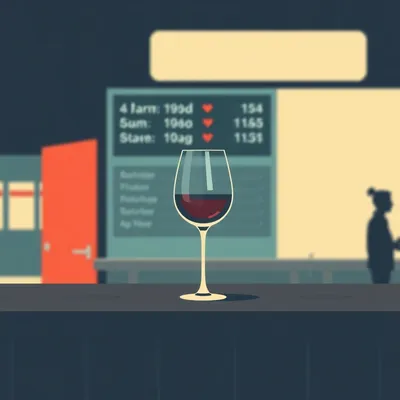
Daniel sent us this one — he's got this observation about airport bars being these weird social fishbowls, and I think he's onto something. He's a guy in his late thirties, parent to a one-year-old, busy, night owl — he'll enjoy a quiet glass of wine at home a couple times a week, but he basically never goes to a bar alone. Except at the airport. And the reason, he says, is that the airport bar gives him this social license to drink by himself that he just doesn't feel anywhere else. In his own city, he's worried about being seen as an alcoholic, a loner, someone looking for an affair. Even in a foreign city, some of that awkwardness follows him. But at the airport? The question he's really asking is: what's actually going on there? And what does a bar even become when it can never have regulars?

The first thing to say is that he's identified something real, and the mechanism has a name. Social psychologists call it a permission structure — the set of contextual cues that tell you whether a behavior is going to be read as normal or deviant. And the airport bar is basically a permission structure with a departure gate attached to it.
The permission is literally built into the architecture. You're not at a bar — you're at an airport, and the bar happens to be inside it. The framing flips.
And there are three things doing the work here. The first is purpose. Travel is a legitimate reason to be alone. Nobody looks at a person eating alone in an airport food court and thinks "what's wrong with them" — they think "that person has a flight." The bar inherits that same framing. The second is temporariness. You will never see these people again. The bartender, maybe, but even that's unlikely. So the social cost of being judged drops to near zero. And the third is shared context. Everyone else in that bar is also waiting. It's not a social venue where people go to socialize — it's a holding pen that happens to serve alcohol. And that changes everything about how people behave in it.
That holding pen point is the one that actually makes the whole thing click for me. A normal bar is a destination. You go there to be there. An airport bar is just a place you're passing through — which means the social rules of a destination bar don't apply. You're not there to meet people, you're not there to be seen, you're just killing time. And everyone knows it.
That shared knowledge is what creates the permission. It's not just that you're anonymous — you're anonymous inside a frame that explicitly authorizes being alone. Compare that to a bar in a foreign city. You're anonymous there too, but the frame is still "this is a social venue where people come to socialize." So being alone still feels like a statement, even if nobody knows who you are.
Right, because the bar in the foreign city still has regulars, still has a culture, still has people who are there to be there. You're an outsider in a social space. At the airport, there is no insider — everyone's an outsider. That's the great equalizer.
This is where we get to the thing that I think is genuinely fascinating about Daniel's observation. He says an airport bar can't really have regulars. By definition, the customer base is one hundred percent transient. So what does a bar become when it has no community? My argument is it becomes a stage set. A simulation of a bar.
That's bleak. And also completely accurate. The dark wood, the brass rails, the sports on TV — it's all designed to signal "this is a real bar." But a real bar is made of the people in it. The airport bar is a bar-shaped container filled with people who are all about to leave.
Yet — and this is the paradox — it works anyway. People use it. People enjoy it. Daniel clearly looks forward to his once-a-year airport glass of wine. So the simulation is doing something real, even if the ingredients aren't what you'd find in a neighborhood pub.
Let's talk about what it's actually doing. Because I think the simulation framing is right, but it undersells the function. The airport bar isn't failing to be a real bar — it's succeeding at being something else entirely. It's a permission machine. And that's a different product.
I think that's exactly right. And the economics back it up. Airport bars charge fifteen to thirty percent more than street-level equivalents. And it's not because the beer is better — it's because you're paying for the license to be there alone. The premium is for the permission, not the product.
The permission is the product. That's the whole business model.
It works because of the captive audience, obviously — you can't exactly walk down the street to a cheaper bar when you're past security. But captive audience explains why you pay more. It doesn't explain why you feel okay about it. The permission structure explains why you feel okay about it.
There's also something about the time constraint that shapes the whole experience. Daniel mentioned nobody wants to get too intoxicated, and he's right. Industry data puts the average airport bar customer dwell time at forty-five to sixty minutes. That's not a lot of time to get drunk, even if you wanted to. So what you get is this unique social equilibrium — everyone's slightly performative, slightly restrained. It's controlled release, not abandon.
Which is actually perfect for the self-conscious person. The bar is full of people who are all maintaining a version of the same composure you are. Nobody's getting sloppy. Nobody's making a scene. Everyone's keeping one eye on the departure board. It's the least threatening bar environment imaginable.
That's the thing — for someone like Daniel, who's self-conscious about being judged, the airport bar is almost custom-built to remove every source of judgment. The other patrons aren't judging you because they're not even thinking about you. They're thinking about whether their flight's on time, whether they remembered to pack their charger, whether the person next to them at the gate is going to be a loud talker. Your glass of wine is the least interesting thing in the room.
There's a clinical angle here that I keep coming back to. In my practice, I saw plenty of patients who struggled with social anxiety — people who wanted to do things alone in public but felt policed by an imaginary audience. And the airport bar is basically exposure therapy with training wheels. You get to practice being alone in a social space, but the stakes are zero. Nobody knows you, nobody will remember you, and the whole context screams "this is normal.
Does the skill transfer, though? If you get comfortable drinking alone at an airport bar, does that make you more comfortable drinking alone at a bar in your own city? Or is the license too context-dependent?
I think it's mostly context-dependent, honestly. The permission is so tightly bound to the airport frame that it probably doesn't generalize well. But I do think it teaches you something about the nature of your own self-consciousness. You learn that the judgment you fear is mostly in your head. The airport bar makes that truth visible, because you can see with your own eyes that nobody cares. Whether you can carry that insight into a different context — that's a harder question.
I want to go back to something you said earlier about the airport bar being a stage set. Because I think there's a more generous way to read that. The bar itself can be the regular. Even if the patrons are transient, the bar has a consistent identity — its design, its staff, its location, its menu. The bartender is the only witness, the only continuous presence. And a good airport bar leans into that.
The Portland example.
Right — Portland International, PDX. Their terminal bar consistently gets ranked as one of the best airport bars in the country. Local craft beer, welcoming atmosphere. And what makes it work, I think, is that it has a local identity even though the customers are transient. The bar is from Portland, and it knows it. It's not pretending to be a generic pub that could be anywhere. It's rooted in a place, and that gives it a culture that survives the turnover of patrons.
Compare that to the generic airport bar with the fake Irish pub name and the laminated menu of sixteen-dollar burgers. That bar has no identity except "bar." And without regulars to give it a culture, it's just a room with alcohol. The Portland model works because the bar itself is the regular. The staff, the beer list, the aesthetic — those things are consistent. They're the continuity.
It's like the bar has a personality, and the patrons are just passing through that personality. You don't need to know anyone at the bar to feel like you're somewhere specific.
That specificity matters. There's a reason people seek out the good airport bar instead of just sitting at the gate. It's not just about the alcohol — it's about being in a place that feels like a place, even if only for forty-five minutes.
Let me pull on another thread here. Daniel mentioned he's a parent, he's busy, he doesn't have time for a local bar even if he wanted one. And I think that's part of what makes the airport bar so appealing for people in that stage of life. It's not just that the airport bar gives you permission to drink alone — it's that it might be the only bar you ever get to visit.
This is the third place argument. Sociologist Ray Oldenburg coined the term in nineteen eighty-nine — the idea that people need three kinds of spaces: home, work, and somewhere else. The third place is where you're neither family member nor employee. It's where you're just a person among people. Pubs, cafes, barbershops, parks. And for a lot of people, especially parents of young children, the third place just evaporates. You don't have time. You don't have energy. The local bar might as well be on the moon.
The airport bar becomes your third place by default. Not because it's convenient — it's wildly inconvenient, you have to buy a plane ticket to get there — but because it's the only context where being alone in a social space feels permissible and available. You're already at the airport. You're already waiting. The bar is right there. And for once, nobody needs you for anything.
That's not nothing. For a parent of a one-year-old, an hour alone with a glass of wine and no responsibilities might be the most restorative thing that happens all month. The airport bar is doing emotional work that has nothing to do with the quality of the beer.
It's almost like a miniature vacation inside the vacation. Or inside the business trip. A pocket of solitude that's socially sanctioned.
This is where I think the airport bar is a microcosm of something bigger. Remote work, hybrid travel, the normalization of being alone in public — we're seeing a broader shift in how people negotiate social permission. The airport bar has been doing this for decades, but the dynamics it relies on are spreading to other contexts. Coworking spaces, for example. You're alone, but you're alone in a room full of other people who are also alone, and the shared context — work — makes it normal.
The coffee shop has been doing this forever too, but the coffee shop has regulars. The airport bar is the purified version. Zero regulars, maximum permission.
That purification is what makes it such a good case study. You can isolate the variables. Take away community, take away continuity, take away the possibility of being known — what's left? Permission and product. And it turns out permission is enough.
Let me push on the dark side of this for a second, because I think it's worth naming. The same anonymity that makes the airport bar a safe space for the self-conscious also makes it a hiding place for people with actual problems. If you're trying to conceal problematic drinking from your community, the airport bar is perfect. No regulars means no one will notice if you're there too often. No one will say anything. No one will intervene.
Except the bartender. The bartender is the only witness. And I wonder how often airport bartenders see patterns that nobody else does — the business traveler who's on their fourth whiskey before a ten AM flight, the person who's at the bar every Tuesday even though they don't seem to fly that often. The bartender becomes an accidental guardian, and they have almost no tools to do anything about what they see.
That's the flip side of the permission machine. The license that lets Daniel enjoy a glass of wine also lets someone else hide a problem. Same structure, different use.
It's worth saying that this isn't an argument against airport bars. It's just an acknowledgment that permission structures are morally neutral. They enable and they conceal. They're tools. The question is what you do with them.
I want to loop back to something Daniel said about European train station bars, because I think there's a useful comparison there. He mentioned that in Switzerland and Germany, station bars are often good bars — some of the best in town — and they have a mix of travelers and locals. The airport bar is the purified version: travelers only. And that purification is what creates the unique permission structure, but it's also what makes the airport bar feel slightly unreal.
The train station bar has one foot in the city and one foot in transit. You could become a regular at a train station bar. You could walk there from your apartment. The airport bar is sealed off — you can't get there without a boarding pass. That seal is what creates the fishbowl effect Daniel described. You're in a transparent container, visible but unreachable, part of the city but not really in it.
That unreachability is part of the appeal. You're off the grid. Not in a dramatic way — you're still trackable, you still have a flight to catch — but socially off the grid. Nobody from your real life can stumble in and see you. The airport bar is a social quarantine zone.
Which is a phrase I'm going to steal. Social quarantine zone. That's exactly what it is. A place where your normal social identity is suspended for the duration of your layover.
What do we do with this insight? If the airport bar works because of temporariness and shared context and built-in permission, can we design more spaces that work the same way?
I think we already are, in some ways. Pop-up bars, temporary installations, time-bound events — they all borrow the airport bar's permission structure. You're not committing to anything. You're just passing through. And that lowers the barrier to entry for people who'd never walk into a permanent bar alone.
The pop-up is the airport bar of the city. It's here for six weeks, then it's gone. No regulars, no culture to penetrate, no social cost to being there alone. You're just checking it out, like everyone else.
Urban planners and designers are starting to think about this more deliberately. How do you design public spaces that feel welcoming to people who are alone? Part of the answer is making the space feel temporary or transitional — a place you're meant to pass through, not a place you're meant to belong to. Waiting rooms, transit lounges, ferry terminals. Spaces where being alone is the default, not the exception.
The ferry terminal is actually a great example. Same dynamics — everyone's waiting, everyone's in transit, nobody's judging. But ferry terminals rarely have bars. They have vending machines and plastic chairs.
Somebody should open a bar in a ferry terminal and see what happens. Call it The Permission.
That's a good name for a bar. I'd go.
You'd go once. That's the whole point.
But I'd enjoy it. And here's the thing I keep coming back to — Daniel's observation that he only does this once a year. The airport bar is a treat, a rarity. And maybe that rarity is part of what makes it work. If you were at the airport bar every week, it might start to feel like a regular bar, and the permission might start to erode. The rarity preserves the magic.
Or it might just become your actual third place, and you'd develop a relationship with the bartender, and it would stop being a stage set and start being a real community. But that requires frequency, and frequency requires flying, and flying that often is its own kind of strange life.
The road warrior's local. The bar where everybody knows your name, but only between flights to Dallas and Chicago.
There's actually a whole subculture of frequent flyers who do exactly this. They have their preferred airport bars, they know the bartenders, they have a routine. For them, the airport bar is a real third place. It's just a third place that requires a security checkpoint.
Which is a very specific kind of commitment to your social life. I respect it, but I'm not sure I'd recommend it.
The TSA as social gatekeeper. That's a whole other episode.
Let me try to pull this together into something useful, because I think Daniel's prompt is really asking two things. One: why does the airport bar feel different? And two: what can we learn from it? On the first question, I think we've landed on a pretty clear answer. The airport bar feels different because it's a permission machine. Purpose, temporariness, shared context — those three things combine to create a space where drinking alone isn't just tolerated, it's expected. The judgment that follows you around your own city can't get past security.
On the second question — what can we learn — I think there are a few takeaways. For the self-conscious person, the practical move is to look for liminal spaces. Places defined by transition. Airports, train stations, ferry terminals, even hospital waiting rooms. These spaces come with built-in social license. Being alone in them isn't weird — it's the default. If you want to practice being alone in public, start there.
For designers and planners, the insight is that temporariness can be a feature, not a bug. We tend to think of good social spaces as permanent, rooted, community-building. But there's a whole category of people who are better served by spaces that don't require commitment. Pop-ups, temporary installations, time-bound events — they create permission structures that permanent venues can't. The airport bar is proof of concept.
For anyone who's ever felt self-conscious about doing something alone in public, the airport bar is a mirror. The judgment you fear is mostly in your own head. Everyone else is too worried about their own flight, their own gate, their own life to care about your glass of wine. The airport bar just makes that truth visible, because you can see it happening in real time. A room full of people, all alone together, and nobody cares.
The most artificial bar might actually be the most honest place to be yourself. That's the paradox.
Which brings me to the open question I keep turning over. What happens to airport bars as air travel gets more stressful and less glamorous? Are they a dying breed, or do they become more important as escape valves? My guess is the latter. The worse the airport experience gets, the more people need that forty-five minutes of permission. The bar becomes a pressure-release valve for the whole system.
I think that's right. And I think Daniel's once-a-year glass of wine is probably more common than the industry realizes. People who don't go to bars in their real lives, but who find something at the airport bar that they can't find anywhere else. A pocket of permission in a world that increasingly polices how we spend our time alone.
The airport bar as a place between places. Not quite here, not quite there. A temporary autonomous zone with a drink menu.
Now: Hilbert's daily fun fact.

In the eighteen-forties, geologists surveying diatomaceous earth deposits along the coast of Labrador discovered that the fossilized silica shells in those strata contained trace amounts of vanadium — a metal that wouldn't be isolated and named for another two decades.
The vanadium was just sitting there, unnamed, for twenty years.
Waiting for someone to notice it.
This has been My Weird Prompts. Thanks to our producer Hilbert Flumingtop for keeping the whole thing running. If you enjoyed this episode, tell someone about it — or better yet, send us your own weird prompt at show at my weird prompts dot com.
Until next time.