You know, hearing that audio from Daniel, with the traffic and the sirens and the general chaos of modern Jerusalem in the background, it really makes you realize that some things never change. He is walking through the city reading Simon Montefiore’s history, and it is almost like the two versions of the city are overlapping right there in the recording.

It is a fantastic book. Herman Poppleberry here, by the way. And Daniel is right, Montefiore has this incredible way of making history feel almost dangerously alive. When you read about the Roman period in Jerusalem, especially the Herodian era, it does not feel like a dry textbook. It feels like a high stakes political thriller mixed with a bit of a fever dream.
Exactly. And Daniel’s question is such a good one because we often get caught up in the big names. We talk about Herod the Great, or Pontius Pilate, or the various high priests, but we forget that there were tens of thousands of people just trying to get through their Tuesday. They were buying groceries, dealing with annoying neighbors, and apparently, if Montefiore is right, drinking beer for breakfast.
That beer for breakfast point is a classic historical hook, and we should definitely dive into the chemistry and the social necessity of that in a bit. But to set the stage, we have to talk about the physical reality of the city. If you were an average inhabitant in the first century, say around the year thirty or forty of the common era, the first thing you would notice is the noise. Not the honking of the light rail that Daniel was hearing, but the sound of stone on stone.
Right, because Jerusalem back then was basically one giant, multi decade construction site. Herod the Great had passed away, but his projects were still being finished. The expansion of the Temple Mount was this massive, generation spanning architectural feat. We actually touched on the scale of these buildings back in episode two hundred four when we talked about the vertical revolution in the city. Back then, the scale of the Temple was the ancient equivalent of a skyscraper.
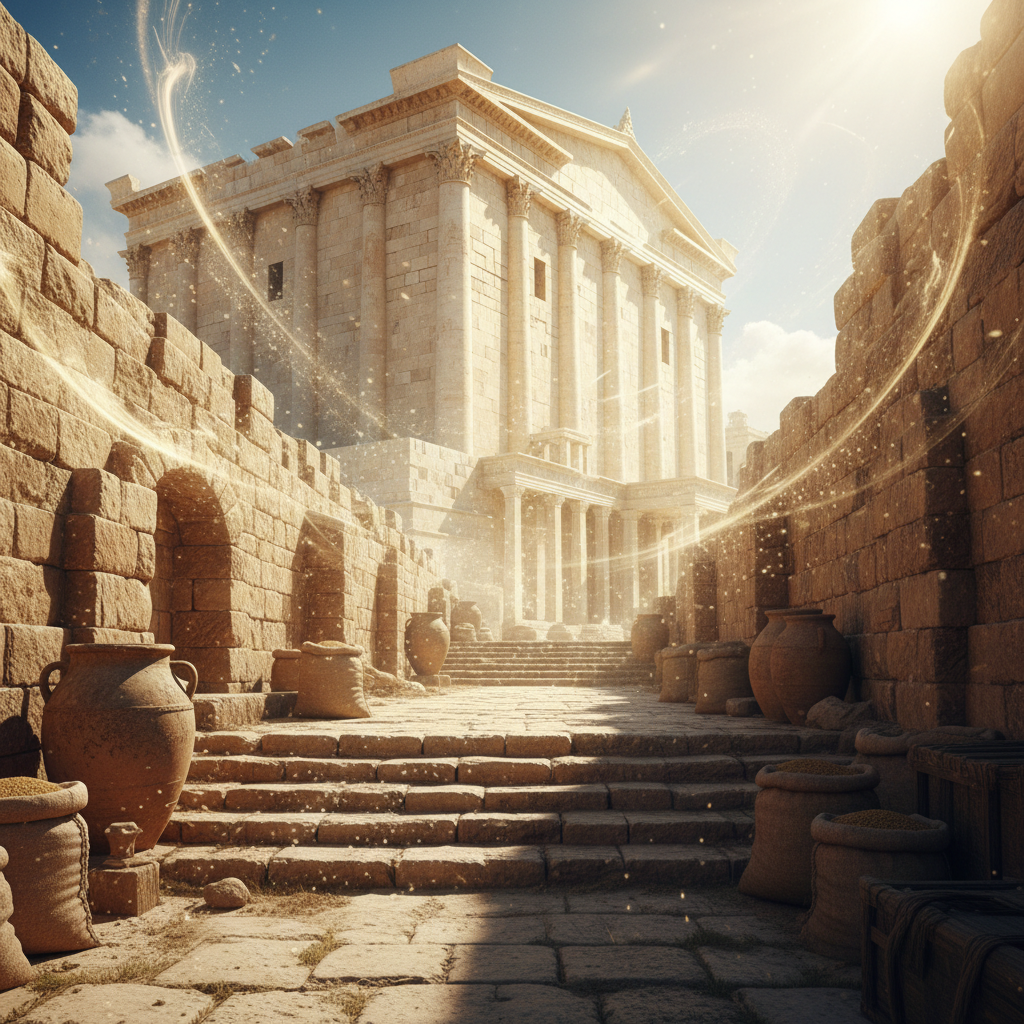
It really was. Imagine walking through narrow, stepped streets made of white limestone. The sun in Jerusalem is incredibly bright, and that limestone reflects it, so the city would have had this almost blinding, ethereal glow. But then you look down and the streets are crowded. We are talking about a permanent population of maybe sixty thousand to eighty thousand people, but during the three major pilgrimage festivals, that could swell to over three hundred thousand. It was the ancient equivalent of hosting the Super Bowl three times a year.
That is an insane level of density for an ancient city. How did an average person even move around? I mean, if I am a potter or a weaver living in the Lower City, what is my day actually like?
Your day starts at sunrise. There is no snooze button in the ancient world. You are up because the light is there and you have work to do. If you are a typical artisan, you are likely living in a multi story stone house with an internal courtyard. This is a detail people often miss. The houses were not isolated; they were clusters. You shared a courtyard with your extended family or other tradespeople.
So, no privacy.
Very little. The courtyard was where the cooking happened, where the laundry happened, and where the kids played. And to Daniel’s point about the beer and wine, that is where your first meal would take place. But we have to clarify what beer for breakfast actually meant. It was not like cracking a heavy craft I P A at seven in the morning.
Right, because the water quality was the real issue. We think of ancient Jerusalem as having these great aqueducts, but the water in cisterns could get stagnant and carry parasites.
Precisely. Fermentation was the primary method of water purification. The beer of the ancient Near East, often brewed from barley or emmer wheat, was more like a thick, nutritious porridge that had been lightly fermented. It was low in alcohol, maybe two or three percent, but high in B vitamins and calories. For a laborer, that beer was essentially liquid bread. It gave you the energy to go out and haul stones or work the loom for twelve hours.
And the wine was almost always diluted, right? I remember reading that drinking undiluted wine was considered a sign of being a barbarian or a complete drunkard.
Exactly. You would mix three parts water to one part wine. So, while it sounds like everyone was walking around buzzed, they were actually just staying hydrated and avoiding the pathogens that lived in untreated water. But the vivaciousness Daniel mentioned, that feeling of a society that was quite crazy, that comes from the intensity of the religious and political atmosphere.
Let’s talk about that intensity. Because it was not just about the Romans versus the Jews. Inside the Jewish community itself, the friction was constant. You had the Sadducees, who were the wealthy elite and controlled the Temple. You had the Pharisees, who were more like the middle class scholars. And then you had the Zealots, who were basically looking for any excuse to start a fight with a Roman soldier.
And you are living in the middle of this. Imagine you are walking to the market in the Upper City. You pass a Roman soldier in his segmented armor, and you have to decide, do I look him in the eye? Do I move out of the way? The tension was palpable. You might even see the Sicarii, the dagger-men, moving through the crowds. They were an extremist group that would assassinate collaborators in broad daylight and then disappear back into the throng. It was a city of constant surveillance and sudden violence.
But at the same time, the city was an economic engine. The Temple was not just a church; it was the central bank, the national slaughterhouse, and the biggest tourist attraction in the eastern Mediterranean all rolled into one.
It really was. And the slaughterhouse aspect is something that really hits you when you read the descriptions of the festivals. The amount of incense used in the Temple was not just for ritual; it was a practical necessity to mask the smell of thousands of animal sacrifices. Imagine the scent of burning fat and blood mixed with heavy frankincense and myrrh.
It is a sensory overload. The smell of roasting meat, the sound of Levite choirs singing psalms, and the constant clinking of money changers. If you were an average Jerusalemite, your economy was tied to that Temple. You were selling souvenirs, you were providing lodging, or you were a craftsman making the stone vessels used in the rituals.
And those stone vessels are important because the city was obsessed with purity. Archaeology has found an incredible number of ritual baths, the mikvaot, in almost every house. Even the smaller ones. Stone was used because, unlike pottery, stone was thought to be immune to ritual impurity. That suggests that for the average person, religion was a constant, daily ritual.
It sounds exhausting, honestly. But I wonder if that shared set of rules is what gave the society that vivacity Daniel was talking about. Everyone was playing the same high stakes game.
It definitely created a sense of communal identity, but it also created those mad rulers Montefiore writes about. When you have a population that is this deeply invested in every detail of law and tradition, the leaders often become paranoid or megalomaniacal trying to manage it. Herod the Great is the prime example. He was a brilliant builder, but he was also a man who had his own family members executed because he was convinced they were plotting against him. By the time Daniel is reading about, you have governors like Gessius Florus, whose corruption and cruelty eventually pushed the city over the edge.
And the average person would have known about this. The gossip in the markets must have been incredible. You are sitting there with your diluted wine and your flatbread, and you hear that the King has just built a new fortress or that a new prophet has appeared in the wilderness. It was a city of rumors.
It was the original social media. The markets were where news traveled. And the language was a mix. You would hear Aramaic, which was the daily tongue of the people. You would hear Hebrew in the Temple. You would hear Greek from the merchants and the educated elite. And you would hear Latin from the Roman administrators. It was a true cosmopolitan hub, even if it was a volatile one.
I want to go back to the food for a second, because Daniel mentioned the beer and wine. What else was on the plate of a regular person? We talk about the Mediterranean triad—grain, grapes, and olives—but was there more variety than that?
For the average person, meat was a luxury. You might eat meat only during the festivals when a sacrifice was shared. Most of your protein came from legumes—lentils, chickpeas, and beans. You had a lot of onions and garlic. Fish was common, often salted and brought up from the Sea of Galilee. And lots of fruit, especially figs and dates. The dates from this region, specifically the Judean Desert dates, were actually famous throughout the Roman Empire. They were considered a delicacy in Rome, prized for their size and sweetness.
So it was actually a pretty healthy diet, if you could afford enough of it.
It was, but it was also a struggle. Taxation was brutal. You were paying tithes to the Temple and taxes to Rome. For many people, life was a subsistence game. If there was a drought or a bad harvest, the city felt it immediately. We saw this in the archaeological record of the Burnt House, which we have discussed in the context of city layers before. You see the signs of a society that was incredibly wealthy at the top, but where the average person was living right on the edge.
That brings up the question of health. Daniel mentioned that he would not want to trade his healthcare in twenty twenty-six for the healthcare of the biblical era. What did an average person do when they got sick?
Well, you prayed. But you also used a lot of herbal remedies. We find a lot of evidence of things like mandrake and various resins being used for pain relief. There was also a surprising amount of surgery, though without anesthesia, it was a nightmare. We have found skulls from that period that show signs of trepanation—drilling holes in the skull to relieve pressure—and the patients actually survived and the bone healed. It shows a level of grit we can barely imagine.
That is terrifying and impressive at the same time. But it speaks to that toughness. People were physically resilient because they had to be. Walking everywhere, carrying water, manual labor.
And the city itself was a workout. Jerusalem is all hills. Even today, walking from the Old City up to the modern center is a climb. Back then, it was all stairs and steep alleys. Your legs would have been like iron. But there is another side to the vivacity Daniel mentioned, and that is the entertainment. It was not all prayer and work.
Right, Herod built a theater and a hippodrome, which was very controversial, wasn’t it?
Extremely. To the more conservative elements of the city, having a Roman style theater or chariot racing was an abomination. It brought foreign gods and foreign customs right into the heart of the holy city. But for the average person, especially the younger generation or those who were more Hellenized, it was a draw. Imagine the tension of a young man sneaking off to the theater while his father is at the Temple protesting the presence of Roman statues.
It feels like the generational divide we see today, just with much higher stakes. If you were caught being too Roman, you might be ostracized by your community. But if you were too rebellious, you might end up on a cross on the side of the road.
That is the grim reality of the Roman period. Crucifixion was the standard punishment for sedition. It was designed to be public and humiliating. As an inhabitant of Jerusalem, you would have seen crosses. It was a part of the landscape. It served as a constant, brutal reminder of who was really in charge, no matter how much the Temple authorities tried to exert their own power.
It is such a strange contrast. The beauty of the Temple, the ritual purity, the beer for breakfast communal vibe, and then the absolute brutality of Roman law. It is no wonder people were constantly looking for a Messiah or some kind of divine intervention. The pressure cooker was always at the point of exploding.
And it did explode, eventually, in the year sixty-six. But in the decades leading up to that, the era Daniel is reading about, it was a city of incredible intellectual and spiritual ferment. You had all these different schools of thought. People were debating the nature of the soul, the meaning of the law, and the future of the nation in every courtyard and on every street corner.
I think that is the vivacity Montefiore is capturing. It was a society where ideas mattered enough to die for. Today, we might argue about politics on the internet, but back then, a disagreement about how to interpret a verse in the Torah could lead to a riot.
It really could. And yet, life went on. Even in the middle of all that, people were getting married, they were celebrating births, they were mourning their dead. We find these beautiful stone ossuaries, the boxes used for secondary burial, that are carved with intricate floral patterns. Even in death, they wanted to surround themselves with beauty and a sense of order.
It makes me think about the Jerusalem of Above versus the Jerusalem of Below that we discussed in episode two hundred ninety-one. The myth of the city is so powerful, but the reality was made of stone, dust, sweat, and a lot of very strong smelling markets.
And that brings us back to Daniel’s observation about the craziness. When you live in a city that is considered the center of the world by multiple groups of people, the ego of the city becomes massive. Everyone feels like they are part of a grand cosmic drama. That makes the daily experience very intense. You are not just a potter; you are a potter in the City of God. You are not just drinking beer; you are nourishing yourself to serve the Creator.
So, if we had to give Daniel a takeaway for his walk through the city today, how should he look at the ruins of that period? When he sees the massive stones of the Western Wall or the remains of the houses in the Jewish Quarter, what should he be imagining?
He should imagine the smells and the sounds. He should imagine the white limestone reflecting the sun so brightly that you have to squint. He should imagine the taste of that thick, yeasty beer and the sound of four different languages being shouted at once in the market. He should realize that the people walking those streets were just as smart, just as anxious, and just as full of life as he is today. They were not ancient people in their own minds. They were the moderns of their time.
I love that. They were the ones at the cutting edge of their world. They were dealing with the modern problems of Roman globalization and religious fundamentalism. It is not so different from what we see when we look out the window today.
Not at all. And if you want to understand the craziness Montefiore describes, you have to realize that it came from a place of deep, passionate engagement with the world. They didn’t have the luxury of being jaded or cynical. Everything was urgent.
That urgency is something I think we have lost a bit. We have so much downtime, as Daniel put it, but maybe that downtime is actually just a form of disconnection. Those people were connected to their city, their community, and their God in a way that was almost total.
It was a totalizing experience. And while I agree with Daniel that I appreciate modern dentistry and antibiotics, there is something enviable about that level of purpose. Even if that purpose sometimes led to madness or war.
Well, I think we have successfully established that ancient Jerusalem was a place you would want to visit with a very good guide and a very strong stomach, but maybe not a place you would want to live without a reliable source of diluted wine.
Exactly. And a good pair of sandals for those hills.
We should probably mention, for anyone who wants to see the physical evidence of what we are talking about, the Davidson Center right by the Western Wall is incredible. You can see the actual stones that were thrown down by the Romans in seventy. It makes the history very literal.
And the Burnt House in the Old City. It is a time capsule of the final days of that era. You can see the soot on the walls and a spear that was found in the debris. It brings the vivacity and the violence Daniel mentioned into very sharp focus.
It is amazing how much of that is still accessible to us. We are living in a city that is basically a giant museum that people are still living in. We touched on that in episode three hundred sixty when we talked about the ghost apartments and the vertical safety deposit boxes. The city is always struggling between being a monument to the past and a living place for the future.
It is a tension that will probably never be resolved, which is exactly why we keep talking about it.
Well, before we wrap up, I want to make sure we address Daniel’s point about the mad rulers. We talked about Herod, but Montefiore also goes into the later rulers, the ones who were perhaps suffering from neurosyphilis or other conditions. It adds this layer of unpredictability to daily life. You never knew if the person in charge was going to have a religious epiphany or a psychotic break.
And that unpredictability is what breeds the need for community. When the top of the pyramid is unstable, the base has to hold itself together. That is why those courtyards and those shared meals were so important. Your neighbor was your safety net.
It is a powerful image. A crowded, noisy, dusty, brilliant city where everyone is a bit on edge but everyone is deeply, vibrantly alive.
I think that is the best way to describe it. A city on the edge of the world and at the center of the world all at once.
Well, Daniel, thanks for the prompt. It definitely gave us a lot to chew on, or to drink in the form of ancient beer, I suppose.
I will stick to my modern coffee for now, but I appreciate the historical context.
If you are listening and you have enjoyed this deep dive into the streets of the first century, we would really appreciate it if you could leave us a review on your podcast app or on Spotify. It genuinely helps other people find the show and join the conversation.
It really does. And you can find all our past episodes, including the ones we mentioned today about Jerusalem’s architecture and myths, over at our website, myweirdprompts.com. There is a search bar there where you can look up any topic we have covered over the last four hundred seventy odd episodes.
Thanks for joining us for another exploration of the weird and the wonderful. This has been My Weird Prompts. I am Corn.
And I am Herman Poppleberry. We will see you next time.
Stay curious, and maybe keep the beer for after breakfast.
Just a suggestion. Goodbye, everyone.