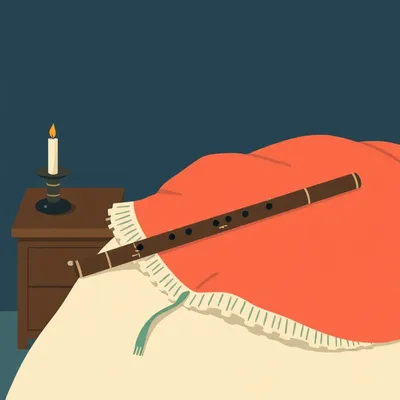
Daniel is not wrong to want to put down the phone and pick up a flute.

Daniel sent us this one — he's noticed music has a calming effect on his son Ezra, and like most parents, his first instinct is to reach for YouTube. But he's asking whether there's a deeper tradition of parents performing live music for their children at bedtime, and he wants instrument recommendations. He played piano for years but never loved it — felt more like family obligation. Now he's drawn to the flute, and he's wondering about donning medieval clothing while playing Baroque flute music as a full sensory bedtime ritual. So the question is: which instrument should a former reluctant pianist pick up to soothe his kid to sleep, and is the costume idea whimsy or wisdom?
That's a fantastic framing because it's actually three questions stacked inside each other. There's the neuroscience question — does live music actually work differently than recorded for infant sleep. There's the historical question — have parents been doing this forever or is Daniel reviving something lost. And then there's the practical question — which instrument, and why flute specifically, and why Baroque.
The medieval tunic. Let's not bury the lede on the medieval tunic.
We'll get to the tunic. I promise we'll treat the tunic with the respect it deserves.
Of course we will. So where do we start?
Let's start with the science, because Daniel's intuition that live music is different from recorded is actually backed by some remarkable recent research. The core mechanism is something called entrainment. When a live performer plays or sings for an infant, they naturally and unconsciously sync their tempo to the infant's respiration and heart rate. You see the baby's chest rising and falling, you slow down fractionally, you speed up when they stir — it's a real-time biofeedback loop that a fixed recording simply cannot replicate.
The parent is literally breathing with the child through the music.
Well, not exactly, but yes. There was a 2023 study from the Max Planck Institute that looked at forty-two infants aged three to nine months. They had each infant listen to a live lullaby and then the same lullaby as a recording. Heart rate variability — which is a measure of how well the autonomic nervous system is regulating — was significantly higher in the live condition. The infants were more physiologically settled when a real person was in the room making the sound.
Higher heart rate variability being a good thing here.
Right — higher heart rate variability indicates a more flexible, responsive parasympathetic system. It's associated with calm alertness and better emotional regulation. Low heart rate variability is what you see in stress states. So the live music was literally producing a measurably different physiological state.
That's before we even get into what the infant is seeing.
That's the second layer — what researchers call the presence effect. In 2024, the University of Toronto did an fMRI study with twenty-eight infants, comparing brain responses to live versus recorded singing. The live singing activated the superior temporal sulcus and the orbitofrontal cortex more strongly. The superior temporal sulcus is involved in processing biological motion and social cues — it's the part of the brain that says "this is a living being interacting with me." The orbitofrontal cortex is involved in emotional processing and reward. So the infant brain is not just hearing the music — it's reading the parent's face, breath, and body movements as part of the auditory experience. It's a multimodal calming signal.
When I hit play on a YouTube video of someone else playing a lullaby, the infant brain knows — at some level — that this is not a person in the room.
That's what the evidence suggests. And the mechanism might be even more granular than that. Recorded audio — especially compressed streaming audio — strips away what audio engineers call micro-dynamics. The tiny breath sounds, finger noises, the subtle variations in room acoustics. These are precisely the acoustic cues that human ears evolved to detect as signals of caregiver proximity. Infants are exquisitely sensitive to them. A parent humming two feet away produces a sound texture that no recording can match, because the recording has been through compression algorithms designed to remove exactly those "imperfections.
The compression algorithm is filtering out the very thing that says "I am here.
It's the uncanny valley of audio. The recording is too clean. The infant's brain evolved in an environment where all sound was live sound. The concept of reproduced audio is about a hundred and forty years old. Our auditory systems haven't caught up.
Daniel's instinct to put on a costume and play an instrument in the room is not retro whimsy — it's actually restoring the auditory environment that infant brains expect.
And this connects to something even deeper, which is the history. The lullaby is one of the oldest human musical forms. The oldest known lullaby is on a Babylonian cuneiform tablet from around 2000 BCE — it's housed at the British Museum. The text translates to something like "little baby in the dark house, you have seen the sun rise, why do you cry?" Four thousand years ago, a parent was singing those words to a child who wouldn't sleep.
Four thousand years of parents going "please, just close your eyes.
The tradition of parents learning instruments specifically for domestic music-making — that's more recent but still centuries old. In eighteenth-century Europe, middle-class parents took up the harpsichord and later the piano explicitly for home music-making. The parlor piano was functionally a parenting tool. Before recorded music, if you wanted music in the home, someone had to make it. And bedtime was one of the primary contexts. The German Hausmusik tradition — fathers playing flute or violin for children's bedtime, mothers singing, older children joining in — this was normal domestic life.
Daniel is actually reviving something that was standard practice until astonishingly recently. The recorded music era is the anomaly, not the live performance.
We've had about a century of recorded music and about forty thousand years of live music. The YouTube reflex is the aberration.
Which brings us to the instrument question. Daniel played piano for years and didn't enjoy it. He's drawn to flute. Is that a good match for what he's trying to do?
It's an excellent match, and for reasons that go beyond just "he likes the sound." The flute is a wind instrument, which means it requires breath control. Slow, diaphragmatic breathing — exactly what flute playing demands — activates the vagus nerve. Within about two minutes of slow, deep breathing, you can lower your heart rate by ten to fifteen beats per minute. So the act of playing the flute is calming the parent while the parent is calming the child. It's a two-way regulation system.
Daniel is self-medicating with flute breath while simultaneously soothing the baby.
That's exactly what's happening. And it matters which flute. Daniel mentioned Baroque flute specifically, and that's a smart instinct. Modern silver flutes are pitched at A equals four hundred forty hertz — they're designed to project over an orchestra. Baroque flutes, or traversos, are typically pitched at A equals four hundred fifteen hertz — a half-step lower. The tone is softer, breathier, more wooden. It's closer to the frequency range of a human voice. Less piercing, more shushing quality. For an infant's ears, that difference matters enormously.
The modern flute is the glockenspiel of corporate approachability. The Baroque flute is a parent humming in the dark.
That's a perfect way to put it. And the Baroque repertoire is uniquely suited to this purpose. Telemann's fantasias, Hotteterre's suites, Quantz's sonatas — these are melodically simple, rhythmically predictable, and often written in slow dance meters like the sarabande and siciliana. A sarabande is in three-four time with a characteristic emphasis on the second beat — it literally rocks. It mirrors the motion of a parent swaying with an infant.
You're playing music that physically rocks the child, on an instrument that forces you to breathe in a calming rhythm, producing a tone that sounds like a human voice. That's a remarkably coherent system.
Daniel could be playing Telemann's Fantasia Number One in G major — the slow movement — within three to four months of practice. You don't need to be a virtuoso. The infant doesn't care about your articulation. The infant cares that you're there, breathing, making sound.
What about the piano background? Does that help or hinder?
It helps enormously. Daniel already reads music. He understands phrasing and dynamics. The challenge with flute is embouchure — the mouth shape — and breath control. Those are new skills. But the musical literacy is already there. And here's the thing: Daniel said he didn't enjoy piano because it felt like family obligation. That's almost certainly about the pedagogy, not the instrument. Piano pedagogy — especially the traditional kind — is built on rote practice, performance pressure, graded examinations. It's extrinsically motivated. What Daniel is describing now is intrinsically motivated music-making. He wants to play for his son. That's a completely different relationship to the instrument.
It's the difference between being assigned a book in school and reading to your child at bedtime. Same activity, entirely different meaning.
And the flute might feel liberating precisely because it's not piano. It's a fresh start with no baggage. It's also portable — you can play it anywhere in the house. It doesn't dominate a room the way a piano does. It's an intimate instrument.
Let's talk about the medieval clothing, because I think most people would hear that and file it under "charming eccentricity," but you mentioned treating it seriously.
I do take it seriously. What Daniel is describing is a ritual frame. A consistent visual signal — a specific costume, a specific lamp, a specific shawl — that tells the child "this is sleep time." Children thrive on predictable routines. The costume creates a clear boundary between ordinary parent and bedtime parent. When the medieval tunic goes on, the child's brain begins the wind-down cascade before the first note is played.
It's Pavlovian. The tunic is the bell.
In the best possible way. And it works for the parent too. Putting on the costume is a ritual that helps Daniel transition from work mode to parent mode, from the cognitive demands of the day to the calm presence required for bedtime. It's not silly — it's psychologically sophisticated.
There's the visual capture element. An eleven-month-old — Ezra's age — is going to be fascinated by unusual clothing. The costume holds attention while the music does its work.
The medieval or Renaissance aesthetic — flowing sleeves, rich fabrics, visual texture — it's inherently interesting to an infant's developing visual system. It's a spectacle. And spectacle plus soothing sound equals a very effective sleep ritual.
If Daniel wants to do this properly — Baroque flute, medieval clothing, the full production — what's his shopping list?
First, the flute. I'd recommend a Baroque flute in A equals four hundred fifteen hertz from a maker like Bernolin or Küng. Bernolin makes resin traversos that are affordable and durable — you don't need a five-thousand-euro wooden instrument to start. The resin models are around three to four hundred euros and they're practically indestructible, which matters in a household with an infant.
Resin Baroque flute.
Second, the repertoire. Start with Telemann's Methodical Sonatas — these were literally written as teaching pieces, and the slow movements are ideal. The Fantasia Number One in G major, slow movement, is about two minutes long and gorgeous. Practice ten minutes a day. That's all. The breath work alone will improve Daniel's own sleep quality — remember the vagus nerve effect.
Ten minutes of flute practice as sleep hygiene for the parent. That's a sellable wellness trend right there.
It genuinely is. Third, the costume. He doesn't need to go full Renaissance faire. A simple linen tunic, a belt, maybe a cloak — something that feels distinct from everyday clothing and creates that ritual boundary. The key is consistency. Same costume, same time, same sequence of events.
What if Daniel tries flute and it doesn't click? Are there backup instruments that fit his profile?
The ocarina is extremely easy to learn — it's basically a vessel flute with a soft, rounded tone. It's portable, historically used as a children's instrument in Mesoamerican cultures, and you can get a decent one for thirty dollars. The learning curve is about a week to play a simple melody.
The ocarina is the ukulele of wind instruments.
That's fair. Another option is the lyre harp — no breath technique required at all. It's an ancient lullaby instrument, intuitively plucked, visually striking. A seven-string lyre can be learned in an afternoon. The tone is gentle and harp-like, naturally soothing.
If he wants to stay in the flute family but lower the barrier?
It's cheap, it's easy, the Baroque recorder repertoire overlaps heavily with flute, and a good wooden recorder has a lovely soft tone. The alto recorder in F is the workhorse. But honestly, the flute remains the strongest recommendation because it matches Daniel's stated attraction and offers the breath-regulation benefit that plucked instruments don't.
The recommendation hierarchy is: Baroque flute first, then alto recorder, then ocarina, then lyre harp if all breath instruments fail.
That's the order I'd suggest. And I want to emphasize something that often gets lost in these discussions: the infant prefers the parent's imperfect live performance to a perfect recording. The 2023 Max Planck study didn't use professional musicians. They used the infants' own parents, singing however they sing. The mechanism is presence, not perfection.
That's the most liberating sentence a parent could hear. Your imperfect humming beats a professional recording. Not because the recording is bad, but because it's not you.
That's the broader insight for any parent listening. The YouTube reflex is understandable. It's convenient. It works in a pinch. But even two minutes of live humming or singing outperforms thirty minutes of recorded lullabies. The mechanism is presence. You don't need to learn an instrument at all. Your voice, your breath, your body in the room — that's the active ingredient.
The instrument is a wonderful enhancement, but the core technology is you.
And that's what the four-thousand-year-old Babylonian tablet was recording. A parent in the dark, singing to a child. The technology hasn't improved because it can't.
To bring this back to Daniel's specific question. Baroque flute, A equals four fifteen, Bernolin or Küng, Telemann's Methodical Sonatas, ten minutes a day. Medieval tunic as ritual frame. Start with the slow movement of Fantasia Number One. Expect to be playing something soothing within three to four months. And in the meantime, just hum.
If the flute doesn't work out, the ocarina is waiting. The lyre harp is waiting. The recorder is waiting. There's a whole world of gentle, portable, parent-friendly instruments that our great-great-grandparents would have recognized as normal domestic tools.
It's strange to think that we're now rediscovering something that was completely unremarkable two hundred years ago. A parent playing an instrument at bedtime was not a lifestyle choice — it was just what you did if you wanted music.
We've outsourced that to algorithms. The algorithm chooses the playlist, the speaker reproduces the sound, the parent scrolls on their phone while waiting for the child to sleep. Daniel's instinct is to reverse all of that — to be physically present, making the sound with his own breath, dressed in clothes that signal "this moment matters." That's not eccentric. That's a forty-thousand-year-old human tradition.
The algorithm is the aberration. The flute is the norm.
Put that on a t-shirt.
I'm going to push back slightly on one thing. You said the infant prefers the parent's imperfect performance. But what about parents who are tone-deaf or have no rhythm? Is there a floor below which live performance becomes counterproductive?
That's a fair question. The research suggests the floor is very low. The key variable isn't musical accuracy — it's emotional attunement. If the parent is present, calm, and directing attention toward the child, the specific pitch accuracy barely registers. What the infant is tracking is prosody — the rises and falls, the emotional contour — not whether you hit the note. Tone-deaf parents still have prosody. They still breathe. They still have a familiar voice.
The only real failure mode is being distracted. Scrolling your phone while half-heartedly humming.
That's exactly what breaks the spell. The infant detects divided attention. The whole point of the live performance is that it's undivided — the parent's body and breath and attention are all in the same place, directed at the child. That's the signal. The music is the carrier wave.
Which is also why the costume idea is smarter than it sounds. It's hard to scroll your phone in a medieval tunic. The costume commits you to the bit.
The costume is a commitment device. You can't half-participate when you're wearing a cloak. You've crossed the threshold into the ritual.
Like adopting a feral cat.
I'm not sure that analogy works, but I appreciate the attempt.
One more practical question. The Baroque flute is pitched at A equals four fifteen. If Daniel ever wants to play with other musicians, he's going to be a half-step flat. Does that matter for his use case?
Not at all. He's playing solo for an infant. The lower pitch is actually a feature — it's warmer, less stimulating, closer to the frequency range of a male speaking voice. If he ever wants to play in an ensemble, he can get a modern flute later. This is a single-purpose instrument for a single-purpose ritual.
The bedtime flute. It doesn't need to do anything else.
And I want to circle back to something we touched on earlier — the vagus nerve effect. This isn't just about the infant. Daniel is getting a physiological benefit from the breath control required by flute playing. Slow, diaphragmatic breathing for ten minutes before bed lowers cortisol, reduces heart rate, and improves sleep onset. There's a growing body of research on breath work for insomnia, and flute practice is essentially structured breath work with a melody attached.
The pitch is: learn the flute, sleep better yourself, and your kid sleeps better as a side effect.
That's the honest framing. The parent's sleep quality improves, and the child benefits from the parent's improved regulation. It's a virtuous cycle.
I want to go back to the historical thread for a moment. You mentioned the Babylonian tablet. What happened between 2000 BCE and the eighteenth-century Hausmusik tradition? Was there a continuous tradition of parental instrumental performance for children, or did it wax and wane?
It waxed and waned with technology and class. In most pre-industrial societies, the primary instrument was the voice. Lullabies were sung, not played. Instruments entered the picture when they became affordable to the middle class — that's the eighteenth-century shift. The harpsichord and later the piano became domestic furniture. But before that, in medieval and Renaissance Europe, you had the troubadour tradition — traveling musicians who would perform in homes. And in many non-Western traditions, instruments like the kora in West Africa or the shakuhachi in Japan were used for meditative and soothing purposes, including for children.
Daniel in his medieval tunic playing Baroque flute is actually collapsing several historical traditions into one. The troubadour, the Hausmusik father, the ancient singer of lullabies.
He's a one-man historical reenactment of bedtime. And I think that's wonderful. There's something about consciously reviving a pre-industrial practice that feels like an antidote to the screen-saturated parenting of the current moment.
This is June 2026 — we're in a moment where digital minimalism for kids is peaking. Parents are hungry for low-tech, high-connection alternatives. The live lullaby might be the next wellness trend.
I could see it. Breath work is already having a moment. Slow living is having a moment. Analog parenting is having a moment. Learning a simple instrument for bedtime sits at the intersection of all three.
Before we wrap up, let's give Daniel the concrete action plan. What does he do tomorrow?
Tomorrow, he hums. He doesn't need to wait for an instrument to arrive. He puts on whatever he wants to use as his ritual garment — even if it's just a specific scarf or sweater — sits with Ezra, and hums a slow, simple melody for two minutes. That's day one.
Day two, he orders the flute. Bernolin resin traverso, A equals four fifteen. While he waits for it to arrive, he practices humming and singing. He establishes the ritual frame. Same time, same place, same garment, every night. When the flute arrives, he spends the first week just producing a clear tone. No repertoire, no pressure. Just the sound of breath through wood.
He starts the first phrase of the Telemann slow movement. Maybe four bars. He plays it until it feels natural, then adds the next phrase. Ten minutes a day. By month three or four, he's playing a complete two-minute movement that his son associates with safety, presence, and sleep.
If at any point it feels like a chore, he stops and just hums. The instrument is a tool, not an obligation.
The moment it becomes another thing to feel guilty about, it's failed. The whole point is presence and connection. If the flute ever gets in the way of that, put it down and sing.
That's the exit strategy. What's the costume strategy?
A linen tunic is forty dollars online. Add a belt. If it sticks, he can expand the wardrobe. The key is consistency, not authenticity. It doesn't need to be museum-quality medieval reenactment gear. It needs to be a visual signal that says "this is bedtime.
The broader message for any parent listening who's not going to buy a Baroque flute but wants to apply this principle?
Put down the phone. Pick up your voice. Your child doesn't need perfect pitch — they need your breath. Two minutes of live humming outperforms thirty minutes of recorded lullabies. The mechanism is presence. You are the instrument. Everything else is enhancement.
That's the episode. Daniel's medieval flautist dreams are not eccentric — they're ancestral. The science backs the intuition. Live music activates infant brains in ways recordings can't touch. The breath control of flute playing calms parent and child simultaneously. And the costume is a ritual commitment device that would make a Babylonian parent nod in recognition.
Four thousand years of parents trying to get their kids to sleep, and the technology hasn't fundamentally changed. Breath, presence, voice, ritual. Everything else is just accessories.
Now: Hilbert's daily fun fact.
Now: Hilbert's daily fun fact.

In the 1970s, Turkmenistan revived a coronation tradition in which a newly appointed regional governor was presented with a ceremonial melon — a practice that linguists trace to the Old Turkic word "kagan" meaning both "ruler" and, in some dialects, "one who receives the first harvest." The melon was not eaten but displayed on a felt cloth for forty days.
A ceremonial melon.
So the question we're left with is whether we'll see a genuine resurgence of parents learning instruments for child-soothing as a reaction to screen-saturated parenting. The live lullaby might be the next wellness trend — and unlike most wellness trends, this one has forty thousand years of field testing behind it.
Daniel's instinct to put on medieval clothes and play Baroque flute is not eccentric. It's tapping into the oldest human tradition of using music, costume, and ritual to create safety for children. The Babylonian parent singing in the dark house would recognize exactly what he's doing.
Put down the phone. Pick up an instrument — or just your voice. Your child doesn't need perfect pitch. They need your breath.
This has been My Weird Prompts. Thanks to our producer Hilbert Flumingtop. You can find us at myweirdprompts.com or wherever you get your podcasts.
If you enjoyed this episode, leave us a review — it helps other parents find their way to the Baroque flute section of the internet. We'll be back next time.