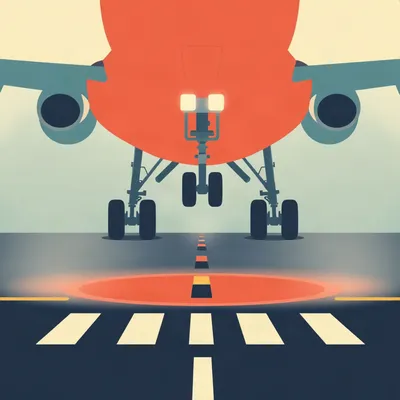
You've seen the footage — a passenger jet coming in sideways, nose cocked at what looks like a thirty-degree angle to the runway, hanging there like it's sliding on glass, and then at the last possible second it straightens out and the wheels kiss the tarmac. To the untrained eye it looks like something's gone wrong. Like the pilot's fighting the aircraft. But that maneuver — that crab into a last-second alignment — is one of the most practiced, most engineered, most routine things in commercial aviation.

It never gets old. I've watched hundreds of those videos and every single time there's this moment where your brain says "that can't be right" and then the aircraft just... It's a controlled skid that isn't a skid at all.
Daniel sent us this one — he's been on an aviation kick lately and he wants to know how modern aircraft manage to land in strong crosswinds. Different planes have different crosswind limits, there's constant monitoring to make sure conditions don't exceed those limits, and then there's the wild card of wind shear, which often shows up in exactly the kind of blustery conditions that make crosswind landings necessary in the first place. He wants to know how aviation has figured all this out — the testing, the engineering, the operational systems that let flights operate safely even at airfields where calm days are the exception.
This is more relevant than it's ever been. We're seeing more extreme weather events, gustier conditions at major hubs — the engineering and operational rigor behind crosswind landings isn't just a niche fascination for people who watch cockpit videos on YouTube. It's the thing standing between you and a very bad day when your flight starts rocking on final approach.
Which is exactly where we're going. We'll start with the physics of the landing itself — what pilots are actually doing with their hands and feet — then move to how manufacturers certify these limits by deliberately flying into the worst winds they can find, then to the real-time monitoring systems that keep flights safe, and finally to wind shear, which is a completely different beast from a steady crosswind.
Here's the thing that surprised me when I first dug into this — the number you always see quoted, the "maximum demonstrated crosswind component," is not a hard structural limit. It's not the point where the wings fall off. It's the highest wind the manufacturer actually tested during certification. Pilots can legally exceed it in an emergency. But for routine operations, it's a firm boundary, and the entire system is built around respecting it.
Before we get into the drama of those viral landing videos, let's get the vocabulary straight. What exactly is a crosswind component, and why is that the number pilots obsess over instead of just looking at the total wind speed?
Here's the thing about wind and runways — the number that actually matters to a pilot isn't the thirty-knot gust the weather report leads with. It's the crosswind component. You take the wind direction, you take the runway heading, and you calculate how much of that wind is blowing perpendicular to the centerline.
Which means a twenty-five knot wind blowing straight down the runway has a crosswind component of essentially zero. But a fifteen-knot wind coming in at a forty-five degree angle to the runway? That's giving you roughly ten knots of sideways push. Lower total wind speed, but a much trickier landing.
The math is wind speed times the sine of the angle between the wind and the runway. Pilots aren't doing trigonometry in their heads on final approach — they get the number from the tower or from their flight planning software — but that's the geometry. And it's why you can have a perfectly manageable landing on a gusty day if the wind is aligned with the runway, and a white-knuckle approach on a breezier day if it's coming across.
The crosswind component is the sideways shove. The thing trying to push several hundred thousand pounds of aluminum off the centerline. And every aircraft type has a published number for how much of that shove it can handle.
And this is where the "maximum demonstrated crosswind component" gets interesting. That number — say thirty-three knots for a Boeing 737, or thirty-five for an Airbus A380 — is not derived from a structural engineer running calculations about when the landing gear will shear off. It's empirical. It comes from test pilots flying the aircraft in progressively stronger crosswinds until the manufacturer is satisfied they've shown the aircraft can handle it safely with adequate control margin.
"adequate control margin" means the pilot still has enough rudder authority to align the nose with the runway, enough aileron to keep the upwind wing down, and isn't running out of control travel or approaching a bank angle limit. It's about controllability, not structural failure.
That's the key distinction. The airframe could physically survive a landing in higher winds. But the pilot might not have enough control surface deflection left to keep the aircraft tracking straight. And that's where the operational boundary comes from — it's a handling limit, not a breaking limit.
Which also means that in a genuine emergency — fuel critical, no alternate available — a pilot can legally attempt a landing above the demonstrated limit. They're not going to get violated for it. But it's not something you do on a routine Tuesday afternoon.
The system is built so you never have to. Dispatch won't release a flight if the forecast crosswind at the destination exceeds the aircraft's limit at the scheduled arrival time. Alternates are chosen specifically so there's always an out. The whole operational framework treats that number as a hard wall for planning purposes, even though the airworthiness regulations leave the door open for exceeding it in extremis.
That's the vocabulary and the stakes. Crosswind component is the sideways part of the wind, measured in knots, and it's the number that dictates whether a landing happens or doesn't. The published maximum isn't a structural cliff — it's the edge of the tested envelope, and the entire airline system is designed to keep operations comfortably inside it.
Which sets up the real question: how do pilots actually fly those approaches? What's happening in the cockpit when the wind is trying to push you off the runway and you've got to bring two hundred tons of jet down onto a strip of asphalt a hundred and fifty feet wide?
There are two techniques, and most landings are actually a blend of both. The first is crabbing — you point the nose into the wind enough that your ground track stays aligned with the centerline. From the cabin window it looks like you're approaching sideways, but the aircraft is flying straight through the air mass. It's aerodynamically clean.
The problem with crabbing is that you can't touch down like that. If you land with the nose pointed fifteen degrees off the runway heading, the landing gear is going to experience a massive side load the moment it contacts pavement. That's how you snap things.
Which is where the second technique comes in — the wing-down or sideslip method. You lower the upwind wing into the wind to stop the drift, and simultaneously apply opposite rudder to align the fuselage with the runway centerline. The aircraft is now flying slightly crossed — banked one way, yawed the other — and that asymmetry is exactly what counters the wind's sideways push.
You're basically flying crooked on purpose. One wing low, nose straight, and the whole thing is balanced against the crosswind. It's controlled asymmetry.
It's physically demanding. You're holding crossed controls — aileron into the wind, rudder away from it — and the stronger the crosswind, the more deflection you need. Eventually you run out of rudder travel, and that's what sets the limit. On a Boeing 737, the maximum demonstrated crosswind component varies by variant and flap setting, but it's typically thirty-three to thirty-six knots. The 737 Max, interestingly, is certified to thirty-three knots with full flaps — slightly lower than some earlier models because of the larger engine nacelles and their effect on directional stability.
Then you've got the A380 at the other end of the spectrum — certified to thirty-five knots during testing, but there are operational reports of landings in forty-plus knots. The sheer mass and the four-engine configuration give it a lot of rudder authority.
The Bombardier CRJ series, by contrast, maxes out around twenty-seven knots. Smaller aircraft, higher wing loading, less control surface area relative to the fuselage. The wind doesn't scale down just because the airplane does.
How do manufacturers actually arrive at these numbers? They can't just wait for a windy Tuesday and hope for the best.
They go hunting. Boeing uses Moses Lake in Washington state, and they'll position test aircraft there specifically when strong crosswinds are forecast. The test pilots fly approach after approach in progressively stronger conditions, instrumenting every control deflection, every bank angle, every foot of lateral drift. They're looking for the point where the pilot still has enough control margin to maintain directional authority without exceeding the aircraft's bank angle limit — typically around five to seven degrees in the flare.
The FAA and EASA require demonstration at whatever number the manufacturer wants to publish. If you claim thirty-five knots, you'd better show footage of a test pilot doing it cleanly. But here's the thing — manufacturers routinely test beyond the published number. They want a safety buffer. If the book says thirty-three knots, there's probably test data at thirty-eight or forty that never made it into the manual.
This is where those viral YouTube videos come in. The famous Düsseldorf footage — a Boeing 777-300ER coming in during severe gusty conditions, the aircraft crabbing hard, and then that last-second kick of the rudder to straighten out just before the mains touch. It looks terrifying. But it's almost certainly within the aircraft's demonstrated envelope. The 777 has a maximum demonstrated crosswind of around thirty-eight knots. What makes that video dramatic isn't that the aircraft is near its limit — it's that you can see the crab angle so clearly from the ground.
The Hamburg A380 video is even more striking because of the sheer scale of the thing. You're watching the world's largest passenger aircraft come in at what looks like a forty-five degree angle to the runway, and then it just... The control surfaces on that aircraft are enormous — the rudder alone is about the size of a small aircraft's wing — and you can see every bit of that authority being used in the final seconds.
What's wild is that these pilots train for this constantly. Simulator sessions include crosswind approaches at the limit and beyond. They practice the transition from crab to sideslip until it's muscle memory. By the time you're watching a real 777 crab into Düsseldorf, the pilot has done that exact maneuver hundreds of times in a box on the ground.
The viral video that makes passengers gasp is, to the pilot, just another Tuesday with a stiff breeze.
The pilot's skill is only one layer. Behind the scenes, there's a whole operational infrastructure making sure that pilot never has to use every knot of that demonstrated limit unless something has gone seriously wrong. Airlines don't just glance at the windsock and hope for the best.
Dispatch and flight planning systems are calculating crosswind components for the destination and every alternate hours before the aircraft ever leaves the gate. If the forecast shows winds exceeding the aircraft's limit at the scheduled arrival time, the flight doesn't go. Or it goes with a different aircraft type that has a higher crosswind ceiling. Or it carries enough fuel to hold until the wind shifts.
The dispatch software is pulling from multiple weather models, updating constantly. It's not a human looking at a single forecast and making a judgment call. The system flags any destination where the predicted crosswind component exceeds the aircraft's limit, and it won't release the flight plan unless there's a legal alternate within limits.
Which means the whole thing is designed to keep the operational margin comfortable. The pilot's crosswind skill is the backup system, not the primary defense.
That brings us to the thing that's more dangerous than any steady crosswind — wind shear. Because unlike a crosswind, which is predictable and steady enough to plan around, wind shear is transient, violent, and can exceed an aircraft's performance capability even when the wind is blowing straight down the runway.
What actually is wind shear? Because people hear the term in cockpit voice recorder transcripts and it sounds like pilot-speak for "bad wind." But it's a specific phenomenon.
It's a sudden change in wind speed or direction over a short distance. The classic scenario is a microburst — a column of sinking air from a thunderstorm that hits the ground and spreads outward in all directions. An aircraft flying into it first encounters a strong headwind, which increases airspeed and lift, and then a fraction of a second later it's in a tailwind, and the airspeed just falls away. You lose lift at the worst possible moment — low altitude, low energy, no time to recover.
It's not a lateral control problem like a crosswind. It's a vertical energy problem. The aircraft isn't being pushed sideways — it's being shoved toward the ground by a sudden loss of performance.
That distinction is everything. A crosswind you fight with rudder and aileron. A microburst you fight with thrust and pitch, and if you're too low and too slow, there's no fight to win. You're just along for the ride.
Which is why the detection systems exist. Tell me about LLWAS.
Low-Level Wind Shear Alert System. It's a network of anemometers — wind sensors — positioned around the airport, some near the runway thresholds, some a mile or two out. They're all feeding wind speed and direction data to a central processor in real time. If the system detects a significant divergence — say one sensor reading twenty knots from the north and another reading thirty knots from the south — it triggers an alert. The tower gets it, the flight crews get it, and the standard response is a go-around.
LLWAS was born from a specific tragedy.
Eastern Air Lines Flight 66, June 1975. A Boeing 727 on approach to JFK. A thunderstorm was sitting right over the approach path, and the crew encountered a microburst on final. The aircraft lost airspeed, descended into the approach lights, and crashed short of the runway. A hundred and thirteen people died. The investigation found that the wind shear was detectable — the anemometer network existed, but there was no system to interpret the data and issue a warning. LLWAS was the direct result.
Then a decade later, Delta 191 at DFW showed that LLWAS alone wasn't enough.
Delta Flight 191, a Lockheed L-1011, flew into a microburst on final approach to Dallas-Fort Worth. The aircraft encountered a rapid shift from headwind to tailwind, lost airspeed, and crashed a mile short of the runway. A hundred and thirty-seven fatalities. The LLWAS at DFW did trigger an alert, but it gave the crew about twenty seconds of warning — not enough. The microburst was too localized for a ground-based anemometer network to catch it in time.
That's what drove TDWR.
Terminal Doppler Weather Radar. Instead of measuring wind at discrete points on the ground, TDWR uses Doppler radar to scan the airspace around the airport and detect the velocity signature of a microburst — the classic pattern of converging winds followed by diverging winds at low altitude. It can see the thing forming before the outflow hits the ground. TDWR gives controllers and crews minutes of warning instead of seconds.
LLWAS is the ground truth — actual wind measurements at specific locations. TDWR is the early warning radar — it sees the hazard developing in the air column. Together they cover the blind spots.
Today, over a hundred U.airports have one or both systems installed. The FAA mandated them after Delta 191. It's one of those cases where the regulatory response to an accident fundamentally changed the safety landscape. Wind shear went from being an invisible killer to a detectable, avoidable threat.
Which loops back to what we were saying about crosswind limits. A steady crosswind is a known quantity — you measure it, you plan around it, and if it's within limits, the aircraft can handle it. Wind shear is the opposite — it's unknown until the detection systems catch it, it can be catastrophic even within the aircraft's performance envelope, and the only correct response is to get away from it. Go around, climb out, try again later.
That's the layered safety philosophy in a nutshell. Crosswind limits keep you out of conditions the aircraft isn't tested for. Dispatch planning keeps you from ever being forced to test those limits. And wind shear detection catches the thing that doesn't care about your limits at all. Three layers, each backing up the one before it.
What does all this mean for someone who isn't sitting in the cockpit? If you're an aviation enthusiast watching those crosswind landing compilations on YouTube, there's one thing to look for that separates the genuinely impressive from the merely dramatic. Watch the transition from crab to sideslip in the last few seconds before touchdown. The pilot who kicks the rudder too early has to hold the sideslip longer, burning control authority. The pilot who waits until the last possible moment and executes it in one smooth motion — that's the mark of real skill.
The counterintuitive thing is that the most dramatic-looking landings are often the most controlled. When you see a 777 come in at what looks like a ridiculous crab angle and then straighten out at the very last second, that's not a pilot fighting the aircraft. That's a pilot who knows exactly how much rudder authority they have left and is using every knot of it deliberately. The sloppy ones actually look tamer — a gradual drift off centerline that gets corrected late.
The drama is in the precision, not the struggle. Which is a good rule of thumb for a lot of aviation, honestly.
For the frequent flyers listening — the ones who grip the armrest when the aircraft starts rocking on final and then suddenly the engines spool up and you're climbing again — that go-around is not a failure. It's not the pilot losing control. It's the system working exactly as designed.
Pilots are trained to abort if the approach becomes unstable. There are specific criteria — if you're not established on the centerline by a certain altitude, if your sink rate exceeds a threshold, if your airspeed is fluctuating beyond a defined band, you go around. No questions asked. And wind shear alerts override everything. If the cockpit gets a wind shear warning, the response is immediate — full thrust, pitch up, climb out. There's no deliberating, no trying to salvage the approach.
The stable approach criteria are drilled into pilots from their first simulator sessions. Most airlines require the approach to be stable by a thousand feet above the runway in instrument conditions, five hundred feet in visual conditions. If it's not, you execute the missed approach. The go-around isn't the backup plan — it's the primary plan when conditions deteriorate. The landing is the backup.
Which is a mental reframe that might help the nervous flyer. When you feel that surge of power and the nose coming up, you're not watching a crisis. You're watching a professional execute a maneuver they've practiced hundreds of times because the conditions didn't meet the standard they're required to uphold.
That's really the broader takeaway here. Aviation safety isn't one brilliant piece of engineering or one heroic pilot. It's layers. Crosswind certification testing makes sure the aircraft can physically handle the wind. Pilot training makes sure the human in the cockpit can execute the maneuver. Dispatch planning makes sure the flight never launches into conditions that exceed the limits. And wind shear detection — LLWAS and TDWR — catches the unpredictable threat that doesn't care about any of those limits.
No single layer is perfect. Crosswind testing doesn't cover every possible gust profile. Pilots have off days. Weather forecasts are wrong. Detection systems have blind spots. But the layers overlap. The gaps in one are covered by another. And the whole thing is designed so that multiple things have to fail simultaneously before you get a bad outcome.
It's the Swiss cheese model in action. Every slice has holes, but the holes don't line up. That's the philosophy that took commercial aviation from the accident rates of the nineteen seventies to where we are now — where you're statistically safer in the air than you are driving to the airport.
Next time you're on a flight and the wind is throwing the aircraft around on final, you can remind yourself: the aircraft was tested in worse conditions than this, the pilot has practiced this exact scenario more times than you've watched Netflix this month, and there's a network of sensors and radars on the ground watching for the one thing that could actually ruin the day. And if any of those layers says no, you're going around.
As we look ahead, the question gets interesting. Aircraft designs are evolving in ways that directly affect crosswind capability. The Boeing 777X, for example, has those folding wingtips — seventy-one meters of wingspan that fold down to sixty-five for gate compatibility. But from a crosswind certification standpoint, you've now got a moving control surface at the wingtip that isn't a flight control. The FAA and EASA are going to want to know exactly what happens when you're in a thirty-knot crosswind, in the flare, and those tips are extended.
Longer wingspans mean more leverage for the wind to work with. More surface area to catch a gust. Fly-by-wire helps — the flight control computers can make corrections faster than any human — but the physics doesn't care about your processor speed.
That's the open question. Fly-by-wire control laws can blend aileron, rudder, and spoiler inputs in ways that make the aircraft feel more stable to the pilot. The A380's crosswind capability owes a lot to its flight control computers. But there's a hard limit that no software can erase: eventually you run out of rudder authority, and that's a function of the physical size of the tail, the speed of the airflow, and the moment arm. No algorithm can create control surface deflection that isn't there.
The question becomes whether the next generation of airliners will push crosswind limits higher, or whether the limits stay roughly where they are while the technology just makes landing at those limits easier and more consistent.
The other side of the equation is the weather itself. We're seeing more extreme conditions at airports that historically didn't deal with this. Airfields in regions where calm days used to be the norm are now experiencing gusty crosswind events more frequently. That puts pressure on the infrastructure side — more airports investing in crosswind runways, more wind shear detection systems, more TDWR installations at places that never needed them before.
The conversation between aircraft capability and airport infrastructure isn't going to slow down. If anything, it's going to accelerate. And the good news is that the system we've described — the layered safety approach — is designed to adapt. The detection technology gets better. The training simulators get more realistic. The certification testing gets more rigorous.
Next time you're sitting in a window seat and the aircraft starts crabbing hard on final, and you feel that little surge of adrenaline, remember: you're not watching a machine at war with the elements. You're watching decades of engineering, thousands of hours of test flying, and a pilot executing a maneuver they've practiced since their first week in the simulator. That smooth touchdown in a stiff breeze isn't luck. It's a system that earned every knot of that crosswind limit the hard way.
Now: Hilbert's daily fun fact.
Hilbert: In the nineteen eighties, scientists in Tasmania discovered that permafrost methane, when trapped in ice cores, fluoresces a pale greenish-blue under ultraviolet light due to trace organic pigments from ancient methanogenic archaea.
...right.
This has been My Weird Prompts. Our producer is Hilbert Flumingtop, and the show is at my weird prompts dot com. If you enjoyed this, leave us a review wherever you listen — it helps. We'll catch you next time.