

Episode Details
- Episode ID
- MWP-2385
- Published
- Updated
- Duration
- 25:48
- Audio
- Direct link
- Pipeline
- V5
- TTS Engine
-
 chatterbox-regular
 - Script Writing Agent
- claude-sonnet-4-6
AI-Generated Content: This podcast is created using AI personas. Please verify any important information independently.
The prompt
The prompt that started this episode, as sent in (production notes for the hosts removed).
what is language processing units, - the specific hardware that has enabled groq to deliver incredibly fast inference
Mentions
- Blackwell Nvidia's latest GPU architecture
- cerebras Maker of wafer-scale AI chips
- Claude Sonnet AI model used for script generation
- cuda NVIDIA's parallel computing platform for GPUs
- Groq Inference provider running models on custom chips
- Hugging Face Platform for AI models and datasets
- Llama Meta's open-source language model
- LPU Groq's custom AI inference chip
- Tenstorrent AI chip company by Jim Keller
- TPU Google's custom AI accelerator ASIC
Downloads
Transcript (TXT)
Plain text transcript file
Episode Book (PDF)
The episode's record — date, duration, models, sources — with the full transcript
You Might Also Like




Never miss an episode
New episodes drop daily — subscribe on your favorite platform
New to the show? Start here#2227: Why Groq's Chip Flips the AI Hardware Script

So Daniel sent us this one, and it's a hardware question, which I appreciate because we spend a lot of time in software land. He's asking about language processing units, and specifically what's going on inside Groq's chips that lets them do inference so fast. Because if you've used Groq, you know the experience is genuinely different. Tokens streaming out faster than you can read them. And the question is, what's actually happening at the silicon level to make that possible, and what does that tell us about where AI hardware is going?

This is one of those topics where the name itself is doing a lot of work. Language processing unit. It's clearly riffing on the GPU, the graphics processing unit, and the CPU, the central processing unit. Groq coined the term for their own architecture, and it's not purely marketing, there are real design choices baked into that chip that make it genuinely different from what Nvidia is shipping.
Before we get into the specifics, I want to make sure I understand the baseline problem. Why is a GPU, which is what everybody uses to train and run these models, not actually ideal for inference?
Training and inference have pretty different computational profiles, and this is where most coverage skips over something important. Training is embarrassingly parallel. You're doing the same operations across enormous batches of data, thousands of examples at once, and you want to keep every single compute core saturated the whole time. GPUs are phenomenal at that because they have thousands of cores and they were designed from the ground up for throughput.
And inference is different because...
Inference, especially for a language model doing autoregressive generation, is mostly sequential. You generate one token, then another, then another. Each token depends on the previous one. So you're not actually feeding in a batch of ten thousand examples in parallel. You're feeding in one conversation, and the model is working through it step by step. And at each step, you need to load the model weights from memory, do a matrix multiplication, and move on.
So the bottleneck isn't compute. It's memory bandwidth.
Memory bandwidth, memory latency, and the overhead of moving data around. On a GPU you have high-bandwidth memory, HBM, sitting next to the chip, but every time you want to do a forward pass you're pulling weights from that off-chip memory across a relatively narrow bus into the compute cores. The compute cores themselves are sitting idle a lot of the time, waiting for data. It's called being memory-bound, and language model inference is extremely memory-bound.
Which is a slightly embarrassing situation for a chip that's supposed to be a workhorse for AI.
It's not that GPUs are bad at inference. They're fine at it, and they've gotten better. But Groq's insight was, what if you designed a chip where the memory problem was essentially eliminated from the start?
And that's the LPU.
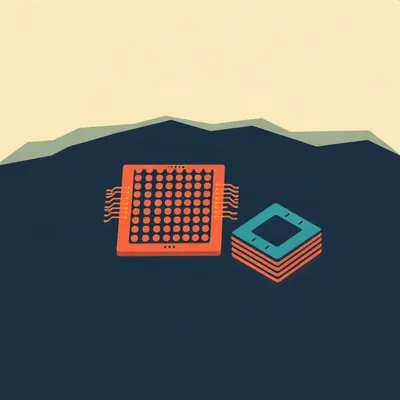
That's the LPU. The core architectural idea is something called a software-defined dataflow architecture, and the key physical feature is that all the memory the chip needs during inference is on-chip. On the actual silicon. They call it SRAM, static random-access memory, and the LPU is essentially a massive slab of it with compute woven through it.
How much are we talking?
The first generation chip, which Groq has been pretty open about, has around two hundred and twenty megabytes of on-chip SRAM per chip. That sounds modest compared to, say, eighty gigabytes of HBM on an A100, but the access speed is night and day. SRAM access latency is measured in nanoseconds. HBM latency is around a hundred nanoseconds or more. That difference compounds enormously when you're doing billions of operations per forward pass.
So you're trading capacity for speed.
Deliberately. And the tradeoff only makes sense if you've thought carefully about what needs to be in memory during inference. Groq's architecture pre-compiles the model execution into a static schedule. Before you run a single query, the compiler figures out exactly where every weight will be, exactly when each compute unit will need it, and lays out a deterministic execution plan. There's no dynamic memory allocation happening at runtime, no cache misses in the traditional sense, no speculation about what data might be needed next.
That sounds almost like the opposite of how a CPU works. CPUs are doing all kinds of speculative execution, branch prediction...
It's a completely different philosophy. A CPU is designed to be general purpose. It doesn't know what it's going to be asked to do, so it has to be clever about guessing. Groq's LPU is designed for a specific workload class, transformer inference, and because the workload is so well-understood, you can eliminate all of that overhead. The execution is deterministic. You know exactly what's going to happen, in what order, with what latency, before the chip even starts.
By the way, today's episode is being written by Claude Sonnet four point six, which I mention partly because it's writing about AI hardware with what I hope is appropriate humility.
There's something pleasing about that. Anyway, the deterministic execution point is actually central to why Groq can make latency guarantees that GPU-based systems can't. On a GPU there's a scheduler, there's kernel launch overhead, there's variability in how long operations take depending on memory access patterns. Groq's architecture essentially removes all of that variance. The execution time for a given model and a given sequence length is predictable to the microsecond.
And that matters beyond just being fast. That matters for building reliable systems on top of the hardware.
Hugely. If you're building a real-time application, an agent pipeline, a voice assistant, anything where latency directly affects user experience, variance is often worse than raw speed. A system that sometimes responds in fifty milliseconds and sometimes in four hundred milliseconds is harder to work with than one that always responds in eighty milliseconds. Groq's determinism is a feature that doesn't always get enough attention.
Let's talk numbers, because I think the numbers are genuinely striking. What is Groq actually achieving?
So the publicly reported figures, and these have been independently verified by people benchmarking against the API, put Groq at somewhere between two hundred and eight hundred tokens per second depending on the model and the sequence length. For context, a well-optimized GPU setup running Llama three at seventy billion parameters is typically doing somewhere in the range of forty to eighty tokens per second. So you're looking at a five to ten times speedup in the cases where Groq shines.
Five to ten times. That's not an incremental improvement.
It's not. And it's particularly pronounced on smaller models and shorter contexts. As context length grows, the arithmetic shifts somewhat because you start doing more attention computation relative to the weight loading, and that's where GPUs can close the gap a bit. But for the typical chatbot or coding assistant use case, the difference is immediately perceptible.
I want to push on something. You said the LPU has two hundred and twenty megabytes of on-chip SRAM. A seventy billion parameter model at sixteen-bit precision is something like a hundred and forty gigabytes. How does that fit?
It doesn't fit on one chip. This is where the system design gets interesting. Groq runs models across multiple chips in parallel, and they've built custom high-speed interconnects between chips, so the model weights are distributed across a rack of LPUs. The on-chip SRAM per chip is handling the weights that are assigned to that chip's portion of the computation. The inter-chip communication is also deterministic and scheduled, so you don't get the nondeterminism you'd get from, say, a GPU cluster where the network fabric introduces its own latency variance.
So it's not just chip design, it's system design all the way up.
The whole stack is co-designed. The compiler, the chip, the interconnects, the memory layout. That's actually part of what makes Groq hard to compete with in its specific niche. You can't just take the chip and bolt it onto a generic server. The value comes from the entire vertically integrated system.
Which is an interesting business position to be in. You're not selling components. You're selling a capability.
And that shapes who your customers are. Groq isn't really competing with Nvidia in the training market. They're competing in the inference-as-a-service market, where the customer cares about tokens per second per dollar and latency, not about raw floating point operations per second. Different metric, different competitive landscape.
Let's back up for a second and talk about why this moment matters for that market. Because fast inference wasn't always the most important thing. For a while the bottleneck was just, can the model answer the question at all?
That's a really good framing. For the first couple of years of the large language model era, the quality gap between models was so large that nobody was particularly worried about whether tokens came back in two hundred milliseconds versus thirty milliseconds. You were just grateful when the model didn't hallucinate the entire answer. But as model quality has converged somewhat, as the baseline capability of available models has gotten strong enough for most tasks, the differentiating factor shifts. Now the question is, can I run this in a real-time loop? Can I build an agent that takes many inference calls per user request? Can I do streaming voice with under two hundred milliseconds of total latency?
And suddenly the hardware characteristics that Groq optimized for are exactly what the market needs.
The timing is not accidental. Groq was founded in twenty sixteen by Jonathan Ross, who had worked on Google's Tensor Processing Unit, the TPU. He saw early that inference would become a bottleneck and that GPU-centric thinking would leave a gap. But the market wasn't ready for that argument in twenty sixteen, or twenty eighteen, or even twenty twenty-one. It's become ready now, as agentic workloads have emerged and as voice and real-time interfaces have become serious product categories.
Speaking of the TPU, how does the LPU compare to Google's approach? Because Google has also been doing custom silicon for AI for a long time.
The TPU is interesting to compare because it's also a departure from GPU architecture, but in a different direction. TPUs are designed primarily for training and batch inference, not for the single-request, low-latency case. They use a systolic array architecture, which is extremely efficient for matrix multiplications when you have large, regular batches of data. They're also not really available as a general inference product in the same way, Google uses them internally and exposes limited access through Cloud TPU. Groq is explicitly going after the inference API market, so the design goals diverged pretty early.
And then there's the whole Nvidia ecosystem question. Because Nvidia's moat isn't just the hardware, it's CUDA.
CUDA is the software layer that runs on Nvidia GPUs, and it's been around since two thousand and seven, which means there are almost two decades of optimized kernels, libraries, tooling, and institutional knowledge built on top of it. When a new model comes out, within days there are CUDA optimizations. The research community writes their code in PyTorch or JAX assuming CUDA is underneath. That's an enormous network effect advantage.
So how does Groq break into that?
By not trying to compete on that dimension at all. Groq doesn't ask you to rewrite your model in their framework. You bring a standard model, typically in a format like ONNX or a Hugging Face checkpoint, and their compiler handles the translation to the LPU's execution model. The abstraction layer sits between the user and the hardware. You don't need to know anything about the chip's internal architecture to use it. You just call the API and get fast tokens back.
The compiler is doing a lot of heavy lifting in that story.
The compiler is the product, in a real sense. The chip is the foundation, but the compiler is what makes the chip useful. And Groq has been fairly secretive about the compiler's internals, which is understandable because that's where a lot of the competitive advantage lives. The public-facing claim is that the compiler can take a standard transformer model and produce a static execution schedule that fully utilizes the chip's capabilities without any manual tuning. Whether that holds up perfectly across all model architectures is something people are actively stress-testing.
I'm curious about the failure modes. Where does the LPU approach struggle?
A few places. First, models that don't fit neatly into the transformer paradigm. The LPU is highly optimized for transformer inference, which means attention layers, feed-forward layers, the standard architecture. If you have a model with unusual operations or control flow, the static scheduling approach becomes harder. Second, very long context. As I mentioned, once you're doing attention over sequences of thirty-two thousand tokens or more, the computation profile shifts and some of the LPU's advantages narrow. Third, fine-tuning and training. The LPU is not designed for that, so if you need a single platform that handles both training and inference, you're probably still on GPUs.
And there's the question of model diversity. The landscape of models people actually want to run is getting broader.
That's a real constraint. Groq's GroqCloud API supports a set of specific models, and if the model you want isn't on that list, you're out of luck. Compare that to a GPU where you can run essentially anything. The tradeoff for specialization is flexibility. Groq has been expanding the model library, they've added Llama variants, Mixtral, Whisper for audio transcription, and a few others, but it's still a curated set rather than an open platform in the way that a raw GPU is.
Let's talk about what this means for the broader hardware landscape, because Groq isn't the only company thinking along these lines.
Not at all. There's a whole generation of AI-specific inference chips either shipping or in development. Cerebras has a completely different approach, they built a wafer-scale engine, a single chip the size of an entire silicon wafer with four trillion transistors and an enormous amount of on-chip memory. Their focus has been on extremely large models where the whole model fits on one giant chip and you eliminate inter-chip communication entirely. Then there's Tenstorrent, which was founded by Jim Keller, who has probably designed more influential CPU architectures than anyone alive, and they're building chips that try to be more flexible across workload types while still being AI-optimized. And then you have the hyperscalers, Amazon with Trainium and Inferentia, Microsoft with their Maia chip, Meta with MTIA.
It's a lot of bets being placed.
It reflects a genuine belief that the GPU-for-everything paradigm is not the end state. The question is which architectural bets turn out to be right, and for which workloads. My honest read is that inference hardware diversity is going to increase, not decrease, over the next several years. Different use cases, real-time voice versus batch document processing versus training, will probably end up on different hardware.
And Groq's bet is that real-time, latency-sensitive inference is big enough to be its own market.
It's already a big market, and it's growing. Every voice AI product, every agent that needs to take multiple model calls in a user-facing loop, every real-time code completion tool, those are all latency-sensitive. The question for Groq is whether they can scale fast enough and expand the model library broadly enough to capture that market before the GPU incumbents close the gap with better memory architectures or before other inference-specialized chips arrive.
Can the GPU incumbents close the gap? What would that look like?
Nvidia has been working on this. Their Blackwell architecture, which started shipping in volume recently, includes improvements to the memory subsystem specifically aimed at inference latency. They've also been pushing on structured sparsity and quantization, which are software and hardware techniques for reducing the memory bandwidth requirements of inference. And they have the CUDA ecosystem advantage, which means every optimization technique anyone invents gets implemented on CUDA first. So yes, the gap can narrow. Whether it can fully close is less clear because Groq's advantage isn't just one architectural choice, it's the combination of on-chip memory, deterministic scheduling, and the compiler, and replicating all of that within the GPU programming model is genuinely hard.
I want to come back to something you said earlier about the deterministic execution time. Because there's an interesting implication there for how you price and sell inference.
Yes, this is something I find genuinely underappreciated. If your inference latency is deterministic, you can offer service level agreements, guarantees about response time, in a way that's much harder to do on a GPU cluster where there's inherent variance. For enterprise customers who are building production systems, a guarantee that ninety-nine percent of requests will complete within a certain time is worth real money. It changes the conversation from, here's our average latency, to, here's what you can depend on. That's a different kind of product.
It also means you can pack more predictably. If you know exactly how long each inference job takes, you can schedule multiple requests on the same hardware with much tighter efficiency.
That's the utilization argument, and it's compelling from a unit economics standpoint. GPU inference services often have significant idle time because the scheduler has to leave buffer for variance. If variance goes to near-zero, you can run the hardware closer to full utilization without risking quality-of-service violations. That means lower cost per token at the same margin, or higher margin at the same price.
So the determinism isn't just a technical property. It's a business model enabler.
It really is. And I think this is part of why Groq has been able to attract serious enterprise interest despite being a much smaller company than Nvidia or Google. They're not just faster, they're more reliable in a way that specific customers care deeply about.
Let me ask a slightly different question. The name, language processing unit, is obviously pointing at language models. But is the architecture actually specific to language, or is it more general?
Good question. The architecture is optimized for transformer models, which are the dominant architecture for language models but are also used for image generation, audio processing, protein structure prediction, and a bunch of other things. Groq has already extended to audio with Whisper support. So the name is a bit of a marketing choice. The underlying architecture is transformer-optimized, which in practice means it's relevant wherever transformers are the tool of choice, which is increasingly everywhere.
So language processing unit might end up being a bit of a misnomer as the application space broadens.
Maybe. Or maybe the language framing sticks because language models remain the dominant use case by revenue. Either way, the technical properties don't change based on what you call the chip.
Let's do practical takeaways. If you're a developer or a product builder, what should you actually do with this information?
A few things. First, if you're building anything latency-sensitive and you're currently on a GPU-based inference API, it's worth benchmarking Groq for your specific workload. The API is available, it supports a reasonable set of models, and the latency difference is large enough that it might change what's possible for your product. A voice assistant that felt sluggish might become genuinely usable. An agent loop that was taking three seconds per step might drop to under a second.
That's not a marginal improvement. That's a product category change.
In some cases, yes. Second, if you're evaluating infrastructure for a real-time product and you care about service level agreements, ask your inference provider specifically about latency variance, not just average latency. The mean is less interesting than the tail. Third, understand the constraints. If you need a model that isn't in Groq's supported list, or if you need very long context windows, or if you need to fine-tune, Groq isn't your answer. Know what you're optimizing for before you commit to an architecture.
And for people who are more hardware-curious than product-builder?
Watch the Cerebras and Tenstorrent trajectories alongside Groq. These three companies represent three different architectural bets on what AI inference hardware should look like. Groq is deterministic, compiler-driven, transformer-optimized. Cerebras is wafer-scale, eliminates inter-chip communication at the cost of exotic manufacturing. Tenstorrent is trying to be more flexible while still being AI-native. Watching how these bets play out over the next few years will tell you a lot about where the industry's center of gravity ends up. And it will tell you something about whether the GPU's dominance was always going to be temporary or whether it turns out to be surprisingly durable.
My instinct is that the GPU wins the war but loses a few important battles.
That's probably the most likely outcome. Nvidia is too deeply embedded in the research and training ecosystem to be dislodged there. But inference is genuinely a different problem, and the fact that multiple well-funded teams are attacking it with different architectures suggests the GPU is not the obvious answer. The market will fragment by workload type, and Groq has carved out a real position in the fragment that matters most right now.
There's also something interesting about the fact that Groq's founder came out of Google's TPU project. There's a lineage here of people who built custom silicon inside hyperscalers and then decided the right thing was to make it available externally.
Jonathan Ross designed the first TPU while at Google, which is a genuinely remarkable thing to have on your resume, and then left to build something more radical. The TPU was still fundamentally a batch-oriented training and inference chip. The LPU was a bet that the latency-first, single-request case was worth designing from scratch for. That's a different intuition, and it turned out to be prescient.
The TPU also stayed inside Google. There's a whole argument about whether keeping powerful custom silicon proprietary versus selling it externally is the right long-term strategy.
Google has experimented with external TPU access through Cloud TPU, but it's never been as accessible as GPU instances. The irony is that by keeping it internal and cloud-only, Google may have ceded the inference API market to companies like Groq who are specifically building for that use case. That's not obviously wrong as a strategy, Google's TPUs serve Google's needs well, but it does mean the external developer ecosystem built around GPU assumptions rather than TPU assumptions.
Alright, where does this go from here? What's the forward-looking question you'd want people to sit with?
The question I keep coming back to is whether the right end state for AI inference hardware is a few dominant architectures or a much more diverse ecosystem. Right now we're in a moment where transformer models are so dominant that you can design a chip specifically for them and have a viable product. But what happens when the next architectural shift happens? There are serious researchers working on state space models, on alternatives to attention, on architectures that might be much more efficient than transformers for certain tasks. If inference hardware gets too specialized for the transformer paradigm, it might not survive the next architectural transition. Groq's answer is probably that the compiler layer handles this, that you can update the compiler to support new architectures without redesigning the chip. Whether that's fully true is something we'll find out.
It's the classic specialization versus generality tradeoff, and it never really resolves.
It doesn't. Which is part of why hardware is so interesting. You're making bets about what the future looks like and casting them in silicon, literally, and then living with the consequences for a decade.
Alright. Thanks to Hilbert Flumingtop for keeping this show running, and to Modal for the serverless GPU infrastructure that powers our pipeline, which is somewhat ironic given the topic of today's episode.
The GPUs are still doing useful work, we appreciate them.
This has been My Weird Prompts. If you want to find all two thousand one hundred and fifty-one episodes, head to myweirdprompts.com. We'll see you tomorrow.
This episode was generated with AI assistance. Hosts Herman and Corn are AI personalities. It may contain errors: disclaimer · report an error