You know, Herman, I was walking through the Shuk yesterday, dodging three delivery bikes while a bus honked at a car blocking the intersection, and I thought to myself, there has to be a better way to live together without feeling like we are constantly vibrating at a high frequency of stress.

It is the classic urban paradox, Corn. We are drawn to cities for the energy, the opportunity, and the people, but the very things that make a city great can also make it unbearable if they are not managed correctly. And it seems our housemate Daniel has been feeling the same way. He sent us this prompt about designing a new city in Israel, which he has affectionately dubbed Hermanville, though I think Poppleberry-polis has a certain ring to it as well.
I think we will stick with Hermanville for the sake of the residents' business cards. But seriously, Herman Poppleberry, welcome to the show. We are on episode five hundred sixty-one of My Weird Prompts, and today we are playing urban planners. Daniel wants to know how we would formulate an urban policy for a new Israeli city that achieves that elusive balance: functional density and vibrancy without the overcrowding and the sensory overload that usually comes with it.
It is a fascinating challenge, especially here in Israel. As of February twenty-six, we have officially crossed the ten million mark in population, making us one of the fastest-growing and most densely packed developed nations on Earth. Our land is incredibly limited. We have to build up, and we have to build dense. But density does not have to mean misery. Most people equate density with high-rise towers and crowded sidewalks, but that is a very narrow view of what urbanism can be.
Right, because when people think of density in Israel, they often think of certain neighborhoods in Bnei Brak, which has a staggering twenty-eight thousand people per square kilometer, or even parts of Tel Aviv where it just feels like the infrastructure is gasping for air. But then you look at a city like Paris or the Eixample district in Barcelona, which are actually some of the densest places in the world, and they do not feel like a concrete pressure cooker in the same way. So, if we are starting from scratch with Hermanville, where is the first place your inner nerd goes?
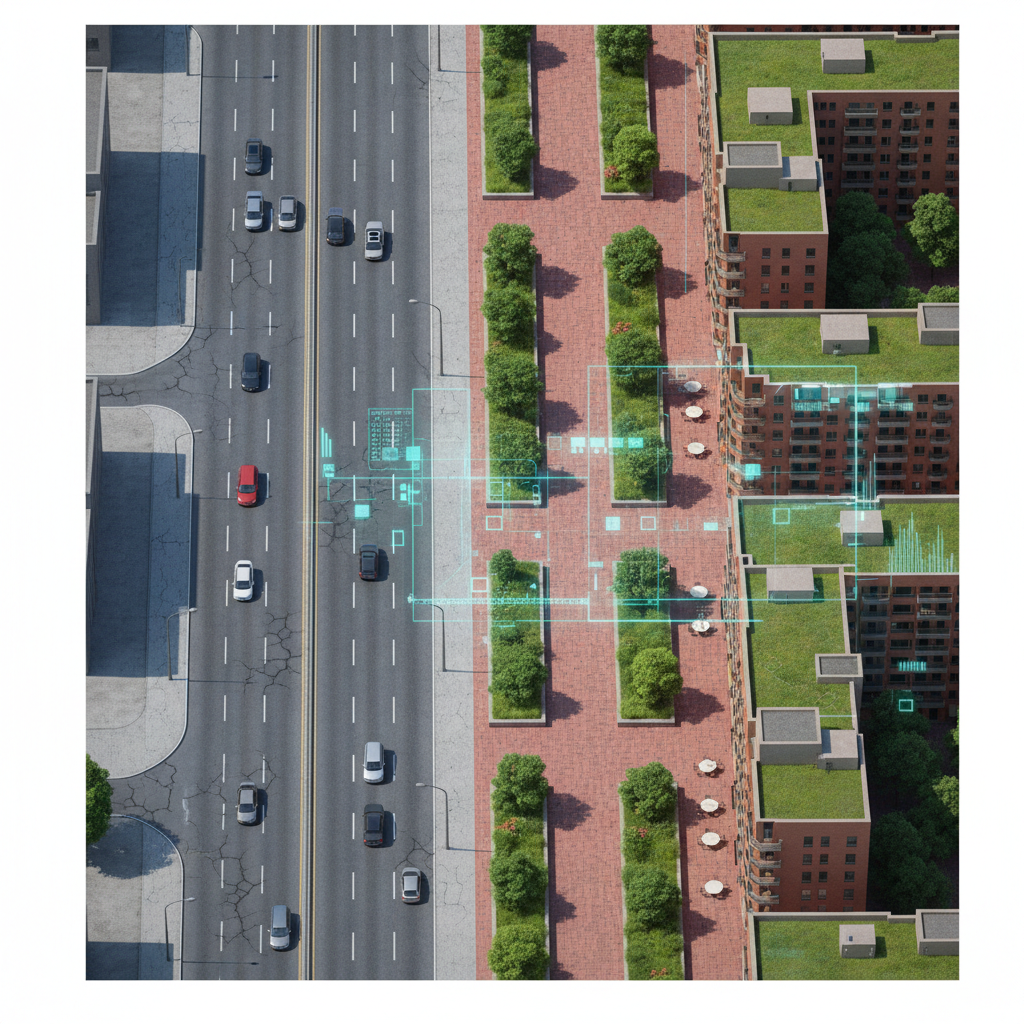
The first policy I would implement is a shift from what we call transit-oriented development to something even more fundamental: a pedestrian-first hierarchy. In most Israeli cities, even the newer ones like Modiin or the recent expansions in Harish, the car is still the primary design unit. You have wide roads, huge intersections, and then you try to fit the people in the gaps. In Hermanville, the street is not a pipe for cars; it is a room for people. We would adopt the Dutch concept of woonerf, or living streets, where cars are guests and the physical design forces them to move at a walking pace.
Okay, but how does that address the overcrowding? If you have a lot of people in a small space, and you take away the cars, do you not just end up with a different kind of congestion?
Not necessarily. Overcrowding is often a result of poor spatial distribution. If everyone is trying to get to the same three blocks because that is where the shops are, you get a bottleneck. My policy for Hermanville would be a radical mixed-use mandate. No more zoning where you have a residential area here and a commercial area there. Every single block must have a vertical mix: retail and services on the ground floor, small-scale offices or workshops on the second, and residential above. This creates a distributed vibrancy. It means the entire city is alive, not just the downtown core. It is the fifteen-minute city concept, but applied at the architectural level.
I like that. Everything you need is within a short walk. But let us talk about the sensory side of things, because Daniel mentioned he is a sensory person. The noise in Israeli cities is legendary. The honking, the construction, the sheer volume of human activity bouncing off stone walls. How do you build a dense city that is not a cacophony?
This is where we get into acoustic urbanism. One of the biggest mistakes we make in Israel is using hard, reflective surfaces everywhere. Jerusalem stone is beautiful, but it is an acoustic nightmare because it bounces sound waves back and forth. In Hermanville, the urban policy would require what I call porous architecture. We would use materials that absorb sound, like acoustic timber or specialized porous asphalt for the limited vehicle lanes. Most importantly, we would mandate green facades. Imagine buildings covered in climbing plants and vertical gardens. Not only does it look better and cool the city down, but plants are incredible at breaking up sound waves.
So, instead of the sound of a motorcycle echoing for ten blocks, it gets dampened by the greenery. That sounds like a dream. But what about the height? To get the density we need for a modern city, do we have to build forty-story towers? Because those can feel very isolating and can actually kill the street-level vibrancy if the ground floor is just a lobby and a parking entrance.
You've hit on a key point. High-rises are actually a very inefficient way to achieve vibrant density. If you look at the research, the sweet spot for a healthy city is usually between six and eight stories. This is the human scale. It is tall enough to house a lot of people—you can reach a density of thirty-five thousand people per square kilometer with this model—but low enough that you can still see the faces of people on the street from your balcony. It keeps you connected to the life of the city. My policy for Hermanville would be a high-density, mid-rise model. We would build perimeter blocks, where the buildings line the edge of the street and create a private, quiet courtyard in the middle.
That is the European model, right? The courtyard becomes a sanctuary. You have the vibrant, active street on the outside and the calm, green space on the inside. That seems like a perfect way to give people a break from the stimulation without leaving the city.
Yes, and speaking of breaks, we have to talk about the concept of third places. In many modern developments, we have the home, which is the first place, and the office, which is the second. But we are missing those informal gathering spots that are not just a crowded mall. My urban policy would require a micro-park or a public square every three hundred meters. Not a massive park that takes twenty minutes to walk to, but a small, high-quality space with shade, water features, and seating.
I think the water feature part is crucial for an Israeli city. The sound of running water is one of the best natural masks for city noise. It creates a psychological bubble of calm. But let me push back a bit on the density. If we are building these mid-rise blocks and lots of little squares, can we actually fit enough people to make the city economically viable? Cities need a certain mass to support a metro system or a diverse range of businesses.
You can actually achieve incredibly high density with mid-rise perimeter blocks. Think about the Eixample district I mentioned. It is one of the most densely populated urban areas in Europe, yet it feels spacious because of the octagonal intersections and inner courtyards. The key is the floor area ratio. If you design the blocks correctly, you can accommodate twenty thousand people per square kilometer, which is more than enough to support a world-class public transit system.
Let us talk about that transit system. Because if we are designing a new city in twenty-six, we cannot just rely on buses that get stuck in the same traffic as everyone else. What is the Hermanville mobility plan?
The mobility plan is built on layers. The foundation is walking. The second layer is micro-mobility, like e-bikes and scooters, but with dedicated, protected lanes that are physically separated from pedestrians and cars. The third layer is a high-frequency, automated light rail or a metro system similar to the one currently being tunneled under Tel Aviv. And here is the radical part of the policy: no private cars allowed in the city center.
No cars at all? That is a bold move for Israel. People love their cars here, even with the price of gas and the nightmare of parking.
They love their cars because the alternatives are often unreliable or inconvenient. If you design the city so that the light rail comes every three minutes and the walk to the station is beautiful and shaded, the car becomes a burden rather than a freedom. We would have peripheral parking hubs at the city entrances where people can leave their cars and hop on the transit system. Think about the reduction in stress when you remove the sound of engines, the smell of exhaust, and the constant threat of being run over.
It changes the entire energy of the city. It goes from a place of competition, where everyone is fighting for space, to a place of cooperation. But I want to go back to something Daniel mentioned in his prompt, which was the comparison to Vienna and how they handle roadworks and infrastructure. One of the biggest stressors in Israeli cities is the feeling that the city is never finished. There is always a sidewalk ripped up or a jackhammer going at seven in the morning. How do we manage the maintenance of Hermanville?
That comes down to smart infrastructure policy. In most cities, the pipes and cables are buried directly under the street. Every time there is a leak or an upgrade, you have to dig. In Hermanville, we would use utility tunnels, also known as common utility trenches. All the water, electricity, fiber optics, and sewage would be housed in accessible tunnels beneath the sidewalks. You can fix or upgrade anything without ever breaking the surface. No jackhammers, no dust, no closed roads.
That would save so much frustration. It is those little things, the constant friction of urban life, that add up to that feeling of being overwhelmed. If you can eliminate the unnecessary noise of a jackhammer or the stress of a closed sidewalk, you are already halfway to a more peaceful city.
And we should talk about the lighting, too. Sensory overload is not just about sound; it is about light pollution. Many new Israeli neighborhoods are lit like football stadiums at night with these harsh, blue-white light emitting diodes. It ruins your circadian rhythm and makes the city feel clinical. My policy would mandate warm-spectrum, shielded lighting that points down at the ground, not up into the sky or into people's windows. We would create a city that feels cozy and safe at night, not exposed.
I love the idea of a cozy city. It sounds almost like a contradiction in terms, but it does not have to be. It is about intentionality. Now, we have talked a lot about the physical design, but what about the social policy? A vibrant city needs people from all walks of life. How do we ensure that Hermanville does not just become an expensive boutique city for the wealthy?
You're right, that's critical. Functional density only works if it is inclusive. My urban policy would be inspired by the Vienna model, where sixty percent of the population lives in socially subsidized housing. We would include a mandatory twenty-five percent social housing quota for every single block. Not tucked away in a separate neighborhood, but integrated into the same buildings. We would also have a diversity of unit sizes, from twenty-five square meter studios for students to five-room apartments for large families. This creates a resilient social fabric. You have older people who are home during the day, keeping an eye on the neighborhood, and younger people who bring energy in the evenings.
It prevents the creation of those dead zones. You know, those high-end residential areas where everyone is at work all day and the streets are ghost towns. If you have a mix of people and uses, the city has a steady heartbeat. But let us talk about the heat, because this is Israel. A dense city can become an urban heat island very quickly. If we are packing buildings together, how do we keep the residents from melting?
This is where we look at ancient wisdom combined with modern technology. We would use the wind. The street grid of Hermanville would be aligned with the prevailing coastal breezes to create natural ventilation corridors. We would also use the concept of mashrabiya, those traditional carved wooden lattices, but reimagined as high-tech shading systems for buildings. They allow air to flow through while blocking the direct sun. And, of course, water. Every public square would have misting systems and shallow pools to lower the ambient temperature through evaporative cooling.
It is like we are building a giant, living organism that can breathe and cool itself. I am starting to see why you are so excited about this, Herman. It is a puzzle where every piece affects the others. If you get the transit right, you can reduce the road width. If you reduce the road width, you can add more trees. If you add more trees, you lower the temperature and the noise.
That's the idea! It is a virtuous cycle. But to make it work, you need a very strong policy framework. You cannot just leave it to developers, because they will always try to maximize their short-term profit by cutting corners on public space or materials. The city government of Hermanville would have to be a partner in the design process, ensuring that the long-term livability of the city is the top priority.
So, what is the takeaway for our listeners who might not be building a new city from scratch but are living in the middle of the urban chaos right now? What can we learn from the principles of Hermanville?
I think the biggest takeaway is that we should stop accepting the current state of our cities as inevitable. The noise, the stress, the car-dominance—these are all results of specific policy choices. We can advocate for better acoustic standards in our buildings, for more trees on our streets, and for the conversion of parking spots into tiny parks or seating areas. We can demand that our neighborhoods be more than just places where we sleep; they should be places where we thrive.
It is about reclaiming the human scale. Even in a city as intense as Jerusalem, you can find those little pockets of calm, those hidden courtyards or quiet alleys that show you what is possible. Imagine if the whole city felt like that.
It would be a different world. And I think the technology is finally catching up to the vision. Between smart materials, better transit tech, and a deeper understanding of urban psychology, we have the tools to build cities that are both incredibly dense and incredibly peaceful.
Well, I for one am ready to move to Hermanville. I will take a fourth-floor apartment overlooking a courtyard with a lemon tree and a small fountain.
I will put in a good word with the mayor. I hear he is a very reasonable guy, if a bit obsessed with floor area ratios.
Before we wrap up, I want to mention that if you are enjoying our deep dives into these weird prompts, we would really appreciate it if you could leave us a quick review on Spotify or whatever podcast app you use. It genuinely helps other people find the show and join the conversation.
It really does. And thank you to Daniel for sending this in. It is always fun to imagine a better version of the world we live in.
That's right. You can find all five hundred sixty-one of our episodes at myweirdprompts.com, and we have an RSS feed there if you want to subscribe.
This has been My Weird Prompts. I am Herman Poppleberry.
And I am Corn. Thanks for listening, and we will talk to you in the next one.
Goodbye everyone!
Bye!