Here's something I noticed after moving from Cork to Jerusalem — and it took me years to put my finger on what was actually going on. In Cork, a proper day of torrential rain, the kind where you'd be soaked through in thirty seconds, the drains would handle it. Streets got wet, sure. But the lights stayed on. The internet stayed up. It took something genuinely extreme to push the system past its limits. Here in Jerusalem, a rainstorm that Cork wouldn't even remark on — forty-five millimeters in a few hours — and suddenly fourteen thousand households lose power. Roads flood at junctions that should be able to cope. And I kept asking myself: is this just about money? Is Israel's infrastructure worse?

The answer is more interesting than yes or no, isn't it.
Much more interesting. Because here's the thing — if Cork had Jerusalem's summer temperatures, the roads would literally melt. Irish asphalt uses a binder rated for cooler climates. A heatwave in twenty twenty-two caused two million euros in damage to the M50 alone. The same temperatures in Israel are just Tuesday in July. So neither place has better infrastructure. They have infrastructure optimized for different threats.
That's the puzzle Daniel's getting at in his prompt. He moved from Cork to Israel about ten years ago and noticed the same thing — moderate rain that wouldn't challenge Irish drainage at all causes power outages and internet interruptions here. And he's asking what actually accounts for these differences. Is it engineering standards? Something structural about how cities decide what's worth protecting against?
What we found is that it comes down to a single number that most people have never heard of — the design return period. And the uncomfortable truth is that good enough is a moving target based on what a society has learned to expect from its weather.
Once you understand that number, you start seeing infrastructure differently everywhere you go. Not as better or worse, but as a set of bets a society placed about what the future would look like — bets that climate change is making increasingly shaky.
Let's define the term, because it's the key that unlocks the whole comparison. A design return period is the statistical likelihood of an event that a piece of infrastructure is built to withstand. When engineers say a drainage system is designed for a one-in-one-hundred-year storm, they don't mean that storm happens exactly once a century. They mean there's a one percent chance of it happening in any given year.
Which sounds reassuring until you realize that over the thirty-year life of a system, that one percent annual chance compounds to about a twenty-six percent probability of getting hit at least once. The math is less comforting than the label.
And here's where it gets political — choosing a return period is choosing an acceptable failure rate. A one-in-ten-year standard means the system is expected to be overwhelmed roughly once a decade. A one-in-one-hundred standard means you've decided that's unacceptable, and you're willing to pay the premium to push that failure further into the tail of the probability distribution.
When we talk about Cork versus Jerusalem, we're not comparing competence. We're comparing what each society decided was worth paying for.
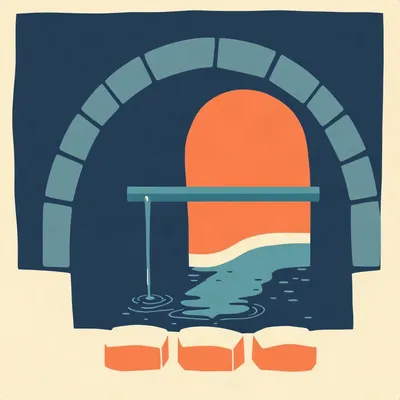
Cork decided to pay a lot. The Lower Lee Flood Relief Scheme cost a hundred and forty million euros. It's not just a bigger drain — it's a one-point-four-kilometer underground tunnel, three and a half meters in diameter, that diverts floodwater away from the city center. Combined with upstream storage at the Inniscarra and Carrigadrohid dams, it's a multi-layered system designed to the Office of Public Works' one-in-one-hundred-year standard.
A tunnel under a city, upstream dams, coordinated release schedules — that's not drainage. That's flood defense as civilizational commitment.
It reflects decades of accumulated political will. Cork has flooded repeatedly — two thousand nine was particularly bad — and each event built the case for spending that exponential premium. The marginal cost to go from one-in-fifty to one-in-one-hundred protection is steep, and you only make that jump when voters have seen the water in their living rooms.
Now flip to Israel. Mediterranean climate, long dry summers, rain concentrated in a handful of winter events. The drainage systems are designed for infrequent but intense bursts — typically one-in-ten or one-in-twenty-five-year standards. That's not negligence. It's rational allocation. If rain events that challenge the system happen once every few years, the political pressure to upgrade between events simply doesn't build the way it does in a place where flooding is an annual conversation.
That's the maintenance asymmetry that really matters. Cork's drainage network gets cleaned and inspected annually — there's a season for it, the crews know the rhythm, the budget line is never in question. In Israel, storm drains can sit uncleaned for three or four dry years because there's no forcing function. Then a heavy rain hits, and suddenly the accumulated construction debris and dust and plastic from three summers of dry weather all hits the grates at once.
The system isn't worse by design. It's worse by deferred attention — which is itself a rational outcome of the climate's incentive structure.
Tel Aviv in January twenty twenty-four is the case study that makes this concrete. Sixty millimeters of rain — not extraordinary by global standards — and twelve neighborhoods lost power. The post-event investigation didn't find design flaws in the drainage system. It found storm drains clogged with construction debris that had been accumulating since the previous summer's building boom. Three dry years of dust, sand, and plastic sheeting, all hitting the grates in the first hour of heavy rain.
The drainage capacity was theoretically adequate, but the actual capacity on the day was a fraction of what was on the engineering drawings. The maintenance deficit turned a manageable storm into twelve simultaneous neighborhood outages.
That's where the cascading failure mechanism kicks in — and this is the part Daniel's prompt is really probing, whether he knew it or not. In Cork, when drainage gets overwhelmed, you get street flooding. It's inconvenient, it's messy, but it rarely takes out the power. Because after the two thousand nine floods, ESB Networks hardened the substations in flood-prone areas. Electrical infrastructure is elevated, junction boxes are sealed, and the grid is designed so that water on the street stays on the street.
Storm Babet in twenty twenty-three proved that investment worked. Eighty millimeters in forty-eight hours — a genuine pounding — and Cork had minimal power outages. The water came, the tunnel did its job, and what did overflow stayed in the gutters where it belonged.
Now compare Jerusalem's twenty twenty-two event. Forty-five millimeters in three hours — that's less than what Babet dropped on Cork, and in a shorter window, sure, but not a biblical deluge. Fourteen thousand households lost power. The post-event analysis found that sixty percent of the failures occurred at ground-level junction boxes that had never been flood-proofed.
Never been flood-proofed. It's not that someone forgot. It's that in a climate where heavy rain is a once-every-few-years event, the cost-benefit calculation for elevating every junction box and sealing every conduit looks different than it does in Cork, where the question isn't whether it'll flood but when.
The marginal cost curve makes that calculation even sharper. Going from a one-in-twenty-five-year drainage standard to one-in-fifty is a manageable increment — maybe thirty or forty percent more in construction costs. Going from one-in-fifty to one-in-one-hundred can triple the bill. You're not just laying bigger pipes at that point. You're building tunnels, acquiring land for upstream storage, redesigning entire catchment basins.
Cork's hundred and forty million euro tunnel exists because the city collectively decided that the exponential spend was worth it. But that decision was forged by repeated flooding — two thousand nine especially, when the River Lee broke its banks and the city center was under water. Political will for exponential spending doesn't come from actuarial tables. It comes from people remembering what their furniture looked like floating.
Israel's infrastructure planners are looking at the same marginal cost curve and making a different call — and it's not an irrational one. If you've got a limited capital budget and your dominant threats are heat, drought, and seismic risk, spending the exponential premium on one-in-one-hundred-year flood protection means you're not spending it on earthquake retrofitting or water desalination capacity.
The tradeoff is real. Every shekel you put into a tunnel you hope never fills with water is a shekel you didn't put into a desalination plant you know you'll need every summer.
We've established that the design standards are different by design. But here's where it gets interesting — these differences don't just affect flood risk. They cascade into other systems in ways that are easy to miss, and they shape how people perceive the competence of the place they live.
This is the part Daniel's prompt is really circling — the experience of moving from a wet climate to a dry one and feeling like the infrastructure is creaking at points that should be routine. He's not wrong to notice it. But what he's noticing isn't failure. It's optimization for a different threat profile.
I think there's a name for this — the infrastructure perception gap. You spend decades in a wet climate and you develop a mental model of what normal infrastructure performance looks like. The drains handle a day of heavy rain. The power stays on. When you move somewhere dry and the same rain event causes outages, your brain doesn't say ah, different design return periods. It says what is wrong with this place.
That perception gap has real political consequences. It erodes trust in local government, even when the government is making perfectly rational engineering decisions. Daniel mentioned the controversy in Cork around flood preparedness — that's the same dynamic in reverse. People in Cork demanded the hundred-million-euro tunnel because they'd seen the water in their homes. In Jerusalem, the political pressure to flood-proof junction boxes simply doesn't accumulate the same way, because the failure is infrequent enough that it never becomes a defining civic grievance.
The practical question, though, is whether that calculation still holds. Israel's power outages during rain aren't random — they follow a predictable pattern of ground-level infrastructure failure. The sixty percent of failures at junction boxes in Jerusalem twenty twenty-two, the twelve neighborhoods in Tel Aviv — these are solvable problems. Elevate the junction boxes, install submersible transformers, seal the conduits. The engineering is well understood.
The cost question is brutal. If these failure events happen once every two or three years, is the spend justified? You could easily burn through hundreds of millions of shekels hardening infrastructure against a threat that materializes for three hours every thirty-six months.
That's where the heat versus rain symmetry Daniel mentioned becomes so elegant. Irish roads use an asphalt binder rated PG sixty-four minus twenty-two. Israeli roads use PG seventy-six minus twenty-two. Those numbers refer to the temperature range the binder can handle before it either cracks or rutts. The Israeli binder handles higher heat but is more brittle in cold — which doesn't matter, because Israeli cold isn't cold by Irish standards.
In twenty twenty-two, Ireland had a heatwave that caused two million euros in road surface failures on the M50. The same temperatures in Israel were unremarkable — just summer. Neither country built bad roads. They built roads for the temperatures they actually get.
The asphalt paradox is the perfect mirror of the drainage paradox. Each climate optimizes for its dominant stressor, and the optimization that makes sense in one place looks like negligence in the other. A Jerusalem engineer looking at Cork's roads would say those roads can't handle real heat. A Cork engineer looking at Jerusalem's drainage would say those drains can't handle real rain. Both are right, and both are missing the point.
Which brings us to the broader lesson. Resilience isn't an absolute. It's a portfolio of tradeoffs. A city that spends a hundred and forty million euros on flood defense cannot also spend a hundred and forty million on heat-proofing its roads. The optimal allocation depends on the probability-weighted cost of failure, and that calculation is different in every single location.
Here's the uncomfortable part — the probability distributions these systems were designed for are shifting under our feet. The Office of Public Works updated its Cork flood modeling in twenty twenty-four, and under the moderate emissions scenario, the one-in-one-hundred-year flood level is projected to increase by fifteen percent by twenty fifty. That means Cork's hundred-and-forty-million-euro tunnel may effectively become a one-in-thirty-year standard within a few decades.
Same problem, different direction, in Israel. The twenty twenty-five National Infrastructure Plan allocated two and a half billion shekels for stormwater management upgrades — but over a fifteen-year timeline. That means the current infrastructure will face at least three or four more major failure events before the upgrades are complete. And by the time they're done, the climate baseline they were designed for may have already shifted again.
This is the black swan problem applied to infrastructure. We design for return periods based on historical data, but climate change is making that historical data increasingly unreliable. The one-in-one-hundred-year event becomes the one-in-thirty. The one-in-twenty-five becomes the one-in-ten. And the pace of infrastructure retrofit — thirty to fifty years for major systems — is slower than the pace of climate change.
You're chasing a moving target with tools that take decades to deploy. That's not a failure of engineering. It's a structural mismatch between the speed of the problem and the speed of the solution.
If you're listening to this and thinking "great, infrastructure is complicated, what do I actually do with this" — here's the practical version. When you want to know whether a city's infrastructure is resilient, ask two questions. One: what's the design return period for the dominant risk? Two: what's the maintenance cycle for the secondary risks? The gap between those numbers is where the failures will happen.
That gap is the thing you can actually see from the outside. You don't need engineering drawings. You just need to notice whether storm drains are cleaned annually or once every never. Whether junction boxes sit at street grade or above it. Those are visible proxies for the invisible design decisions.
For the professionals listening, there's a rule of thumb that's worth tattooing somewhere. The marginal cost of resilience curve means the last ten percent of protection costs as much as the first ninety percent. Going from one-in-twenty-five to one-in-fifty is a check. Going from one-in-fifty to one-in-one-hundred is a bond measure. Smart infrastructure planning finds the ninety percent point and accepts the residual risk rather than chasing perfection that bankrupts the budget.
That's the uncomfortable discipline of it. Perfection is available — you just can't afford it and also afford everything else. The city that builds the unsinkable drainage system is the city that didn't build the earthquake retrofit or the desalination plant.
For citizens — for anyone who's moved between climate zones — the single most useful thing you can do is recalibrate. The infrastructure you left wasn't better. It was optimized for a different threat portfolio. The failures you see in your new home are features of a different risk calculus. They're not bugs of incompetence.
This is the hard one, because it feels wrong. When your power goes out during a rainstorm that wouldn't have registered back home, every instinct says the system is broken. But what you're actually experiencing is a system making a different bet about what's worth protecting against. Recognizing that doesn't make the outage less annoying. But it does make the political response more productive — you stop demanding competence and start demanding a different risk appetite.
Which brings us to the meta-takeaway, and I think this is the one that'll stick with me. Infrastructure is a society's collective memory of what hurt it. Societies that have been flooded learn to build for floods. Societies that have been burned learn to build for fires. The engineering standards aren't abstract — they're scar tissue.
Cork's tunnel exists because enough people watched the Lee rise and said never again. Israel's ground-level junction boxes exist because the memory of fire and drought is more recent and more visceral than the memory of flood. Neither society is wrong. They've just been hurt by different things.
The challenge of this century — the thing that makes all of this more than an academic exercise — is that climate change is making everyone's scar tissue obsolete. The historical data we used to calculate return periods is becoming a worse and worse guide to the future. The floods you remember are not the floods you're going to get.
That's the open question that keeps me up. Not whether the engineering is good — the engineering is good. It's whether the pace of adaptation can possibly match the pace of change. We're designing for yesterday's one-in-one-hundred-year storm while tomorrow's one-in-ten is already forming offshore.
That's where the research is heading — toward something called climate-adaptive design. Instead of picking a single return period based on historical data and building to that, you design for a range of possible futures. The system has to perform adequately whether the one-in-one-hundred-year storm arrives once a century or once a decade.
Which is a fundamentally different engineering problem. You're not optimizing for a known load. You're building systems that can be adjusted as the load changes — modular drainage, expandable tunnels, junction boxes that can be raised incrementally rather than replaced wholesale.
The Dutch have been doing versions of this for decades, but they had no choice. Most countries are only now confronting it as a design philosophy rather than a retrofit panic. Israel's fifteen-year stormwater plan includes some adaptive elements — but the plan itself acknowledges that the climate in year fifteen may not resemble the climate that justified the plan.
That's the knot at the center of all of this. The planning horizon for major infrastructure is thirty to fifty years. The climate is shifting meaningfully inside of ten. We're writing checks against a bank account whose balance changes faster than the ink can dry.
That's a fitting place to leave this — because next episode we're tackling water desalination, which is the other side of this exact coin. Desalination is what you build when the rain becomes too unreliable to count on. It's infrastructure as a hedge against the failure of infrastructure.
This whole series has been about the invisible systems that make modern life possible, and desalination might be the purest example. A city deciding the sky can't be trusted anymore and building a backup plan out of pipes and membranes.
If this episode made you look differently at the storm drains on your street — or if you've moved between climates and have your own version of the Cork-Jerusalem perception gap — we want to hear about it. Send us an email at show at my weird prompts dot com, or leave a voicemail.
Now: Hilbert's daily fun fact.
Hilbert: In the seventeen-twenties, Patagonian seal hunters accidentally discovered that burying penguin carcasses in coastal peat bogs preserved them nearly perfectly for decades. The acidic, oxygen-starved conditions essentially pickled the birds. The hunters initially used this to cache food, but later realized the unintended consequence: the preserved penguins attracted fur seals, making the hunting grounds more predictable.
I have so many questions and I'm not sure I want answers to any of them.
resourceful and deeply unsettling in equal measure.
This has been My Weird Prompts. I'm Corn.
I'm Herman Poppleberry. Our producer is Hilbert Flumingtop, and our prompts come from Daniel. If you enjoyed this episode, leave us a review wherever you listen — it helps people find the show. We'll be back next week with desalination.