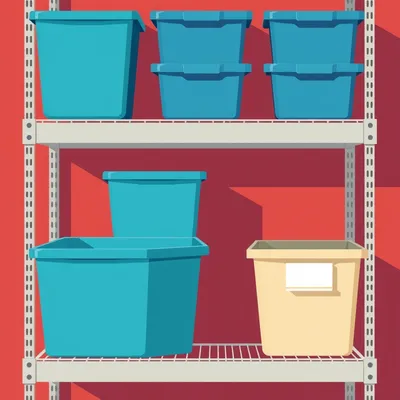
Daniel sent us this one, and it starts with a story I suspect a lot of people know in their bones. A few years back he picked up an Ivar modular storage unit at IKEA, bought what seemed like a good set of bins for it, and then a year later — discontinued. Now he's got one storage system with four different sizes of containers, and every time he's at IKEA he can't remember which dimensions he actually needs because the whole thing has become completely ununified. He looked into the Euro container system and realized he'd probably have saved money if he'd gone that route from the start — everything standardized, everything stackable. So the prompt is basically: introduce these modular storage systems for people who haven't heard of them, talk about how they work in private homes and not just warehouses, especially if you run a business from home, and cover the most useful sizes, costs, suppliers, the US standard, and the specialized systems for things like automotive garages.

That Ivar story is the exact pain point that makes this whole topic worth exploring. It's the moment you realize you've been sold a storage system that doesn't actually systematize anything. And what's fascinating is that there's been a solution sitting in warehouses and factories for decades that most homeowners have never even heard of.
The Euro container. Which sounds like something you'd find on a loading dock in Düsseldorf and nowhere else.
That's exactly the misconception we should tackle right at the top. These are just standardized plastic bins that conform to a six hundred by four hundred millimeter footprint, derived directly from the EUR-pallet standard — twelve hundred by eight hundred millimeters, ISO six seven eight zero. A standard EUR-pallet fits exactly four Euro containers in a two by two grid. No overhang, no wasted space, no shifting during transport.
The pallet is the parent standard and the containers are its logical children.
And once you understand that relationship, everything else clicks into place. The containers stack and interlock regardless of who manufactured them. Schoeller Allibert, Utz, Bekuplast — doesn't matter. A six hundred by four hundred container from one company stacks securely on the same footprint container from another. They've got interlocking lugs on the lids or rims that prevent lateral shifting. You can stack them four, five, six high and they won't slide off each other the way a pile of SAMLA bins will.
I've seen those SAMLA stacks. They have a certain Jenga-tower energy.
The common heights — this is where it gets useful for home planning — are one twenty millimeters, one seventy, three hundred, and four twenty. The three hundred millimeter height, about twelve inches, is what I'd call the Goldilocks container. Big enough for power tools, small kitchen appliances, stacks of clothing, but not so heavy when full that you can't lift it off a shelf.
Let's anchor this in the Ivar story. Daniel's got this IKEA shelving unit, it's pine, it's modular in theory, but the bins that fit it are now a patchwork of discontinued SKUs. What would the Euro container version of that setup have looked like?
Instead of an Ivar frame, you'd have a boltless shelving unit — sometimes called rivet shelving — with shelves at least six hundred millimeters deep to accommodate the container footprint. These units typically hold two thousand pounds or more per shelf, which is wildly overbuilt for household goods, but that's the point. A four-shelf unit runs somewhere between a hundred and three hundred dollars from suppliers like Uline or Global Industrial. The containers themselves, in that three hundred millimeter height, are fifteen to thirty dollars new, or five to ten dollars used.
Five to ten dollars used. That's cheaper than the IKEA bin that got discontinued.
Here's the kicker. A comparable IKEA SAMLA bin — the big one thirty liter — runs about eight to twelve dollars. But it doesn't interlock, it doesn't stack securely for transport, it doesn't fit any pallet grid, and if IKEA discontinues it, you're back to square one. The Euro container will be the same footprint in twenty years. These standards don't change.
The IKEA bin is cheaper in the cart but more expensive over time. That's the planned obsolescence of storage.
It's not just IKEA. Sterilite, Rubbermaid, all the consumer brands — they change their molds, tweak the taper angles, introduce new product lines that don't stack on the old ones. It's not malicious necessarily, but it's not designed for longevity either. The Euro container system is designed for supply chains that span decades.
Let's talk about why that pallet compatibility matters in a home context. Why should someone in a two-bedroom apartment care about the two-by-two grid?
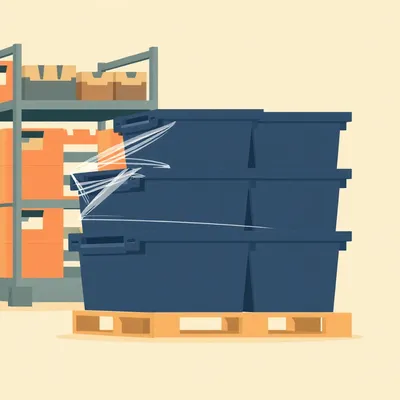
If you already own Euro containers and racking, moving becomes a matter of pulling the racking apart, stacking the containers on pallets, and shrink-wrapping them. No cardboard boxes. Professional movers charge a hundred to two hundred dollars per hour for a two-person crew. Standardized containers can reduce packing time by thirty to fifty percent because the crew isn't playing Tetris with random box sizes in the truck.
You're not buying forty cardboard boxes at three dollars each plus tape.
The moving box economy is a hidden tax on every relocation. Two hundred dollars for boxes and tape and padding that you use once and then recycle or let mildew in the basement. If you've already invested in Euro containers for your home storage, your moving container cost is zero. The only consumable is shrink wrap, maybe fifty dollars. And a manual pallet jack runs about two hundred dollars — a one-time purchase that turns your storage system into a moving system.
For about the cost of one move's worth of cardboard and labor, you can own the infrastructure that makes every future move dramatically easier.
That's the ROI argument that doesn't show up on the sticker price. When you're standing in IKEA looking at an eight-dollar SAMLA bin versus a twenty-dollar Euro container, the Euro container looks expensive. But the SAMLA bin costs you again on moving day, and again when you have to replace it because the lid cracked, and again when you buy more and they don't stack on the old ones.
There's a psychological dimension here too. A pallet stack says "I have a plan" while a cardboard pile says "I'm procrastinating." The Euro container system is that same energy applied to everyday storage. You walk into your garage and everything is uniform, everything is labeled, everything stacks. It's the visual equivalent of a well-organized spreadsheet.
It eliminates what I'd call bin archaeology — the thing where you need the one item at the bottom of a stack of four mismatched bins, so you have to unstack everything, the lids pop off, something falls, and suddenly your garage floor looks like a yard sale.
The archaeological dig through your own disorganization.
With Euro containers, because they all share the same footprint, you can access any container without unstacking the ones above it — assuming you've got them on shelves. And if they're on a dolly or pallet, you can still slide one out from the middle of a stack more easily because the interlocking is designed for stability, not permanent fusion. They're meant to be handled.
Let's get into the racking piece, because I think that's where people's eyes might glaze over. What are we actually talking about?
Boltless shelving is exactly what it sounds like — shelving units that assemble without nuts and bolts. The beams lock into the uprights using a rivet-and-keyhole system. You can put together a four-shelf unit in about twenty minutes with a rubber mallet. The shelves are typically particle board or wire decking, and the weight capacities are absurd for home use — two thousand to four thousand pounds per shelf on the heavy-duty units.
You could store an engine block on one shelf, theoretically.
The relevant spec for home use isn't the weight capacity, it's the shelf depth. Standard industrial shelving comes in depths of four hundred, five hundred, six hundred, and eight hundred millimeters. For Euro containers, you want the six hundred millimeter depth — that gives you a perfect fit for the four hundred millimeter container depth with a bit of overhang, or you can fit the containers sideways if your layout prefers that.
The eight hundred millimeter depth would let you put two containers back to back?
No, the containers are six hundred by four hundred, so on an eight hundred millimeter deep shelf you'd have four hundred millimeters of container and four hundred millimeters of dead space behind it. Better to go with six hundred deep shelves and use the full depth. Some people put the containers in sideways — so the four hundred millimeter side faces out — which gives you more containers per shelf but makes labels harder to read.
This is the kind of optimization that I find genuinely satisfying. It's like packing a moving truck but for your permanent living space.
Once you start thinking this way, you notice how much wasted space exists in typical home storage. The average garage has shelves that are sixteen or eighteen inches deep because that's what fits consumer-grade plastic shelving from Home Depot. But the wall has more depth available. A six hundred millimeter deep Euro rack uses that space efficiently.
Let's talk about the US market, because a lot of our listeners are there, and they might be wondering if this is one of those charming European things that simply doesn't exist on this side of the Atlantic.
It's a fair concern. The US pallet standard is forty-eight by forty inches, roughly twelve hundred by one thousand millimeters — wider than the EUR-pallet. But Euro containers are widely available in the US through industrial suppliers. Uline stocks them. Global Industrial stocks them. Grainger stocks them. You can find them on Amazon, eBay, and from liquidators who handle warehouse closeouts.
The containers exist, but the racking ecosystem might skew toward US pallet dimensions.
Slightly, but boltless shelving is depth-agnostic. You order the six hundred millimeter deep uprights and beams, and you're in business regardless of what pallet standard your country uses. The containers don't care. And the EUR-pallet itself is actually used globally — it's ISO six seven eight zero for a reason. Even in the US, if you're shipping internationally, you'll encounter EUR-pallets. They're not exotic.
What about used containers? You mentioned liquidation sales.
This is the hack. Euro containers are nearly indestructible. They're made of high-density polyethylene or polypropylene, UV-stabilized, can handle temperature swings from minus twenty to plus forty Celsius without getting brittle, and they're designed to survive forklift impacts and being dropped from loading docks. A used Euro container that's been in a warehouse for ten years is functionally identical to a new one — maybe a bit scuffed. Search terms: "Euro stacking container," "Euro crate," "eurobox," or the German "Eurobehälter" if you're feeling adventurous. eBay and Craigslist often have lots of twenty or thirty from warehouse cleanouts.
Five to ten dollars versus fifteen to thirty new. That's a meaningful difference when you're outfitting a whole garage.
The used market is part of what makes the system so cost-effective over time. You can start with twenty used containers and a new rack, and that's maybe four hundred dollars all in. Compare that to five years of buying IKEA bins, replacing discontinued ones, buying lids separately, and dealing with the chaos. The Euro system breaks even somewhere around year two or three.
We've covered bulk storage. But the prompt also asked about specialized systems — automotive, small parts, the kind of thing where you're organizing screws and sockets, not winter coats.
For small parts storage in garages and workshops, there are systems like Sortimo, Raaco, and Bott that use a different footprint — typically around three hundred by two hundred millimeters for the small bins — but they're designed to be compatible with Euro container racking. So you can have a single shelving unit where the bottom shelf holds four large Euro containers full of bulk items, and the upper shelves hold arrays of small parts bins for fasteners, connectors, and tools.
Sortimo is the one I've seen in work vans. Those are the modular cases with the colored bins inside.
Sortimo uses a system called T-Boxx and i-Boxx — injection-molded cases and bins that click together and fit into van racking. They're expensive, a single case can run fifty to a hundred dollars, but they're designed for mobile professionals who need to access specific tools without digging. The smaller Raaco bins, more like twenty to fifty dollars for a set of assorted compartments, are the home-gamer version. They fit on standard shelving and are great for screws, washers, electrical connectors.
The compatibility with Euro racking means you're not running two separate storage ecosystems. You've got one rack, and it holds everything from bulk containers down to compartment bins.
That's the elegance. Once you standardize on the rack depth and shelf spacing, everything else is just choosing which container format fits the items you're storing. The rack is the platform, the containers are the apps.
The iOS of garage storage. A walled garden, but the walls are made of steel and you can actually see over them.
Unlike iOS, the accessories are cross-compatible across manufacturers. You can buy lids from one company, dividers from another, a dolly from a third. They all fit because the six hundred by four hundred footprint is the interface standard.
Let's talk about lids, because that's one of those details that seems trivial until you're moving and you realize your bins don't have them.
Consumer storage bins often come with snap-on lids that are proprietary to that specific bin model. Euro container lids are standardized by footprint. A lid for a six hundred by four hundred container will fit any six hundred by four hundred container regardless of height or manufacturer. They typically have stacking lugs on top so the next container interlocks with the lid. Some lids are hinged, some are fully removable, some have access hatches. And they're sold separately, which seems annoying until you realize you only need lids for the containers on top of each stack.
Because the container above acts as the lid for the one below.
In a rack, only the top container on each stack needs a lid. The rest are covered by the container above them. That saves money and makes access faster.
If I'm starting from scratch, what's the first purchase? What does the "starter kit" look like?
One boltless shelving unit, four shelves, six hundred millimeter depth, roughly eighteen hundred millimeters tall — about six feet. Twenty to thirty Euro containers in the six hundred by four hundred by three hundred millimeter size. A label maker or a stack of adhesive labels and a Sharpie. Total cost: about four hundred to five hundred dollars if you buy used containers, maybe six hundred to seven hundred all new. That setup will store the contents of a medium-sized storage unit.
If you're running a home business — the prompt mentioned that specifically — what changes?
You add more racks. The beauty of the system is that it scales linearly. Need more storage? Buy another rack and more containers. They'll all interoperate. If you're doing e-commerce from your garage, you can dedicate one rack to inventory, one to shipping supplies, one to returns. And when you need to do a trade show or a market, you pull the containers for that product line, stack them on a pallet, shrink-wrap, and load.
That's the case study I want to hear. Someone who actually made the switch.
There's a pattern that shows up in garage-business forums repeatedly. Someone starts with IKEA SAMLA bins or Costco storage totes, their inventory grows, and suddenly they can't find anything. They can't stack bins higher than three without them leaning. They can't palletize for events. So they switch to Euro containers and a boltless rack, and they report storing about forty percent more inventory in the same footprint. The vertical density is the key — Euro containers can stack five or six high safely, where consumer bins start getting sketchy at three.
Forty percent more in the same footprint. That's not a marginal improvement, that's a transformation.
It's not just the physical density. It's the retrieval time. When every container is the same size and labeled on the same face, you can grab what you need without moving three other bins. In warehousing, they call that reducing "touches." Every time you touch a bin that isn't the one you need, that's wasted motion. Euro containers minimize touches.
Which connects back to that episode about the cost of a touch — the hidden economics of physical inventory. Every unnecessary lift, every unstack-restack cycle, is a tax on your time and your back.
Standardized containers reduce those touches dramatically. You label the short face of each container, put them on the shelf with the label facing out, and you can read the entire rack at a glance. No bin archaeology.
Let's address the aesthetic objection, because I know it's coming. Someone's going to say, "I don't want my garage to look like a warehouse.
The honest answer is that Euro containers come in colors — blue, gray, yellow, red, green — and a uniform rack of matching containers looks intentional. It looks professional. I'd argue it looks better than a chaotic pile of mismatched Sterilite bins with cracked lids and faded labels. There's a certain minimalist satisfaction to a wall of identical containers.
It's the difference between a library and a used bookstore. Both have books, but one has a system.
You can take the aesthetic further if you want. People build custom plywood enclosures around their boltless racks. They add LED strip lighting. They paint the rack uprights to match the garage. The rack is infrastructure, and you can finish it however you like.
The prompt also asked about the US standard specifically. You mentioned the forty-eight by forty inch pallet. Are there containers designed for that footprint?
The US standard is less unified than the Euro system, but the most common container footprint for US pallets is roughly twenty-four by twenty inches, about six hundred by five hundred millimeters. These are often called "attached lid containers" or "distribution totes" and they're used heavily in automotive supply chains and retail distribution. The problem is they're not as standardized across manufacturers as Euro containers. The Euro system benefits from being an actual ISO-derived standard.
If you're in the US and you want true cross-manufacturer compatibility, you're still better off with the Euro footprint, even though it's not the domestic pallet standard.
The six hundred by four hundred footprint is locked in by the EUR-pallet standard, which is itself locked in by ISO. No single manufacturer can change it. In the US, the forty-eight by forty pallet is standardized, but the container ecosystem around it is more fragmented. Uline sells "stackable storage bins" that fit US pallets, but they're Uline's own design. If Uline discontinues them, you're in the same situation as the Ivar bins.
That's the core insight, isn't it? Standardization is insurance against discontinuation.
When you buy into the Euro container system, you're buying into a standard that's been stable for decades and will be stable for decades more. The EUR-pallet was introduced in nineteen sixty-one. The container standard followed and hasn't changed meaningfully since. IKEA changes its storage lineup every few years because new designs drive foot traffic. The Euro system doesn't need to change because it already works.
There's something almost comforting about a standard that's older than I am and will outlive me.
That's part of why I find this topic exciting. It's not just about bins. It's about choosing infrastructure over disposability. We've been trained by consumer retail to think of storage as something you replace every few years. But storage should be like plumbing or electrical — you install it once and it works for decades.
Let's talk about the hidden costs of switching. If someone's convinced and wants to make the jump, what are they not thinking about?
The biggest hidden cost is disposing of the old system. If you've got fifty mismatched consumer bins, many municipal programs won't take large rigid plastics. You might need to make a trip to a specialty recycler or list them for free on Craigslist. Someone will take them.
The circle of storage life. Someone's discontinued IKEA bins become someone else's problem.
The second hidden cost is the racking assembly. Boltless shelving is easy to put together, but it's heavy. The uprights for a six-foot-tall unit can weigh thirty to forty pounds each. You might need a second person to hold things steady during assembly. And you need a level floor — garages often have a slight slope for drainage, and that can make the rack lean if you don't shim it.
That's a good practical note. Nothing undermines a storage system like a rack that's slowly tipping forward.
The third thing is that Euro containers, when full, are heavy. A six hundred by four hundred by three hundred container filled with books or tools can weigh sixty or seventy pounds. That's fine on a shelf at waist height, but if you put it on a high shelf, you need to be able to lift it safely. Part of planning your rack layout is putting the heavy containers at the bottom and the lighter ones up top.
Which is just basic physics, but it's easy to forget when you're excited about filling your new rack.
The fourth hidden cost — or hidden benefit, depending on how you look at it — is that once you standardize, you start noticing all the other areas of your life that aren't standardized. Your kitchen containers. Your office supplies. Your holiday decoration storage. The Euro container system is a gateway drug to standardization in general.
The Marie Kondo of industrial logistics.
I'd say it's more like the containerization of domestic life. Malcolm McLean revolutionized global shipping by standardizing the shipping container in nineteen fifty-six. The Euro container is the same idea at the scale of a single household.
That's a bold comparison. McLean's container changed the global economy.
The principle is identical. Standardize the container, and everything built around it — ships, cranes, trucks, warehouses — becomes more efficient. Standardize the home storage container, and everything built around it — shelving, moving, inventory management — becomes more efficient. The scale is different, but the mechanism is the same.
Let's get into some specifics for people who are ready to buy. What suppliers should they be searching?
For new containers in the US: Uline, Global Industrial, Grainger, and McMaster-Carr all stock Euro containers. Uline's selection is probably the broadest — they carry multiple heights, lids, dividers, and dollies. For used containers: eBay, Craigslist, Facebook Marketplace, and industrial liquidators like BidSpotter or EquipNet. Search terms are "Euro stacking container," "Euro crate," "eurobox," "Schoeller Allibert," or "Utz container." In Europe, the options are even broader — Amazon Germany and the UK have extensive listings, and there are specialist suppliers like Auer Packaging and Bekuplast.
Uline and Global Industrial again for boltless shelving. But you can also find it at Home Depot and Lowe's, though their selection skews toward lighter-duty units. Look for "rivet shelving" or "boltless shelving" with a depth of at least twenty-four inches — roughly six hundred ten millimeters, close enough to the Euro standard. The brand doesn't matter much; these are commodity products. Just check the weight capacity per shelf and make sure it's at least eight hundred to a thousand pounds so you're not pushing the limits with heavy containers.
For the specialized automotive systems?
Sortimo is the premium option — their van racking and T-Boxx cases are used by tradespeople across Europe and increasingly in the US. Raaco is the more affordable option for small parts storage, and their HandyBox and Assorter lines are widely available on Amazon. Bott is another European brand that makes van racking and workshop storage systems. All three use modular designs that play well with Euro container footprints.
What about the IKEA of this world? Are there consumer-grade products that come close?
IKEA's TROFAST system is modular for kids' toys but doesn't stack or palletize. The KUGGIS line uses non-standard dimensions. The SAMLA bins are the closest in spirit to Euro containers — they're clear plastic, they come in multiple sizes — but the dimensions are arbitrary, they don't interlock, and the lids are flimsy. There's a reason you see SAMLA bins with cracked corners in every basement.
The universal constant of home storage: a cracked SAMLA lid.
The thing is, IKEA could absolutely make a Euro-compatible storage line. They have the manufacturing scale, the distribution network, and the design expertise. They choose not to, because their business model rewards product churn. A storage system that lasts twenty years doesn't generate repeat visits to the store.
That's the planned obsolescence you mentioned. IKEA benefits when you have to come back because your bins don't match anymore.
It's not just IKEA. It's the entire consumer storage industry. Sterilite changes its product line every few years. Rubbermaid discontinues the bins you bought last decade. The industry has no incentive to standardize because incompatibility drives replacement purchases.
The Euro container system isn't just a better product. It's a different economic model. It's infrastructure sold into a market that's built around disposability.
That's why most homeowners have never heard of it. The marketing budget for industrial storage is essentially zero at the consumer level. These products are sold through B2B channels to warehouse managers and logistics planners. The fact that they're also perfect for home garages is an accident of standardization.
An accident we're happy to exploit.
The more people who adopt these systems for home use, the more the used market grows, and the more accessible they become. It's a virtuous cycle.
Let's bring this back to the moving angle, because that's where this whole conversation started. The pallet episode.
If you've already got Euro containers on boltless racks, moving day looks like this: you pull the containers off the shelves, stack them four to a pallet, shrink-wrap the stack, and roll the pallet onto the truck with a pallet jack. The racking comes apart with a rubber mallet in about ten minutes per unit. The uprights and shelves go on the truck as flat-packed metal. At the new place, you reassemble the racks, unstack the pallets, and put the containers back on the shelves. You're done in hours, not days.
The alternative is the cardboard box ballet — assembling boxes, taping them, filling them, labeling them, stacking them, having them collapse, having the bottom fall out of the one with the kitchen stuff.
The cardboard box economy is a tax on people who don't own standardized storage. And it's a regressive tax — it hits renters and young people hardest, because they move more often and have less money for infrastructure.
That's a important point. The people who would benefit most from this system are the ones least likely to know about it or be able to afford the upfront cost.
That's where the used market becomes so important. You can build a Euro container setup for the cost of two or three moves worth of cardboard boxes and tape. If you're planning to stay in one place for five years, it pays for itself. If you move sooner, you take it with you and it keeps paying.
What's the first step for someone who's convinced but overwhelmed? What do they do tomorrow?
Measure your space. Figure out where the rack is going to go, and measure the width, depth, and height available. A standard boltless rack is about thirty-six inches wide and six feet tall, but they come in narrower and wider versions. Once you know your dimensions, order one rack and twenty containers in the six hundred by four hundred by three hundred millimeter size. Don't overthink the configuration — you can adjust shelf heights later. Just get the system into your space and start using it.
Start small, prove the concept, then expand.
The mistake people make is trying to design the perfect system before they've ever touched a Euro container. Buy a small batch, use them for a month, and you'll figure out what heights and configurations work for your stuff. Then buy more.
The prompt also asked about dry goods storage — kitchen applications. Is that a real thing?
It is, especially in Europe. Euro containers are food-safe if they're made from virgin HDPE or polypropylene. People use them for bulk dry goods — flour, rice, pasta — in pantry setups. The three hundred millimeter height is great for this because you can see the contents at a glance and scoop from the top. The containers are airtight enough for dry goods, though I wouldn't use them for long-term storage of anything that needs a hermetic seal.
Your garage and your pantry could be running on the same container system. That's either beautiful or deeply concerning, depending on your personality.
I'd say it's beautiful. But I'm the one who gets excited about boltless shelving specifications, so my calibration might be off.
Your calibration is exactly where it needs to be for this topic. So let's wrap with some concrete numbers for people who want to price this out. What's the all-in cost for a starter system?
One boltless rack, four shelves, six hundred millimeter depth: roughly a hundred fifty to two hundred fifty dollars depending on brand and weight capacity. Twenty used Euro containers at the three hundred millimeter height: roughly a hundred to two hundred dollars depending on condition and source. Ten lids: about thirty to fifty dollars. A manual pallet jack if you're planning to move: about two hundred dollars. Total: around five hundred to seven hundred dollars for a system that will last decades and pay for itself in one or two moves.
The comparable IKEA setup?
An Ivar shelving unit with a few shelves and cabinets might run two hundred to three hundred dollars. Twenty bins of various sizes that may or may not fit properly, another hundred fifty to two hundred dollars. And none of it stacks, palletizes, or survives a move intact. The IKEA setup looks cheaper on day one, but the Euro system wins by year three.
That's the headline, really. Euro containers are the buy-once-cry-once of home storage.
The crying is mostly about having to admit that industrial logistics solved this problem fifty years ago while the rest of us were buying cracked SAMLA bins.
I want to leave listeners with one question that might reframe how they think about storage entirely. The next time you're standing in front of a wall of bins at IKEA or Target or wherever, ask yourself: am I buying storage, or am I buying a future headache? Because if the answer is the second one — and it almost always is — there's a better way. It's just not in the aisle you're standing in.
Standardization is freedom. It's not the sexiest slogan, but it's true. When everything fits everything else, you stop thinking about storage and start thinking about what you actually want to do with your space.
Now: Hilbert's daily fun fact.

Tardigrades in the desiccated "tun" state can survive temperatures up to one hundred fifty-one degrees Celsius, but certain species found in the Aral Sea basin express a unique carotenoid pigment that shifts from orange to deep red as salinity increases, essentially acting as a natural salinity meter visible to the naked eye.
A salinity meter you can see. Nature's litmus test, in tardigrade form.
That's going to sit with me.
This has been My Weird Prompts. Thanks to our producer, Hilbert Flumingtop, for the fact that I now know tardigrades change color when the salt goes up. If you enjoyed this episode, leave us a review wherever you listen — it helps more people find the show. Find transcripts and past episodes at myweirdprompts dot com.
I'm Corn.
I'm Herman Poppleberry.
Measure your shelves before you buy the bins.