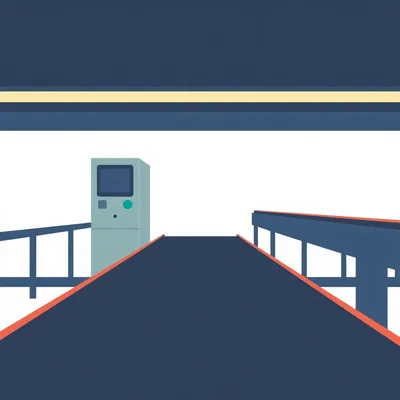
Daniel sent us this one — he's been driving Route 443 between Jerusalem and Tel Aviv, and he passes Ofer Prison, the Ofir Camp, with its watchtower that looks like it hasn't been updated since the seventies, some rusted barbed wire, and not much else. He also mentions the Russian Compound police station in Jerusalem — notorious interrogation facility, but it's got a popular bar right next door. His question is basically: these places look shabby and low-tech from the outside, but they're clearly high-security facilities. What's the security we're not seeing? What's actually keeping the perimeter secure, both from the outside looking in and the inside looking out?

That visual contradiction is exactly what makes this so interesting. You drive past Ofer on the four-four-three, and it looks like a relic — a watchtower that could be a set piece from a nineteen-seventies war film, some barbed wire that's probably older than both of us combined. And yet this is a maximum-security facility holding high-risk detainees. Your brain does a double-take. Is this neglect, or is it deliberate?
I think most people's instinct is to assume neglect. Government facility, limited budgets, things fall apart. But Daniel's actually onto something much more interesting — the possibility that the shabbiness is the point.
And we know this now more than ever because of what happened on October seventh, twenty twenty-three. The Gaza perimeter fence was the most visible security barrier in the region — billions of dollars, concrete, sensors, the whole package — and it was breached in hours by people with paragliders and bulldozers. That failure rewired how security professionals think about visible versus invisible defenses. The stuff you can see failed. The question becomes: what was supposed to be working behind it?
Let's start with what you actually see when you look at a place like Ofer, and then pull back the curtain on what you don't. Because Daniel's prompt is really about three things happening at once — the visible deterrent, the concealed hardening, and the surveillance layer you can't detect at all. Most people only register layer one.
Layer one is what Daniel described — barbed wire, concrete walls, watchtowers. And here's the thing about barbed wire: it's not designed to stop a determined attacker. It costs about ten to twenty dollars per linear foot. It's a psychological tool. It says "this is a boundary, crossing it will hurt, and beyond it there are people with guns." Its real function is channeling — it forces anyone approaching to move toward controlled entry points where they can be observed and challenged. It's the security equivalent of a "keep off the grass" sign, except the grass is also sharp.
The barbed wire is basically theater. Not fake theater — it will cut you — but its purpose is behavioral, not physical.
And that watchtower that looks like it's from the seventies? The concrete structure itself might be old, but what's inside it almost certainly isn't. Modern watchtowers at facilities like Ofer function as sensor fusion hubs. They aggregate data from buried sensors, camera arrays, drone detection systems, and communications intercepts into a single operator console. The tower is just a box. The contents get upgraded constantly.
Which brings us to layer two — the stuff you can't see at all. And this is where it gets genuinely clever.
Layer two is concealed hardening. The star of the show here is buried fiber-optic sensor fencing. Picture a cable buried six to twelve inches underground around the entire perimeter. It works by detecting seismic disturbance through changes in light transmission through the fiber. Someone walks near it, the ground vibrates microscopically, and that vibration changes how light travels through the cable. The system can pinpoint the location of the disturbance within a few meters.
It's essentially a microphone for the ground.
It's not cheap — about a hundred to two hundred dollars per linear foot, compared to ten to twenty for barbed wire. But it's invisible. You can't cut it because you don't know exactly where it is. You can't jam it because it's passive — it's just listening. And modern systems can distinguish between a human footstep, a vehicle, an animal, and environmental noise like wind or rain.
What else lives in layer two?
These are invisible tripwires — a transmitter and receiver create a focused beam of microwave energy between them. Anything that passes through the beam disrupts the signal and triggers an alert. They're used to cover gaps in the buried sensor coverage, or to create secondary perimeters inside the main fence line. Then there's ground-penetrating radar for tunnel detection — which became a very big deal after certain events in Gaza. The radar sweeps the ground continuously, looking for voids and excavations. Combined with the seismic sensors, you get a pretty complete picture of what's happening underground.
All of this is completely invisible from the road. Daniel drives past, sees rusty wire and an old tower, and has no idea there's a web of microwave beams and fiber-optic ears surrounding the place.
That's the operational security benefit. If a facility looks like a dump, it reduces the likelihood of targeted attacks. An insurgent doing reconnaissance might drive past and think "this place is falling apart, we can probably get through." They underestimate it. And that underestimation leads them to make mistakes — like not accounting for the buried sensor net they can't see.
The shabbiness as camouflage. It's almost like the military equivalent of a sleeper car — unremarkable on the outside, engineered to the teeth underneath.
Layer three is where it gets even more sophisticated — behavioral and electronic surveillance. We're talking AI-driven video analytics that don't just record footage but actually interpret it. The system watches for specific behaviors: loitering near the perimeter, climbing motions, objects being thrown over the fence, groups forming in unusual patterns. Traditional motion detection would trigger on a bird or a plastic bag blowing in the wind. Modern AI analytics reduce false alarms by eighty to ninety percent because they understand context.
The camera isn't just a camera anymore. It's a behavioral analyst that never blinks.
It's paired with thermal imaging that sees through dust, fog, and low light — which matters in a desert environment where dust storms are common. Then there's drone detection. Since October seventh, this has become mandatory at every high-security facility in Israel. RF scanners that detect the radio signals between a drone and its operator, acoustic arrays that listen for the specific sound signature of drone propellers, and optical systems that can track and identify drones visually. All of this feeds into a central security operations center where operators monitor a fused picture of everything happening around the perimeter.
Let's talk about the Russian Compound, because that's a fascinating case. You've got a nineteenth-century building that houses a police station with an interrogation wing, and right next door there's a popular bar. Civilians are drinking beer thirty meters from where interrogations are happening.
The civilian adjacency problem is one of the hardest challenges in urban security design. At the Russian Compound, you can't build a fortress — it's in the middle of Jerusalem. So the security has to be retrofitted invisibly into a historic building, and it has to account for the fact that civilians are constantly in close proximity. That bar next door is, from a security perspective, a counter-surveillance nightmare. Anyone can sit there with a drink and observe shift changes, patrol patterns, vehicle movements.
How do you secure that?
Aggressive counter-surveillance. Plainclothes security personnel are almost certainly present in and around that bar. There are likely facial recognition cameras covering the entrance — anyone who shows up repeatedly gets flagged. Regular sweeps for listening devices, because if you can sit at a table thirty meters from an interrogation room, a directional microphone becomes a real threat. And ground-penetrating radar isn't just for tunnel detection in this context — it's also for detecting buried devices or excavations near the building foundation.
The bar patrons have no idea they're being passively screened by a security apparatus that's watching for patterns.
That's the elegance of it. The civilian presence actually helps obscure the security activity. In a rural facility like Ofer, anyone approaching the perimeter stands out. In an urban setting, the crowd provides cover — but it also provides cover for the security forces. They blend in.
The Russian Compound is essentially a nineteenth-century shell containing a twenty-first-century surveillance node, surrounded by a civilian environment that's being quietly monitored by people you can't identify.
That's the model. And it's not unique to Israel — you see similar approaches at high-security urban facilities worldwide. But the Israeli context adds a particular urgency because the threat environment is so active.
Let's flip the direction. Daniel asked about security from the inside looking out too. Keeping people in, not just keeping people out.
The inside-out problem is actually more technically demanding than the outside-in problem, for a simple reason: prisoners have inside knowledge. They know the layout, they know the routines, they know when shift changes happen, and they have nothing but time to study the security. Escape detection systems have to be more sophisticated because the adversary is more informed.
What does that look like in practice?
Buried magnetic field sensors are common. They detect the presence of metal objects moving underground — like digging tools. Pressure pads under the soil that trigger if weight is distributed in an unusual pattern. Tripwires in unexpected locations. But the real innovation is in behavioral monitoring inside the facility. AI systems that track prisoner movement patterns and flag anomalies — someone spending too much time in a particular area, groups forming in unusual configurations, changes in noise levels that might indicate digging or construction.
The same AI that's watching the outside perimeter is also watching the inside, looking for patterns that don't belong.
This is where the Gilboa Prison escape in twenty twenty-one becomes the essential case study. Six Palestinian prisoners escaped through a tunnel they'd dug under the perimeter. The tunnel was detected by seismic sensors — the technology worked. But the alert was dismissed as a false alarm. The human operator looked at the data and decided it wasn't worth investigating.
The multi-million-dollar sensor net did its job, and a person said "probably nothing.
And that's the fundamental vulnerability in any perimeter security system. The technology is only as good as the humans who respond to its alerts. False alarm fatigue is a real operational problem. If your system triggers fifty alerts a day and forty-nine of them are cats or wind or nothing, your operators learn to ignore alerts. That's why the AI-driven false alarm reduction is so critical — it's not just about saving money on response teams, it's about preserving operator attention for the alerts that actually matter.
The Gilboa case is almost a perfect illustration of the whole thesis. The visible perimeter — walls, fences, guards — was defeated by a tunnel. The hidden perimeter — seismic sensors — detected the tunnel. And the human layer failed. Three layers, and the failure happened at the one layer that doesn't appear on any spec sheet.
It's worth comparing this to how other countries handle the same problem. ADX Florence in Colorado, the federal supermax, uses a similar multi-layer approach but with much more visible hardening — massive concrete walls, steel reinforcement, the whole fortress aesthetic. The Israeli approach favors concealment, particularly in urban settings. You can't build ADX Florence in central Jerusalem. So you build invisible ADX Florence inside a nineteenth-century Russian Orthodox compound.
Which brings us to the cost question. What does all this actually cost, and why does Israel invest so heavily in the hidden layers while keeping the visible layers cheap?
Let's put numbers on it. Visible barbed wire: ten to twenty dollars per linear foot. Buried fiber-optic sensor fence: a hundred to two hundred dollars per linear foot. A full multi-layer system with AI analytics, thermal cameras, drone detection, and sensor fusion: can exceed a thousand dollars per linear foot. For a facility with a perimeter of, say, two thousand feet, you're looking at two million dollars just for the perimeter security, not counting the building, the personnel, the ongoing operations.
The rusty barbed wire isn't neglect — it's a resource allocation strategy. Every dollar you spend on visible hardening is a dollar you can't spend on buried sensors and AI analytics.
The buried sensors do more work. Barbed wire doesn't tell you anything — it just sits there. A fiber-optic sensor cable generates data continuously. It learns the normal seismic signature of the environment and flags anomalies. It's not just a barrier, it's an intelligence-gathering asset. From a security engineering perspective, that's a much better return on investment.
When Daniel drives past Ofer and sees a seventies watchtower and some rusted wire, the appropriate response isn't "they're not trying." It's "they're trying very hard, and they want you to think they're not.
That's the operational security principle. If a facility looks formidable, attackers study it more carefully. They plan more meticulously. They bring more resources. If it looks like a dump, they get sloppy. And sloppy attackers trigger sensors.
Let's talk about false alarms a bit more, because I think that's the part of this that most people don't appreciate. You mentioned eighty to ninety percent reduction from AI. What was the baseline?
Traditional perimeter security systems — motion detectors, basic seismic sensors, infrared beams — could generate hundreds of false alarms per day at a facility like Ofer. Wind, wildlife, temperature changes, vehicle traffic on Route 443, even the vibrations from heavy trucks passing on the highway. Every one of those required a human to assess and respond. The operator's job was essentially triage — figure out which of the hundred beeps is a real threat before your attention span runs out.
Which it does, after about twenty minutes of constant beeping.
There's research on this — alarm fatigue sets in quickly, and once it does, response times degrade and error rates climb. The AI systems that have been deployed in the last five years learn the baseline signature of the environment. They know what a truck on Route 443 feels like to the seismic sensors. They know what a bird landing on the fence looks like to the cameras. They know what wind through the barbed wire sounds like to the acoustic arrays. And they filter all of that out, so the operator only sees anomalies that don't match any known benign pattern.
The operator goes from a hundred alerts a day to maybe five or ten, and those five or ten are actually worth investigating.
That's the difference between a security system that works and one that doesn't. Not the sensors, not the barriers, not the cameras — the signal-to-noise ratio that reaches the human decision-maker.
Which loops us back to Gilboa. The sensor worked. The alert was real. The human dismissed it. All the technology in the world can't fix that unless you also fix the process and the training.
The post-Gilboa reforms in the Israeli prison system were almost entirely about process, not hardware. They didn't rip out the seismic sensors and buy new ones — the sensors were fine. They changed the protocols for alert verification, added mandatory secondary confirmation for tunnel-related alerts, and restructured shift schedules to reduce operator fatigue. The technology was never the problem.
Let's talk about something Daniel didn't explicitly ask but that's implicit in his prompt — the drone question. Since October seventh, drones have gone from a niche threat to the primary concern for perimeter security everywhere. What's changed?
Before October seventh, drone defense was mostly about protecting against surveillance drones — someone flying a consumer quadcopter over the fence to take photos. The Gaza attack demonstrated that cheap commercial drones can be weaponized effectively — dropping grenades, conducting reconnaissance for ground assaults, even acting as loitering munitions. A fifty-dollar drone can defeat a million-dollar fence by simply flying over it.
You can't put a roof on a prison.
You can — some facilities do have anti-drone netting or canopy systems — but it's expensive and it creates its own problems with visibility and ventilation. The more common approach now is layered drone detection and mitigation. RF scanners that detect the control signals between the drone and its operator, and can sometimes identify the operator's location. Acoustic sensors that recognize the sound signature of specific drone models. Radar systems optimized for tracking small, slow-moving objects. And then the mitigation piece — jamming, spoofing, or in some cases kinetic interception.
All of this is invisible from the road too. Daniel drives past Ofer and has no idea there's a counter-drone system scanning the airspace above the facility.
The watchtower that looks like it's from the seventies probably has antenna arrays on it that are very much from the twenty-twenties. They're just designed not to look like anything special from a distance.
Let's pull this together into something useful. What does all this mean for the people who design these facilities, operate them, or just observe them from the highway?
For security professionals, the core lesson is that the visible perimeter is a decoy. It's not where your security budget should go. The real security is in the sensors you can't see and the processes that interpret their data. And the biggest vulnerability isn't a gap in the fence — it's an operator who's tired, bored, or conditioned to ignore alerts. Invest in false alarm reduction. Invest in operator training. Invest in protocols that require verification before alerts are dismissed.
For the curious observer — which is what Daniel is, driving past these places and wondering — the lesson is: don't mistake shabbiness for vulnerability. If a facility looks like it's falling apart, that's probably intentional. The most dangerous perimeter is the one that looks harmless.
For policymakers, Gilboa is the case study that should be required reading. A multi-layer system with seismic sensors, ground-penetrating radar, and AI analytics still failed because one person looked at a real alert and decided it wasn't worth their time. You can't buy your way out of the human factor. You have to design processes that account for it.
There's an open question here that I think is worth sitting with. As drone technology and AI advance, will the hidden layer eventually become visible? If attackers can map buried sensors from the air using ground-penetrating radar of their own, or if AI can analyze satellite imagery to identify sensor arrays, the advantage shifts. The invisible becomes visible.
That's the arms race. Every hidden sensor eventually has a countermeasure. The fiber-optic cable can be detected with the right equipment. The microwave barrier can be mapped. The AI analytics can be spoofed with adversarial patterns. The question isn't whether any single layer is impenetrable — none of them are. The question is whether the layers work together well enough that an attacker has to defeat all of them simultaneously, and whether the human at the console is alert enough to notice when something doesn't add up.
The next time you drive past a run-down-looking facility with rusted barbed wire and a watchtower that looks abandoned, ask yourself: what am I not seeing? Because that's the real perimeter.
If you're Daniel, maybe don't pull over to take photos.
No, definitely don't do that. The buried sensors will notice.
And now: Hilbert's daily fun fact.

During the early Renaissance, travelers crossing the Gobi Desert commonly consumed dried camel milk curds mixed with powdered mare's milk as their primary sustenance — a single pound of this mixture provided roughly three thousand eight hundred calories, equivalent to about seven modern energy bars.
...right.
Thanks to our producer Hilbert Flumingtop. This has been My Weird Prompts. If you want to send us your own questions about the security you can't see, email the show at show at my weird prompts dot com. We'll be back next week.