Daniel sent us this one, and I have to say, it's personal. He's asking about the three in one — that quintessential Irish late-night takeaway, chips, curry sauce, and rice, all in one box — where it came from, what culinary traditions collided to produce it, and whether anyone actually invented it or if it just sort of... materialized out of collective hunger and desperation at closing time.

I mean, two in the morning, you've just been ejected from a pub, it's cold, it's damp, and your body is demanding something warm and carb-heavy. The three in one is basically the answer to a question that doesn't need to be asked twice.
It's a dish that only makes sense in context. Which is exactly why it's interesting. By the way, today's episode is powered by Claude Sonnet four point six.
Good to know our script is in capable hands. So, the three in one — what's the deal with that? Let's break it down.
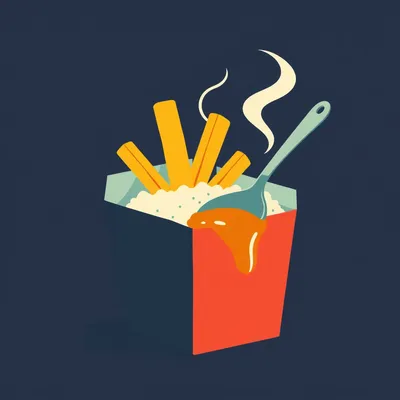
At its core, the three in one is exactly what it sounds like. You get chips, curry sauce, and rice — usually boiled, sometimes egg fried — all piled into one container. That's the canonical version. Some places throw in a spring roll or a battered sausage depending on who's behind the counter, but chips, curry, rice is the holy trinity.
The research actually confirms this came out of Ireland's Chinese takeaway scene specifically. It's not a chipper dish in the traditional sense — it's not cod and chips wrapped in paper. It's a Chinese takeaway adaptation. The chippers and the Chinese restaurants occupied slightly different niches in the late-night ecosystem, and the three in one is firmly in the Chinese takeaway column.
Which is worth pausing on, because I think a lot of people assume it's just a chip shop thing. The word "chipper" gets used loosely.
Right, and that distinction matters for understanding where it came from. The Chinese takeaways were doing something specific — they were translating their menu into what a hungry Irish crowd at midnight actually wanted, which was something warm, filling, starchy, and saucy. Rice plus chips is almost aggressively carb-forward, but that's precisely the point.
There's a reason nobody's ordering a salad at two in the morning.
And the curry sauce element is doing a lot of work there — it ties everything together, it's warm, it's got enough flavor to cut through the oil. As a delivery mechanism for post-pub satisfaction, it's genuinely well-engineered.
I keep coming back to the rice-and-chips combination though, because on paper that sounds like a mistake. Like someone knocked two orders into the same box by accident.
Yet it works. I think the key is texture — the chips give you that crispy exterior and soft interior, the rice gives you something that absorbs the sauce differently, more evenly, and the result is that every forkful is slightly different from the last. You're not eating one monotonous thing. You're eating three things that happen to coexist very peacefully.
It's accidental variety engineering.
Nobody sat down and thought about mouthfeel. They just put the things in the box and it turned out to be a good decision.
We've got a dish built for a very specific moment. But how did that moment come to exist? What forces shaped Ireland's late-night food culture to make something like this iconic?
It really comes down to urbanization and licensing law. Ireland in the early seventies was changing fast, especially Dublin. You had a population shift from rural to urban, young people moving into the city for work, and a pub culture that had been the social center of Irish life for generations. But pubs closed at eleven, sometimes half ten depending on the county, and that created a gap. Suddenly, you've got a crowd of people out on the street with nowhere to go and nothing to eat.
Which is a problem that commerce tends to solve pretty efficiently.
And what filled that gap was the takeaway. Chipper shops had been around since the late nineteenth century — the Italians brought fish and chip culture to Ireland and Britain, and it stuck. But the late-night economy around chippers really accelerated through the sixties and into the seventies as urbanization put more people in city centers after dark.
That Italian connection is interesting actually. Because when most people think about Irish food history they're not thinking about Italian immigrants as a foundational piece.
It's one of those things that gets lost. The Italians who came over — a lot of them from the Veneto region and parts of Tuscany — they set up chip shops because the overhead was low, the product was simple, and there was clearly an appetite for it. In Scotland you've got a similar story. The chippie as an institution is substantially Italian in origin, which nobody advertises.
Even before the Chinese takeaways enter the picture, Ireland's late-night food culture already has this immigrant-driven, adaptive quality to it.
The template was already there. And it's worth saying that the chipper wasn't just a food stop — it was a social institution. You went to the chipper after the dance, after the match, after the pub. It had a specific place in the rhythm of a night out that was already established by the time the Chinese takeaways arrived.
The infrastructure was already there. The chippers existed. The question was what came next.
And what came next was a wave of Chinese immigration into Ireland, particularly from Hong Kong, that brought Chinese restaurants and takeaways into cities that had never really seen them before. By the mid-seventies you had Chinese takeaways operating in Dublin, Cork, Limerick — and crucially, they were open late. Later than most chippers, later than anything else on the high street.
Which in a pub culture is a significant competitive advantage.
It's the whole game. If you're the only place serving hot food at midnight, you don't need a Michelin star. And these Chinese takeaways were smart about it — they weren't trying to recreate Hong Kong cuisine for an Irish audience that had no reference point for it. They were adapting. Chips were already on the menu because chips are what people wanted. The curry sauce was a British-style adaptation — that thick, slightly sweet, mildly spiced sauce that bears some ancestral relationship to Indian curry but had already been filtered through decades of British chip shop culture before it landed in Ireland.
The curry sauce isn't even Chinese, really. It's a kind of culinary telephone. Indian spices, British adaptation, Irish Chinese takeaway.
And nobody was precious about it. The goal was to give people something that tasted good and filled the need. Rice made sense because it was already on the menu, it was cheap, it was filling, and combined with chips you had a volume of carbohydrate that could absorb a significant quantity of Guinness.
Medically speaking, yes. And the economic dimension is important here too. This was not an expensive dish. Ireland in the seventies was not a wealthy country — unemployment was high, emigration was still a major fact of life, and disposable income was limited. The three in one was a meal you could afford after a night out. It democratized late-night eating in a way that a sit-down restaurant never could have.
How cheap are we talking, roughly? Because I think that framing matters — there's a difference between "affordable" and "this is what you could scrape together from your pocket at the end of a night.
The latter, really. In the late seventies and into the eighties, you're talking about something in the range of a pound or less in many places. Which, even accounting for inflation, was positioned to be accessible to people who hadn't budgeted for a meal out — people who'd spent their money on pints and were now working with whatever was left. It wasn't a treat. It was a necessity that happened to be satisfying.
There's something almost elegant about that. The dish exists precisely because it's cheap, filling, and available when nothing else is. It's not aspiring to be anything other than what it is.
That lack of pretension is part of why it lasted. There's an RTE piece from earlier this year that traces the three in one as part of Ireland's broader food-on-the-go tradition — alongside things like crubeens, which are pig's trotters, and the spiceburger, which is this spiced meat patty that was a Dublin chipper staple. The through line is food that serves a functional purpose in a specific social context.
Crubeens and curry sauce. Ireland contains multitudes.
It really does. And the spiceburger is actually a useful comparison point because it has a similarly murky origin story — there's a manufacturer, Doyle's, who's been making them since the forties, but the exact moment when they became a chipper institution rather than just a product is hard to pin down. The cultural adoption happened gradually and then all at once, which is the same pattern as the three in one.
The dish doesn't become iconic at the moment it's created. It becomes iconic when enough people have had the same experience of eating it under the same circumstances.
Critical mass of shared memory. And you can't manufacture that. You can only create the conditions and wait.
The Chinese takeaways threading into that existing tradition is the key move. They weren't replacing Irish late-night food culture — they were extending it, offering something that slotted into the same ritual at the same hour, just with a different culinary vocabulary underneath. Which brings us to the spice bag, right?
The spice bag is the next chapter in that story. Because the three in one didn't just sit still — it evolved.
It didn't. The spice bag is basically what happens when the three in one gets a makeover. Strips of fried chicken, crispy vegetables, spiced chips, all tossed together — it came out of the Sunflower Chinese Restaurant in Templeogue in Dublin, around late 2008 or early 2009. And the format is clearly descended from the three in one. Same logic: multiple components, one container, optimized for eating standing up in the cold.
The timing of that is interesting too — 2008, 2009, right in the middle of the financial crash. Ireland was getting hammered economically. Is there something to the idea that the spice bag emerged partly because it was, again, a cheap and filling option at a moment when people needed that?
The crash hit Ireland particularly hard — there was a real contraction in disposable income, the property bubble had collapsed, emigration started ticking back up. And the spice bag is not an expensive dish. The chicken strips and spiced chips are economical to produce, the portion sizes are generous. It fits the same economic logic as the three in one did thirty years earlier.
History rhyming, as it tends to do.
The other thing about the spice bag timing is that social media was just starting to become a real force. The three in one spread by word of mouth in the most literal sense — you had it, you told someone, they went and had it. The spice bag got that same word of mouth but also started appearing on early food blogs and eventually Twitter, which accelerated its spread enormously. It went from a single restaurant in Templeogue to a nationwide phenomenon in a way that would have taken the three in one a decade.
The three in one essentially spawned its own successor. Which tells you something about how durable the underlying idea was.
The template was sound. And the spice bag apparently emerged from end-of-shift experimentation — kitchen staff playing with available ingredients after the dinner rush. Nobody sat down and designed it. It just happened, and then it spread.
Which is the same story as the three in one itself. No documented inventor, no founding moment. Just a dish that materialized out of a particular set of conditions and stuck around because it worked.
That's actually quite common with communal food traditions. The things that survive aren't usually the things someone invented — they're the things that solved a real problem for enough people that they kept getting ordered.
What does the three in one actually do for people socially? Because I think there's more going on than just calories.
There's a lot going on. Post-pub eating in Ireland is communal in a way that's hard to overstate. You've spent the evening in a pub, which is already a social institution with its own rituals and rhythms, and then the queue at the takeaway becomes an extension of that. You're standing outside with the same people you were drinking with, or strangers who were in the same pub, and there's this shared state of mild hunger and mild dishevelment and the collective project of obtaining food. The three in one is the thing you eat together at the end of the night.
It's almost a closing ceremony.
The format helps — it comes in one box, it's easy to share, you can eat it walking or sitting on a kerb or on the bus home. There's no table required, no cutlery situation to navigate. It fits the moment perfectly.
Although I will say — eating chips with a plastic fork at two in the morning on a bus is its own kind of challenge. The structural integrity of a plastic fork is not rated for cold chips.
The fork is aspirational. Most people abandon it within ninety seconds and just use their hands, which is the correct choice. The fork is there to make you feel like you're having a meal rather than just eating directly from a box, which is a useful fiction at that hour.
The fork as social performance.
You're not an animal, you have a fork. You're just choosing not to use it.
Compare that to something like a kebab, which is doing a similar job in British or German late-night culture. The kebab is also portable, also post-pub, also filling.
The kebab is more individualized though. You're eating your kebab, I'm eating mine. The three in one — especially when people start sharing chips across containers — has a more communal texture to it. And the curry sauce is almost designed to be dunked into, which encourages that kind of informal sharing.
The curry sauce as social lubricant.
And there's a German parallel worth mentioning actually — the currywurst, which is sliced sausage with a curried ketchup sauce, has a similarly well-documented origin story, a woman named Herta Heuwer in Berlin in 1949, and it occupies a very similar cultural space. Post-work, post-event, street food, cheap, filling. But the currywurst has this single documented inventor, there's a museum dedicated to her, there's a plaque. Whereas the three in one has nobody. No plaque, no museum, no founding figure.
Which is kind of fitting for something that emerged from collective need rather than individual ingenuity.
The currywurst is a product. The three in one is a tradition. The distinction matters.
Then you've got the variations, because nothing stays static. Some places started offering cheese on top — which is its own kind of commitment — or gravy instead of curry sauce for people who wanted something more in the British chip shop tradition. You'd get places adding spring rolls, adding battered sausage, and eventually the line between the three in one and whatever the house special happened to be got fairly blurry.
Is it still a three in one if you've got cheese, gravy, a spring roll, and a battered sausage on top?
Philosophically, I think you've left the three in one behind and entered something else entirely. But nobody's policing it at midnight.
As it should be. What's its status now though? Because Ireland's food scene has changed considerably. You've got more options, more cuisines, more everything.
It's still around — you can still get it in Chinese takeaways across Ireland. But it's no longer the only game in town the way it was in the seventies and eighties. Burgers got more serious, kebab shops expanded, and the spice bag essentially ate into its own market share. Younger generations might know the spice bag better than the three in one.
The child surpassing the parent.
In a very greasy sense, yes. But the three in one hasn't disappeared. It occupies a slightly nostalgic register now — people who grew up with it have an attachment to it that the spice bag, however good, can't quite replicate. It's the original.
Nostalgia is a strange thing with food specifically, because it's one of the few areas where the memory is almost always better than the reality — except sometimes it isn't, and the thing actually holds up.
The three in one holds up. I think that's the honest answer. If you eat one now, it's not a disappointment. It's not one of those things where you've built it up and then the actual experience deflates you. The chips are still chips, the curry sauce is still warm and slightly sweet, the rice still does what rice does. The function is intact.
The nostalgia is earned rather than borrowed.
It's not trading on memory alone. There's something actually there.
There's something almost poignant about that. A dish that was purely functional — cheap, filling, available — acquiring sentimental value decades later precisely because of what it represented in the moment.
Food does that. The function and the memory become inseparable. You're not just eating chips and curry sauce, you're eating a particular version of being young in Ireland at two in the morning with nowhere particular to be.
That's what separates food from fuel. Fuel you forget once it's done its job. But food that carries memory? That's a different category entirely.
The three in one earns that status honestly. It wasn't designed to be memorable. It was designed to be available and affordable and sufficient. The nostalgia came later, as a byproduct of the moment it inhabited.
What do you actually take away from all this? Because I think there are a couple of things here that go beyond just one dish in one country.
The big one for me is how necessity shapes culinary innovation. The three in one didn't emerge from a test kitchen or a chef with a vision. It emerged from a specific collision of circumstances — pub culture, licensing laws, urbanization, immigration, economic constraint — and the dish that resulted was perfectly calibrated to all of them simultaneously. That's not design, that's evolution.
The corollary to that is that comfort food isn't a lesser category. It's doing serious cultural work. The three in one is holding together a late-night social ritual that would otherwise just dissolve into people going home separately.
The shared box of chips is load-bearing infrastructure.
And I think there's something in the immigration story that deserves to be said plainly — the Chinese takeaways that created and popularized this dish were run by people who were navigating a new country, adapting their culinary traditions to serve a community that wasn't theirs by birth, and in doing so they produced something that became Irish in the cultural sense. That's a form of contribution that doesn't always get named.
It doesn't. And it's not unique to Ireland — you see the same pattern in Britain with South Asian restaurants and the chicken tikka masala story, in America with Italian-American food, in Australia with the various waves of immigrant cuisines that became embedded in the national food culture. The food that ends up feeling most local is often the food that came from somewhere else and adapted.
The adaptation is the point. The willingness to meet people where they are, at midnight, hungry, with what you have available.
Which is also just good hospitality, at the most basic level.
If you're in Ireland and you've never had one, the practical advice is fairly simple — find a Chinese takeaway that's been around for a while and order it. Not a chipper, a Chinese takeaway. That distinction matters, as we've established.
If you're not in Ireland, making something approximating it at home is achievable. Oven chips, a jar of curry sauce — British-style, the kind that's thick and mildly sweet — and boiled or egg fried rice. The components are not complicated. What you can't replicate is standing outside in the cold at midnight with people you've just spent four hours in a pub with.
That part is non-negotiable. The context is half the dish.
Which raises the question of where it goes from here. Ireland's food scene keeps moving — more internationalization, more options, more people who grew up with the spice bag rather than the three in one. Does the original hold on?
My instinct is yes, but differently. Not as the default late-night choice for everyone, more as a specific kind of touchstone. The dishes that accumulate that much social memory don't usually disappear — they just shift registers.
There's a broader question underneath it, which is whether the template itself travels. The three in one worked because it solved a very particular problem in a very particular place. But the underlying logic — cheap, filling, multi-component, shareable, optimized for eating outdoors at midnight — that logic could emerge anywhere with a similar set of conditions.
It probably already has. In forms we don't have a name for yet.
That's the thing about dishes that originate communally. They don't announce themselves. The three in one didn't issue a press release. Some version of it is probably happening right now in a city we've never visited, in a context we couldn't predict, out of ingredients that would surprise us completely.
In thirty years someone will write an article about it with no founding date and no inventor.
The pattern repeats. Anyway — a great prompt from Daniel. Big thanks to Hilbert Flumingtop for producing, and to Modal for keeping the infrastructure running so we can keep doing this. If you want to find us, myweirdprompts.com has all two thousand two hundred and forty episodes. This has been My Weird Prompts. We'll see you next time.