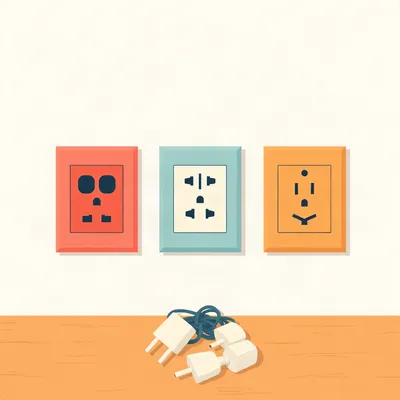
The wall of adapters. Every Israeli apartment has one, and nobody planned it.

Daniel's follow-up on standards takes us from the global picture straight to the kitchen drawer. He wants to know how the Standards Institution of Israel got built, why it decided it needed its own plug that no other country on earth uses, and how a small standards body survives alongside the giant ISO family. And he's asking the harder structural questions too. Transposition, interoperability, mutual recognition, where those have actually failed. His wife Hannah's an architect, so the building code side of this is personal for them. Daniel frames it as a case study in when a country decides its own way is better, and when that decision just becomes bureaucracy that shows up in the price of a toaster.
And the wall of adapters is the physical receipt for that decision.
It is. So let's start with how Israel got here, because the origin story explains most of the weirdness.
The Standards Institution of Israel was established in 1945 under the British Mandate. That's three years before the state existed. The British had built out standards infrastructure across their mandate territories, and when the mandate ended, the institution just carried over. It became the official standards body in 1953, four years after independence. So you have this institution that predates the country it serves, inheriting a British administrative framework, and then being asked to serve a brand new state that was trying to build everything from scratch.
That's the key phrase. Build everything from scratch. In 1948 and 1949, Israel was absorbing hundreds of thousands of immigrants, building housing, wiring cities, setting up factories. There was a genuine nation-building logic to saying, we need our own technical rules. You're not just declaring political independence, you're declaring technical independence.
And for some things, that made complete sense. Israel has a unique climate, unique water scarcity, unique seismic risks. If you're writing a building code for a country sitting on the Dead Sea Transform fault line, you should not just copy the British building code and hope for the best.
The Dead Sea Transform is the part people forget. It's not a hypothetical risk. The 1927 Jericho earthquake was magnitude six point two, killed roughly five hundred people, and it happened before the state existed. The memory of that was fresh. So when the SII wrote its seismic building standard, SI twelve twenty two, it was responding to a real, local, physical threat.
And that standard has been updated when the ground reminded everyone it was still there. The 1995 Nuweiba earthquake, which was centered in the Gulf of Aqaba, shook buildings in Eilat badly enough that the seismic codes got amended afterward. That's a standard with a genuine local rationale. You cannot import that from Europe.
Right. So the criticism of the SII is not that every standard is protectionist nonsense. Some of them are doing real work. The problem is the institution conflated two completely different functions. Safety and quality standards, where local context matters, and interoperability standards, where local context is irrelevant. The plug is the canonical example of the second category.
The SI thirty two plug. Israel created its own three pin design that is not compatible with the European CEE seven seven plug and not compatible with the British BS thirteen sixty three plug either. It has flat pins, which makes it look superficially British, but they're arranged differently. And here's the thing. No other country uses this design. Not one. Israel is the entire installed base for the SI thirty two plug.
And unlike a seismic code, there is no local rationale for a unique plug. The voltage is the same as Europe. The frequency is the same. The safety requirements are the same. The only reason to have a different plug is that you decided to have a different plug.
Which gets to the mechanism. Once that decision is made, it creates a compliance industry around it. Testing labs, certification fees, import inspections. Every unique standard is a small economy of people whose job is to enforce that uniqueness. And the SII is self funded. It charges for testing and certification. That's its revenue model.
So the institution that decides which standards are mandatory is the same institution that gets paid to certify compliance with those standards. That's a perverse incentive. The more mandatory standards there are, the more testing gets done, the more revenue the institution earns. You've built a machine that has a structural reason to expand its own scope.
And it did. Israel now has roughly three thousand total standards, of which about six hundred are mandatory. Six hundred things that you cannot legally sell in Israel unless the SII, or a lab the SII recognizes, has tested and certified them. Even if the product already carries a European CE mark. Even if it's already been tested in a German lab.
That's where the cost of living argument comes in. An importer bringing in a washing machine that's already certified for the entire European market has to pay for Israeli testing anyway. The cost of that testing gets added to the retail price. And it's not just the testing fee. It's the delay, the warehousing, the administrative overhead. Every imported product carries a small surcharge that exists only because Israel decided it needed to re-verify what Europe already verified.
And the number of standards keeps growing because the institution has an incentive to grow them. But here's the part that I think gets under-reported. The exporter's double bind. An Israeli manufacturer selling domestically has to meet SII standards. Selling abroad requires ISO or EU compliance. Often both. So the same product gets tested twice, certified twice, documented twice. That's not a tax on imports. That's a tax on Israeli companies trying to compete globally.
A power strip maker in Petah Tikva has to get SI thirty two certification for the Israeli market and CE certification for the European market. Same surge protection circuit. Same components. Two separate testing processes, two sets of fees, two sets of paperwork. And if they want to sell in the United States, they're getting UL certification as a third round.
The asymmetry is the structural problem. Israel is a standard taker in global markets. It has no power to shape ISO or the EU's rules. The market size is too small. But domestically, it's a standard setter. It gets to make its own rules. And the friction lives in the mismatch between those two roles. The domestic rules don't align with the global rules, so anything crossing the border in either direction has to be translated.
That's what the reform program is trying to fix. Daniel mentioned it. The banner is, what's good for Europe is good for Israel. The idea is that if a product already carries a European certification, Israel should accept that as sufficient. No duplicative local testing. No second round of fees. Just recognize the foreign certification and let the product be sold.
And that's mutual recognition in a nutshell. The principle that a product legally sold in one jurisdiction should be sellable in another, unless the importing country can justify a restriction on genuine public health or safety grounds. The classic case is the European Court of Justice ruling in 1979, the Cassis de Dijon case. A German importer wanted to sell a French blackcurrant liqueur in Germany, and the German authorities said no, because German law required fruit liqueurs to have a minimum alcohol content that Cassis de Dijon didn't meet. The court said that was a disguised trade barrier. If it's legal to sell in France, it's legal to sell in Germany, unless Germany can show a real safety reason to block it.
That ruling is the foundation of the EU's single market. It's why you can buy a toaster in Berlin and plug it in in Paris. But notice what it applies to. Product characteristics. Alcohol content, food additives, safety features. Things you can verify on the product itself.
And notice what it does not apply to. Infrastructure. The physical stuff that's already installed in the walls. The Cassis de Dijon principle cannot fix Israel's plug problem, because the problem is not the standard. The problem is the millions of SI thirty two sockets already wired into every building in the country. You can recognize the European plug as sufficient tomorrow, and it wouldn't matter, because nobody can plug a European device into an Israeli wall.
That's the path dependence problem. The plug standard is locked into the physical infrastructure. To switch to the European plug, you would have to rewire every building in Israel, or at least replace every socket. That's not a regulatory decision. That's a construction project on a national scale. And nobody wants to pay for it.
Brazil is the instructive contrast. Brazil had four incompatible plug types in use simultaneously, depending on when and where a building was wired. It was chaos. So in 2001, Brazil adopted a unified national plug standard, NBR fourteen one thirty six, and started transitioning the entire country onto it. That's a case of a country consolidating to reduce divergence. Israel did the opposite. It created divergence from day one and has been stuck with it ever since.
And the building codes are the same category. You can't mutually recognize a building code. The building is already built. The concrete is already poured. If Israel's seismic standard requires different reinforcement than the European standard, you can't fix that by recognizing the European code. The building is standing there, and it was built to the old rules.
The distinction that matters is not between good standards and bad standards. It's between product standards and infrastructure standards. Product standards can be harmonized, mutually recognized, transposed. Infrastructure standards are locked in place by the physical installed base. And that's where the real costs accumulate, because you can't reform your way out of them.
Transposition is the term for taking an international standard and adopting it as a national one. The EU does this constantly. ISO publishes a standard, the EU transposes it into a European norm, and then member states transpose it into national law. The text is the same, or nearly the same, but it gets re-issued under a national designation. That's how a global standard becomes local law without losing interoperability.
Israel has done some of this. Daniel mentioned that Israeli firms advertise ISO compliance. That's true, and it's significant. An Israeli software company can be ISO twenty seven thousand one certified for information security, and that certification is recognized globally. The SII doesn't block that. In fact, the SII often serves as the local certification body for ISO standards. So the coexistence is possible. Israel can be a minor standard setter and still plug into the global ISO system.
The problem is the mandatory domestic standards that don't map onto anything global. The SI thirty two plug. The Hebrew labeling requirements. The specific testing protocols that exist only in Israel. Those are the friction points. They're the ones that create the double certification burden, because they have no international equivalent to recognize.
The Hebrew labeling requirement is a good example of what I mean by friction that has nothing to do with safety. A product sold in Israel has to carry certain information in Hebrew. That's not a safety standard. It's a linguistic requirement. But it's mandatory, and it means a product manufactured for the European market has to be re-labeled for Israel. New packaging, new printing, new compliance check. The cost is small per unit, but it's nonzero, and it applies to everything.
The SII inspects for it. That's what makes the compliance industry real. Someone has to verify that the Hebrew label is there, and that someone gets paid. The system isn't just the standard. It's the entire apparatus of enforcement around the standard.
Let me pull the threads together. Israel inherited a British standards institution in 1945. It turned that into a national standards body in 1953, with a nation-building mandate to create technical independence. Some of what it created was necessary. The seismic codes, given the Dead Sea Transform and the 1927 Jericho earthquake, are defensible. But the institution also created standards that had no local rationale, the plug being the most visible, and then built a funding model that rewarded it for creating more standards. The result is six hundred mandatory standards, many of which duplicate international certifications, and a compliance burden that shows up in consumer prices and in the exporter's double bind.
The reform program is trying to unwind the product-level duplication through mutual recognition, but it can't touch the infrastructure problem. The plug is here to stay, not because anyone thinks it's a good design, but because the sockets are already in the walls.
Where does that leave the exporter? An Israeli manufacturer today has to think about three markets. The domestic market, where SII rules apply. The European market, where CE marking applies. And the global market, where ISO applies. Three regimes, three testing processes, three sets of documentation. The reform program helps with the first one, by accepting European certification for domestic sale. But it doesn't help with the second and third, because those are foreign requirements that Israel has no control over.
For a small country, that's the structural disadvantage. The United States can set its own standards and the rest of the world adapts, because the US market is too big to ignore. The EU can do the same. Israel cannot. When Israel sets its own standards, the rest of the world simply doesn't care. The SI thirty two plug is not a standard that anyone else is going to adopt. It's a standard that Israel has to maintain, at its own cost, forever.
That's the sovereignty trap. Every country has the right to set its own standards. It's a form of national self-determination. But exercising that right has a cost, and the cost scales with how integrated you are into global trade. Israel is deeply integrated. It exports technology, it imports consumer goods, it participates in global supply chains. Every divergence from global standards is a tax on that integration.
The tax is paid by ordinary people. The family buying a washing machine pays the testing surcharge. The exporter paying double certification fees passes that cost on to their customers. The person with the wall of adapters pays in daily inconvenience. It's a distributed tax, so nobody sees it as a single line item, but it's there.

I did quality assurance consulting in the early two thousands for a power strip manufacturer outside Haifa. Small shop, maybe fifteen employees. They made surge protectors. Good product, honestly. The circuit design was solid. They had CE certification from a lab in Germany. Passed everything. Then they wanted to sell domestically, and the SII required them to re-test the exact same surge protection circuit. Same components, same design, same everything. The German lab had already certified it. The SII charged three times what the German lab charged, and the inspection took six weeks. The inspector's main concern was whether the brand name was printed in Hebrew on the underside of the unit. That was the thing he kept coming back to. Not the grounding, not the surge rating. The Hebrew label.
The label requirement is mandatory, but the fact that it became the focus of the inspection tells you something about what the system is actually enforcing.
My wife's cousin in Haifa has a wall of adapters next to the television. The apartment was built in the eighties, so every socket is SI thirty two. But every device they buy now comes with a European plug. The television, the soundbar, the game console, the router. All European plugs. So there's a power strip with European sockets, and then an adapter from the strip to the wall, and then another adapter for the one device that still has an Israeli plug. It's a permanent installation. They don't even think about it anymore. It's just part of the furniture.
The adapter wall is the physical residue of a decision made in the nineteen forties. Nobody alive today chose the SI thirty two plug. It was chosen by administrators working under the British Mandate, and then carried forward by a new state that wanted to assert technical independence. And now every Israeli living room pays for it.
The Hebrew label detail is interesting because it shows how a standard can drift from its original purpose. The label requirement probably started as a consumer protection measure. Make sure people can read the safety warnings. But somewhere along the way, it became a compliance checkbox that exists for its own sake. The inspector wasn't checking whether the label was accurate. He was checking whether it was there.
The power strip company eventually paid for the certification, got the Hebrew label printed, and sold the units. But the margin was gone. Three times the testing cost, six weeks of delay, and a label redesign that required new packaging. They stopped selling domestically after that. Just exported to Europe. Easier to deal with the Germans than with the SII.
That's the quiet cost. Israeli companies choosing not to sell in Israel because the domestic compliance burden is higher than the export burden. The standards body that was created to support Israeli industry ends up driving Israeli industry away.
Which is the exact opposite of what the founders intended. The SII was supposed to protect domestic manufacturers by creating a level playing field, maybe even a slight advantage for local firms who knew the local standards. Instead, it created a moat that only the largest importers can afford to cross, while the smaller domestic manufacturers find it cheaper to sell abroad than at home.
The cousin's adapter wall is the same story from the consumer side. She didn't choose any of this. She just wants to plug in the television. But the television was designed for the European market, and the wall was built for the Israeli market, and the two have never met.
The open question is whether Israel ever fixes the plug. The reform program can handle product standards. It can say, if it's good enough for Europe, it's good enough for us. But the plug is infrastructure. To fix it, you'd need a national transition program. Replace every socket in the country over some number of years. That's a construction project, not a regulation. And nobody's proposing it.
The Brazilians did something like it. They had four plug types and they consolidated to one. But that was a mess already. Israel has one plug type, and it's the wrong one. The transition would be from a stable, if unique, standard to a different stable standard. And the benefit would only materialize at the end of the transition. During the transition, you'd have a country with mixed sockets, which is worse than what you have now.
The plug stays. The adapter wall stays. The double certification stays. Mutual recognition can trim the edges, but it can't solve the core problem, because the core problem is embedded in the physical environment.
That's the broader lesson for any country. Standards are cheap to set and expensive to change. A regulator can write a new standard in a year. But once that standard is wired into buildings, manufactured into products, and trained into inspectors, changing it costs billions. So the decision to diverge from global standards should be made with enormous caution, because you're not just deciding what the rule is. You're deciding what the future will be stuck with.
Israel made that decision in the nineteen forties, in the chaos of nation-building, with the best intentions and the worst possible timing. And seventy years later, the country is still paying for it, one adapter at a time.
Thank you to our producer, Hilbert Flumingtop, for keeping the show running.
This has been My Weird Prompts. Email us at show at my weird prompts dot com. See you tomorrow.