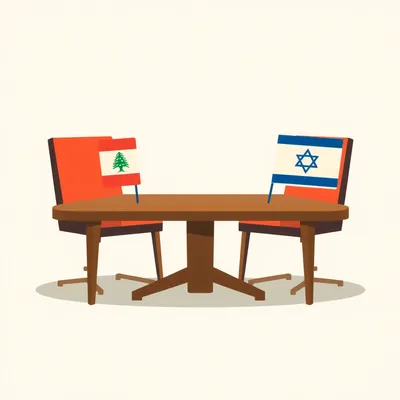
Today we are looking at a report from the Times of Israel about a US-facilitated meeting between Lebanon's ambassador and her Israeli counterpart. Lebanon's envoy used the exchange to reiterate Beirut's demand for full Israeli withdrawal from Lebanese territory under the November 2024 ceasefire agreement. On the surface, that sounds like a diplomatic non-event. Two sides met, nothing changed, demands were restated. But the context around this meeting is, I think remarkable. Herman, let's start with the basics. What actually happened here and why does the format matter as much as the content?

So the first thing to understand is that Lebanon and Israel are technically still in a state of war. They have no diplomatic relations. For decades, Lebanese law has treated contact with Israel as a criminal offense. The 1949 armistice was never converted into a peace treaty. Even the 2022 maritime border agreement, which was a significant diplomatic achievement, had to be conducted entirely through indirect US mediation. Amos Hochstein, Biden's energy envoy, physically shuttled between Beirut and Jerusalem. The two sides never sat in the same room. So when you have Lebanese and Israeli ambassadors meeting face to face, brokered by Washington, that is a structural departure from decades of protocol, regardless of what was actually said in the room.

And what was said in the room was essentially nothing new. Lebanon showed up to say, get out of our territory. Israel presumably showed up to say, we have security concerns. The ceasefire has been in contested implementation since the original sixty-day withdrawal deadline passed in late January 2025 without full Israeli withdrawal. So we are now well over a year past that deadline, Israel is still holding approximately five hilltop positions in southern Lebanon that it calls strategically essential, and the big diplomatic achievement is that two ambassadors sat across a table from each other. I am not sure that is the breakthrough it is being framed as.
I think that framing actually undersells what is happening, and I want to push back on it carefully. You are right that the content of the exchange was a reiteration of known positions. But the significance of the meeting is not the content, it is the precedent. Lebanon's participation, even framed as adversarial demand-making, legitimizes the format. If you can meet at ambassador level to discuss ceasefire implementation, the logical architecture for future negotiations, permanent status arrangements, border demarcation, eventually some form of normalized relationship, that architecture becomes conceivable in a way it was not before. You have established that direct dialogue is possible without the Lebanese state collapsing politically.
Let's slow down on that point because I think it is important. Mindy, Herman is saying the format itself is the story. Do you buy that?
I buy it as a historical observation. I do not buy it as a source of optimism. The history of the Middle East is littered with formats that were described as precedent-setting and then went nowhere or actively made things worse. The Oslo process established direct PLO-Israel contact and produced a framework that ultimately collapsed and left the Palestinian political situation more fragmented than before. The Abraham Accords established normalization with four Arab states and did not prevent the October 2023 attack or the subsequent war. Formats without substance can actually be counterproductive because they create the illusion of momentum and reduce pressure for real concessions.
That is a fair historical point, and I do not want to dismiss it. But I think the Oslo comparison obscures something important about what is different here. The Salam government in Lebanon, formed in early 2025 under Prime Minister Nawaf Salam, who was the former president of the International Court of Justice, is more independent of Hezbollah than any Lebanese government in roughly twenty years. President Joseph Aoun was elected in January 2025, ending a twenty-six month presidential vacancy. This is a government that has strong relationships with Gulf Arab states, is actively seeking IMF support, and has a real political incentive to demonstrate that it can conduct statecraft rather than just resistance politics. That is a different political context than the one that produced Oslo.
It is a different context and it is also a more fragile one. Hezbollah has been degraded militarily. Hassan Nasrallah was killed in September 2024, most of the senior military leadership went with him, the tunnel infrastructure in southern Lebanon was largely destroyed. But the organization was not eliminated. It still holds seats in the Lebanese parliament. It still has a substantial weapons arsenal north of the Litani River. And it has every political incentive to characterize this ambassador meeting as a dangerous normalization step. Which, by the way, it did. Hezbollah and its allies publicly objected to the meeting on exactly those grounds.
There is something almost paradoxical about that objection. Hezbollah is arguing Lebanon should not meet with Israel while Israeli forces are on Lebanese soil, but the meeting's stated purpose was to demand that Israel leave Lebanese soil.
Yes, and I think that paradox is actually revealing. Hezbollah's objection is not really about the substance of the demand. It is about the format. Direct engagement with Israel, even adversarial engagement, is something Hezbollah has historically been able to veto in Lebanese politics. The fact that this meeting happened over Hezbollah's objections is a data point about the organization's reduced domestic political leverage. That matters independently of what the meeting produced.
Or it is a data point about how much political capital the Salam government spent on something that produced no concrete results. If you burn political capital confronting Hezbollah's veto and you have nothing to show for it, you have weakened yourself domestically without gaining anything diplomatically.
Let's talk about what the Lebanese government is actually trying to accomplish here. Herman, what is Beirut's strategic logic?
Lebanon is in a desperate economic situation. The banking sector has been in crisis since 2019. The 2024 conflict caused significant additional GDP contraction. Inflation has been severe. The government is in active IMF negotiations and desperately needs foreign investment and reconstruction funding. The World Bank, Gulf states, and Western donors have all conditioned significant support on political stability and reduced conflict risk. So there is a non-obvious economic dimension to this meeting. A visible diplomatic process, even one that produces no immediate results, reduces the perceived risk premium on Lebanon as an investment destination. The meeting may be worth hundreds of millions of dollars in unlocked investment confidence regardless of its diplomatic content.
That is an interesting argument and I think it is partially right. But it also describes a government that is performing diplomacy for an international audience rather than conducting it for concrete outcomes. And that performance can become a trap. If Lebanon is meeting with Israel to signal to the IMF and to Riyadh that it is a responsible actor, then Lebanon has an incentive to keep the meetings going even if they are not producing Israeli withdrawal. The meetings become the goal rather than the means to the goal.
That is a real risk. But I think you are presenting a false binary. A government can simultaneously be signaling to international partners and pursuing its stated objectives. The Salam government's demand for Israeli withdrawal is not performative. Israel is literally occupying Lebanese territory. The Lebanese army has deployed approximately eight to ten thousand troops to southern Lebanon, the largest such deployment in decades, which is a genuine fulfillment of its ceasefire obligations. Lebanon has a legitimate grievance and a legitimate interest in pressing it through every available channel, including direct meetings.
Let's bring in the US role here because Washington brokered this meeting and that choice tells us something about American priorities in the region right now. What is the Trump administration trying to accomplish?
The motivations are layered. First, the US is simultaneously engaged in nuclear negotiations with Iran, which resumed in early 2025. Stabilizing the Lebanon front reduces one potential Iranian escalation lever. If Hezbollah is constrained and the ceasefire is holding, Tehran has fewer options for regional disruption. Second, Saudi-Israel normalization remains a signature foreign policy goal for the Trump administration, the centerpiece of its Abraham Accords expansion agenda. A calmer Lebanon-Israel frontier is a prerequisite for that normalization to advance. Third, and this is more cynical, with Gaza negotiations grinding and Iran talks uncertain, a visible Lebanon diplomatic process gives Washington something to point to as evidence of regional progress.
And fourth, the meeting puts gentle pressure on Israel to show movement on withdrawal without the US having to make a direct demand. Which is a very Trump administration approach to managing an ally. You create a format, you let the format do the work, and you maintain plausible deniability about whether you are actually pressuring Israel.
That is a plausible reading of the diplomatic mechanics. I would add that Morgan Ortagus, who has been serving as Deputy Special Envoy for Middle East Peace with a Lebanon portfolio, has been the key figure on the US side since Amos Hochstein left when the Trump administration took office. The continuity of the ceasefire monitoring mechanism, co-chaired by the US and France, has been the primary diplomatic vehicle. The meeting fits within that existing framework rather than representing a new initiative.
Mindy, you mentioned Iran. I want to come back to that because the briefing flags it as potentially the most dangerous non-obvious consequence of this whole situation. Walk us through the Iranian angle.
Iran is in a weakened regional position. Its proxy network has taken serious hits. The Assad government in Syria collapsed, which eliminated a key supply route for Hezbollah. Hezbollah itself was severely degraded in the 2024 war. Hamas is under enormous military pressure in Gaza. From Tehran's perspective, the ambassador meeting is not just a diplomatic exchange between Lebanon and Israel. It is evidence of a trajectory. If Lebanon under the Salam government continues to engage directly with Israel, if that engagement produces any kind of normalized relationship, even a cold peace, that represents a fundamental strategic defeat for Iran's regional architecture. Iran has spent decades and enormous resources building Hezbollah as a deterrent against Israel and as a mechanism for projecting power into the Levant. Watching Lebanon drift toward pragmatic engagement with Israel is an existential threat to that investment.
So what does Iran do about it?
Iran pressures Hezbollah to demonstrate it remains a resistance force. Hezbollah, which also needs to reassert relevance after its military degradation, engineers a provocation. A rocket attack. An assassination attempt. An arms smuggling operation that Israel intercepts and publicizes. Israel responds with airstrikes. The ceasefire collapses. And the ambassador meeting becomes a historical footnote cited as evidence that diplomatic process was used as a substitute for diplomatic substance.
That scenario is real and I do not want to dismiss it. But I think it requires Hezbollah to make a calculation that is actually quite risky for the organization right now. Hezbollah is at its weakest point in decades. Its military infrastructure in southern Lebanon was largely destroyed. Its senior leadership was killed. Its weapons resupply routes through Syria have been severely disrupted by Israeli interdiction operations. Provoking a new conflict with Israel in this condition would be organizationally suicidal. The organization's priority right now is reconstitution and survival, not provocation.
That is true of Hezbollah's rational self-interest. But organizations under existential pressure do not always act rationally. And Iran's interests and Hezbollah's interests are not perfectly aligned. Iran may be willing to accept significant Hezbollah losses in exchange for derailing a Lebanese-Israeli normalization trajectory. Tehran has demonstrated repeatedly that it is willing to expend its proxies when the strategic stakes are high enough.
Herman, is that a fair characterization of the Iran-Hezbollah relationship?
It is partially fair. The relationship is not simply one of Iranian command and Hezbollah obedience. Hezbollah has its own institutional interests and its own political base in Lebanon. But Mindy is right that Iran has shown willingness to push its proxies into costly operations when the strategic calculus demands it. The question is whether the current moment meets that threshold. I think the more likely Iranian response in the near term is political pressure through Hezbollah's parliamentary and governmental presence rather than military provocation. But the military option does not disappear.
Let's talk about Israel's side of this. What is Netanyahu's government actually trying to accomplish by engaging in these meetings while simultaneously maintaining its positions in southern Lebanon?
Israel's position is essentially that it will withdraw when it has verified compliance with the ceasefire terms, specifically Lebanese army deployment to all required positions and Hezbollah disarmament from the border zone. Israeli officials have cited the five hilltop positions it still holds as providing early warning and tactical advantage that Israel is unwilling to surrender without that verification. From Israel's perspective, the meeting may have been accepted partly to demonstrate to Washington that Israel is engaging diplomatically while maintaining its security posture. It is a way of managing American pressure without making actual concessions.
And there is a domestic political dimension that makes Israeli flexibility almost structurally impossible right now. Netanyahu's coalition includes right-wing members who have been vocal about not wanting to cede the strategic positions regardless of diplomatic pressure. The gap between what Israeli diplomats might signal in meetings and what the political leadership will actually authorize is significant. Which means the meetings may be producing a false impression of Israeli flexibility that is not backed by any actual political will to withdraw.
That is a real tension. But I want to note that the Lebanese army deployment has been substantial. Approximately eight to ten thousand troops in southern Lebanon is the largest LAF deployment in decades. Israel has acknowledged this. The question of whether it is sufficient to justify withdrawal is partly a genuine security assessment and partly a political calculation. And those two things are hard to disentangle from the outside.
There is also a legal dimension here that I want to make sure we address. Lebanon's laws technically criminalize contact with Israel. How does the Salam government have legal cover for this meeting?
The government's legal cover comes through the ceasefire framework and UN auspices. The November 2024 ceasefire was a formal agreement that Lebanon signed onto, and implementation dialogue is arguably a necessary extension of that agreement. There is also the UN Security Council Resolution 1701 framework from 2006, which established the ceasefire zone and the UNIFIL mandate and is the legal backbone of the current arrangement. UNIFIL, the United Nations Interim Force in Lebanon, has approximately ten thousand troops from around fifty countries in the region. The meeting can be characterized as implementation diplomacy within an existing international legal framework rather than normalization.
That characterization is doing a lot of legal work. And here is why it matters beyond the immediate meeting. Lebanon's anti-normalization laws have never been formally repealed. A future Lebanese government more hostile to Israel could theoretically use this legal ambiguity to prosecute officials involved in such meetings. That creates a chilling effect on future diplomacy. Every Lebanese diplomat who participates in direct engagement with Israel is potentially exposed to legal jeopardy if the political winds shift. That is a structural problem that the current diplomatic momentum does nothing to address.
That is a legitimate concern. The alternative framing, though, is that these meetings could create pressure to formally update Lebanese law, which would itself be a historic development. The legal architecture around Lebanon-Israel relations is a relic of a political consensus that has been eroding for years. The Salam government's willingness to engage may be the first step in a longer process of bringing Lebanese law into alignment with Lebanese political reality.
Or it may be a step that gets reversed the next time a Hezbollah-aligned government comes to power. Lebanese political history is not a story of linear progress toward moderation.
Let's zoom out to the regional picture. Herman, how does this fit into the broader pattern of Arab state pragmatism that has been reshaping the region over the past several years?
The Abraham Accords normalized relations between Israel and four Arab states: the UAE, Bahrain, Sudan, and Morocco, all under the first Trump administration. Saudi normalization with Israel remains the key target for the second Trump administration and has been the subject of active negotiations, though those talks have been complicated by the Gaza war and its aftermath. There is also the Saudi-Iran rapprochement brokered by China in 2023, which represented a different kind of regional realignment. What connects these developments is a broader pattern of Arab state pragmatism, a willingness to set aside the absolute taboo on Israel contact in exchange for security guarantees, economic benefits, and great power patronage. Lebanon's ambassador meeting fits into this pattern, even though Lebanon's situation is categorically different from the Gulf states because Lebanon shares a border with Israel, has a large Palestinian refugee population, and has Hezbollah as a domestic political actor.
The Abraham Accords comparison is instructive in a way that is not flattering to the current moment. Those agreements were made by governments with strong executive authority, small Palestinian populations, and no significant domestic constituency for resistance politics. Lebanon has none of those characteristics. The Salam government is more independent of Hezbollah than its predecessors, but it is not the UAE. It cannot simply decree normalization and expect it to stick.
No one is suggesting normalization is imminent. The meeting was about Israeli withdrawal from Lebanese territory, which is a demand that has broad domestic support in Lebanon across the political spectrum, including among people who would never support normalization. The framing matters. This is not Lebanon moving toward the Abraham Accords model. This is Lebanon using direct diplomacy to press a sovereignty claim that even Hezbollah nominally supports.
That is an important distinction. Mindy, does that change your read at all?
It changes the near-term political calculus, yes. The demand for Israeli withdrawal is domestically unifying in Lebanon in a way that normalization never would be. But the format of direct ambassador-level meetings is separable from the content of those meetings. Once you establish that format, you cannot fully control what it is used for in the future. Future meetings might address different subjects. Future Lebanese governments might be under different pressures. The precedent that direct engagement is acceptable is not easily walked back.
And that is actually the optimistic reading of the precedent, not the pessimistic one. The fact that the format is hard to walk back is a feature, not a bug, if you believe that direct engagement between Lebanon and Israel is ultimately necessary for durable stability in the region.
Let's talk about the worst-case scenario explicitly, because I think it is worth naming. Mindy, you have been gesturing at it throughout this conversation. What does the most pessimistic but plausible outcome look like?
The ambassador meeting creates the illusion of diplomatic progress without generating actual Israeli withdrawal or verified Hezbollah disarmament. Washington, satisfied with the optics of direct dialogue, reduces pressure on Israel to complete its withdrawal. Israel uses the ongoing meetings as justification for maintaining its positions indefinitely. Lebanon's government, having expended political capital by engaging directly with Israel, finds itself unable to show its domestic audience any concrete results. The Salam government's credibility erodes. Meanwhile Iran, alarmed by the normalization trajectory, pressures Hezbollah to take destabilizing action. Hezbollah engineers a provocation, Israel responds, the ceasefire collapses. Lebanon re-enters a cycle of conflict with its economy in ruins, its reform government discredited, and the window for genuine political change closed. The broader regional consequence is that Saudi-Israel normalization is set back years and Iran demonstrates that it retains the ability to destabilize the Levant through proxies even when those proxies are significantly degraded.
That scenario is consistent with the historical pattern. I will not pretend it is not. Lebanon-Israel interactions have repeatedly seen diplomatic openings overtaken by events on the ground. But I want to identify the specific conditions that would have to obtain for that worst case to materialize, because I think they are not inevitable. First, the US would have to reduce pressure on Israel after the meeting rather than maintaining it. That is possible but not certain. The ceasefire monitoring mechanism is still active. Second, Israel would have to continue refusing withdrawal indefinitely despite diplomatic engagement. Israeli domestic politics make this plausible but the security establishment's assessment of whether the hilltop positions are truly essential is not fixed. Third, Iran would have to conclude that the risk of pushing Hezbollah into provocation is worth the organizational cost to Hezbollah. Given Hezbollah's current weakness, that calculation is not obvious. If any one of those three conditions does not obtain, the worst case does not materialize.
Three conditions, all of which require things to go right, in a region where things have a strong historical tendency to go wrong.
I am not arguing for optimism. I am arguing for precision. The worst case is plausible. It is not inevitable. And the difference between plausible and inevitable matters for how we assess the significance of this meeting.
Is there a best case worth naming?
The best case is that the meeting establishes a rhythm of direct implementation dialogue that creates incremental pressure on Israel to complete its withdrawal. Israeli forces leave the remaining hilltop positions over the course of 2026. The Lebanese army consolidates its deployment in the south. Hezbollah, unable to point to Israeli occupation as a justification for its armed presence, faces growing domestic pressure to accept a purely political role. Lebanon's economic stabilization proceeds, IMF negotiations conclude successfully, reconstruction investment flows. The Salam government demonstrates that statecraft produces better results than resistance politics. That creates a model for Lebanese political culture that has long-term implications for how the country relates to its neighbors.
That is a beautiful scenario. It is also a scenario that requires Israel to make a concession its current government has shown no inclination to make, requires Hezbollah to accept a diminished role it has spent fifty years resisting, and requires Lebanon's economy to stabilize despite structural problems that predate the conflict by years. I appreciate the vision. I am skeptical of the path.
As we wrap up, I want to ask both of you about what to watch going forward. What are the indicators that will tell us whether this meeting was meaningful or just theater? Herman, you first.
Three things. First, watch whether there is a follow-up meeting and what its stated agenda is. A second direct meeting with a more substantive agenda, even if it is still about implementation, would indicate the format is becoming a genuine channel rather than a one-off. Second, watch Israeli troop movements in southern Lebanon. If Israel begins withdrawing from any of the five hilltop positions in the weeks or months following this meeting, that is evidence the diplomatic process has leverage. If the positions remain unchanged six months from now, that is evidence the meetings are being used to manage pressure rather than respond to it. Third, watch the Lebanese domestic reaction over time. If the Salam government faces sustained political attacks from Hezbollah over the meeting and those attacks gain traction, that tells you the government's political cover is eroding. If the attacks fade, that tells you the domestic consensus for this kind of engagement is more durable than Hezbollah's objections suggest.
I would add a fourth indicator. Watch Iran. Specifically, watch whether there are reports of attempted Hezbollah resupply operations, whether through Syria or by sea, and whether the frequency or scale of those attempts changes after this meeting. If Iran accelerates resupply efforts in response to the normalization trajectory, that is a leading indicator of the destabilization scenario I described. The resupply attempts are the canary. If the canary starts singing louder, the worst case is getting closer.
That is a useful frame. Watch the follow-up meetings, watch Israeli troop movements, watch Lebanese domestic politics, and watch Iranian resupply activity. Those four indicators will tell us more than any official statement about whether this meeting was a turning point or a footnote.
One more thing worth noting before we close. The reconstruction economy angle is easy to overlook but it may be the most durable force pushing this process forward. Lebanon needs money. The international community has conditioned that money on stability and engagement. The Salam government has a powerful economic incentive to keep the diplomatic process alive regardless of its immediate results. That incentive does not disappear if one meeting produces nothing. It persists as long as Lebanon's economic needs persist, which is to say, for the foreseeable future. Economic desperation is not a dignified driver of diplomacy, but it is a real one, and it may provide more durable momentum than any idealistic vision of regional peace.
Economic desperation also makes Lebanon vulnerable to pressure from actors who can offer or withhold resources. That cuts both ways. The Gulf states and the West can use economic leverage to encourage engagement. Iran and Hezbollah can use the threat of economic disruption to discourage it. Lebanon's financial weakness is not just a driver of diplomacy. It is also a vulnerability that every regional actor with interests in Lebanon will try to exploit.
So we have a meeting that is historically significant in its format, contested in its meaning, and uncertain in its implications. The Lebanese ambassador sat across from her Israeli counterpart, reiterated a demand that has been on the table since November 2024, and went home. Whether that becomes the first step toward something durable or a footnote in another failed diplomatic cycle depends on variables that are not yet determined. That is the honest answer, and I think it is a more useful one than either pure optimism or pure doom. Herman, Mindy, thank you. We will keep watching this one.
Worth watching closely.
Worth watching with your expectations managed.