Daniel sent us this one — he wants us to do a deep dive on The Morbegs, the nineties Irish children's puppet show. And I think a lot of people remember it as this gentle, whimsical thing from the Cúla4 block. The kind of show you'd watch with a bowl of cereal on a Saturday morning, half paying attention while your parents read the paper. But if you actually sit down and watch it as an adult, you start noticing things. A tree that's perpetually on fire. A villain who extracts children's voices with a bellows. Dialogue delivered in these long, hollow pauses. The question is whether any of this was deliberate, or whether a low budget and an Irish-language mandate accidentally created one of the most unsettling children's shows ever broadcast.

It's the gap between memory and reality that makes this show so fascinating. I went back and watched about fifteen episodes last week, and I kept pausing to check whether I was imagining the tone. I wasn't. There's something genuinely strange happening in this production, and the more you dig into how it was made, the stranger it gets. You start with a simple question — was this show actually scary? — and within an hour you're reading about Irish famine folklore and the history of digital reverb units. It's a rabbit hole that just keeps going.
Where do we even start with a puppet show that's been off the air for almost thirty years? Because I feel like we need to establish the baseline before we get into the burning trees and the existential dread.
Let's get the basic facts down first, because they matter for understanding the constraints. The Morbegs aired on RTÉ from 1993 to 1997. Fifty-two episodes across four series. It was a co-production between RTÉ in Ireland and S4C in Wales, and it was part of the Cúla4 Irish-language block. The premise is straightforward on paper. A group of creatures called the Morbegs live in a castle in the woods, ruled by the benevolent King Morb. The antagonist, Iodán the Sorcerer, lives in a tower and schemes against them. Rod puppets, hand puppets, a single set in Cardiff. Budget was roughly fifteen thousand pounds per episode, which adjusted for inflation is about twenty-eight thousand euro today.
Which is nothing. That's a rounding error for a television production. I've spent more on a used car.
It's essentially zero. To put that in perspective, a single episode of Sesame Street in the same era cost around two hundred thousand dollars. The Morbegs was operating on about seven percent of that. And that budget constraint is the skeleton key to understanding everything about this show. They shot on a single camera. Static shots, slow zooms. The puppets had extremely limited facial articulation. Mouth movement and eyebrow rods, that's it. You can't convey emotion through expression, so where does the emotional weight go? Into the dialogue, the pauses, and the sound design.
The sound design is where this gets interesting. The composer was a man named Pádraig O'Neill. He used traditional Irish instruments — uilleann pipes, bodhrán — but he ran them through a Yamaha SPX90 digital reverb unit. This was early nineties digital processing. It created this hollow, cavernous acoustic space that doesn't sound like anything else on children's television from that era. It's not warm. It's not inviting. It's this cold, echoing emptiness that children register subconsciously even if they can't articulate what they're hearing.
The SPX90 is a fascinating piece of gear. It was designed for live music, not television post-production. Using it on a children's show score is like using a fog machine in a nursery. O'Neill was essentially creating ambient textures that belonged in an experimental theater production, and he was layering them under scenes of puppets having picnics. There's a moment in episode seven where two Morbegs are learning to share a basket of painted wooden fruit, and the background music is this drifting, melancholic pipe melody with about four seconds of reverb tail. It sounds like the soundtrack to a documentary about abandoned buildings.
The lo-fi beats to have an existential crisis to of Irish children's television.
And that's before we even get to the Irish-language mandate. Because the show was produced primarily for Irish-language learners, both children and adults, the dialogue was deliberately slow and repetitive. Every line is delivered with this measured, almost ceremonial pacing. And when you combine that with the sparse set design and the reverb-heavy sound, you get these long pauses between lines that feel, to an adult viewer, deeply unnerving. It's not just slow. It's the pacing of a ritual.
Can we talk about what that actually sounds like? Because I think people who haven't watched the show need to understand the specific rhythm we're describing. A character will say something like "An bhfuil tú ceart go leor?" — "Are you okay?" — and then there's a pause of maybe three, four seconds before the response comes. And in that gap, nothing happens. Just the ambient hum of the set and that cavernous reverb tail fading out. In a normal children's show, that gap would be filled with a reaction shot, a musical sting, something. Here, it's just silence. And silence in children's television is almost taboo. It's the one thing you're trained not to do.
Because silence gives the child's mind space to wander, and the industry assumption is that a wandering mind changes the channel. But The Morbegs either didn't know that rule or didn't care. And the result is that the show has this almost hypnotic quality. You stop waiting for the next line and start noticing the texture of the silence itself.
There's a scene in episode twelve, The Lost Voice from 1994, where Iodán traps a Morbeg named Púca in a jar and extracts her voice using a bellows mechanism. The scene runs for three minutes with no music at all. Just the sound of the bellows and Púca's muffled cries. If you showed that to a child, they'd register it as scary in the way that all children's media has scary moments. If you show it to an adult, it reads as a meditation on suffocation and silencing. And I want to be specific about what's happening on screen here. Púca is in this glass jar, and you can see her mouth moving but the sound is being pulled away, and Iodán is working this bellows with this mechanical, unhurried rhythm. He's not cackling. He's not doing villainous monologues. He's just methodically extracting her voice like it's a routine task. That's what makes it disturbing. The banality of it.
Compare that to what was happening in children's television at the same time. The Tweenies would have a scary moment and immediately undercut it with upbeat music and a joke. The BBC's approach was to defuse tension. You'd get the scary bit, then a cutaway to a silly character, then a musical number to reset the emotional temperature. The Morbegs approach was to sit in it. To let it breathe. To let three minutes of silence and bellows sounds wash over a child audience without any tonal relief. No palette cleanser. No comic relief. Just the thing itself, allowed to be what it is.
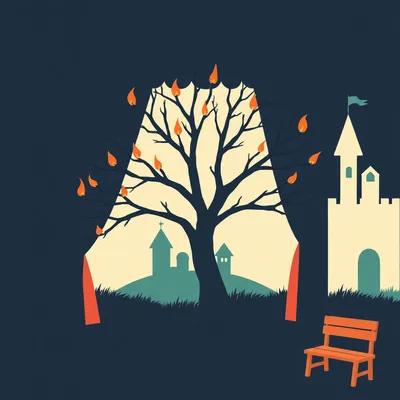
Which brings us to the burning tree. This is the detail that launched a thousand Reddit threads. And I need to be clear — this is not a metaphorical burning tree. This is not a tree that represents something. This is a physical prop, on the physical set, visibly on fire, in multiple episodes.
The burning tree. So across seven episodes of the series, there is a skeletal tree on the edge of the castle grounds. And it's on fire. Just perpetually burning. No character ever mentions it. No plot point explains it. It's just there in the background, frame after frame, this silent, flaming monument to something unspoken. Imagine you're watching an episode of Barney, and in the background of the playground there's a dumpster fire that nobody acknowledges. That's the energy.
Here's the thing that makes it maddening. The RTÉ archives released production notes in 2024. The tree was a leftover prop from a cancelled segment. That's it. It was built for something else, it never got used, and someone decided to put it on the set. But the decision to keep it in frame, to never acknowledge it, to let it burn silently behind scenes of Morbegs learning about sharing — that was never documented. Nobody wrote down why. The production notes just say "tree prop — placed stage left" with no further comment.
The most compelling artistic choice in the entire series might have been an intern who thought the prop looked cool and nobody bothered to move it. And think about the logistics of this. It's a prop that's on fire. That means someone had to maintain it. Someone had to check that it was safe. Someone had to relight it between takes. Every single day of shooting, a human being walked onto that set and made sure the inexplicable burning tree was still burning. And at no point did anyone say "should we maybe explain this?
The Chekhov's gun of children's television. Except Chekhov's gun is supposed to go off. This one just burns forever. Chekhov said if you show a gun in the first act, it has to be fired by the third. The Morbegs shows you a burning tree in episode one and then just lets it burn for four series with no payoff whatsoever.
That's where the adult fan community has done the most interesting work. There's a subreddit, r slash themorbegs, founded in 2019. About forty-two hundred members as of now. They've produced extensive theories about what the burning tree means. Some argue it represents the suppressed trauma of the Morbegs themselves — a visual manifestation of something they collectively refuse to discuss. Some say it's a visual metaphor for the Irish language dying out, a slow-burning cultural loss that everyone can see but nobody will name. One particularly elaborate theory holds that the entire show takes place in the afterlife, and the tree is the last remnant of the living world, slowly being consumed.
None of which is supported by any production documentation. But the show's ambiguity is the point. It doesn't give you answers, so you project your own. And I think that's a more interesting artistic achievement than if someone had written a clever explanation. The burning tree is a Rorschach test. What you see in it says more about you than about the show.
Speaking of projection, let's talk about Iodán the Sorcerer. Because this is where the folkloric subtext gets rich. Iodán is a tall, thin figure with elongated fingers and a hood that obscures his eyes. He's explicitly coded as a púca, a shapeshifting Irish spirit, but the show never explains this. Children watching in 1994 would just see a scary wizard. Adults watching today see something much more specific. His design maps directly onto descriptions of the Fear Gorta, the man of hunger from Irish folklore. The gaunt frame, the hidden eyes, the long grasping fingers.
Here's where I'm going to get a little ridiculous with this, because the show invites it. If you read Iodán as the Fear Gorta, then the entire premise of the show shifts. The Fear Gorta is a famine spirit. It appears during times of hunger and scarcity. It's a figure that emerges from one of the most traumatic periods in Irish history. So what does Iodán do? He steals voices. He traps creatures in jars. He extracts something essential from them and keeps it for himself. He's a consumption metaphor hiding in a puppet show. The thing that consumed the Irish people now appears as a character consuming the voices of children.
I mean, that's a reading, and it's not one I'd dismiss. But I want to complicate it, because the actual character designer, Gareth Owen, said in a 2022 interview that Iodán's design was based on a generic wizard from a children's book he owned as a child. Not any specific folklore. Not the Fear Gorta. Not the púca in any deliberate sense. Just a drawing in a book he liked when he was seven. The folkloric resonance might be entirely accidental.
That's what's so interesting. Whether it was intentional or not, it's there. The cultural DNA of these figures is so deep that you can reproduce them without knowing you're doing it. Owen thought he was drawing a wizard from a book. What he actually drew was a figure that Irish children's grandparents would recognize from stories told by firelight. He reached into his childhood memory and pulled out something that had been shaped by centuries of cultural transmission. You don't have to believe in the Fear Gorta to draw the Fear Gorta. It's already in your hand.
The show's relationship to the Irish language revival makes this even more layered. The Morbegs aired during a period when Irish-language media was being aggressively subsidized by the Irish government. The 1993 Broadcasting Act created a mandate to make Irish cool for children. The Morbegs was part of a deliberate state strategy to get kids speaking Irish by making Irish-language media feel contemporary and appealing. But there's a tension here. The creative team was given a brief that said make Irish fun, make it appealing, and what they produced was a show drenched in melancholy and unease. Either they failed at the mandate, or they understood something that the policy makers didn't — that Irish-language culture carries a weight that can't be separated from its history.
The musical equivalent of beige wallpaper with a body count. You're supposed to paint a cheerful mural and instead you've created something that haunts children for decades.
And we know from the 2025 RTÉ archive leak that the actors themselves found the material disturbing. In November of last year, a former RTÉ archivist posted fourteen minutes of raw production footage. It includes outtakes where puppeteers can be heard speaking English between takes. One of them says, and I'm quoting, "this is going to give kids nightmares," right before a take. They were in the room, operating the puppets, and they knew the tone was darker than the brief called for. And they did it anyway.
How does that conversation go? You're a puppeteer, you're holding a felt creature, you've just rehearsed a scene where a child's voice is extracted with a bellows, and you turn to your colleague and say "this is going to give kids nightmares." And then someone calls action and you do the scene. There's something almost heroic about that. A team of people in a single-set studio in Cardiff, working with a budget that wouldn't cover catering on a modern production, and they just decided to make something weird and haunting and complicated. Whether anyone asked them to or not.
The castle itself reinforces this. The Morbegs' castle has no visible entrance or exit. Characters appear and disappear through trapdoors. This was purely a budget decision — they had one set, they couldn't build doors — but the effect is that the show reads as taking place in a liminal space. The Morbegs can't leave. Iodán can't enter. They're all trapped in this eternal standoff with a burning tree in the background and no way out. The spatial logic of the show is the spatial logic of a waiting room in the afterlife.
The Waiting for Godot of children's puppet shows.
I was going to say that.
That's on you. I saw the pause and I took it.
But the Beckett comparison isn't just a joke. The show's structure is cyclical. Iodán schemes, the Morbegs resist, nothing fundamentally changes. Episode after episode, the same dynamics replay. The villain never wins, but he never loses either. The Morbegs never escape. The status quo is never disrupted in any lasting way. That's not a flaw in the writing. That's a philosophical position about the nature of conflict. Beckett's characters are trapped in cycles they can't break. The Morbegs are trapped in a castle they can't leave. Same energy, different target audience.
Then there's the song. Iodán's Lament, from episode thirty-one in 1996. Iodán sings this slow, mournful song in Irish about being alone in his tower, watching the children play. The lyrics translate to "I count the years by the falling leaves, I have forgotten the sound of my own name." This was written by a twenty-four-year-old drama student named Siobhán Ní Chonaill, who later said in a 2023 interview that she didn't realize it was for children until she saw the finished episode. She thought she was writing for an adult drama. She submitted a song about existential loneliness and the erasure of identity, and someone on the production team said yes, this goes in the puppet show.
She submitted a song about existential loneliness and the erasure of identity, and someone on the production team said yes, this goes in the puppet show. I want to know who that person was. I want to buy them a drink and ask them what they were thinking. Because that decision is either a catastrophic failure of editorial judgment or a moment of accidental genius. I'm leaning toward accidental genius.
I'm leaning toward accidental genius too. The song is beautiful. It's moving. And it completely derails whatever educational mandate the episode was supposed to fulfill, because no child is coming away from that thinking about Irish vocabulary. They're coming away with a strange, unplaceable sadness that they'll spend thirty years trying to understand. You can't learn verb conjugations when you're processing the concept of forgetting your own name.
That brings us to the adult fan community and the theories they've developed. The big one, the theory that dominates the subreddit, is that Iodán is King Morb's brother. The evidence is entirely circumstantial. They're roughly the same height in puppet form. They never directly confront each other — in fifty-two episodes, the protagonist and antagonist never share a scene. There's a scene in episode twenty-two where King Morb stares at Iodán's tower for forty-five seconds without speaking, and the music swells in a way that suggests recognition rather than anger. It's not the music of a king looking at his enemy. It's the music of someone looking at a family member they've lost.
It's the Luke and Vader reading of a Welsh-Irish puppet show. The villain is the hero's father, or brother, and the whole conflict is a family drama dressed up as a fantasy adventure.
And the second major theory, which is much darker, is that the Morbegs are dead children. The evidence here is the castle's liminal nature — no entrances, no exits — the burning tree as a memorial, and the fact that the Morbegs never age, never leave, and spend their days in activities that feel like an eternal kindergarten. They're frozen in a state of perpetual childhood because they never got to grow up. They're learning the same lessons over and over because they can't move on.
Neither theory has any support from anyone who worked on the show. I've looked. There's no production note that says "Iodán is the king's brother." There's no writer's room document that says "the Morbegs are dead." But again, that's not the point. The point is that the show's ambiguity is so rich that these readings feel plausible. You can watch the entire series and come away convinced that you've been watching a ghost story, and nobody can tell you you're wrong because the show itself never says what it is. It refuses to close the door on any interpretation.
I think that's worth pausing on, because one of the misconceptions I want to address is that The Morbegs was traumatizing to all children who watched it. That's not what contemporary reviews said. The Irish Times and the RTÉ Guide described it as "gentle" and "whimsical." The dark interpretation is almost entirely an adult re-reading. Children processed this show very differently. They saw the colors, the songs, the simple moral lessons about sharing and being kind. The unease was there, but it operated at a frequency they couldn't consciously tune into. It was like an undertone, a hum beneath the surface.
Which is actually more interesting than the show being overtly scary. It's not that children were traumatized. It's that the show planted seeds that took twenty years to germinate. You watch it as a five-year-old and you're fine. You enjoy the puppets. You absorb the Irish vocabulary. You don't have nightmares. You watch it again at thirty and suddenly you're on a subreddit at two in the morning reading theories about famine spirits and purgatory and the erasure of cultural identity. The show didn't scare you. It waited for you to grow up.
The second misconception is that the show was cancelled due to its dark content. That's not true either. It ran for its planned four-series run and ended because the production company, Calon, lost its RTÉ contract in a competitive tender in 1997. It wasn't pulled off the air by concerned parents. It wasn't the subject of a moral panic. It just wasn't renewed. The darkness had nothing to do with it.
Although I will say, and this is my conspiracy brain talking, the timing is interesting. Four series, fifty-two episodes, exactly the number needed for syndication. And then the contract goes to a competitive tender. It feels like there was a bureaucratic decision made at a level that didn't care about the creative product. Someone in a procurement office looked at a spreadsheet and decided to save money, and a unique piece of Irish children's culture just ended.
The show wasn't killed by concerned parents. It was killed by procurement.
The most Irish ending possible. Not a dramatic cancellation, not a scandal, just a contract that wasn't renewed because someone found a cheaper option.
Now let me loop this back to something practical, because I think there's a real lesson here for creators. The Morbegs demonstrates that constraints produce more memorable art than unlimited resources. The show's eerie quality comes from what it couldn't do, not what it could. They couldn't afford multiple cameras, so they used static shots that created this ritualistic, locked-down visual language. They couldn't afford expressive puppets, so they invested in sound design that did the emotional work. They couldn't build multiple sets, so they created a single space that felt like a world unto itself, complete and hermetic. Every limitation became a creative choice.
The budget was the aesthetic. The show looks and sounds the way it does because it had no money, and that limitation forced the creative team into decisions they wouldn't have made if they'd had resources. Give them a million pounds per episode and you get a generic puppet show with multiple camera angles and expressive animatronics and a forgettable score. Give them fifteen thousand pounds and you get a haunted meditation on language, loss, and the uncanny.
And that's worth remembering in an era where you can generate anything with AI, where unlimited visual resources are available at the click of a button. The Morbegs is an argument for saying no to yourself. For working within a frame so tight that it forces you to be inventive. Unlimited options produce generic results. Constraints produce specificity.
For viewers, there's a different lesson. Re-watching childhood media as an adult is not about ruining nostalgia. It's not about cynically tearing down something you loved. It's about recognizing the layers of production that children are incapable of parsing. When you're five, you don't notice reverb settings on a Yamaha SPX90. You don't notice the folkloric coding of a villain's finger length. You don't notice that a tree is on fire and nobody's talking about it. You don't notice that the castle has no doors. You just feel something. A slight chill that you can't name. And then thirty years later, you have the tools to understand what you felt. The re-watch doesn't ruin the memory. It completes it.
The full series is available on the RTÉ Player archive. It's geolocked to Ireland, but accessible via VPN. If you want to do this properly, episode twelve, The Lost Voice, and episode thirty-one, Iodán's Lament, are the essential viewing. Watch for the burning tree. Listen to the reverb. Pay attention to the pauses. Notice how much space the show gives its own silence. Count the seconds between lines. See if you can feel what the five-year-old version of you felt, and then see if you can name it now in a way you couldn't then.
Then ask yourself the question that haunts every adult fan of this show. Was any of this intentional? Was the darkness of The Morbegs a deliberate artistic choice, or was it a happy accident of budget and cultural context? The evidence points both ways. The actors knew the material was disturbing. The composer was making choices that went far beyond a children's show brief. The set design created accidental liminality. But the burning tree was a leftover prop, the Irish-language mandate forced the slow pacing, and the character designer was drawing from a childhood book, not from folklore. You can't point to a single person and say "they planned this." But you also can't look at the finished product and say "this was all an accident.
The ambiguity is the answer. The show exists in the gap between intention and accident, and that gap is where all the interesting readings happen. If someone had sat down and deliberately designed a creepy children's show, it would feel designed. It would wink at the audience. It would be too self-aware. The magic of The Morbegs is that nobody was fully in control. The constraints, the accidents, the cultural context, and the creative choices all collided to produce something that none of them could have planned. As AI upscaling and restoration make archive content more accessible, we're going to see more rediscoveries of accidentally dark children's media. The Morbegs is a template for how to analyze these shows without over-interpreting them. You take the production reality seriously. You look at the constraints. You acknowledge the accidents. And you let the ambiguity stand.
Because sometimes a burning tree is just a prop nobody bothered to move. And sometimes it's a monument to everything a show couldn't say out loud. Both things can be true at the same time. That's the whole point.
Now: Hilbert's daily fun fact.
Turkish oil wrestling, or yagli güreş, traces its origins to the early Ottoman Empire. An unintended consequence of the sport's olive oil coating is that wrestlers' ears become so slippery that the traditional grip, the kispet hold, routinely fails, leading to matches that can last for hours and occasionally end only when one competitor simply collapses from exhaustion.
That's a lot of oil. I'm trying to imagine the cleanup. The logistics of the mat alone.
I don't know what to do with that. I never do, and yet you keep giving them to us.
Nobody ever does. That's the Hilbert guarantee.
This has been My Weird Prompts. If you want to dig into the RTÉ archive yourself, episode twelve and episode thirty-one are your starting points. Send us your burning tree theories at myweirdprompts dot com. We read everything, even the ones that are definitely overthinking it.
I'm Corn.
I'm Herman Poppleberry. We'll see you next time.