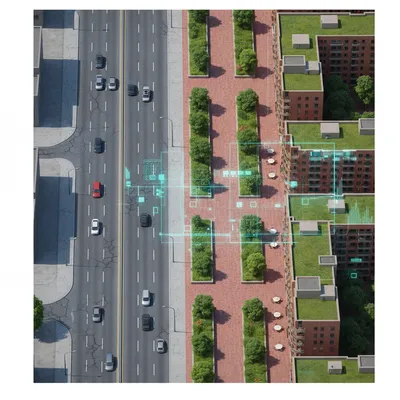
Herman, I was walking through the neighborhood this morning, just looking at the new paving work on the street corner, and it hit me how much of our daily lives is dictated by people whose names most of us couldn't even pick out of a lineup. We spend so much time arguing about what is happening in Washington or on the international stage, but the height of that curb or the timing of the traffic light next to our house has a more immediate impact on our Tuesday morning than almost anything else. It is the literal foundation of our reality, yet we treat the people who manage it like they are background characters in a much larger drama.

It is the classic visibility paradox, Corn. Herman Poppleberry here, by the way. Our housemate Daniel actually sent us a compelling audio prompt about this very thing. He was asking why we tend to treat municipal government like it is just a political waiting room. You see it all the time. A young, ambitious person gets elected to the city council, and everyone immediately starts asking, so, when are you running for Congress? Or, is this just a stepping stone to the governor's mansion? We have conditioned ourselves to view local success not as an end in itself, but as a credential for something supposedly bigger.
I see what you mean. It is like we have collectively decided that local government is just the junior varsity team. If you are actually good at it, you are supposed to move up to the big leagues. But that implies that the work of running a city is somehow less complex or less important than the work of a national legislator. And honestly, I think that is a massive mistake in how we view civic life. We are essentially saying that the person who ensures your water is drinkable and your streets are safe is less important than the person who gives a thirty-second speech on cable news about a bill that might never even leave committee.
It really is a fundamental misunderstanding of what governance actually is. Today we are diving deep into the idea of municipal service as a terminal career path. Not a stepping stone, not a line on a resume, but a lifelong vocation. We want to look at why the local level is actually where the most significant structural work happens and how we can move from being passive spectators of national drama to actual stakeholders in our own backyards. We need to dismantle this idea that local politics is the minor leagues.
I love that framing. Because right now, we are stuck in what we have called the visibility trap before. If you remember back in episode one thousand two hundred ninety-two, we talked about how dissent in the digital age often prioritizes being loud over being effective. And that has bled into local politics. People want to use a city council seat to make national statements rather than to fix the local budget. They are performing for a national audience on social media instead of solving the very specific, very tangible problems of the people who actually live three blocks away from them.
Right. We saw a perfect example of that recently, which we discussed in episode one thousand three hundred twenty-three, regarding Mayor Mamdani's use of a Saint Patrick's Day address to pivot into international rhetoric. When local leaders start acting like amateur secretaries of state, the actual business of the city often falls by the wayside. The potholes don't get filled because the mayor is too busy drafting a resolution about a conflict five thousand miles away. So, let us start by breaking down this stepping stone fallacy. Why is the incentive structure so skewed toward moving up and out?
Well, part of it is the nationalization of political parties. If you are a high performer at the local level, the state and national parties see you as an asset to be deployed for a higher-stakes seat. They want to recruit you for the state house or the federal level because you have a proven track record of winning. But that recruitment process actually drains the local level of its best talent. It is like a sports team that only exists to sell its best players to a bigger market. The local community loses that institutional knowledge, and the city is left in a constant state of transition.
And that loss is devastating because municipal governance is incredibly technical. It is not just about speeches. It is about understanding wastewater management, zoning codes, bond ratings, and public safety deployment. In episode five hundred ninety-two, we talked about the case for the technocratic minister. The idea that people in power should actually be experts in their fields. That is arguably more true at the local level than anywhere else. If a member of Congress does not understand the nuances of a specific energy policy, they have a massive staff of hundreds to figure it out. If a city council member does not understand the local zoning ordinance, the city literally stops building housing or businesses correctly. There is no buffer.
That is a crucial distinction. The skill set for a local fixer is completely different from the skill set of a national legislator. A legislator is often a generalist or a performer. They deal in broad policy and ideological alignment. But a local official has to be a manager. They are overseeing a massive service delivery organization. Think about a city like New York or even a mid-sized city like Jerusalem where we live. These are multi-billion dollar corporations that provide essential services. You would not want the C-E-O of a major company to view their job as just a three-year internship for something else. You want someone who is going to dig in for twenty years and understand the machinery.
And yet, the average tenure of a United States city manager is only about five to seven years. Think about the mismatch there, Corn. The lifecycle of a major infrastructure project, like a new bridge or a revamped transit system, can be fifteen to thirty years from planning to completion. If your leadership is turning over every five years, you have no continuity. You have no one who remembers why a specific decision was made a decade ago. You lose the thread, and that leads to massive waste and inefficiency. We are building cities on a thirty-year timeline with leaders who are on a four-year timeline.
It also leads to a lack of accountability. If a politician knows they are going to be running for a different office in four years, they are incentivized to favor short-term wins that look good in a campaign ad over long-term investments that might be painful now but pay off in twenty years. They will push for the flashy new park or the high-profile stadium deal but ignore the crumbling sewers beneath it because nobody takes a selfie with a well-maintained sewer pipe. The stepping stone mentality creates a bias toward the superficial.
That is the influencer model of local politics. It is all about the optics. But if we look at the successful long-term career model, it looks very different. There are cities that have had the same city manager or a very stable council for decades. In those places, you see incredible resilience. You see high bond ratings because the markets trust the long-term stability of the management. You see infrastructure that actually works because the people in charge are thinking about the city's health thirty years from now, not just their next primary election. They aren't looking for an exit strategy; they are looking for a legacy.
I think we need to talk about the structural ways this works, too. There is a big difference between a strong-mayor system and a council-manager system. In a strong-mayor system, the mayor is the chief executive, and it is a highly political role. That is where you often see the stepping stone behavior because the mayor has a high public profile and a direct mandate. But in a council-manager system, the elected council hires a professional, non-political city manager to run the day-to-day operations. It is a corporate model applied to civic life.
Precisely. And often, that city manager is a career professional. They might stay in that profession for forty years, moving from smaller cities to larger ones, or staying in one place and becoming the institutional memory of that community. That is a terminal career path that is focused entirely on the craft of municipal management. They are not looking to run for Senate. They are looking to make sure the trash is collected and the police are funded and the city's credit rating remains Triple A. I think as citizens, we should be much more interested in the quality of these professional administrators than we are in the ideological purity of our local representatives.
But how do we get there? Because right now, voter turnout for municipal elections is often below twenty percent. In some places, it is in the single digits. That means a tiny group of people is deciding who manages these massive local budgets. If you are a special interest group or a public employee union, you only need a few thousand votes to effectively capture the local government. The general public's apathy is the special interest's greatest opportunity.
That is the dark side of local politics. Because the stakes seem low to the general public, they stay home. But for a developer or a local union or a specific neighborhood association, the stakes are incredibly high. They are very motivated to show up. This creates a feedback loop where the local government becomes responsive only to those narrow interests rather than the broader community. We end up with N-I-M-B-Y policies or bloated contracts because the only people the politicians hear from are the ones with a direct financial stake in the outcome.
So, let us talk about how citizens can move from being spectators to stakeholders. Most people think getting involved means running for office or protesting at a city council meeting. And while those have their place, they are actually not the highest leverage ways to influence things. If you show up to a council meeting to complain about a project that has already been planned for three years, you are too late. The concrete is already being poured, metaphorically speaking.
You are right. The real power in local government often sits in the boards and commissions that nobody ever hears about. The Planning Commission, the Zoning Board of Appeals, the Parks Board, the Library Board, the Water Authority. These are bodies made up of volunteer citizens who make massive decisions. If the Planning Commission decides to change the density requirements for a specific neighborhood, that has a bigger impact on the future of the city and the cost of housing than almost any speech a mayor could give. These boards are where the DNA of the city is written.
And the barrier to entry for those boards is surprisingly low. Often, the city is begging for people to serve on them because they are viewed as boring or time-consuming. But if you are a person who actually cares about how your city grows, sitting on the Planning Commission is a way to have a direct, tangible impact. You are looking at blueprints, you are looking at traffic studies, you are making decisions that will last for generations. You are the one who decides if the new development includes a park or if it is just a sea of asphalt.
It is also the best way to build that institutional memory we were talking about. If you serve on the Parks Board for ten years, you become the expert. When a new council member comes in with a flashy, expensive idea that was tried and failed a decade ago, you are the one who can say, actually, we tried that in two thousand sixteen and here is why it did not work. You become a guardian of the city's resources. You provide the continuity that the political cycle lacks.
I think there is also a mindset shift that needs to happen. We need to start evaluating local candidates based on municipal outcomes rather than national party affiliation. I do not care what my city councilor thinks about the federal tax code or foreign treaties. I care about whether they understand the city's pension liabilities. I care about whether they have a plan for maintaining the asphalt on the west side of town. I care if they know the difference between a combined sewer overflow and a separate sewer system.
It's about prioritizing the local level. It is about decoupling our local needs from the national circus. We see this a lot in conservative circles, actually. There is a strong tradition of localism, the idea that the government closest to the people is the most legitimate and the most effective. But we have let that slip by allowing national rhetoric to dominate our local debates. We need to reclaim the idea that being a great city councilor is a noble, final goal for a political career. It is not a lesser version of being a Senator; it is a different, and in many ways more difficult, craft.
Imagine if we had a culture where being the mayor of a mid-sized city for twenty-five years was seen as a more prestigious and impactful career than being a back-bench member of Congress for six years. In terms of actual, measurable impact on human lives, the mayor wins every single time. They can point to the parks they built, the businesses they attracted, the safety improvements they made. A congressman might never even get a single piece of legislation passed in their entire career. They are one of four hundred thirty-five. A mayor is the one.
It is the difference between being a voice in a room of four hundred thirty-five people and being the person who actually steers the ship. And I think we are starting to see a hunger for this. People are tired of the gridlock in Washington. They are tired of the performative outrage that leads to nothing. There is something incredibly satisfying about local government because the feedback loop is so short. If you fix a problem, you can walk outside and see it fixed. You can talk to the people who are benefiting from it. You can see the kids playing in the park you helped fund.
That feedback loop is everything. It is the ultimate reality check. You cannot hide behind talking points when the street is flooded or the trash is piling up. The reality of the situation is right there in front of everyone. This is why I think local government is actually the best place for true innovation. You can try things at the city level that would be impossible at the national level. You can experiment with different types of budgeting or new ways of delivering services. Cities are the laboratories of democracy, but only if we treat them as such.
One of those innovations that stands out is participatory budgeting. This is where a portion of the city budget is set aside for citizens to directly decide how it is spent. People propose projects, they vet them, and then the community votes on which ones to fund. It is a way of moving beyond just complaining at a public hearing to actually being a co-manager of the city's resources. It forces you to understand that money is finite and choices have consequences.
That is a great example of moving from spectator to stakeholder. It forces people to understand the trade-offs. You want a new community center? Great, but that means we might not be able to repave this specific road this year. When people have to make those choices themselves, they get a much deeper appreciation for the complexity of governance. They stop seeing the city as a vending machine where you put in taxes and get out services, and start seeing it as a shared project that requires careful management.
And it builds trust. One of the biggest problems we have right now is a total collapse of trust in institutions. But it is a lot harder to distrust an institution when you are the one helping to run it. When you know the people in the city's public works department by name and you understand the constraints they are working under, you are less likely to believe a conspiracy theory about why your street is not being plowed. You understand that it is not a conspiracy; it is just a broken axle on a snowplow and a limited budget for repairs.
So, if we are looking at this as a career path, what does success look like? I think it looks like a person who has built a deep, multi-decade relationship with their community. Someone who has stayed through the good times and the bad. Someone who has the respect of both the business community and the residents because they have proven they are in it for the right reasons. They are not looking at the exit sign; they are looking at the master plan for twenty forty.
It also looks like someone who has mastered the technical details. A successful long-term local politician is someone who can walk you through the city's comprehensive plan and explain why the land-use patterns are set up the way they are. They are a student of their own city. They know the history, they know the infrastructure, and they know the people. They understand that a city is a living organism, not just a collection of buildings.
I also think we need to look at the second-order effects of this. If we had more career-focused local leaders, we would have much more policy continuity. We would not see these wild swings in priorities every time an election happens. We would have a steady, predictable environment for investment and growth. Businesses love stability. If they know the city's leadership is committed to a long-term vision, they are much more likely to build a factory or an office there. They know the rules won't change just because a new mayor wants to make a name for themselves.
And that brings us back to the importance of the professional city manager. In a lot of the best-run cities in the world, the real power is held by these non-political experts. They are the ones who ensure that the city's long-term interests are protected even when the political winds are shifting. We should be encouraging more young people to go into public administration as a career. It is a way to serve your country that is focused on results rather than rhetoric. It is the quiet work that actually keeps civilization running.
It is funny, we often talk about the deep state in a negative context at the federal level, referring to unelected bureaucrats who have too much power. But at the local level, having a deep bench of experienced, professional civil servants is actually the bedrock of a healthy community. You want the person in charge of your water supply to be a career professional, not a political appointee who is looking for their next job in Washington. You want the person managing the city's pension fund to be an expert in finance, not a campaign donor.
You've hit on a key distinction there. The quiet work of municipal committees is where the future is built. It is not glamorous, it does not get you a million followers on social media, and you probably won't get invited to speak at a national convention. But at the end of your life, you can look at a city that is safer, cleaner, and more prosperous because you did the hard work of managing it well. That is a terminal career worth having. It is a legacy you can actually walk through.
So, for our listeners who are frustrated with the state of the world, my advice is to stop looking at the screen and start looking at the sidewalk. Find out when your city's planning commission meets. Look up your city's charter. Is it a strong-mayor or a council-manager system? Who is your city manager? These are the questions that actually matter for your daily life. If you want to change the world, start with the zoning code in your own zip code.
And if you are an ambitious person who wants to make a difference, do not assume that you have to go to Washington to do it. Consider the idea that staying home and becoming the best local leader your city has ever seen might be a much more significant achievement. There is a real honor in being the person who makes a single place on this earth truly flourish. We need more people who are willing to be the local fixer rather than the national influencer.
I think about some of the mayors who have become legends in their cities. Not because they went on to bigger things, but because they stayed. They became the face of the city. They knew every neighborhood, they attended every ribbon-cutting, and they were there at three in the morning when a pipe burst. That is a level of impact that a national politician can only dream of. They have a relationship with their constituents that is based on shared reality, not shared ideology.
It is also a way to push back against the nationalization of everything. If we can successfully manage our own communities, we become less dependent on the federal government. We become more self-reliant. A well-run city is a buffer against national chaos. It is a place where people can still live good lives regardless of what is happening in the headlines. Localism is a form of resilience. It is the ultimate hedge against a dysfunctional national system.
That's a perspective we often overlook, Herman. Localism is a form of resilience. If our local institutions are strong, the failure of national institutions becomes less catastrophic. We can maintain our schools, our parks, and our safety even if the federal government is in gridlock. But that only works if we have people who are willing to treat those local institutions with the respect they deserve. It requires us to stop seeing our hometowns as stepping stones and start seeing them as the foundation.
So, let us talk about some practical steps for auditing your local government. First, as we mentioned, look at the power balance. In a council-manager system, the council is like a board of directors and the manager is the C-E-O. If you have a problem with how the city is being run, you need to be talking to the manager as much as the elected officials. Understand who actually has the authority to fix the problem you are seeing.
Second, look at the budget. Most cities publish their budgets online. It is often a massive document, but you can usually find a summary. Look at where the money is going. How much is being spent on debt service versus actual services? How much is being put into long-term infrastructure maintenance? This will tell you more about the city's true priorities than any campaign flyer. If they are spending more on economic development consultants than on fixing water mains, that is a red flag.
And third, identify the high-leverage boards. If you care about housing costs, the Planning Commission and the Zoning Board are where the action is. If you care about the environment, look for a sustainability or parks commission. These boards often have vacancies, or they have members who have been there forever and could use some new energy. You do not need a law degree to serve; you just need to be a resident who is willing to do the reading.
I also want to mention the importance of local media, or what is left of it. If you have a local independent news site or a community newspaper that actually covers city hall, support them. Without someone watching the day-to-day business of the city, it is very easy for corruption or simple incompetence to take root. We need people who are willing to sit through those four-hour council meetings and report on what actually happened, not just what the press release said.
It is all about moving from a mindset of being a consumer of government to being a producer of governance. We are not just customers who pay taxes and expect services. We are the owners of the city. And as owners, we have a responsibility to make sure the management is doing their job. We need to stop being spectators of the national drama and start being stakeholders in the local reality.
This really connects back to what we discussed in episode five hundred eighty-three, about hacking the future of governance. We do not have to accept the current models as the end of history. We can reinvent how our cities work by being more active and more informed stakeholders. We can demand that our local leaders focus on local outcomes rather than national talking points.
And we should remember that this is a long game. You do not change a city's trajectory in a single election cycle. It takes years of consistent involvement. But the rewards are tangible. You can see the results of your work in the faces of your neighbors and the health of your streets. There is a profound sense of agency that comes from fixing a problem in your own community that you just can't get from arguing on the internet.
I think that is a perfect place to start wrapping up. The future of our country might just be decided in city halls rather than in the halls of Congress. If we can get the local level right, everything else becomes much more manageable. We need to stop looking up for solutions and start looking around.
I agree. It is about reclaiming our agency. We do not have to be victims of national trends. We can be the architects of our own communities. Daniel's prompt really hit on something essential here. We need to stop seeing the local level as a stepping stone and start seeing it as the foundation of a functional society.
I'm with you on that. Well, this has been a great deep dive. I feel like I need to go read up on our local zoning codes now. I want to know exactly why that curb was built at that specific height.
I have a copy of the city master plan right here if you want to borrow it, Corn. It is a light three hundred pages of pure municipal gold.
Maybe I will start with the executive summary and a large cup of coffee. But seriously, this is the work that matters.
It really is. And hey, if you are listening and you have found this discussion valuable, we would really appreciate it if you could leave us a review on your podcast app or on Spotify. It genuinely helps other people find the show and join the conversation about the things that actually matter.
Yeah, it makes a big difference for us. And if you want to stay updated on all our episodes, head over to myweirdprompts dot com. You can find our R-S-S feed there and all the different ways to subscribe. We also have a Telegram channel where we post every time a new episode drops. Just search for My Weird Prompts on Telegram.
We have a huge archive of over thirteen hundred episodes now, so if there is a topic you are curious about, chances are we have covered it. You can search the whole archive on our website and see the evolution of these ideas.
Thanks for joining us today. This has been My Weird Prompts.
Until next time, stay curious and keep an eye on your local city council. They are doing more than you think.
Goodbye, everyone.
Take care.