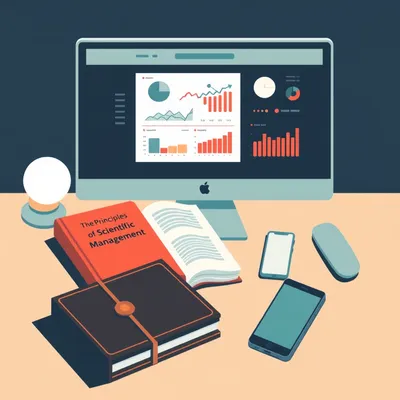
So Daniel sent us this one. He's asking how long the nine-to-five schedule has been the dominant working paradigm for knowledge workers. The short answer is, not nearly as long as it feels. It feels like a law of nature, like we evolved to commute and sit in cubicles from nine to five. But it's really just a cultural operating system we inherited, not one we ever designed for the work most of us actually do.

And today's script is coming to us from DeepSeek V three point two. Which is fitting, given the topic.
Is it? Because the AI doesn't sleep?
Because it's a perfect example of post-industrial, non-linear, output-based work. It doesn't have a schedule. It just… does the thing when prompted. The idea of it logging hours at a virtual desk is absurd.
Right. So we're talking about the mismatch. The nine-to-five feels eternal, but for the kind of person listening to this podcast—someone whose job is thinking, writing, coding, analyzing—its reign as the default expectation is a historical blip. A fascinating, recently-ended blip.
It’s the dominant cultural container, but it was built for a completely different kind of work. It’s like trying to run modern software on the operating system from a factory time clock.
Which is literally what happened. So where do we even start unpacking this? Do we go back to Henry Ford and the factory whistle, or do we start with the fact that most of us haven't actually worked a strict nine-to-five in years?
We have to start with the transplant. How a system designed to maximize the use of expensive physical machinery got grafted onto work that happens inside our heads. The schedule is an artifact—a powerful, sticky one, but an artifact all the same.
And that artifact forces us to define our terms. What do we mean by 'knowledge worker'? That phrase itself is a clue to the timeline.
It sounds like a modern HR buzzword.
It's actually from 1959. Peter Drucker coined it in his book 'Landmarks of Tomorrow'. He was describing the emerging class of worker whose primary capital is knowledge, not physical labor. The analyst, the manager, the engineer. Their output isn't a widget you can count at the end of a shift; it's a decision, a design, a line of code.
So the very concept of the knowledge worker is only about sixty-five years old. And for most of that time, we've been stuffing them into a work schedule designed for the previous kind of worker.
And we should be clear on scope. When Daniel asks about the dominant paradigm, we're talking about the cultural expectation in white-collar offices across America and much of the West. We're not talking about shift work at a hospital, or a global team spanning time zones. We mean that specific, culturally-loaded idea: be at your desk from nine to five, Monday through Friday.
The suit-and-tie prison, immortalized by Dolly Parton.
That's the container. And here's the core thesis. That container's dominance as the default setting for knowledge work is shockingly brief. It's not a centuries-old tradition. It's roughly a forty to fifty year phenomenon. It solidified in the nineteen seventies, peaked in the nineties, and began visibly crumbling in the twenty twenties.
So its entire reign is about as long as the average listener has been alive.
Probably less. It was built on pure industrial logic. The mismatch is the whole story—taking a time-oriented system designed to coordinate bodies around machines, and applying it to an output-oriented process that happens in the human brain.
Right, the mismatch is the whole story. So to understand it, we have to rewind to before the mismatch existed. What was work like for the proto-knowledge worker? The clerk, the accountant, the lawyer before the office block?
It was nothing like the industrial rhythm. Before factories, work was largely agrarian or craft-based. It was task-oriented, not time-oriented. You worked until the field was plowed, or the garment was sewn, or the ledger was balanced. The rhythm was set by daylight, seasons, and the job itself. There was no universal 'nine a.m. start' because there was no universal clock to sync to.
And that's a fundamentally different relationship to work. You're measured by the thing you produce, not the hours you log being present. The industrial revolution didn't just change what we made, it changed how we measured the making.
Right. And that's where Henry Ford comes in, in nineteen fourteen. This is the transplant moment. He didn't invent the eight-hour day—labor activists had been pushing for it for decades—but he standardized it at his plants. And he did it for purely industrial reasons.
Not out of the goodness of his heart.
Not at all. He doubled pay to five dollars a day, which is the part everyone remembers, but the crucial part was cutting the workday from nine hours to eight. He did it to reduce crippling turnover and increase productivity. But the productivity gain was about the machines. If you ran expensive factory equipment on multiple shifts, you got more out of your capital investment. The schedule was about maximizing machine use, not human potential. It was about controlling labor and synchronizing bodies to the rhythm of the production line.
So the whistle blows, the line starts. The whistle blows, you go home. Your value is your presence during those hours, keeping the machine fed. Your cognitive state is irrelevant.
And this logic is perfect for assembling Model Ts. It is catastrophically bad for writing a legal brief or designing a bridge. But after World War Two, when the managerial class exploded, what model did they have for organizing these new 'knowledge workers'? The only successful, modern, professional model they had was the factory. So they copied it.
They took the schedule, stripped out the whistle and the grease, put it in a building with better air conditioning, and called it professionalism.
That's the post-war office. William H. Whyte's 1956 book 'The Organization Man' captures this perfectly. Showing up, being present, fitting into the corporate culture—that became the measure. The schedule was a status symbol. Working nine-to-five in an office meant you weren't a laborer. You were a respectable professional. Your presence was your commitment.
So we swapped the factory floor for the cubicle farm, but kept the fundamental metric: hours logged on-site. The output became… what? Meetings attended? Papers shuffled?
Often, yes. The work became nebulous. How do you measure the output of a middle manager in 1965? It's hard. So you measure input instead. Time. Presence. Face time with the boss. This is where 'presenteeism' is born. It's not about what you do, it's about being seen doing it.
And this all crystallizes in the nineteen seventies. That's your inflection point.
It is. A few forces converge. The forty-hour workweek, which had been established by the Fair Labor Standards Act back in nineteen thirty-eight, becomes truly widespread across the white-collar economy. The service sector surpasses manufacturing as the largest employer. And you get the cultural codification.
Dolly Parton's 'Nine to Five' comes out in nineteen eighty. That song isn't describing a new phenomenon; it's an anthem for a system that has finally become the universal expectation. It's the cultural stamp. Everyone now knows what 'nine to five' means.
And think about the imagery. The song is about office work—the typing pool, the bosses, the coffee breaks—but it's grafted onto a time schedule invented for factory shifts. The movie poster has Jane Fonda, Lily Tomlin, and Dolly Parton holding a giant clock. The clock is the villain.
So to answer Daniel's question directly: the nine-to-five as the dominant paradigm for knowledge workers has its roots in a 1914 factory policy, gets adopted as a status symbol for managers in the 1950s, and becomes the universal cultural default in the 1970s. Its reign as the undisputed norm is maybe fifty years, from the seventies to the twenty twenties.
And the reason it stuck wasn't productivity. It was mimicry and managerial convenience. It's easy to manage what you can see. If everyone is in the same box at the same time, you feel like you have control. You don't have to figure out how to measure a thought process, you just measure the chair being warm.
Which is a tragically low bar for managing the most expensive, complex resource in the building—the human brain.
It's the ultimate cargo cult. We saw the factory schedule work for factories, so we built office towers and performed all the rituals—the commute, the lunch hour, the time clock—hoping the productivity would follow. We were worshipping the container, not the content.
So the stage is set. You have this massively dominant, culturally ingrained system, built on a logic that is completely alien to the work it's supposed to facilitate. It's a powder keg. So what finally starts the cracks?
They start with the tools. The internet and the mobile phone. Because in the nineteen nineties and two thousands, knowledge work finally became measurable in a way it never was before. Not by hours, but by output you could actually see and track.
Because you could send the output through a wire.
An engineer submits code to a repository. A writer files a story to an editor by email. A designer uploads a mockup. The work product detaches from the physical body that produced it. For the first time, you could evaluate a knowledge worker's contribution without seeing them sit at a desk for eight hours. The metric shifts from input to output.
And the mobile phone meant the office leash got longer. You could be reached anytime, anywhere. Which initially just extended the presence theater—now you were expected to answer emails at nine p.m.—but it also subtly undermined the sanctity of the nine-to-five physical box. If the work can reach you anywhere, why does your body need to be in a specific chair?
That tension builds for two decades. And then the pandemic in twenty twenty was the forced, global experiment. Overnight, for huge swaths of the economy, the container vanished. The office building closed. All that was left was the work itself. And a fascinating thing happened. For cognitive work, the world didn't end. In many cases, productivity went up.
Because you removed the commute, the pointless meetings, the performative busyness. You were left with just the tasks that actually mattered.
Right. And it exposed the arbitrariness of the schedule for cognitive tasks. If your best thinking happens at six a.m. or ten p.m., you could do it. The nine-to-five wasn't just a box you were in; it was a rhythm imposed on your brain. Remote work shattered that imposition for millions. It proved the core thesis: the schedule was always about control and coordination, not about optimizing how people think.
And this is where the rise of asynchrony really takes off. Tools like Slack and GitHub aren't just communication tools; they're cultural engines for decoupling work from synchronous presence. A pull request can be reviewed at two a.m. A Slack message can be answered three hours later. The work moves forward based on the output, not on everyone being in the same virtual room at the same time.
That's the fundamental shift. The industrial model is intensely synchronous. The line starts, everyone works. The line stops, everyone leaves. Knowledge work, in its pure form, is asynchronous. Deep thinking is a solo, non-linear activity. Collaboration happens in bursts. The tools finally caught up to that reality.
Give me a concrete case study. How does this play out for, say, a software developer?
Take a developer pre-pandemic. Their value might have been judged by hours logged in the office, maybe by lines of code—a terrible metric—but largely by visibility. Post-pandemic, on a fully async team, their value is tracked by commits to the main branch, pull requests reviewed, features shipped. The work is visible in the output trail. A manager doesn't need to see them; they need to see their GitHub contribution graph. The developer might work intensely from noon to eight p.m., then take a three-hour break, then do a code review at midnight. The schedule is irrelevant. The output is everything.
That's the 'maker's schedule' versus the 'manager's schedule' Paul Graham wrote about back in two thousand nine. He said there are two types of schedule. The manager's day is chopped into hour-long meetings—that's the nine-to-five. The maker—the programmer, the writer—needs half-day blocks of uninterrupted time to get into a state of flow. Graham said forcing a maker onto a manager's schedule is a recipe for destroying their productivity.
And that essay was prescient. It identified the core conflict fifteen years before the pandemic made it unavoidable. The nine-to-five is a manager's schedule. It's designed for coordinating people, not for producing deep work. The pandemic forced a collision, and in many places, the maker's schedule won.
So what's the landscape look like now, in twenty twenty-six? It's not a uniform shift to async nirvana.
It's fragmented. Deeply fragmented. You have sectors that have reverted to rigid nine-to-five, in-office mandates—often in finance, some government roles, places where control and tradition are paramount. You have fully async, output-based companies, mostly in tech and digital services. And then you have the vast, messy middle: hybrid. Which is often the worst of both worlds.
Because hybrid is frequently just the old nine-to-five logic, but part-time remote. You're still expected to be online and available from nine to five on your 'office days' and your 'home days'. It's the industrial schedule, just with a longer leash.
Precisely. It doesn't resolve the fundamental mismatch; it just dilutes it. A twenty twenty-five Gallup study found that only twenty-eight percent of fully remote knowledge workers report adhering to a strict nine-to-five schedule. Most cluster their work around 'core collaboration hours'—maybe ten a.m. to two p.m.—and then do deep work whenever it fits their rhythm. But in hybrid models, the expectation of synchronous availability often remains, creating constant context-switching and guilt.
So the paradigm isn't being replaced by one new paradigm. It's shattering into a million pieces. We're in a period of chaotic experimentation. The old container is broken, but we haven't agreed on a new one.
And that's why it feels so unstable. The cultural operating system is corrupted. Some are trying to reboot the old one. Some are running entirely new code. Most are stuck with a glitchy patch that crashes constantly. The nine-to-five isn't dead, but its hegemony is over. It's now a choice, one option among many, and its flaws are nakedly visible.
So the container is broken, and we're all living in the rubble. That's the diagnosis. What's the prescription? If I'm a knowledge worker listening to this, and I now see the nine-to-five as this arbitrary, industrial-age artifact... what do I actually do with that information on Monday morning?
You start with an audit. A personal work audit. For one week, track your time not just by task, but by category. How many hours are genuine, output-critical deep work? How many are 'presence theater'—meetings you don't need to be in, checking emails to be seen as online, staying late for the optics? The goal isn't to shame yourself; it's to get a clear picture of where the industrial schedule is forcing you to waste your cognitive energy on performance.
Because you can't negotiate from a position of ignorance. If you go to your manager and say 'the nine-to-five is a factory relic,' you sound like a philosophy major. If you go with data and say 'last week, thirty percent of my scheduled hours were spent on activities that didn't contribute to my key projects, and my most productive coding block was from six to nine p.m.,' you're speaking the language of output.
That's the second actionable insight. Shift the negotiation. Don't defend or attack the schedule itself. Negotiate for clarity on output expectations. Ask your manager: 'What are the key deliverables for this role this quarter? What does success look like in concrete terms?' Once that's established, you can have a practical conversation about how and when that work gets done. You're moving the focus from monitoring the input to evaluating the output.
And for the managers listening—and I know there are a few of you—this is your playbook. Your job is to measure contribution, not attendance. You need to design workflows for deep work, not just for meeting availability. That means protecting your team's maker schedules. It means defaulting to asynchronous communication like shared documents and project boards, and reserving synchronous meetings only for true collaboration or complex decision-making.
It also means rethinking your own metrics. If you're judging your team by who's first in and last out, you're running a factory, not a knowledge team. The most valuable person might be the one who logs on at ten, works in a focused burst until two, takes a long walk, and then solves the critical bug at eight p.m. Your system has to be able to recognize and reward that.
So here's a prompt for our listeners. Don't answer out loud, just think about it. What does your optimal cognitive schedule look like? If you could design your week purely around how your brain works best—for focus, for creativity, for collaboration—how much would it deviate from the standard nine-to-five, Monday-to-Friday template? My guess is for most knowledge workers, it would look radically different. Maybe you'd start later. Maybe you'd take a three-hour break in the afternoon. Maybe you'd work Saturday morning and take Wednesday off.
And that's the real takeaway. The power isn't in destroying the old schedule. It's in realizing it was never a natural law. It's a tool. And if the tool is making your actual work harder, you have both the permission and the framework to propose a better one. The goal isn't anarchy; it's designing a work rhythm that serves the work itself.
Right, designing a better tool. So the question that leaves us with is, are we actually moving toward a new dominant paradigm? Something like core collaboration hours with async deep work as the standard? Or is this just permanent fragmentation, where every company and team figures out its own weird compromise forever?
I think we're in the messy transition phase. The next major cultural battle isn't remote versus office. That's a real estate debate. The real fight is synchronous versus asynchronous work culture. It's a fight over the fundamental unit of coordination. Is it the shared clock, or is it the completed task?
And that's a much harder shift. Letting someone work from home is a policy change. Rebuilding every process, every expectation, every measure of performance around output instead of presence requires rewriting an organization's entire operating system.
Which is why so many fall back to hybrid as a halfway house. It feels safer. But the gravitational pull is toward async for one simple reason: it works better for the actual work. When you stop forcing cognitive work into an industrial time container, you get more of it, and often higher quality. The economic incentive eventually wins.
Final thought, then. The nine-to-five was a brilliant solution to an industrial problem—how to maximize the use of expensive machinery and coordinate thousands of bodies. Knowledge work has a completely different problem set: how to facilitate deep thinking, creativity, and complex collaboration. Using the factory solution for that is like using a hammer to perform surgery. It's the wrong tool.
And recognizing it as a tool, not a law, is the first step to picking a better one. Thanks for a fantastic discussion on this. And as always, a huge thanks to our producer, Hilbert Flumingtop, for keeping this whole operation running.
And to Modal, our sponsor, whose serverless GPUs power the pipeline that makes this show possible. If you're building anything that needs serious compute without the infrastructure headache, check them out.
This has been My Weird Prompts. If you got something out of this, leave us a review wherever you listen. It makes a real difference.
We'll see you next time.