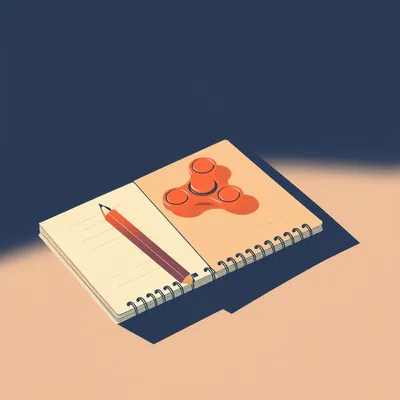
Daniel sent us this one — he's in the middle of a move, decluttering like a man possessed, and he's discovered something. He's walking around his apartment with a white paint pen, writing gigantic labels on the things he always loses. His notebook now says "notebook" in inch-high letters. His step ladder says "office" so he stops grabbing the patio one by mistake. And he's aware this sounds a little unhinged, which is why he prefaced the whole thing with "Daniel, did you really need to send that in? You sound like a crazy person.

He also gave us the exact pen model, which I deeply appreciate. Sakura Pen-Touch 2mm, white, oil-based, xylene-free, AP-rated. He did his homework on the chemistry — found out oil-based markers bond to wood and plastic in ways alcohol-based ones don't, and they need a full twenty-four hour cure time. That's a man who has gone deep on paint markers.
Of course he has. That's the Daniel special — take something that seems trivial, discover three layers of industrial chemistry underneath, then realize it connects to how your brain processes reality.
Here's what I find genuinely fascinating. He's not just labeling for the move — he's labeling the things he chronically mislays. And he says something really specific. When he puts things down, he doesn't register it. He's not being careless. Something isn't firing. And the label — this big, white, high-contrast mark — catches his eye in a way the object itself doesn't.
That's the tension at the center of this. To a neurotypical observer, writing "notebook" on your notebook looks like the behavior of someone who's lost the plot. It's visual clutter. It's redundant. But Daniel's experience suggests the opposite. The label isn't redundant. It's doing something the object alone can't do.
That's what we're going to unpack. First, the actual neuroscience of why some brains don't register objects in their visual field — what's happening in the visual cortex and attention systems that makes a notebook disappear even when you're looking right at it. Second, why conventional advice like "just put things away" fails for those brains, and what environmental scaffolding actually works instead. Third, practical design principles — if you're going to label your life, how do you do it so it helps rather than adding to the chaos.
This isn't really about paint pens. It's about what the paint pen reveals — that visual processing differences in ADHD and other forms of neurodivergence might explain why some of us lose things constantly, and why the solution isn't trying harder to remember, but engineering the environment so you don't have to.
Alright, so Daniel has stumbled onto something that feels both deeply personal and surprisingly universal. But before we get into the neuroscience, let's actually understand what he's doing and why it matters.
Let me push back for a second, because I think a lot of listeners might be thinking what I initially thought. Isn't this just a fancy version of a sticky note? Label makers have existed for decades. What makes this different?
First, the objects he's labeling aren't containers — they're the things themselves. He's labeling his notebook, not the shelf it sits on. Second, the method is deliberately high-contrast and permanent. This isn't a tidy little embossed label strip. It's a fat white paint stroke that screams at you from across the room. The label isn't meant to be read so much as seen.
Like a visual flare gun.
And that distinction — between reading and seeing — is going to matter a lot when we get into the neuroscience. Daniel's method works because it bypasses the whole conscious attention system and triggers something more automatic. But before we get there, there's a number I want to put on the table.
A 2019 study in the Journal of Attention Disorders found that adults with ADHD spend an average of twelve to fifteen minutes per day searching for misplaced items. That's seventy-six to ninety-five hours per year. Call it two full work weeks, annually, just looking for things you know you had thirty seconds ago.
That is a staggering number. And it's not time spent being productive or creative or even resting. It's time spent in a low-grade panic, retracing steps, opening drawers you already checked twice.
The emotional toll is arguably worse than the time lost. Every time you can't find something, there's this little spike of self-recrimination. "What's wrong with me? I just had it. Why can't I keep track of basic objects like a functioning adult?" Daniel alluded to this — he said he's self-censored about this stuff, felt he shouldn't tell anyone because they'd think he's crazy. That shame is part of the package.
Which is why I love that he sent this in. He's basically standing up and saying, "I write giant labels on my belongings and it works and I'm done being embarrassed about it." That's the energy we need.
It's not just him. There's a whole community of people with ADHD who've independently discovered similar strategies — color-coding, clear storage bins instead of opaque ones, keeping things at eye level rather than in drawers. Daniel's paint pen is part of a broader pattern, and the pattern points toward something real about how these brains process visual information.
Okay, so the surface level is obvious — label things so you can find them. But Daniel's email hints at something deeper. He says his brain doesn't register putting things down. That's not a metaphor. Let's talk about why.
Let's start with the most fundamental question. Why does Daniel's notebook vanish? He puts it down on his desk, walks to the kitchen, comes back thirty seconds later, and it's gone — not literally gone, but functionally gone. He scans the room and doesn't see it, even though it's sitting right there in plain view. What's actually happening in his brain during that scan?
This is the part where I assume it's not just "he's not paying attention." Because he is paying attention. He's actively looking for the notebook. That's the frustrating part.
Right, and that's the first misconception we need to bust. People assume that if you can't find something you're looking at, you must not be trying hard enough. But the neuroscience tells a different story. There's a system in your brain called the locus coeruleus-norepinephrine system, and it's basically the volume knob for sensory signals. It modulates what gets amplified and what gets filtered out before it even reaches conscious awareness.
It's not a matter of effort. It's a matter of signal strength.
The locus coeruleus sits in the brainstem and sends norepinephrine throughout the cortex. In a neurotypical brain, it helps create a good signal-to-noise ratio — relevant stimuli get boosted, irrelevant background gets suppressed. But in ADHD, this system is dysregulated. The norepinephrine signaling is inconsistent. Sometimes it's too low, which means nothing gets boosted and everything feels equally unimportant. Sometimes it's poorly timed, so the boost comes too late or not at all.
Which would explain both the distractibility and the inattentional blindness. Too much signal from the environment, and you can't focus. Too little, and you can't find your notebook.
And this is something most people don't connect. They think ADHD means being easily distracted by everything, but it can also mean failing to notice things that should be obvious. The same underlying mechanism — poor signal-to-noise modulation — produces both effects.
Daniel's brain is receiving the visual input of the notebook, but it's not flagging it as important. It's just part of the visual noise.
Yes, and there's a classic experiment that illustrates this beautifully. You've heard of the gorilla in the basketball game?
The selective attention test where people are told to count basketball passes, and a person in a gorilla suit walks right through the scene, and about half of viewers don't notice it at all.
That's the one. The finding was that when your attention is directed at a specific task, you can completely fail to register something as obvious as a gorilla. But here's the thing — for people with ADHD, the gorilla effect can happen even without a competing task. The brain's attentional spotlight is just... Objects that aren't actively being tracked can drop out of awareness almost immediately.
Daniel puts down his notebook, shifts his attention to something else for five seconds, and the notebook might as well have been teleported to another dimension. His brain didn't encode its location because the encoding process itself requires attentional resources that weren't allocated.
This connects to something called feature integration theory, developed by Anne Treisman in 1980. Treisman proposed that visual processing happens in two stages. The first stage is preattentive — it happens automatically and in parallel across your entire visual field. Basic features like color, orientation, size, and motion are detected without any conscious effort. The second stage is focused attention, where those features get bound together into coherent objects.
Preattentive processing is like a security camera that records everything. Focused attention is the security guard who actually watches the footage and says "that's a notebook.
Here's where it gets relevant to Daniel's paint pen. When he scans his desk for his notebook, his brain has to perform what's called a visual search. There are two types. A feature search is when you're looking for something defined by a single basic feature — a red item among green ones, a vertical line among horizontals. Feature searches are fast and effortless because they use the preattentive system. A conjunction search is when you're looking for something defined by a combination of features — a red vertical line among red horizontals and green verticals. Those require focused attention and are much slower.
Most real-world object searches are conjunction searches. A notebook on a cluttered desk shares features with everything around it — similar colors, similar shapes, similar sizes.
Daniel's notebook is probably dark-colored, sitting among other dark-colored objects on a desk that might have a dark wood surface. It's a conjunction search from hell. But when he puts a bright white label on it, he's introducing a feature that doesn't exist anywhere else in his visual field — a high-contrast white patch with distinct edges. Now the search changes. His preattentive system can spot that white patch instantly, in parallel, without any conscious effort. He's converted a conjunction search into a feature search.
The label works not because he reads the word "notebook," but because the white blob triggers his automatic attention system before he even knows what he's looking at.
That's the key insight. The label exploits what vision scientists call "pop-out." Certain visual features — high contrast, large size, sharp edges, motion — grab attention automatically from the preattentive stage. Daniel's brain doesn't have to look for his notebook anymore. It just has to notice a white rectangle, which it does without trying.
Which explains why a small, tasteful label wouldn't work as well. If the label blends in, it doesn't create the pop-out effect. Daniel's method of using a fat paint pen — the Sakura Pen-Touch has a 2mm tip, so the strokes are substantial — is actually neurologically optimal. He's maximizing the signal.
This connects to something Daniel mentioned in a previous discussion about his headtorch. He discovered that wearing a bright headtorch while searching for things helped him find them faster. Same principle — the headtorch increases the contrast between the target object and its background, making it more likely to trigger pop-out. Both hacks exploit the same visual processing pathway.
We've established that Daniel's brain literally doesn't see his notebook in the same way a neurotypical brain would. But here's where it gets interesting — because the solution he found isn't just about vision. It's about designing an environment that works with his brain instead of against it.
Let's talk about why conventional organization advice fails so spectacularly for many people with ADHD. The standard line is "a place for everything and everything in its place." It sounds reasonable. It's the foundation of every decluttering book and home organization system. But it makes an assumption that isn't true for all brains.
The assumption being that you'll remember where the place is.
Not just remember — that you'll form a stable mental map of your physical environment. When a neurotypical person puts their keys on a hook by the door, their brain encodes that event. The hippocampus tags the location. The prefrontal cortex links the action to the context. Later, when they need their keys, the memory of placing them there is accessible. It might not be conscious — they might just walk to the hook automatically — but the encoding happened.
For someone with ADHD?
The encoding is unreliable. The prefrontal cortex and hippocampus have to coordinate during memory formation, and in ADHD, that coordination is often disrupted. The person puts their keys down, but the brain doesn't create a strong spatial-episodic tag. Thirty seconds later, the memory of where they put the keys is either weak or nonexistent. They know they had the keys. They know they put them somewhere. But the "where" didn't stick.
This is the "object permanence" thing people talk about with ADHD, right? But I know that's not the clinical term.
Right, it's a colloquialism. In developmental psychology, object permanence is Piaget's concept — the understanding that objects continue to exist even when you can't see them, which infants develop around eight months. Adults with ADHD obviously know objects exist when out of sight. But the subjective experience — "out of sight, out of mind" — is so intense and consistent that the community has adopted the phrase. The object doesn't literally cease to exist, but it ceases to exist in your working mental model of the world.
Which is why drawers and cabinets can be dangerous. If you put something in a drawer, it's gone. Not just from view, but from your entire cognitive landscape. You might not think about it again for six months.
This is where Daniel's labeling strategy gets really interesting, because he's doing something counterintuitive. Conventional decluttering advice says to put things away — behind doors, in drawers, in matching opaque containers. But for an ADHD brain, that's a disaster. Out of sight truly is out of mind. What Daniel is doing is the opposite — he's making things more visible, not less. He's accepting that his brain needs objects to announce themselves.
The label on the notebook isn't just a search aid. It's a persistence mechanism. It keeps the notebook in his cognitive world even when he's not actively thinking about it.
And there's a formal concept for this approach. In the 1990s, a cognitive scientist named David Kirsh introduced the idea of "environmental scaffolding." The insight is that we can structure our physical environments to reduce cognitive load, the same way a chef's mise en place — having all ingredients prepped and arranged before cooking — reduces the working memory demands of preparing a complex dish.
The environment becomes part of your cognitive system. You're offloading mental work onto the physical world.
Kirsh studied how people use their environments to think. A bartender arranging glasses in the order drinks will be served. A factory worker positioning tools in the sequence they'll be used. A programmer leaving a sticky note on their monitor with the one command they keep forgetting. These aren't signs of weakness — they're intelligent uses of external structure to compensate for internal limitations.
We all do this. Pilots use checklists. Surgeons do instrument counts. Nobody accuses a pilot of being lazy because they don't memorize every pre-flight procedure. But when someone with ADHD labels their notebook, suddenly it's a crutch.
That's the double standard, and it's worth naming. Daniel mentioned he self-censors about this — he's worried people will think he's obsessive or ridiculous. But the pilot with a laminated checklist in the cockpit isn't obsessive. The surgeon counting sponges isn't ridiculous. These are professionals using environmental scaffolding to prevent catastrophic errors. Daniel's errors are less catastrophic — he's not going to leave a sponge in a patient — but the principle is identical. He's engineering his environment to prevent a predictable failure mode.
The failure mode isn't a character flaw. It's a neurological constraint. You might as well accuse someone with poor eyesight of using glasses as a crutch. Yes, that's exactly what glasses are — an engineered solution to a biological limitation. The paint pen is glasses for spatial memory.
Let's talk about the social dimension for a moment, because Daniel raised it explicitly. He said he's self-censored about this kind of thing, felt he shouldn't tell anyone. Why is labeling your belongings embarrassing?
Because it looks like you can't handle basic adult functioning. There's a whole set of unspoken rules about how a competent person's space should look. Labels are for warehouses and elementary school classrooms. An adult's home office should be implicitly organized — you should just know where things are.
That's such a neurotypical norm. The idea that organization should be invisible, that the effort should be hidden, that things should just work without visible systems — that's a standard built for a specific kind of brain. For someone with ADHD, invisible organization is no organization at all.
It's the IKEA showroom model of adulthood. Everything has its place, and the place is obvious because the design is intuitive. But what's intuitive for one brain is incomprehensible for another.
There's a concept in disability studies called "the curb cut effect." Curb cuts were originally designed for wheelchair users, but they ended up helping everyone — parents with strollers, delivery workers with dollies, travelers with rolling luggage. Environmental accommodations designed for specific needs often have universal benefits. Daniel's labeling system might be the same. A neurotypical visitor might initially think the labels are weird, but I guarantee they'd never have trouble finding the notebook either.
The question becomes: how do we normalize this? As remote work blurs the line between personal and professional spaces, more people are going to see each other's home environments. The labeled notebook, the whiteboard with giant reminders, the key hook with the word "KEYS" painted above it — these become visible to colleagues on video calls.
That visibility is an opportunity. Every time someone sees a labeled notebook and asks about it, there's a chance to say, "Oh, that's how I keep track of things. My brain doesn't encode object locations automatically, so I engineer around it." Normalizing the accommodation normalizes the difference.
Alright, let's expand the frame. Daniel's paint pen is a visual accommodation, but visual isn't the only sensory modality. Are there equivalent strategies for auditory or tactile processing?
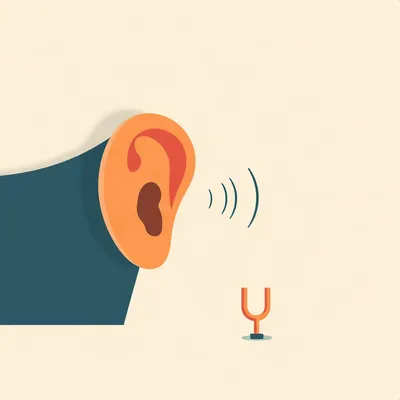
The principle is the same — create a signal that triggers automatic attention in a sensory channel where your brain otherwise loses track. For auditory, Tile trackers and AirTags are a great example — you press a button on your phone and the lost item makes a sound. That's auditory scaffolding. For tactile, textured stickers on frequently-used items. A bumpy sticker on your work phone versus a smooth sticker on your personal phone. Different textures on different key rings. The tactile system works on the same preattentive principle — your fingers feel the difference before your brain has to consciously identify the object.
Daniel mentioned that he's been mislaying things since he was a teenager. This isn't new. What's new is that he's giving himself permission to solve it with engineering rather than self-discipline.
That's the emotional arc of this whole episode. For years, the message Daniel probably received — from parents, teachers, his own inner critic — was "try harder, pay more attention, be more careful." And it didn't work, because the problem wasn't effort. The problem was architecture. You can't try your way out of a neurological constraint any more than you can try your way out of needing glasses.
The paint pen isn't just a label. It's a permission slip. It's Daniel saying to himself, "I'm done trying to fix my brain. I'm going to fix my environment instead.
Here's the paradox Daniel identified in his message. He said that at the time, labeling feels like a complete waste of time. Three hours writing labels around the house, and the whole time part of his brain is saying "this is ridiculous, what are you doing." But then for the next year, he's grateful he did it. There's a cognitive bias at work here.
The upfront cost is visible and painful. The ongoing benefit is diffuse and easy to take for granted. It's the same reason people don't floss — the five minutes feels real, the prevented cavities are abstract.
Let's quantify it. If Daniel spent three hours labeling, and those labels save him even five minutes of searching per day — and the ADHD study I mentioned earlier suggests the average is twelve to fifteen minutes — then the labels pay for themselves in thirty-six days. After that, it's pure profit. Over a year, three hours of labeling saves roughly thirty hours of searching. That's a ten-to-one return on investment.
That's just the time. What's the value of not starting your day with the cortisol spike of "where are my keys"?
Hard to quantify, but probably enormous. That moment of panic when you can't find something you need right now — it's not just an inconvenience. It's a stress response. Your amygdala lights up. And for someone with ADHD, who might experience this multiple times a day, that's a significant cumulative burden. Removing those micro-panics from your daily experience is a quality-of-life improvement that goes beyond time saved.
We've covered why labeling works and why the stigma around it is nonsense. But I want to talk about what Daniel is not doing, because I think it's just as important. He's not labeling everything. He's labeling the three to five things he misplaces most often.
That's crucial. There's a version of this that goes wrong — where someone gets excited about labeling and puts labels on everything in their environment. Every drawer, every shelf, every container. And that backfires, because now the labels themselves become visual noise. If everything is labeled, nothing pops out.
The labels have to be strategic. They need to be rare enough that the high-contrast white patch is anomalous in your visual field. If your entire wall is covered in white labels, the notebook label disappears again.
I'd call this the Three-Item Rule. Identify the three to five items you misplace most frequently. Label only those. For Daniel, it's his notebook, his keys, his wallet, and his step ladder. For someone else, it might be their phone, their glasses, and their water bottle. The specific items don't matter — what matters is that the list is short and the labels are reserved for high-value targets.
Daniel mentioned another important sequencing point. He decluttered first, then labeled. That order matters.
It matters enormously. If you label before decluttering, you're labeling objects in a high-noise environment. The labels have to compete with all the other visual stimuli. But if you declutter first — if you reduce the total number of objects in your visual field — then each label has more impact. The signal-to-noise ratio improves from both directions. Less noise, stronger signal.
Daniel's sequence — declutter first, then label — is neurologically correct. He reduced the visual load, then added strategic markers. That's not just good organization. That's good cognitive engineering.
Let me give some concrete recommendations, because I know there are listeners who are thinking "this is me, what do I actually buy?" Daniel mentioned two manufacturers. Sakura, the Japanese company, makes the Pen-Touch line. The 2mm tip is what he's using. White is ideal for dark surfaces — notebooks, dark wood, black plastic. For light surfaces, you want the opposite — Edding 751 in black. Both are oil-based, which is critical. Oil-based paint bonds to wood and plastic and metal and glass. Alcohol-based markers will smear or fail to adhere on non-porous surfaces.
The cure time matters. He mentioned twenty-four hours.
Yes, and that's not optional. Oil-based paint markers need a full day to cure. If you touch the label before it's cured, you'll smudge it and the contrast will be reduced. Put the item aside for a day after labeling. It feels like overkill, but it's the difference between a label that lasts years and one that flakes off in a week.
What about size? Daniel's labels sound big. Inch-high letters.
For the pop-out effect to work, you want a minimum stroke width of about 2mm — which is exactly what the Pen-Touch 2mm provides. The letters should be large enough to be legible from across the room. If you're squinting to read the label, the preattentive system won't catch it. You want the white patch to be detectable from wherever you typically stand when you're searching.
High contrast is the only rule. Light on dark or dark on light. Avoid medium-contrast combinations — pastels, earth tones on wood, anything subtle. Subtlety is the enemy. You're not designing a magazine spread. You're building a visual flare gun. White on black, black on white, yellow on dark blue — those work.
What about people who don't process visual information as their dominant modality?
For tactile, I'd recommend textured stickers. 3M makes safety tread tape that has a very distinct rough texture — you can cut small pieces and stick them on items you need to identify by touch. Different grits for different items. For auditory, Tile trackers or AirTags with custom ringtones. Assign different sounds to different categories of items — a distinctive chime for keys, a different one for wallet. The auditory pop-out works on the same preattentive principle.
I want to step back and address something that might be bothering some listeners. The idea that all of this is just compensating for a skill deficit. Shouldn't we be training ourselves to be better at remembering? Isn't labeling giving up?
This is perhaps the most important misconception we need to address. The idea that environmental scaffolding is "giving in" to ADHD rather than managing it — it's based on a flawed model of how cognition works. Your brain does not have a fixed capacity that you either use or waste. Cognitive resources are finite and depletable. Every bit of mental energy you spend remembering where your notebook is, is energy you're not spending on your actual work, your relationships, your creative projects.
There's the spoon theory, right?
The spoon theory originated in the chronic illness community — Christine Miserandino used spoons as a metaphor for units of energy. You start each day with a limited number of spoons. Every activity costs spoons. For someone with ADHD, basic executive functions — keeping track of objects, maintaining focus, managing time — cost more spoons than they do for a neurotypical person. Environmental scaffolding reduces the spoon cost of those basic functions. Labeling your notebook means you spend zero spoons finding it, and those spoons are available for something that actually matters.
It's not giving up. It's resource allocation. You're choosing to spend your limited cognitive budget on things that have higher return.
This is where the analogy to programming comes in, because Daniel works in tech. When a programmer uses IDE autocomplete, nobody accuses them of "giving in" to their inability to memorize every method signature. The autocomplete handles the low-level memory task so the programmer can focus on architecture and logic. Daniel's labels are autocomplete for spatial memory. They handle the low-level object-tracking task so he can focus on the work he's actually trying to do.
That's a frame that a lot of people in tech would immediately understand. You're not a worse programmer because you use autocomplete. You're a more efficient one because you're not wasting working memory on syntax.
Alright, we've covered the why. Now let's get practical. If you're listening and thinking "this is me," here's exactly what to do — and what not to do.
First principle: identify your high-loss items. The three to five things you misplace most often. Spend a week noticing what you search for. Write it down every time you have a "where is my...The items that appear multiple times are your targets.
Second principle: declutter first, label second. Before you put a single mark on anything, reduce the total number of objects in your visual field. Get rid of things you don't need. Put away things you use rarely. The labels will be far more effective in a lower-noise environment. Daniel did this during his move, which is perfect timing — a move forces decluttering.
Third principle: high contrast, large format. Get an oil-based paint marker — Sakura Pen-Touch 2mm in white for dark surfaces, Edding 751 in black for light surfaces. The letters should be visible from across the room. Don't aim for pretty. Aim for detectable.
Fourth principle: allow full cure time. Twenty-four hours, untouched. Put the labeled item on a shelf and resist the urge to handle it. Smudged labels lose contrast and defeat the purpose.
Fifth principle: experiment with modality. If visual labels don't work for you, try tactile markers — different textures on different items. Or auditory tags — Tile trackers with custom ringtones. The principle is the same across all senses: create a signal that triggers preattentive processing, so your brain notices before you have to search.
The broader principle underlying all of this: design your environment for your actual brain, not the brain you wish you had. This is not about what your space "should" look like. It's not about what a neurotypical visitor might think. It's about whether your environment supports you or fights you. If a white paint pen turns a daily frustration into a non-issue, the paint pen is correct. The shame is incorrect.
That's the permission slip. You're allowed to engineer your space to work for you. You're allowed to have visible systems. You're allowed to need what you need.
I want to leave listeners with an open question. Daniel discovered the paint pen hack and the headtorch hack independently, through experimentation. What other "weird" accommodations have you discovered that feel embarrassing but work? What's the thing you do that you've never told anyone about because it sounds crazy, but it makes your life function?
Because I suspect there's a whole underground economy of these strategies. People with ADHD and other forms of neurodivergence have been quietly engineering their environments for decades, often feeling ashamed of the very accommodations that keep them functional. Daniel had the courage to send his in. We'd love to hear yours.
If you've got a weird prompt — something that works but you're not sure why — send it in. We'll do the neuroscience so you don't have to. That's the deal.
As remote work continues to dissolve the boundary between personal and professional spaces, these accommodations are going to become more visible. Your colleagues are going to see your labeled notebook and your giant key hook and your whiteboard covered in reminders. And that's an opportunity — to normalize the idea that different brains need different environments, and that visible systems aren't a sign of dysfunction. They're a sign that you understand your own mind well enough to support it.
Daniel's paint pen isn't just a label. It's a declaration. It says: I know how my brain works, and I'm going to work with it instead of against it. That's not giving in to ADHD. That's mastering it.
Now: Hilbert's daily fun fact.
Hilbert: Korean has seven distinct speech levels for expressing formality and politeness, ranging from plain form to formal polite, and the most elaborate system of honorifics was codified in the 1840s by scholars standardizing the language under King Heonjong. The Simpson Desert in Australia, by contrast, has zero native speakers of Korean and is named after a Scottish geographer who never visited it.
quite the juxtaposition.
That was geographically and linguistically comprehensive in ways I did not request.
This has been My Weird Prompts, produced by Hilbert Flumingtop. If you enjoyed this episode, tell someone about it — especially someone who's ever lost their keys while holding them. You can find us at myweirdprompts.
If you've got a weird accommodation that works, send it in. We want to hear about your paint pens, your headtorches, your textured stickers, your strange and brilliant solutions. We'll see you next time.