Daniel sent us this one — and it's a follow-up to a conversation we had about the total lack of standardization in domestic storage. Every product line has its own dimensions, so when you move, you're forced into buying disposable cardboard boxes that get broken down and recycled after one or two uses. His proposal: what if, instead of cardboard, you bought a small stock of shipping pallets? You assemble them for the move, disassemble them on the other end, store them flat, and reuse them indefinitely. He wants to know if this is actually practical — where to source pallets in Israel, how to put them together so they hold weight, how to pack fragile items, handle stairs, store them outdoors, and what the whole thing would cost.

There's something almost elegant about taking the most standardized object in global logistics and bringing it into your living room. But I want to stress-test this immediately, because the gap between "elegant in theory" and "you're crying on a staircase at 11 PM" is real. I've been on that staircase. Not with pallets, but with a dresser that wouldn't fit through a doorway, and I remember thinking, "the person who designed this building has never moved anything heavier than a suitcase.
That's the tension. Commercial logistics versus domestic chaos. And the domestic chaos always wins unless you plan for it. The pallet is designed for forklifts and loading docks and warehouse floors — perfectly flat, perfectly predictable surfaces. Your apartment building was designed by someone who was thinking about window placement and balcony size, not about how a human being is going to get a heavy rectangular object up three flights of stairs.
So let's start with the most basic question: what kind of pallet should you actually buy, and where do you find one in Israel? Because you can't just walk into any hardware store and ask for "a pallet" and expect to get the right thing.
Because not all pallets are created equal, and the wrong kind will make you miserable. I've made this mistake. I once acquired what I thought was a perfectly good pallet for a DIY project, and it turned out to be a stringer pallet made of the softest, most splinter-prone pine I've ever encountered. I couldn't get a fork under it from the side, the nails kept pulling out, and by the end of the project I had more wood in the scrap pile than in the finished piece.
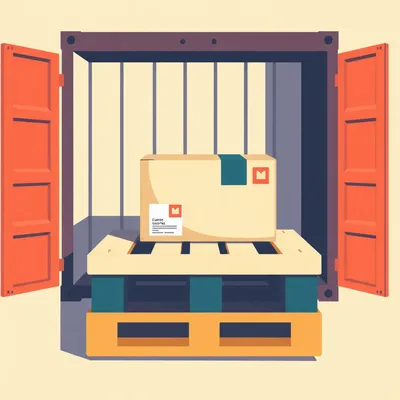
The pallet world has three major standards. There's the EUR-pallet, twelve hundred by eight hundred millimeters. There's the ISO standard, twelve hundred by a thousand. And there's the US GMA pallet, forty-eight by forty inches. Israel adopted the EUR-pallet standard back in the nineteen nineties through the European Pallet Association, the EPAL system. So if you're in Tel Aviv or Jerusalem or Haifa, the EUR-pallet is what you'll most commonly encounter. And that's actually lucky, because it's arguably the best-designed pallet of the three for this kind of application.
EUR-pallets are block pallets, which matters. Can you explain the difference, because I think most people have never looked at a pallet closely enough to notice the structural differences.
It matters enormously. A stringer pallet uses three long parallel beams — the stringers — and the deck boards are nailed across the top and bottom. Fork tines can only enter from two sides. That's two-way entry. Think of it like a house where you can only enter through the front or back door, but not the sides. A block pallet uses nine or twelve solid blocks separating the top and bottom decks. Because the blocks are individual, you get full four-way entry — fork tines or a pallet jack can enter from any side. In a domestic move, where you're maneuvering in tight hallways and narrow doorways, four-way entry is a game changer. You can approach the pallet from whatever angle the space allows, rather than having to line up perfectly from one of two directions.
If you're at a warehouse and someone offers you free stringer pallets, you're getting the pallet equivalent of a car that only turns left. It might get you there eventually, but you're going to spend a lot of time doing three-point turns in places where there's no room to turn.
That's it exactly. The EUR-pallet weighs about twenty-five kilograms. Maximum static load is fifteen hundred kilograms. Dynamic load is a thousand kilograms. Those numbers are so far beyond what a domestic move requires that you're never going to hit the structural limit. To put that in perspective, fifteen hundred kilograms is roughly the weight of a small car. Your entire book collection might weigh two hundred kilograms if you're a serious bibliophile. You're operating at maybe fifteen percent of the rated capacity.
The pallet isn't the weak point. The weak point is how you reassemble it after you've taken it apart. The original pallet is built to industrial standards with industrial fasteners. Once you've disassembled it and put it back together with screws from Home Center, you're working with a different structural system entirely.
Right, and we'll get to that. But first, sourcing. Where do you actually find EUR-pallets in Israel? There are pallet manufacturers — companies like Palletim and Pal-Kal. A new EUR-pallet costs between forty-five and sixty-five shekels, roughly twelve to eighteen US dollars. They're heat-treated, stamped, EPAL-certified, and they'll arrive clean. But the real value proposition is used pallets, because the whole point of this system is that it's cheaper and more sustainable than cardboard, and buying new pallets at sixty shekels each undercuts that argument.
Used pallets in Israel run what, fifteen to thirty shekels?
On Yad2, which is Israel's Craigslist essentially, or Facebook Marketplace, you can find used EUR-pallets in good condition for fifteen to thirty shekels. Industrial zones are the best places to look — Kfar Saba, Petah Tikva, Haifa Bay. Agricultural packing houses are another source, especially in the Sharon region and around the Arava. They go through pallets regularly and often have stacks they're willing to sell cheaply or even give away. I've seen listings where someone just wants them gone and is offering twenty pallets for free if you'll come pick them up.
Now, there's a myth I want to address. The "free pallet" myth. You see stacks of pallets behind grocery stores or construction sites, and they look abandoned. Can you just take them? I think a lot of people assume the answer is yes, because they're sitting there in the open, sometimes for weeks.
The EPAL pool tracks over six hundred million pallets globally in a closed-loop system. When you see a stack behind a supermarket, those pallets are almost certainly still in the pool, waiting to be collected by the distributor who delivered goods on them. Taking them is technically theft. They have a deposit value — in Europe it's around ten euros per pallet — and they're expected to be returned. At a household scale, taking one or two damaged pallets headed for a dumpster is generally tolerated. But the "free pallet" idea is mostly a myth. If you want pallets, you should buy them. The fifteen shekels you spend is buying you legal ownership and peace of mind.
The honest answer is: budget fifteen to thirty shekels per used pallet, and you're doing it legally and cleanly. You're not looking over your shoulder wondering if a truck driver is going to show up and demand his pallets back.
Look for the HT stamp — heat-treated. It means the pallet was kiln-dried to a core temperature of fifty-six degrees Celsius, which kills pests, mold, and larvae. You do not want a pallet stamped MB, which means methyl bromide fumigation. That's a toxic pesticide, and you don't want it in your apartment near your books and dishes. Methyl bromide is a neurotoxin and an ozone-depleting substance. It's been phased out in most countries, but older pallets might still carry that stamp. If you see MB, walk away.
That's a crucial safety point that I don't think most people would know to look for. You see a stamp on a piece of wood and you assume it's just a manufacturer's mark, not a chemical warning label.
The stamp tells you everything. EPAL logo, country code, manufacturer number, treatment method. It's a complete provenance for a piece of wood, which is more than you can say for most furniture.
How many pallets does a typical three-room apartment move require? Because I think people might overestimate or underestimate this.
For a ninety-square-meter apartment — roughly a standard three-room in Tel Aviv — you'd want ten to fifteen pallets. Let's say twelve. That covers books, kitchen items, clothing bins, fragile goods, and miscellaneous household items. Furniture moves separately — you're not putting a sofa on a pallet. So twelve used pallets at twenty shekels each — that's two hundred forty shekels, about sixty-five US dollars. Compare that to cardboard boxes: a decent moving box costs five to fifteen shekels, and for a full apartment you might need thirty to forty boxes. That's anywhere from two hundred to six hundred shekels, and they'll last one or two moves before they're structurally compromised. The corners blow out, the tape loses adhesion, they get crushed if anything heavy is stacked on top of them.
The pallets pay for themselves by move three, conservatively. And that's before accounting for the cardboard waste you're not generating. Which, if you've ever seen the pile of broken-down boxes after a move, is substantial. It's a small mountain of corrugated cardboard that you then have to figure out how to dispose of.
And the cardboard pile is a hidden cost — in time, in recycling bin space, in the sheer annoyance of breaking down forty boxes while you're already exhausted from moving.
Alright, so you've sourced your pallets. Now you have to take them apart. And this is where I imagine most people's enthusiasm meets reality. Because pallets are not designed to be taken apart. They're designed to be assembled once and then survive years of abuse.
The disassembly is the make-or-break moment. Pallets are assembled with ring-shank nails — nails with ridges along the shank that grip the wood and resist pulling out. These are not the smooth nails you use for hanging pictures. Ring-shank nails are designed to go in and never come out. If you try to pry a pallet apart with a regular crowbar, you will split the deck boards and end up with firewood. I've done this. I thought, "how hard can it be?" and forty-five minutes later I had a pile of splinters and a deep resentment toward the pallet industry.
There's a specific tool for this. And I think this is where the "right tool for the job" principle really applies. You can't improvise your way through pallet disassembly.
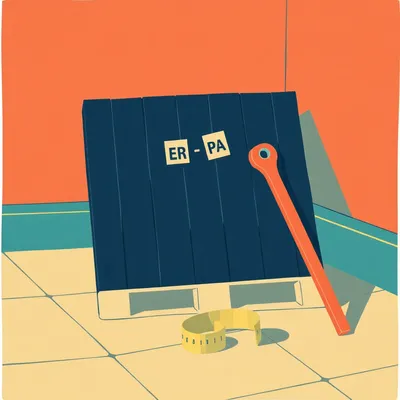
The pallet breaker bar. It's a long steel lever with a forked end and a curved fulcrum. You slide the fork under the deck board, position the fulcrum against the stringer or block, and lever it up. The geometry gives you enormous mechanical advantage — you're applying force at the optimal angle to extract the nail without snapping the wood. In Israel, you can get one at Ace or Home Center for about eighty shekels. With a breaker bar, two people can disassemble twelve pallets in about forty-five minutes. Without one, you're looking at hours of frustration and destroyed wood.
The eighty-shekel tool is non-negotiable. It's not a nice-to-have, it's the price of entry. If you're not willing to buy the breaker bar, don't attempt this system.
Once the pallets are apart, you have a stack of deck boards and stringers or blocks. The original nails are still embedded. You can either pull them out with a nail puller — tedious but doable — or clip them flush with bolt cutters. Either way, you're not reusing the nails. Ring-shank nails are one-time-use fasteners. Once they've been pulled, the ridges are compromised and they won't hold the same way.
For reassembly, what do you use instead? Because you can't exactly go buy industrial ring-shank nails and a pneumatic nailer.
Two-and-a-half-inch coated deck screws, Torx drive. Not Phillips — Torx. Phillips heads strip under the torque you need to sink into hardwood. If you've ever tried to drive a Phillips screw into dense wood and felt that sickening moment when the bit starts spinning in the head, you know exactly what I'm talking about. Torx has a six-pointed star pattern that grips the bit much more securely. You can get a two-hundred-pack for about forty shekels at any hardware store. You'll also want a cordless drill with a Torx bit, and you should pre-drill the holes. The wood in Israeli pallets is typically pine or eucalyptus, and eucalyptus especially will split if you drive a screw into it without a pilot hole.
How strong is a reassembled pallet compared to the original? Because you're trading industrial ring-shank nails for consumer-grade screws. There has to be a strength penalty.
A properly reassembled EUR-pallet, using eight deck screws per stringer — twenty-four screws total — will hold a static load of five hundred kilograms easily. The original pallet is rated for fifteen hundred kilograms static, so you're at about a third of the original strength, but for domestic use you're never going to exceed two hundred kilograms per pallet anyway. A full pallet of books might hit eighty kilograms. You have a massive safety margin. Even if your assembly is imperfect — if you missed a pilot hole or two, if a screw isn't perfectly seated — you're still operating well within the safe range.
The screw-based assembly means you can take it apart again without destroying anything. That's the whole point of the system. You're not building permanent pallets, you're building reusable ones.
That's the key insight. You're trading the one-time-use ring-shank nails for reusable screws. Disassemble, unscrew, stack the boards, store them. Reassemble next time. The wood itself will last through dozens of cycles before the screw holes get wallowed out and you need to drill new ones. And even then, you just drill new holes offset from the old ones. The pallet has a lot of real estate on those stringers.
You've got your pallets. Now comes the hard part — how do you actually pack your grandmother's china onto a wooden platform with gaps in it? Because a pallet is not a solid surface. It's a series of slats with empty space between them.
EUR-pallets have five deck boards on the top, with gaps of about five to ten centimeters between them. Anything smaller than a shoebox will fall right through. So step one is creating a solid base. You need to turn the pallet into a platform.
Six-millimeter plywood sheets, cut to twelve hundred by eight hundred millimeters to match the pallet footprint. At Keter or Home Center, you can get these cut for about thirty-five shekels each. They just drop onto the pallet deck. Now you have a flat, solid surface. For fragile items like plates, wrap each plate individually in packing paper or bubble wrap, stack them vertically in a milk crate — standard Israeli milk crates are four hundred by three hundred millimeters, and three of them fit perfectly across a EUR-pallet — and then strap everything down. The vertical stacking of plates is important, by the way. Plates stacked flat are much more vulnerable to cracking because the weight is concentrated on the bottom plate. Stacked vertically, the force is distributed along the rim.
The unofficial national storage container of Israel. Every apartment I've ever been in has at least three of these, usually acquired through questionable means from the back of a grocery store.
They're standardized, stackable, indestructible, and they're everywhere. Three across a EUR-pallet, two deep — that's six crates per layer. You can stack two or three layers high. Then you use ratchet straps to secure everything to the pallet. Two five-meter ratchet straps, criss-crossed over the load and cinched down. Max Stock sells them for about fifty shekels for a pair. The criss-cross pattern is important — it prevents the load from shifting in any direction. If you just run straps parallel, the crates can slide sideways.
Now your pallet is a self-contained unit. You can move it, stack things on top of it, and nothing shifts. It's like a mini shipping container for your apartment.
This is where the piecemeal move strategy becomes possible. Pack non-essential items two to three weeks before moving day. Palletize the living room, the study, the guest room first. On moving day, only the daily-use items — kitchen, bathroom, bedding — remain unpacked. This eliminates the everything-must-move-in-one-chaotic-day problem that makes moving so miserable.
It turns moving from an event into a process. You're not sprinting, you're doing logistics. And logistics, unlike panic, can be scheduled, optimized, and executed calmly.
Logistics, unlike panic, scales well. You can add more pallets, more time, more trips, and the system doesn't break down. Panic doesn't scale at all — add more stuff and it just becomes more panic.
You've got a pallet loaded with eighty kilograms of books. How do you move it from the third floor to the truck? Because "pick it up" is not a complete answer.
The gold standard is a pallet jack. New, you're looking at about twelve hundred shekels. Used on Yad2, four hundred to six hundred shekels. A pallet jack slides under the pallet, you pump the handle to lift it a few centimeters off the ground, and then you can roll hundreds of kilograms with one hand. It's almost magical how easy it makes moving heavy loads.
A pallet jack requires a flat floor and no stairs. And most Israeli apartment buildings have stairs. So there's a mismatch between the tool and the environment.
Most Israeli apartment buildings have stairs. Even buildings with elevators often have a few steps at the entrance — that classic three-step entrance that seems to be mandatory in Israeli architecture. So the pallet jack is great for ground-floor moves or maneuvering inside a storage unit, but for apartments, you need alternatives. The pallet jack gets you from the truck to the bottom of the stairs, and then you're on your own.
What about a stair-climbing hand truck? I've seen these — they look like regular hand trucks but with some kind of rotating mechanism on the back.
That's the solution. A stair-climbing hand truck has a belt track or rotating triple-wheel system that lets you pull a heavy load up stairs step by step. The triple-wheel system works by having three wheels on each side arranged in a triangle. When you hit a step, the triangle rotates and the next wheel engages the next step. Brands like Mighty Lift sell them in Israel for around twenty-five hundred shekels. That's a significant investment, but if you're moving every year or two, it pays for itself compared to hiring movers. A single move with professional movers in Tel Aviv can run two to three thousand shekels. So the hand truck pays for itself in one move.
For most people doing this, the budget option is two people and some straps. Not everyone wants to store a stair-climbing hand truck between moves.
Which works perfectly well for loads under a hundred kilograms. Two people, each holding one side of the pallet with lifting straps. You take two one-and-a-half-meter ratchet straps, wrap them around the stringers or blocks on each side, and use them as handles. You tilt the pallet about forty-five degrees and walk it up sideways, step by step. For narrow stairwells — and Israeli stairwells can be extremely narrow, under eighty centimeters wide in older buildings — you may need to disassemble the pallet on the spot, carry the load up in bags or armloads, and reassemble the pallet upstairs.
Which sounds like a hassle, but if you've built the pallet with screws, disassembly and reassembly is a five-minute job. You're not destroying anything. You're just temporarily breaking the pallet into its components.
The screws make it modular. You're not committed to moving the pallet as a unit. You can break it down whenever the architecture demands it. That's the flexibility that the original ring-shank nails don't give you. A nailed pallet is a permanent object. A screwed pallet is a kit of parts.
What about storage? The whole premise is that these pallets live in your apartment between moves. A stack of twelve pallets is not small. We're talking about a significant volume of wood that has to live somewhere in your home.
A stack of twelve assembled pallets would be about one point seven meters tall and take up significant floor space. You'd basically have a new piece of furniture that serves no purpose except to be a stack of pallets. But the prompt's insight is that you store them disassembled. Twelve disassembled EUR-pallets stack into a footprint of twelve hundred by eight hundred by about two hundred millimeters. That's roughly zero point two cubic meters. It fits under a bed, behind a sofa, in the bottom of a wardrobe. You can slide it into a corner and forget about it.
In a typical Israeli apartment, where storage is already a premium, the disassembled pallet stack essentially disappears. It's not dominating your living space.
It's the flat-pack advantage. IKEA figured this out decades ago. Disassembly is the cheapest form of storage. A bookshelf that's assembled takes up a cubic meter. The same bookshelf in a flat box takes up a tenth of that. The pallet system applies the same principle to moving equipment.
What if you don't have indoor space? What if the pallet stack has to live on a mirpeset, a balcony, or in a garden shed? A lot of Israeli apartments have a mirpeset that serves as overflow storage.
Then you have to contend with Israel's climate. The coastal plain — Tel Aviv, Netanya, Haifa — has sixty to eighty percent humidity most of the year. In the winter, you get heavy rain. Untreated wood left outside in those conditions will start to rot within a season. And Israel has termites. Subterranean termites are a serious problem in many parts of the country, and a stack of untreated wood on a balcony is essentially a termite welcome mat.
You treat the wood. You can't just stack it out there and hope for the best.
A wood preservative like Sikkens or Ronseal — about eighty shekels per liter — will protect against rot and insect damage. Brush it on after disassembly, let it cure, and then store the boards. For outdoor storage, elevate the stack on concrete blocks to prevent moisture wicking up from the ground. Cover with a heavy-duty PVC tarp — two by three meters, with grommets, about sixty shekels from Home Center. Secure it with bungee balls, not rope, because bungee balls maintain tension as the tarp shifts in the wind. And make sure there's airflow underneath. If you seal the tarp too tightly, you create a greenhouse effect and the wood sweats. Condensation builds up inside the tarp and you end up with mold even though the wood is technically covered.
For Jerusalem winters, where you get rain and occasional snow, is a tarp enough? Jerusalem gets colder and wetter than the coastal plain, and snow adds a whole different moisture dynamic.
For long-term storage in Jerusalem, I'd upgrade to a small plastic shed. Keter makes a model called the Store It Out — about six hundred shekels, fully enclosed, ventilated. The pallet stack goes inside, stays dry, and you can access it easily when you need it. The shed also keeps the pallets out of sight, which addresses the aesthetic objection we talked about earlier. Your neighbors don't have to look at a tarp-covered mound on your balcony.
Let's talk about the environmental math, because that's part of the appeal here. Cardboard boxes versus reusable pallets. Is this actually better for the planet, or does it just feel better?
A standard moving box has an embodied energy of about five kilowatt-hours. That's the energy required to manufacture it, from pulping the wood to forming the corrugated sheets to cutting and printing the box. It lasts one or two moves before the corners blow out and it ends up in recycling. A EUR-pallet has an embodied energy of about twenty kilowatt-hours — four times as much. But it lasts ten or more moves. After ten moves, the pallet has amortized to two kilowatt-hours per move, while the cardboard box is still at five. And that's before accounting for the fifteen kilograms of cardboard waste per household that you're not generating.
The environmental case is straightforward. The pallet is a higher upfront investment in embodied energy, but it pays back over time. But there's a psychological case here that I think is more interesting.
Moving is one of the most stressful life events. It ranks up there with divorce and job loss in terms of psychological impact. Part of that stress is the lack of control. You're dependent on movers, on boxes that might collapse, on a timeline that's compressed into a single chaotic day. The pallet system gives you control back. You can start packing three weeks early. You can move things piecemeal. You can label each pallet with a number and a manifest. You know exactly where everything is. There's no moment where you're standing in a sea of identical brown boxes wondering which one has your coffee maker.
It transforms moving from a chaotic single-day event into a managed logistics operation. Studies on moving stress consistently identify loss of control and unpredictability as the primary stressors, not the physical labor itself. People don't mind the work — they mind not knowing whether their grandmother's china is going to survive the trip, or whether the movers are going to show up on time, or whether they'll be able to find their work clothes on Monday morning.
The pallet mindset. Treat your household goods as modular, standardized units. Each pallet is a container. You know what's on it, you know how much it weighs, and you know it'll survive the trip. You can look at a pallet and think, "that's the kitchen," and you know exactly where it needs to go in the new apartment.
This connects to something bigger. We talked in a previous episode about how the moving industry could be the forcing function for storage standardization. Pallets are already the standard in commercial logistics. Bringing them into the home closes the loop. Your household goods move on the same platform that moves everything else in the global economy. There's an elegance to that.
I want to circle back to a practical question that the prompt raised. What if you need to temporarily store these loaded pallets somewhere? What if you're subletting for a month between leases? This happens all the time in Tel Aviv — your lease ends on the first and the new one starts on the fifteenth, and you have a two-week gap where you and your stuff are homeless.
Then you're looking at a storage unit. And this is where the pallet system really shines. Storage units in Israel — companies like Store-It, BoxIt — typically charge by the square meter. If you walk in with a pile of mismatched boxes and furniture, you waste space. Odd-shaped items don't stack efficiently. You end up paying for air. If you walk in with standardized pallets, you stack them efficiently, floor to near-ceiling, and you maximize every cubic meter you're paying for. You're paying for storage, not for empty space between irregularly shaped objects.
You don't need a pallet jack in the storage unit?
For loading and unloading from the van, a pallet jack helps enormously if the storage facility has a loading dock. But once the pallets are in your unit, you can position them with a simple furniture dolly — one of those flat wooden squares with four casters, about sixty shekels at any hardware store. Slide it under a pallet, roll it into position, slide it out. You're not dragging pallets across the floor and scratching up the storage unit.
Let's address the movers. The prompt mentioned that movers might be confused. I think that's generous. Movers might refuse. They might take one look at your palletized loads and say, "we don't do this.
This is a real concern. Professional movers in Israel are used to boxes. They have systems, they have rhythms. They know how to stack boxes in a truck, how to carry them up stairs, how to load an elevator efficiently. If you present them with twelve pallets loaded with milk crates and strapped down with ratchet straps, they're going to look at you like you've invented a new problem for them. And from their perspective, you have — you've changed the rules of the game they're experts at playing.
The solution, I think, is to not spring it on them. When you're getting quotes from moving companies, tell them upfront: I have twelve palletized loads, each weighing between forty and eighty kilograms, strapped and ready to go. You'll need a truck with a lift gate or a ramp. Be specific about what you're asking them to move.
Some movers will say no. That's fine. Others will recognize that palletized loads are actually easier to handle than loose boxes — they're uniform, they're stable, and they can be moved with equipment rather than back labor. A pallet jack can move an eighty-kilogram pallet in seconds, while moving eighty kilograms of loose boxes takes multiple trips and manual lifting. The ones who say yes are the ones you want. If a moving company hears "palletized" and their response is confusion, they're probably not the company you want handling your grandmother's china anyway.
Alright, let's do a full cost breakdown. If someone listening wants to implement this system from scratch, what are they spending? Give us the shopping list.
Here's the shopping list. Twelve used EUR-pallets with the HT stamp: roughly twenty shekels each, so two hundred forty shekels. One pallet breaker bar: eighty shekels. A two-hundred-pack of two-and-a-half-inch coated Torx deck screws: forty shekels. A cordless drill with a Torx bit — you probably already own this, but if not, budget three hundred shekels for a basic model. Six sheets of six-millimeter plywood, cut to twelve hundred by eight hundred millimeters: about thirty-five shekels each, so two hundred ten shekels. Two pairs of five-meter ratchet straps: fifty shekels per pair, so one hundred shekels. A furniture dolly: sixty shekels. A heavy-duty PVC tarp for outdoor storage: sixty shekels. Optional wood preservative: eighty shekels.
All in, about twelve hundred shekels. That's roughly three hundred thirty US dollars. Your breakeven versus cardboard boxes happens at move three, assuming you'd otherwise spend about four hundred shekels per move on boxes, tape, and packing materials. And that's assuming you buy everything new.
That's assuming you buy everything new. On the used market, you could probably halve that. A used pallet jack instead of a new one saves eight hundred shekels right there. You could do the whole system for six hundred shekels if you're patient and willing to hunt for deals on Yad2 and Facebook Marketplace.
The used market for this kind of equipment is robust. People buy pallet jacks for one project and then sell them. The same goes for hand trucks and dollies. If you're willing to spend a few weeks gathering equipment before your move, you can build this system for surprisingly little money.
I want to pull on a thread that's been running through this whole conversation. The idea that domestic logistics could be standardized the way commercial logistics is. What would that world look like? If we took this pallet idea to its logical conclusion.
Imagine apartment buildings designed with pallet elevators — wider, deeper, rated for heavy loads. Or standardized storage rooms on each floor, with racking systems designed for EUR-pallets. You move in, your pallets slot into the racking. You move out, you pull them and go. No boxes, no tape, no waste. The building itself becomes part of the logistics system.
It's not far-fetched. In Japan, some apartment buildings already have standardized storage modules in the basement. In Switzerland, there are cooperative housing projects with shared moving equipment — pallet jacks, hand trucks, dollies — that residents can check out like library books.
The infrastructure exists. It's the social norm that hasn't caught up. We've normalized disposable moving boxes because they're cheap in the short term, even though they're expensive and wasteful in the long term. The cardboard box is a classic example of a system where the costs are externalized — you pay a small amount upfront, and the waste and inefficiency are someone else's problem.
The pallet-as-a-service idea. Could a startup rent you pallets, a pallet jack, and straps for a week, then collect them? Like a moving equipment subscription.
I think there's a real business model there. The capital cost is low — pallets are cheap, durable, and standardized. The logistics of delivery and pickup are straightforward. The target market is urban renters who move every one to two years. In Tel Aviv alone, that's tens of thousands of people annually. Charge three hundred shekels for a two-week rental of ten pallets and handling equipment. The customer avoids the upfront cost and the storage problem entirely. They don't have to figure out where to keep twelve pallets between moves.
The startup owns the pallets, maintains them, and amortizes the cost across hundreds of rentals. If a pallet gets damaged, they repair or replace it. The customer never has to think about wood preservative or termite prevention.
The unit economics work. The main challenge would be customer acquisition — getting people to think about pallets instead of boxes. But if you marketed it as "moving without cardboard waste" and targeted the environmentally conscious renter demographic, I think you'd find traction. You'd be selling sustainability and reduced stress, not just a cheaper alternative to boxes.
Let's get into some of the mechanical engineering details. You mentioned block pallets versus stringer pallets. Why are block pallets structurally superior? What's actually happening with the forces?
In a stringer pallet, the deck boards are nailed directly into the top edge of the stringer. The nails go in vertically, and the entire load is supported by the shear strength of those nails. Over time, the nails work loose and the deck boards start to shift. The load is hanging on the fasteners. In a block pallet, the deck boards rest on top of the blocks, which are spaced at the corners and midpoints. The weight is transferred directly through the blocks to the ground — the fasteners are mostly keeping things aligned, not bearing the load. It's a fundamentally stronger design. The load path goes straight down through solid wood, not through metal fasteners. Plus, the four-way entry means you can approach the pallet from any direction, which distributes wear more evenly.
What about the wood itself? You mentioned pine and eucalyptus. How do you tell them apart, and which one should people prefer?
In Israel, most pallets are made from either pine or eucalyptus. Pine is softer, lighter in color, and easier to work with — it drills cleanly and doesn't split as easily. You can identify it by the visible grain and the lighter weight. Eucalyptus is harder, heavier, darker, and more resistant to moisture and pests, but it's more prone to splitting when you drive screws without pre-drilling. Eucalyptus pallets tend to come from agricultural use; pine pallets are more common in warehousing and retail. For indoor use and ease of disassembly, pine is probably better. For outdoor storage or long-term durability, eucalyptus. But honestly, at the used-pallet price point, you take what you can get and adjust your technique accordingly.
The pre-drilling thing is important. I can imagine someone getting enthusiastic, buying all the gear, and then immediately splitting their first deck board. That moment of hearing the crack and realizing you've just ruined a piece of your pallet.
A three-millimeter pilot hole — that's all it takes. Drill it first, then drive the screw. It adds maybe ten seconds per screw, and it eliminates the splitting problem entirely. With twenty-four screws per pallet and twelve pallets, you're looking at about forty-eight minutes of extra work. Totally worth it. The alternative is potentially ruining boards that you then have to replace, which costs more time and money than the pilot holes ever would.
What about the nails? You mentioned clipping them or pulling them. Is there a best practice for someone who wants to do this right?
Pulling the nails is better if you're planning to reuse the pallets many times, because the embedded nail shanks can interfere with drilling new pilot holes. If you're drilling near an old nail, the bit can deflect and create an angled hole, or hit the nail and dull the bit. But pulling ring-shank nails is genuinely difficult. A dedicated nail puller with a slide hammer mechanism works, but it's another tool to buy — probably another hundred and fifty shekels. Clipping them flush with bolt cutters is faster and good enough for most purposes. The clipped nail ends stay embedded but don't protrude, so they won't snag on anything. For a system that's going to be used five or ten times, I'd clip. For something you want to pass down to your grandchildren, pull.
The screws won't hit them?
You drill new holes in different locations. Don't try to reuse the nail holes — they're enlarged and the wood fibers around them are damaged. The nail has already compressed and torn the wood. Offset your screw holes by a couple of centimeters. There's plenty of room on a EUR-pallet stringer.
Let's talk about load distribution. You've got a pallet loaded with milk crates full of books. The weight isn't perfectly uniform — maybe one side has heavier crates than the other. Does that matter for stability?
It matters less than you'd think. The EUR-pallet's deck boards distribute weight across the blocks, and the blocks transfer it directly to the floor. As long as the heaviest items are centered and the load is strapped down so nothing shifts, you're fine. The one thing to avoid is a single heavy point load right in the center of a deck board, between two blocks. That's where you could theoretically crack a board. But we're talking about loads well over a hundred kilograms before that becomes a concern. For typical household loads, you're not going to create that kind of point load unless you're moving a safe or an anvil.
The ratchet straps are doing a lot of work here. They're not just keeping things from falling off — they're making the load act as a single unit. The physics of that is interesting.
That's the principle of unitization. In commercial logistics, palletized loads are wrapped in stretch film to make them act as a single rigid object. The film compresses the load inward, and friction between the items prevents them from shifting independently. For domestic use, stretch film works — you can get a roll for about thirty shekels — but ratchet straps are reusable and provide more compressive force. The combination of straps and the plywood base turns a pile of miscellaneous items into a coherent block. When you tilt the pallet to go up stairs, the load moves as one piece rather than shifting and throwing off your balance.
What about stretch wrap for weather protection? If you're moving in the rain, a pallet wrapped in plastic film is going to stay dry. That seems like a smart precaution for winter moves.
Stretch wrap is excellent for short-term weather protection during a move. Wrap the entire pallet in three or four layers of film. It's waterproof, dust-proof, and adds structural rigidity. The downside is that it's single-use plastic. For a move that might involve rain, I'd use it — the protection is worth the waste. For dry-weather moves, the ratchet straps alone are sufficient. You're not generating plastic waste for no reason.
Let's address the stairs problem in more detail, because I think this is where the idea meets its toughest test. Eighty kilograms of books. This is the scenario that makes people say "just use cardboard boxes.
The worst-case scenario. Old Bauhaus building in central Tel Aviv, stairwell width of seventy centimeters, three flights up. You have a loaded pallet and no stair-climbing hand truck. This is not a hypothetical — this is a huge portion of the housing stock in central Tel Aviv and Jerusalem.
What do you do? Walk me through it step by step.
You disassemble the pallet at the bottom of the stairs. Unscrew the deck boards, remove the blocks, and now you have a stack of loose items — milk crates, plywood sheets, and pallet components. You carry the crates up individually. They have handles, they're designed to be carried. You carry the pallet frame — the stringers and blocks, which weigh maybe fifteen kilograms assembled — up as a unit. Then you reassemble the pallet on the landing or in the apartment. You've temporarily converted your palletized load into hand-carriable components.
The modularity isn't just for storage. It's for transport through hostile architecture. The pallet adapts to the building, not the other way around.
The screws make the pallet a temporary structure. You can break it down and rebuild it as many times as the situation demands. That's the fundamental advantage over a nailed pallet, which is effectively permanent. A nailed pallet says, "I am a pallet, deal with me." A screwed pallet says, "I can be whatever you need me to be right now.
How long does a disassembly-reassembly cycle take once you're practiced? Is this a five-minute detour or a forty-minute ordeal?
With a cordless drill and the right bit, about five minutes to unscrew a pallet, maybe seven to reassemble it. If you have to do it for all twelve pallets, you're adding an hour or two to your move. But you're only doing it for the pallets that can't be carried up assembled. In practice, you might only need to break down two or three. The rest might fit in the elevator or be light enough to carry up assembled with two people.
You're trading that hour against the cost and waste of cardboard boxes. Seems like a reasonable trade for anyone who's not in a desperate hurry.
It's a reasonable trade if you value reusability and if you're willing to put in the labor. This system is not for everyone. If you're moving once and never again, buy the cardboard boxes. If you're a serial renter who moves every year or two, the labor investment pays off. You do the work once and it amortizes across multiple moves.
Let's talk about the milk crate thing, because I think it deserves more attention. Milk crates are a whole sub-economy in Israel. They're not just containers — they're furniture, storage, and occasionally a source of social tension.
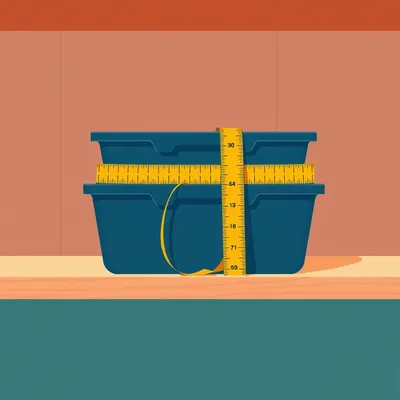
They're the unofficial modular storage system of the country. Standard Israeli milk crates are four hundred by three hundred by three hundred millimeters. They stack, they nest, they're rugged, and they have handles. A used milk crate costs about ten to fifteen shekels. You see them everywhere — in apartments, on balconies, in markets. They're used as bookshelves, as seating, as storage bins. Every Israeli apartment has at least a few.
They fit three across on a EUR-pallet. That can't be an accident.
Twelve hundred millimeters divided by four hundred is exactly three. The fit is so precise you'd think they were designed together. Six crates per layer, three or four layers high, and you have a pallet loaded with eighteen to twenty-four crates, each holding a specific category of items — kitchen utensils, books, clothes, tools. It's a complete modular storage system that costs almost nothing.
The crates themselves are reusable. They become part of your storage system between moves. You're not buying them just for the move and then discarding them.
That's the stacking effect of standardization. The pallet, the milk crate, the ratchet strap — they're all parts of a system that works together. Once you've invested in the system, your marginal cost per move drops to nearly zero. You already own everything. The only cost is the van rental and your time.
I want to go back to something you mentioned earlier about the EPAL pool. Six hundred million pallets, tracked globally. There's something almost absurd about the contrast between that hyper-efficient commercial system and the chaos of domestic moving. We can track a pallet from a factory in China to a warehouse in Germany, but we can't figure out how to move an apartment's worth of stuff across town without generating a small landfill.
The commercial world solved this problem decades ago. The EUR-pallet was introduced in 1961 by the European railways. It was a collaboration between the rail companies and the emerging trucking industry — they needed a standard platform that could transfer seamlessly between trains and trucks. The EPAL system was built around quality control, repair standards, and a closed-loop exchange system. You hand over a loaded pallet, you get an empty one back. The system has been running for over sixty years and it handles hundreds of millions of pallets annually.
Meanwhile, in the domestic sphere, we're still stuffing our lives into whatever boxes the supermarket throws out. Or buying "moving boxes" that are just slightly thicker cardboard with printed labels like "kitchen" and "bedroom" on the side.
It's a classic last-mile problem. The standardization reaches the loading dock and stops. There's no economic incentive for retailers to standardize consumer packaging because consumers aren't the ones bearing the cost of the chaos. The supermarket doesn't care that their boxes are all different sizes — they're not the ones trying to stack them in a moving van.
Until they move.
Until they move. And then the chaos becomes very expensive, very quickly. Lost items, damaged goods, extra truck trips, extra hours of labor. The inefficiency is invisible until you're the one paying for it.
The pallet idea is essentially a hack. It's a way for individuals to borrow the commercial system's standardization and apply it to their own lives, without waiting for the market to solve the problem. It's a bottom-up solution to a top-down failure.
It's a grassroots logistics intervention. And I think that's why it's compelling. It's not just a cost-saving measure — it's a way of asserting control over a process that's designed to be out of your control. You're not a passive consumer of moving services. You're an active participant in your own logistics.
What are the failure modes here? Where does this system break? Because every system has weak points, and I want to make sure we're not selling this as a perfect solution.
The primary failure mode is moisture. If you store your disassembled pallets in a damp basement or under a leaky tarp, you'll open them up six months later and find warped, moldy wood that's structurally compromised. Mold doesn't just look bad — it weakens the wood fibers and can cause respiratory problems. The second failure mode is termites. Untreated wood in ground contact in Israel will attract termites, and once they're in the wood, the pallet is done. You can't see the damage until it's too late — the termites eat the interior while the surface looks fine.
The storage discipline is non-negotiable. Keep them dry, keep them elevated, treat them if they're outdoors. You can't just throw them in a corner and forget about them.
The third failure mode is assembly error. If you don't pre-drill and you split a stringer, that pallet's load capacity is compromised. If you use cheap screws that shear under load, the pallet can come apart during a move. Use the right fasteners, pre-drill, and don't rush. The screws are the structural heart of the reassembled pallet — don't cheap out on them.
The fourth failure mode, I think, is social. Your spouse or roommate looks at the stack of pallets in the living room and says absolutely not. This is not a technical problem, but it might be the hardest one to solve.
That's the adoption problem. This system requires household buy-in. If one person is enthusiastic about industrial-chic logistics and the other person just wants normal moving boxes, the pallets lose. This is not a system you can impose unilaterally. You have to sell it. You have to explain the cost savings, the environmental benefits, the reduced moving-day stress.
The aesthetic objection is real. Pallets are not beautiful objects. A stack of disassembled pallet wood under your bed is not going to spark joy in the Marie Kondo sense. It's not going to look good on Instagram.
Though I'd argue that a stack of broken-down cardboard boxes in the corner of the bedroom, which is the status quo for most renters between moves, isn't exactly a design statement either. At least the pallet stack is intentional. It's a system. The cardboard pile is just deferred waste. It's saying, "I'll deal with this later." The pallet stack says, "I'm ready for the next move.
That's a fair point. The pallet stack says "I have a plan." The cardboard pile says "I'm procrastinating." There's a psychological difference between storing equipment and storing garbage.
There's a certain aesthetic to the pallet system once it's in use. A loaded pallet, strapped and ready, has a kind of utilitarian elegance. It looks competent. It looks like someone thought about this. It's the same aesthetic that makes people take pictures of well-organized workshops and tidy warehouses.
Let's talk about the piecemeal move strategy in more detail. The prompt described packing non-essential items weeks in advance. What does that actually look like in practice? Walk me through the timeline.
You start with the rooms you use least. Guest bedroom, study, storage areas. Three weeks before moving day, you pack everything in those rooms into milk crates, label the crates, load them onto pallets, strap them down. Those pallets can sit in the corner of the room, fully loaded, for two or three weeks. They're not in the way — they're stacked, they're stable, they're ready to go. You're not living around piles of half-packed boxes.
You're not living out of boxes. Your daily life continues normally because the kitchen, bathroom, and bedroom are still functional. You can still make coffee in the morning, take a shower, sleep in your bed. The move hasn't consumed your entire life yet.
That's the psychological benefit. A traditional move compresses all the disruption into a single weekend. You're packing, cleaning, hauling, and unpacking all at once, and by Sunday night you're exhausted and you can't find your toothbrush. The piecemeal approach spreads the disruption across weeks, but at a much lower intensity. By moving day, eighty percent of your stuff is already palletized. You're not waking up at 6 AM to start packing boxes.
On moving day itself, you're just moving pallets. Not boxes, not loose items, not last-minute panic piles. You load the pallets, drive them to the new place, unload them.
You rent a van — Elro six-cubic-meter vans are about three hundred shekels a day — and you move the pallets in batches. Load four or five pallets, drive to the new place, unload, repeat. If the new place has ground-floor access or a freight elevator, you can do it with a pallet jack in a couple of hours. The whole move becomes a series of calm, predictable trips rather than one frantic day.
The batch approach also means you can do the move over two or three days if you need to. You're not racing the clock on a single truck rental. If something goes wrong — traffic, weather, a pallet that needs to be repacked — you have buffer time.
Which is especially valuable in Israel, where moving day often coincides with the end of the month, when everyone's lease expires simultaneously and moving companies are stretched thin. If you can spread your move across a few days, you're not competing for resources on the single busiest day of the month. You can rent a van on a Tuesday when demand is low and prices are reasonable.
The end-of-month moving crunch in Tel Aviv is a real phenomenon. Every rental contract ends on the same day. The streets are full of moving trucks. Elevators are booked solid. If you need a freight elevator, you have to reserve it weeks in advance.
If you're relying on professional movers, you're paying a premium for that date. They know they can charge more because demand spikes. If you're doing it yourself with pallets and a rented van, you can move on a Tuesday in the middle of the month and avoid the chaos entirely. You have flexibility that the traditional moving system doesn't give you.
Let's address a question the prompt raised about temporary storage. The scenario: you're between leases, your stuff needs to live somewhere for two weeks, and you're trying to figure out if the pallet system helps or hurts in that situation.
It helps enormously. If your pallets are already loaded and strapped, they're ready for storage. You don't have to unpack and repack. You take the loaded pallets to the storage facility, stack them in your unit, and lock the door. Two weeks later, you come back, load them onto the van, and take them to the new apartment. The pallets never get disassembled during the storage period — they just sit there, loaded and ready.
Because they're standardized, you can calculate exactly how much storage space you need. Twelve pallets at twelve hundred by eight hundred millimeters each — that's a specific number of square meters. You're not guessing.
You can call the storage company and say, "I need space for twelve EUR-pallets, stacked two high," and they