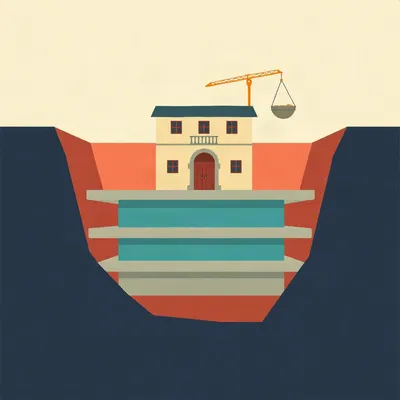
A city spends eleven years building the paperwork for a conversation it has already finished having.

And the paperwork is excellent. That's the part that gets people. Every form is in order.
Daniel's been in Jerusalem a decade, and he wrote in about exactly that gap. The apps, the committees, the email addresses that do exist, the objection processes that collect hundreds of signatures and objections, and then the project goes ahead, and the outcome is total disinterest. He calls it fake citizen engagement and he wants to know if there's a name for it. He's got a theory about why it's pernicious, which is that the municipality can show the national government a functioning process. Channels exist. We listen. The fact that the channels are about as useful as talking to a wall is something only the people who used them know.
And he says he'd rather they didn't exist at all. At least then there'd be no fake expectation. That's the part I want to push on, because the literature pushes back on it.
The literature has names for what he's describing, which is the first answer, and it's not one name. It's about four, and none of them have the reach that greenwashing has, which tells you something on its own about how normalized this is.
There's participation-washing, and there's engagement theatre, and there's participatory theatre, and then there's the framework everything else is standing on, which is Arnstein's ladder from 1969.
Start with the ladder. It's the oldest and it's still the best diagnostic.
Sherry Arnstein published it in the Journal of the American Planning Association in July 1969, and she drew eight rungs. The bottom two she calls Manipulation and Therapy. She's blunt about them. Her words are that they describe levels of non-participation, contrived by some to substitute for genuine participation, and that their real objective is not to enable people to participate but to enable powerholders to educate or cure the participants.
Educate or cure. That's the language of a clinic.
Rungs three and four are Informing and Consultation, and she files both of those under tokenism. Then five through eight are the degrees of citizen power, placation, partnership, delegated power, citizen control. Eight rungs, three zones. And then she gives the one line that survives her, which is, do not ask how many people took part, ask how much power changed hands.
That's the whole thing in nine words.
It's also the test almost none of these processes pass. Where's the power moving? If the answer is nowhere, the rung doesn't matter.
So give me the modern vocabulary.
Participation-washing was coined in 2020 by Mona Sloane and three co-authors in a paper called Participation Is not a Design Fix for Machine Learning, and I'm going to flag where it came from, because it did not come out of planning. It came out of machine learning ethics. Wiktionary's definition is the cleanest one, actually. The practice by organizations, including governments, of hollow consultation of citizens, despite no or little interest in such participation, in order to improve public image and create an illusion of openness. And the hyponym listed under it is citizenwashing, which is the version used specifically when the consultation is offered to citizens rather than users.
So jargon from the AI world that migrated into city hall.
Nobody planned that migration. It happened because the same logic shows up in both places. Participation as consultation, in Sloane's framing, is often performative, short-lived, and with no plan to establish anything long-term. The Ada Lovelace Institute added a line in 2023 that I think is the sharpest one, which is that participation-washing removes accountability.
Removes. It's not that it fails to add accountability. It takes something off the table.
Then there's engagement theatre, which is the planning-theory term. Marcus Foth and Paul Burton at QUT wrote a chapter in the De Gruyter Handbook of Urban Planning and Social Justice this year, and their phrase for it is a persistent pattern of strategic performance. They say it creates the illusion of community participation while insulating decision-making from meaningful public influence, and their keywords are tokenism, orchestration, co-optation.
Orchestration is the word I'd keep out of those three.
And then Hernán Orozco, who writes at Future of City, comes at it from the urbanist side with participatory theatre, which is the process that invites residents to take part in order to legitimise a decision already made. That's his whole definition, there's nothing else in it.
So four names and a ladder. Daniel's intuition isn't a fringe complaint. It's a field.
Which is the part I actually find strange. Greenwashing got one word and it stuck, and everybody from a regulator to a teenager knows what it means. This has been documented in planning scholarship since 1969 and it's still got four competing names, and the newest of them came in sideways from machine learning. There's no moment where the culture decided what to call it.
The name is missing because the people in a position to name it are the ones running the processes.
That's a very good point and I'm going to pretend I made it.
You'll manage. Ask the next question, which is how these processes end up existing in the first place. Nobody sits down and designs a fake consultation.
Orozco's answer is institutionalisation, and his description of it is worth slowing down for. Citizen participation now has laws that require it, officials who manage it, firms that facilitate it, and reports that certify it. And that institutionalisation has a paradoxical consequence. It turns participation into a procedure the project must pass, rather than a space where the project can change.
A procedure the project must pass sounds like an inspection. You don't fail an inspection because the inspector didn't like the building.
Then he gives you the mechanism, and I'll quote this bit because it's tight. The process is designed backwards, from the decision already taken, choosing the questions that commit to nothing, the topics that never touch the budget, and the formats that scatter disagreement.
Formats that scatter disagreement. So you hold room three and room four at different times and the objection never becomes a bloc.
That's exactly what he means. And there's this other piece, from Hajer and Wagenaar, which is cited in Verloo's 2023 paper. They call it an institutional void. Participatory practices lack clear rules, so the outcome depends on informal face-to-face dynamics rather than any formal framework. The procedure doesn't tell you what has to happen to your objection.
So it's not a rigged machine. It's a machine with no gear that connects the input to the output.
That's the better description. And that void is where the real work happens. Which brings me to Nanke Verloo, at the University of Amsterdam, and her paper Ignoring people, the micro-politics of misrecognition in participatory governance. Three years of ethnographic fieldwork in The Hague, twenty-five narrative interviews.
Three years in one city is a serious commitment to watching nothing happen.
She identifies five tactics by which citizens were ignored during the very participatory process they'd been invited into. Disregarding elements of their stories. Omitting their counter-narrative. Neglecting their memories. Showing disdain for their emotional expressions. And being spatially absent from their protest.
Spatially absent. Nobody shows up.
That's the case she documents. Residents who ran a community club, a place they built and ran themselves, were recast in the process as mere volunteers. Their history was quietly forgotten. So when they occupied the building in protest, nobody came. Her line is, there was no response at all.
They were downgraded from the people who built the thing to the people who help out at the thing.
And here's the finding I want to sit on. What the citizens described as the most painful part was not being rejected. It was being ignored. The absence of any response.
So the wall isn't hostile. It's smooth. You press and nothing presses back.
Verloo's own sentence about it is, these people were completely ignored by the same local government that had invited them to participate. That's the loop closed.
There's a Brazilian version of the same thing that came up in a study on urban planning there. Popular participation as provided for in the master plans and the public hearings often gets reduced to a formal ritual without influencing decisions, and the ritual gets captured by economic and political elites. The conclusion is that it produces a kind of urbanism that prioritizes the real estate market over collective interests.
And they reach for Bourdieu to say it. Formal inclusion serving as a façade, reproducing the power structures it claims to open up.
The inclusion is the mechanism of the reproduction.
That's the sentence I'd put at the top of the paper.
Which gets us to Daniel's sharper claim, which isn't about the mechanism. It's that the thing works. The municipality isn't failing to consult. It's demonstrating that it consulted.
Orozco has the document that proves it. The European Parliament's Auken report on Spanish planning in 2009, which is the closest thing I've found to Daniel's complaint with a paper trail attached. It found that participation arrived late, was merely formal and lacked transparency, the plan had already been negotiated by the time citizens could read it, and their objections received boilerplate replies written to complete the file.
Written to complete the file. Somebody had a target.
And then Orozco makes the move that reframes everything, which is that it can be read as a design flaw, or as a design that works. The procedure produces documented evidence that participation took place.
Say the second half of that again, because that's the whole episode.
The procedure produces documented evidence that participation took place. That's the product.
Which is exactly what Daniel said the municipality gets out of it. Not consent from residents. A receipt for the national government.
And this is where your own read matters, Corn, because you said something a minute ago I don't want to let go of. You said the name is missing because the people who'd name it are the ones running it, and I think there's a stronger version. The receipt has a recipient.
'Say it.'
If the only audience for the participation process is the ministry, then the residents were never the counterparty. They're in the room to make the receipt credible. The audience is upstairs.
That's Orozco's assertion and not something anyone's measured, as far as I can tell. Nobody's built the dataset that would show how much of a municipal consultation is written for a national regulator. So it's a strong claim with a weak evidence base and I think it's right anyway.
I'd say the claim is well supported logically and unmeasured empirically. Both of those can be true.
And that gets us to the part where Daniel and the literature disagree, and neither of them is obviously wrong. He says it would be better if these forms didn't exist.
Orozco argues directly against that, and his case is not sentimental. He says not all informing or consulting is theatre. Some decisions carry a strong technical component, and putting everything to a vote would be irresponsible. Informing well is already progress in many places. And total participation can be captured by those with more time and voice.
The people who show up to a nine a.m. committee hearing are the people who can take a Tuesday morning off.
Which is not a neutral filter. And his conclusion isn't abolish consultation. It's call it by its name. Reserve the word participation for the rungs where power is shared. If you're informing, say you're informing. If you're consulting, say that.
So the fix is linguistic, at least at first. Downgrade the word.
Because the word is doing load-bearing work. Arnstein put Informing and Consultation at rung three and four for a reason. They're not zero. They're just not power.
Orozco holds that line. Daniel wants the whole apparatus gone. What breaks the tie?
There's a cautionary tale. Porto Alegre, the participatory budget, invented 1989. Neighbourhood assemblies decided real investments, and the spending shifted toward the poorest districts. It worked, that's the part people forget. Then it travelled.
And it got hollowed out on the way.
Ganuza and Baiocchi's account is that cities kept the name, cut the money at stake, and dropped the binding character. So the label survived and the substance went.
A brand with the product removed from it.
Which is the strongest argument against Daniel's position and the strongest argument for it at the same time. The structure is worth having. The structure is also what gets hollowed out and kept as a shell, and once the shell exists, there's something to point at. The shell is the liability.
Both of you are right and the disagreement is about what the default should be when the shell is what you've actually got.
If your process has real money and binding decisions in it, keep it and defend it. If it has street furniture and a word cloud, I don't know what you're defending.
Give the listener the test.
Orozco's three questions. First, what can change as a result of this process? If the answer is benches and planters rather than land use, it's stagecraft. Second, when does participation arrive? If it lands after the agreement is signed or the project is drafted, it's late on purpose. Third, who answers, and how?
That's the one that separates them.
Serious participation returns reasons. What was incorporated, what was discarded, and why. Participation-washing returns photos, word clouds and thank-you notes.
So you don't measure it by the quality of the meeting. You measure it by what comes back in writing afterwards.
And whether it names the thing you said. Not the theme you said. The thing.
Foth and Burton go further, into what the process should do with the disagreement itself. Their position is that public dissent shouldn't be treated as a disruption to be managed but embraced as a vital expression of democratic life, and they point at elevating counter-narratives and speculative design approaches.
The counter-narrative point connects straight back to Verloo. Her first two tactics are disregarding elements of citizens' stories and omitting their counter-narrative. So the fix is not more listening. It's specifically a written counter-narrative that survives into the document.
But if the counter-narrative gets in and nothing binds, you've just added a nicer appendix.
There is one model that starts from the other end. Proximate documented this in September 2024 out of Mostar, in Bosnia. A four-step process where the residents chose the assembly topics, not the officials.
That's the inversion. Everyone else picks the question and then invites you to answer it.
And the honest assessment in that field note is modest. At the very least, this process identifies the issues in which citizens would most like to be involved. That's not power. That's a better question.
It's rung three done properly. Arnstein would grade it.
Sloane's suggestion is a different kind of fix. Build a searchable database of failures of design participation, so people can learn from the cases that went wrong. Sidewalk Labs' Toronto waterfront project being the one everybody reaches for.
And Daniel's local case, the Jerusalem one, isn't in it.
No. That's the thing I couldn't find. There's no Jerusalem-specific research. The high-rise objections, the pattern Daniel describes, it isn't documented in anything I can reach. The applicable evidence is Spanish, Brazilian, Dutch, American.
I'll take a position on that. The absence is the local version of the problem. If nobody's studying the consultation process, the consultation process has no external check on what it says it did.
There's also one thing neither the literature nor Daniel can settle, which is whether abolition is the right default. Orozco's case for calling it by its name is strong, and it depends on someone being willing to accept a smaller word for what they're doing. If a municipality won't downgrade its own vocabulary, the naming fix doesn't work either.
The receipt is the product. Nobody downgrades the product description.
So then you're at the harder question. Not what to call it, but whether a city that won't call it the right thing should be given the apparatus at all.
Put that to Daniel, actually. He's the one who lives with the answer.
One detail before we move on. The Verloo case, the community club, the residents who were recast as volunteers and whose history got forgotten. That's the one I keep thinking about, because the forgetting was deliberate.
She says precisely that. It wasn't that the file was thin. The history was omitted with intent, because the history was the residents' claim to standing.
You can't be the people who built the thing if the record says you help out at the thing. That's the whole trick, and it happens before the first meeting.

Rung three.
Sorry?
The one you keep calling informing and consulting. Rung three is informing. Rung four is consultation. You rolled them together reading the ladder out.
He did. He said three and four and then read them as a pair.
They're different things. Informing is one direction. You send the leaflet. Consultation means they asked you and you answered. Conflating them is what the council does.
That's fair. That's actually the whole problem in miniature, isn't it. If you can't tell a leaflet from a question, everything looks like engagement.
My brother-in-law spent four years on a steering committee for a bypass. Four years. Every meeting, same room, rented. He's got a folder. I've seen the folder. Two hundred and something pages of minutes, and the last page is the decision, and the decision is the thing they announced in the second meeting. Everything between the two is correspondence.
What was he objecting to?
The road. He lives on the road. He was objecting to the road.
And what did they send him back?
He showed me the letter. One page. There's a paragraph near the bottom, and the paragraph says your comments have been noted and will inform the ongoing development of the scheme. That's the sentence. Your comments have been noted and will inform the ongoing development of the scheme. He had it framed eventually. He cut that paragraph out.
He framed the paragraph.
He handed it in with 40 pages. They gave him 90 words and 40 of them were about the ongoing development of the scheme. He says the scheme is ongoing. That's the laugh in it. Four years, the scheme is ongoing.
Did it get built?
It got built. He still lives on it. He says the noise is actually not bad. But he says that about everything.
What did he do with the two hundred pages?
Nothing. It's in the folder. He won't throw out a folder. I have three of them. My wife has told me to stop taking his folders.
Why did you take three?
Because they're good. You can tell a lot about a scheme from what got minuted and what didn't.
So what happened to the club.
The what?
The community club. The one the government forgot. It's the case in the paper.
I don't know about that. My brother-in-law's road was not a club.
There were four more letters after the first one.
Five. The first one had the pages. The rest of them were the same paragraph with different dates and a reference number at the top. He kept all five.
Refiled.
He wrote the reference numbers on the front of the folder in his own hand.
So the response wasn't empty. It was a response with a serial number. It's the file admitting the exchange happened.
He says it was dealing with people who were doing their job. He doesn't blame anyone. He blames the four years.
The four years was the product.
That's what he says. He says you don't get four years of a man's life for nothing, because nothing doesn't need a committee.
That's going in the notes. Herman, whatever you were going to close on, this goes first.
It has to. Because what Hilbert just described is Orozco's line in the flesh. The procedure produces documented evidence that participation took place. There's a reference number.
And the documented evidence was the four years.
The only thing I'd add to what we've covered is where the literature actually leaves you, which isn't with a fix. There's no single canonical term. Participation-washing is the closest, it's the one the AI-ethics world produced, and it hasn't crossed into planning's vocabulary the way greenwashing crossed into common speech. Engagement theatre is the planning term and it's four months old. And there's no Jerusalem research at all, which means Daniel's local pattern isn't documented, and that's a finding in its own right, even if it's an empty one.
He said ten years, and I think he's right that ten years is enough data.
So the honest floor is Arnstein's test, and it doesn't need a translation. Don't ask how many people took part. Ask how much power changed hands. Everything we've covered today collapses into that one question, and almost none of it survives it.
Which I'd rather end on than any of the alternatives, because it's the one question you can ask out loud in the room.
That's the thing about it. It's portable. You don't need the paper.
Thanks to Hilbert Flumingtop, our producer, for the reference numbers and the folder.
If you want more of this, try episode fourteen oh eight, Israel Wartime Readiness Field Guide; episode three sixty, The Ghost Towers of Jerusalem; and episode eighteen sixty-one, Emergency Prep You Can Sing To. This has been My Weird Prompts, the human-AI collaboration podcast.
If you've got a question about a process you've been through, send us your own prompt on Telegram at t dot me slash MWP listener bot. And a review helps other people find the show.
We'll be back soon.
Back soon. And take the folder.