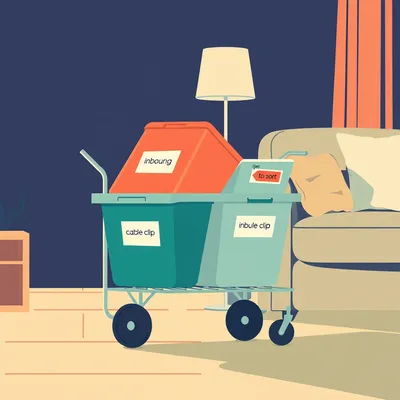
Daniel and Hannah are in the middle of moving apartments in Jerusalem — two adults, one kid, a team of four professional movers — and it took four days. My first thought was, wait, aren't these people supposed to be fast? That's the whole pitch. You hire pros so you don't spend a week of your life drowning in cardboard.

And Daniel's been doing a lot of the move himself too, so he got to compare his own approach side by side with the pros. He noticed something interesting. When he was loading his own car, he'd be conservative — leave some breathing room, not cram things to the gills — because packing tight felt like it was eating time. But the movers did the opposite. They used every centimeter. Every last one. They'd wedge and stack and Tetris until the truck looked like a solid wall of furniture.
His instinct — the one most of us would have — was that spending extra minutes wedging in one more box couldn't possibly be worth it. Just make another trip, right? But he said he thinks he got the equation wrong. And he's right.
That's the thing. Four professionals taking four days isn't a sign they're slow. It's a sign of how much volume a household actually contains, even one that's been decluttered. The question Daniel's really asking is: what are they doing differently beneath the surface? What strategic decisions are invisible to the person just watching them carry furniture?
That's what we're unpacking today. Not the lifting technique — we've covered the physical side before. This is about the hidden playbook. The packing logic that turns a truck into a three-dimensional puzzle, the crew choreography where nobody's ever standing around, and the counterintuitive tradeoffs where loading slower actually saves hours. The pros aren't just stronger. They're making decisions the rest of us don't even see.
Here's the thing most people miss about moving. It looks like a strength problem — can you lift the couch, can you carry the armoire down three flights of stairs — but that's not actually the bottleneck. The real constraint is trips. How many times does the vehicle go back and forth? Because every round trip burns forty-five minutes minimum in a city like Jerusalem. Fifteen minutes driving each way, fifteen minutes unloading. That's your atomic unit of wasted time.
The brute-force approach — just grab things and go fast — is optimizing for the wrong variable. You're saving seconds per box while bleeding hours on extra trips.
The pros understand that the objective function isn't "minimize loading time per item." It's "minimize total trips." And those two goals pull in opposite directions. Loading faster means loading looser, which means more trips. Loading tighter takes more time per item but slashes the trip count. The math is brutal and one-sided. Spending an extra ten minutes cramming the truck to capacity saves you a forty-five minute round trip. That's a net gain of thirty-five minutes every single time you avoid another run.
Daniel's instinct was backwards, and he spotted it himself. He thought he was being efficient by not fussing with the last few centimeters. But he was optimizing loading speed when the real cost was trip count. It's like sprinting to the airport gate and then waiting three hours for the next flight because you didn't check the schedule.
That's a perfect way to put it. And the research bears this out. Professional movers achieve eighty-five to ninety-five percent volumetric efficiency in their trucks. DIY loaders — even careful ones — typically hit sixty to seventy percent. So for the same truck, the pro is carrying roughly thirty percent more stuff per trip. Over a multi-day move, that's the difference between eight trips and five. Three trips you simply don't make.
I want to sit with that thirty percent gap for a second, because it sounds like a small number on paper. But let's make it concrete. If you're moving a two-bedroom apartment across Jerusalem, eight trips at forty-five minutes each is six hours of just driving and unloading. Five trips is three hours and forty-five minutes. That's over two hours of your life you get back, purely from how items are arranged inside a metal box.
That's not even counting the downstream effects. Every extra trip means more fuel, more risk of something getting damaged in transit, more opportunities for a box to fall off a dolly. The compounding costs are invisible until you add them up.
The entire game is about decision-making under a constraint that most people don't even identify. The pros aren't winning because they're faster carriers. They're winning because they've reframed the problem from "move these objects" to "minimize vehicle round trips." And once you see it that way, everything else follows — how you pack, who does what, the order you empty rooms.
Which breaks down into three domains we can actually steal from. The truck-packing logic itself — the three-dimensional puzzle-solving. The way crews divide roles so nobody's ever idle. And the sequencing decisions about what gets loaded when, which is really about reverse-engineering the unload before you've even started.
Let's start with the truck itself, because that's where the most visible difference lives. Pros don't just throw things in. They follow a layering logic that's almost geological. Bottom layer: the heaviest, flattest items. Appliances, furniture bases, anything with a solid footprint. That creates a stable platform. Middle layer: boxes, but stacked in what they call a brick-wall pattern — offset seams, like masonry. You don't line up box edges vertically because that creates weak columns that shift during transit.
It's literally structural engineering. You're building a wall inside a truck.
And the top layer is where it gets clever. Soft goods — mattresses, lamps, bags of bedding — get wedged into the gaps the rigid items leave behind. They're the mortar. The pros look at a half-loaded truck and see negative space the way a sculptor sees the block. Every void is a place something irregular can go.
Which is the opposite of how most people load. You put the mattress in first because it's big and easy, and then you've got this soft foundation that nothing stacks on properly.
And that's how you end up at sixty percent utilization. The other technique that surprised me — they use furniture dollies as mobile shelving inside the truck. Slide a loaded dolly in, strap it down, now you've got a modular unit you can stack around. It turns the truck floor into a grid of movable platforms.
That's not intuitive at all. The dolly feels like a tool for getting things to the truck, not part of the load itself. But wait — how do you secure a loaded dolly so it doesn't roll during transit? That seems like a disaster waiting to happen.
Ratchet straps anchored to the truck walls, and the weight of everything packed around it. The dolly wheels get chocked, and the surrounding boxes and furniture press against it from all sides. Once the truck is fully loaded, nothing can shift more than a few centimeters in any direction. It's like those puzzles where you slide tiles around — except when the last piece goes in, the whole thing locks.
That's a great image. The final box is the keystone.
Here's the weight distribution rule that most people get backwards. You'd think heavy boxes go on the bottom, light on top. That's true for the truck floor. But when you're stacking on top of a piece of furniture — say a dresser — pros put the heavy boxes on top of it, not underneath. It sounds wrong, but the dresser frame is designed to bear weight downward. Put a heavy box under it and you're loading the legs laterally, which is how things snap.
You're using the furniture's own engineering to your advantage. The dresser becomes a load-bearing column instead of fragile cargo. I've absolutely made that mistake. I once put a fully loaded bookshelf on top of a stack of boxes because I figured boxes are sturdy. The boxes collapsed about twenty minutes into the drive and the bookshelf ended up diagonal.
Then there's the sequencing rule that governs the whole operation: last in, first out. Pros mentally walk through the destination apartment before they load a single item. The bed frames need to come off the truck first because you're assembling bedrooms before you unpack kitchen boxes. So bed frames go in last. Essential boxes — the ones with toiletries, phone chargers, the coffee maker — those ride right at the tail of the truck.
The load order is actually the unload order in reverse. You're not packing for the origin, you're packing for the destination.
That's the shift. And it means the person directing the load has to hold the entire floor plan of the new place in their head. They're solving a three-dimensional puzzle in reverse, with the constraint that the pieces have to come out in a specific sequence. A sixteen-foot truck packed this way can swallow a two-bedroom apartment in one trip. Same truck, same apartment, DIY approach — two or three trips. The volumetric efficiency gap isn't about strength. It's about treating every cubic foot as a resource you don't get back.
Packing the truck is only half the story. The real magic happens in how the crew moves together as a system. Watching Daniel's movers, you notice nobody's ever standing still. There's no "okay what next" huddle. They're a four-person organism.
That's crew role specialization, and it's the thing DIY teams get wrong most reliably. The default approach is everyone just carries things. Four people, four carriers. But pros assign distinct roles. You've got the loader — one person who never leaves the truck. Their whole job is directing placement, building that three-dimensional wall we talked about. Then you've got runners bringing items from the house. And often a wrapper prepping fragile stuff — mirrors, electronics, anything that needs padding before it moves.
The loader is the architect and the runners are the supply chain. You're parallelizing the workflow instead of having four people all doing the same thing and getting in each other's way.
And the loader doesn't need to see the inside of the house. They use hand signals or short verbal commands — "dresser next," "pause," "box stack" — so the runners don't have to walk back to the truck to figure out what's needed. It eliminates the bottleneck of everyone needing to see the truck layout.
That's a job you could give to the least physically strong person on your team and it would still be the most impactful role. The strategist beats the lifter every time.
The numbers prove it. A four-person professional crew using role specialization can move a three-bedroom house in six to eight hours. A four-person DIY team — friends, good intentions, everyone carrying things — typically takes ten to fourteen hours for the same volume. Same headcount, nearly double the time.
Half the efficiency gain isn't about muscle. It's about not having four people all trying to decide where the armchair goes.
Then there's the no-empty-hands principle, which sounds obvious but almost nobody does it consistently. Every trip from the house to the truck carries something. Every trip back carries something too — empty boxes, packing paper, flattened cardboard. You never walk empty. Over an eight-hour move, the average person makes something like sixty to eighty round trips. If half of those return trips are empty-handed, that's thirty or forty wasted walks. Multiply by four people, you're looking at over a hundred trips where someone's just...
It's the moving equivalent of a chef cleaning as they go. You're folding the cleanup into the move itself instead of dealing with a mountain of packing waste at the end. And I've been on the receiving end of that mountain. You finish the move, you're exhausted, and suddenly you realize you have to deal with forty empty boxes and a landfill's worth of crumpled paper. It's demoralizing.
Which connects to load sequencing beyond just the truck. Pros plan which rooms get emptied first based on the floor plan of both locations. You start with the hardest-to-access spaces — basements, attics, top-floor rooms with narrow stairs — while everyone's fresh. You end with the essentials — kitchen, one bathroom — so those items come off the truck last and go straight into immediate use at the destination.
You're not just sequencing for the truck. You're sequencing the entire day around human energy curves and floor-plan friction.
And here's a tactic that surprised me when I first saw it. Pros create a staging area — a temporary zone just outside the truck where items get sorted by destination room before they go in. Colored tape on boxes, quick verbal tags. It looks like extra work in the moment, but it prevents what everyone's experienced: the unload chaos where everything gets dumped in the living room and you spend the next three hours playing "which room does this lamp belong to.
Which is basically deferring the sorting cost to a moment when you're exhausted and the new apartment is already full of boxes. That's terrible logistics. It's the physical equivalent of leaving all your email for Friday at 4 PM.
The staging area doubles as a buffer. If the loader needs a specific type of item next — something heavy to anchor a new layer — they can scan the staging zone and pull from there, rather than sending a runner back into the house on a scavenger hunt. It decouples the house-to-truck pipeline from the truck-packing step, which means neither side blocks the other.
Equipment choices enable a lot of this too. Pros don't just have one dolly. They've got appliance dollies with straps for refrigerators, hand trucks for box stacks, furniture sliders for hardwood floors, shoulder dollies for staircases. Each tool unlocks a different strategy. A shoulder dolly — that strap system that goes over two people's shoulders — lets you carry a dresser down three flights of Jerusalem stairs without tilting it. Without that tool, that same dresser is a forty-five minute ordeal.
The tool selection isn't random. It's matched to the specific friction points of the route. Jerusalem apartments are notorious for narrow stairwells and tight corners. The pros know this before they arrive because they've scouted the job. They're not bringing every tool they own — they're bringing the tools that solve the specific geometry of that building.
Which is another invisible decision. The scouting run. Most of us don't even think to do one. We just show up on moving day and discover the couch doesn't fit through the doorway.
The psychological piece of this is counterintuitive too. You'd think pros would sprint — get it done fast. But they don't. They maintain a steady, almost unhurried pace.
There's actual research on this. Sustained moderate effort outperforms burst-and-rest patterns over multi-hour physical work. The sprinters burn out by hour two. The steady-pace crew is still moving at hour six. It's the same principle endurance athletes use — pacing isn't laziness, it's load management across time.
I've seen this in warehouse studies too. When you track output over an eight-hour shift, the teams that look slowest in the first hour are often the highest-performing by the end. The burst teams crash hard after lunch. The steady teams just keep humming.
The whole system is designed to eliminate decision fatigue. The loader decides. The runners run. The wrapper wraps. Nobody's burning mental energy on "what should I do next" because the role answers that question before it's asked.
That might be the most transferable insight for a DIY move. Before you lift a single box, assign roles. One load master who never leaves the truck. Runners who only move between house and staging area. Someone on wrap duty. Tell everyone the no-empty-hands rule. It feels rigid, but it's actually freeing — you stop thinking and start flowing.
If you're staring down a move and you want to steal the pro playbook without the years of apprenticeship, here's what actually transfers. First, designate a load master. One person who owns the truck. They don't carry things from the house, they don't wrap dishes. They stand at the truck bed and direct every single item to its spot. That single decision eliminates the biggest DIY bottleneck — four people playing Tetris by committee.
The load master doesn't need to be the strongest person on your team. They need to be the one who can hold the destination floor plan in their head and think in three dimensions. If you've got a friend who's good at packing a suitcase or organizing a garage, that's your person.
Second, pre-sort by destination room before anything hits the truck. Colored tape on boxes — blue for bedroom, red for kitchen, green for the kid's room. It takes ten minutes with a roll of tape and a marker, and it saves hours of "where does this go" chaos at the other end.
Which is essentially the staging area concept the pros use, just simplified. You're front-loading the sorting cost to when you're fresh instead of deferring it to when you're exhausted and standing in a sea of identical brown boxes.
I'd add a sub-tactic here that costs nothing. Write the destination room on the box in big letters, not just a color code. Colors are great until someone is colorblind or the lighting is bad or you forget which color meant which room. Sharpie on cardboard.
Third, accept that loading will take longer than your gut says it should. Budget twenty percent more time than you think you need. That extra time goes into tight packing, which means fewer trips, which means you finish earlier overall even though each load felt slower.
Fourth, reverse-engineer the unload. The first room you want functional at the destination — probably the bedroom — gets loaded last. The kitchen boxes you won't touch for two days go in first. You're packing the truck backwards from your destination floor plan.
Fifth, the no-empty-hands rule. Every trip toward the truck carries furniture or boxes. Every trip back carries flattened cardboard, empty bins, packing waste. If you're walking, you're carrying. Enforce it with your friends even if it feels pedantic. Over eight hours, it saves dozens of wasted trips.
None of these are physically demanding. They're just decisions made before the chaos starts. The pros don't win because they're stronger. They win because they've already answered every question a DIY team spends half the day arguing about.
The whole thing is a category error. We look at four guys hauling furniture and think "strength." But what we're actually watching is a logistics operation. They're solving a constraint-satisfaction problem in real time, and the lifting is just the interface.
Which makes you wonder what else we're miscategorizing. Packing a suitcase. Loading a dishwasher. Grocery shopping with three kids in tow. How many everyday tasks are we treating as brute-force endurance contests when they're actually optimization problems wearing a disguise?
Grocery shopping is a great one. You watch someone who's good at it and they've got a route through the store that accounts for weight, temperature, and bag-packing order. The rest of us just wander the aisles and hope.
The bag-packing order alone is a whole sub-science. Cold items together so they thermally stabilize each other. Heavy items at the bottom of the bag so they don't crush the bread. Raw meat in its own bag so it doesn't contaminate the produce. Most people just grab and stuff, then wonder why their groceries are a disaster when they get home.
I think that's the bigger takeaway here. The pros aren't just better at moving. They looked at a repetitive task and asked "what's the real constraint?" instead of "how do I do this harder?" That's a mental move you can apply to almost anything. The way you organize a workshop.
It's the difference between working more and working on the right thing. Daniel spotted it in his own moving equation — he was optimizing loading speed when the real cost was trip count. Most of us have a version of that somewhere in our lives. We just haven't stopped to do the math.
Now, Hilbert's daily fun fact.
Hilbert: In the late Victorian period, linguists studying Basque discovered that its ergative case marking creates a distinctive acoustic boundary between the agent of a transitive verb and the subject of an intransitive one — a rhythmic shift in spoken Basque that English speakers consistently fail to perceive without training.
...I'm going to need a moment with that one.
I don't think a moment's going to help.
If you enjoyed this episode, please leave a review — it helps other logistics nerds find us. And if you've got a weird prompt rattling around in your head, send it to show at my weird prompts dot com.
This has been My Weird Prompts. I'm Herman Poppleberry.
I'm Corn. We'll catch you next time.