You're walking down a Tel Aviv street, maybe Rothschild Boulevard, maybe somewhere in the Florentin neighborhood. You step off the curb, your foot comes down on the pavement, and the pavement just isn't there anymore. Beneath where the asphalt was a second ago, there's a hole four meters wide, deep enough to swallow a car, and you're looking straight down into it.

That image is genuinely terrifying. And it's not hypothetical. We've seen exactly this happen. A couple of high-profile cases where the street just opens up, and suddenly the boundary between the surface world and the underground world isn't seamless anymore. It's a gaping hole.
Daniel sent us this one. He's been thinking about the hidden boundary between street level and what's underneath, and he's asking two questions that turn out to be deeply connected. First, why do these dramatic street collapses actually happen, and are construction projects really to blame? And second, when the same underground space beneath our streets has to hold sewer pipes, fiber optic cables, electrical conduits, parking garages, and now light rail tunnels, how does that layering even work? Does deep infrastructure block what you can build above it, or does everything just wedge in wherever it fits?
The timing on this is good, because Israeli cities right now are building in both directions at once. Tel Aviv is pushing deeper with the light rail and the planned Metro, and it's pushing higher with towers. The underground is getting crowded in a way it's never been before. The question isn't just why holes open up. It's how we layer all of this without catastrophe.
Where do we even start? The image everyone remembers is the hole opening and the car half-swallowed. But the real story starts months before that moment, underground, with something you'd never notice.
And the first thing to understand is that most of these collapses in Israeli cities are not sinkholes in the geological sense. When people hear sinkhole, they think of limestone dissolving, karst topography, the kind of thing you see around the Dead Sea. That's not what's happening on HaShalom Road in Tel Aviv or in Mahane Yehuda in Jerusalem.
What is happening?
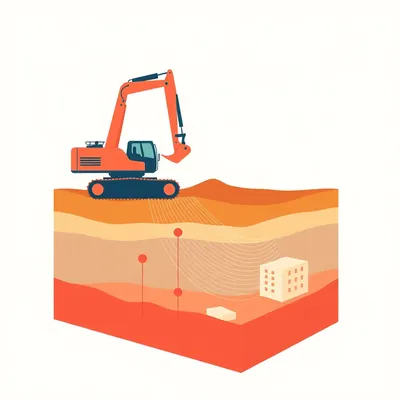
These are what engineers call cover-collapse sinkholes. The mechanism is completely different, and it almost always starts with a leaking pipe. You've got a water main or a sewage line that's been in the ground for fifty, sixty years. It's corroded, it's cracked, and it's been slowly leaking water into the surrounding soil. In Israeli coastal cities, a lot of that soil is sand or sandy fill material, and water just carries it away grain by grain. Over weeks or months, a void forms beneath the pavement, growing larger and larger. The pavement itself is still spanning across the top, held up by something called soil arching, where the granular material bridges over the empty space. Then one day the span gets too wide, or a truck drives over it, or there's vibration from a nearby construction site, and the arch collapses instantly.
The construction site everyone blames in the news is usually just the trigger, not the cause.
And this is the misconception that drives me a little crazy in the coverage. The dramatic footage shows a hole next to a construction site, and the immediate assumption is that the excavation caused it. But when you look at the investigation reports afterward, it's almost always a ruptured legacy pipe that had been washing soil away for weeks before anything visible happened at the surface.
Give me the specifics. You mentioned HaShalom Road.
HaShalom Road in Tel Aviv, 2024. A four-meter-wide hole opened up right near a construction site for a new office tower. The initial headlines all pointed at the excavation. But the investigation found a fifty-year-old water main had ruptured, and it had been quietly eroding the sandy fill beneath the road for weeks. The construction vibration was the final straw, the trigger that collapsed the soil arch, but the void was already there. If that truck hadn't driven over it that day, something else would have triggered it eventually.
The near-miss in Jerusalem?
Mahane Yehuda market area, 2022. A pedestrian was walking on a paving stone, the stone gave way, and the person was nearly swallowed into a void underneath. Again, the culprit was a cracked sewage line, not any deep excavation. The pipe had been leaking effluent into the surrounding soil, creating a cavity just beneath the surface. These are old pipes, installed in the nineteen sixties and seventies, well past their design life in many cases.
The common thread is aging pipes, not construction projects.
That's the pattern. And it's worth emphasizing how rare these events actually are. The media attention makes them seem like an epidemic, but statistically, Israel sees maybe one or two significant street collapses per year nationwide. Out of thousands of kilometers of urban streets, that's vanishingly small. The building codes here are actually quite rigorous. Any excavation requires soil compaction testing and geotechnical surveys beforehand. The weak link is the legacy infrastructure that nobody can see and that often isn't properly mapped.
Let's talk about that soil arching thing for a second, because it explains why these collapses feel so sudden. One moment the street is solid, the next moment it's gone. There's no sagging, no warning.
Soil arching is counterintuitive until you see it demonstrated. Granular soil, sand especially, can actually bridge over a void. The grains interlock and transfer the load horizontally to the sides of the cavity, like the stones in an archway. As long as the span isn't too wide and the load isn't too heavy, the arch holds. The pavement on top looks perfectly normal. You could walk over it every day and have no idea there's a cavity underneath.
Until the span exceeds the soil's tensile strength.
Which isn't much. Sand has essentially zero tensile strength in the long term. The arch is held together by friction and interlocking, not by the grains actually sticking to each other. When the void grows just a little too wide, or when a heavy load pushes down from above, the arch fails all at once. There's no gradual sag. The surface drops instantly, and you get that dramatic hole that looks like it was punched out with a cookie cutter.
It's almost elegant as a failure mode. This invisible structure holding up the street, doing its job silently for weeks, and then one day it just gives up.
Here's the thing that connects this to Daniel's second question about layering. That leaking pipe that caused the void, it's not alone down there. Beneath a typical Tel Aviv street, you've got a whole vertical stack of infrastructure. The top meter or so is where you find the shallow stuff: fiber optic conduits, electrical ducts, gas lines. Then from about one to three meters down, you hit the water mains, the sewage pipes, the storm drains. Below that, three to six meters, you're into parking garages, two or three levels deep. Six to fifteen meters down, you've got light rail tunnels and deep sewer interceptor lines. And below fifteen meters, you're looking at building foundation piles and the future Metro lines.
That leaking water main isn't just eroding empty soil. It's eroding soil that's threaded through with a dozen other utilities, any of which could be compromised if the void collapses.
And when the hole opens up, it's not just a hole. It's a cross-section of everything we've buried down there, suddenly exposed to daylight. You can literally see the layers. Fiber optic cables dangling across the gap, a gas line that thankfully didn't rupture, the broken water main that started the whole thing. It's a very sudden, very dangerous archaeology of urban infrastructure.
Which brings us to the coordination problem. Every new thing we want to put underground has to navigate this existing web, and a lot of that web isn't even properly documented.
This is where it gets difficult. When Tel Aviv was building its light rail, contractors kept hitting things that weren't on any map. At one point they struck an uncharted water main from the nineteen forties, and the excavation flooded. The cost of relocating utilities during that project, in some sections, actually exceeded the cost of boring the tunnel itself. You're not just digging a hole. You're performing surgery on a patient whose anatomy was sketched on a napkin sixty years ago and never updated.
There's a perfect metaphor in there somewhere. Urban infrastructure as a patient with incomplete medical records.
As a retired pediatrician, I can tell you that operating on a patient with bad charts is exactly the right analogy. You open them up and hope what you find matches what the records say, and when it doesn't, you improvise. Except here the patient is a city street, and the improvisation costs millions and sometimes floods your construction site.
We've got two problems that are really the same problem viewed from different angles. The dramatic street collapse is what happens when the underground fails catastrophically. The coordination nightmare is what happens when we try to prevent that failure by managing what's down there, and discover we don't actually know what's down there.
Both problems are getting more urgent because we're asking the underground to do more than ever before. It's not just pipes and cables anymore. It's transit, it's parking, it's retail space in some cases. The same cubic meter of soil that held a water main in nineteen seventy is now being asked to coexist with a light rail tunnel and the foundation piles of a forty-story tower. The margin for error is shrinking.
Let's dig into both sides of this. First, the mechanism of collapse in more detail, because there's some fascinating physics in how soil fails. Then the layering question, how engineers actually design this vertical stacking and what happens when the old and the new get tangled up together.
I think the thread that runs through both is the aging pipe problem. Because that same corroded water main that can open a hole in the street is also the thing that complicates every new excavation. You can't just dig around it, you can't always replace it without shutting down the street, and you often don't even know it's there until you hit it.
The two questions turn out to be a single question viewed from the failure side and the design side. On one hand, what happens when the underground betrays us. On the other, how we're supposed to orchestrate this whole hidden stack so it doesn't.
Israeli cities make a particularly good case study for this, because the density above ground forces density below ground in a way you don't see in a lot of places. Tel Aviv is a narrow coastal strip. You can't sprawl outward, so you go up and you go down. The light rail tunnels run right beneath some of the densest urban corridors in the country. Deep parking garages are carved out under residential towers because there's nowhere else to put the cars. And threaded through all of it is a web of pipes and conduits, some of them a century old, that were never designed to coexist with a metro system.
The boundary between street level and underground is this strange invisible membrane that most people cross a dozen times a day without noticing. You walk into a parking garage entrance that's just a ramp in the sidewalk. You step over a utility cover that looks like any other paving stone. There's an entire world beneath your feet, and the entrance to it is designed to be forgettable.
Until it isn't. Until that forgettable paving stone gives way, or a street intersection collapses into a void that's been growing silently for weeks. That's the moment the boundary becomes very, very visible.
The episode, at its core, is about that boundary. What it's made of, how we engineer the stacking beneath it, and why it occasionally fails in ways that make the news.
I think the reason this matters to an audience that already thinks about infrastructure is that we're entering a period where the underground is going to be asked to do more in the next twenty years than it did in the previous hundred. Every city that's building a metro, every city that's densifying, is facing this same layered coordination problem. Israel is just a particularly compressed version of it.
The same cubic meter of soil under Rothschild Boulevard might hold a British Mandate-era water pipe, a fiber optic line installed last year, and the ceiling of a light rail tunnel. Those things weren't designed together. They just ended up together.
When something goes wrong, the failure cascades across layers. A leaking pipe erodes soil, the soil loss destabilizes a conduit, the conduit shifts and cracks a gas line. Suddenly you've got a hole in the street and three different utilities compromised, and nobody knows which failure came first until the investigation is done.
Here's how we'll trace this. First, we'll go deeper into the collapse mechanism. The physics of soil arching, the specific cases, why the trigger is almost never the cause. Then we'll pull back and look at the layering challenge, how engineers actually design this vertical stacking, what the coordination looks like in practice, and where it breaks down.
I want to get into the solutions too, because there are some interesting things happening. Acoustic sensors on water mains that can hear a leak before it erodes enough soil to create a void. Digital twin models of the entire underground that update in real time. Trenchless drilling techniques that let you install new fiber without ever opening the street.
Before we get to the fixes, we need to understand what's breaking. So let's start with the moment the pavement gives way, and work backward from there.
Let's start with HaShalom Road, because the investigation report on that one reads like a slow-motion disaster that nobody could see. The water main in question was cast iron, installed in nineteen seventy-three. Fifty years underground in coastal soil, which is damp and slightly saline. The corrosion wasn't uniform. There was a single point, maybe the size of a fingernail, where the pipe wall had thinned to almost nothing. When it finally ruptured, it wasn't a dramatic burst. It was a pinhole leak, maybe losing a few liters an hour. But it ran for weeks.
A few liters an hour doesn't sound like much.
It doesn't, until you do the math. A liter of water can mobilize a lot of sand. Over a week, that pinhole leak at HaShalom displaced somewhere between three and five cubic meters of soil. That's a void the size of a small car, growing under the asphalt, and nobody above had any idea. The pavement looked fine. Cars drove over it every day. The soil arch was doing its job.
Walk me through the physics of that arch. Because I think most people imagine soil as just sitting there passively. The idea that it's actively holding up the street over an empty cavity is strange.
It is strange, and it only works under very specific conditions. The soil has to be granular, with angular grains that interlock. Rounded sand grains, like beach sand, don't arch well. The grains at the edges of the void transfer the load sideways into the surrounding soil mass through friction. It's the same principle as a stone arch bridge, except instead of cut stones, you've got individual sand grains, and instead of mortar, you've got intergranular friction. The arch redirects the weight of the pavement and anything on it horizontally, away from the void.
The failure point?
Comes when the void gets too wide, or the load gets too heavy, or water infiltrates and lubricates the grain contacts. At HaShalom, the void had been growing for about three weeks. The span was approaching a critical width, probably around two and a half meters, which is near the limit for that type of sandy fill. Then a concrete truck drove over it on its way to the construction site. The vibration plus the wheel load exceeded what the arch could handle, and the whole thing failed catastrophically. The pavement dropped about three meters in less than a second.
The construction site got blamed.
Of course it did. There's a crane, there's a hole, the visual narrative writes itself. But the investigation was unambiguous. The excavation for the tower foundation was thirty meters away and twenty meters deep. It had no physical connection to the void. The trigger was the truck, and the truck was only there because of the construction, so there's a loose causal chain. But the root cause was a corroded pipe that had been quietly failing for decades.
What about Mahane Yehuda? That one was even scarier because it was a pedestrian, not a vehicle.
It was a sewage line, not a water main, which adds a whole other dimension. Cracked sewage pipes leak effluent, and effluent is more corrosive than clean water. It accelerates the erosion. In that case, the void was much shallower, maybe half a meter beneath the paving stones. The pipe had been cracked for months, possibly years, and the cavity had been growing slowly right under a pedestrian walkway. The paving stone itself was acting as the bridge. When the pedestrian stepped on it, the stone had nothing under it anymore. It tilted and dropped.
That's the thing that gets me. You walk over these stones every day. They feel solid. There's no visible sag, no dip, no warning.
That's exactly what makes cover-collapse sinkholes so dangerous compared to other types of ground failure. With a gradual settlement, you get a depression. The asphalt sags, you can see it, someone calls the municipality, they cone it off. But with soil arching, the surface stays perfectly flat right up until the moment it doesn't. The arch conceals the void completely.
If I'm walking down the street and I want to know if there's a cavity under me, there's literally no surface indicator?
There are some, but they're subtle. Sometimes you'll get a slight change in the sound when you walk over it, a hollower thud. Sometimes there's a tiny crack at the curb line where the pavement is starting to lose support at the edges. But for a pedestrian just walking along, no, there's effectively no warning. This is why the acoustic sensor approach is interesting. You're listening for the leak that creates the void, not for the void itself.
The rate, you said one or two significant collapses per year nationwide. That's almost impressively low given how much aging pipe is down there.
It speaks to how conservative the geotechnical standards are. Before any excavation in an Israeli city, you need a soil survey. You're testing compaction, you're looking for voids, you're checking groundwater conditions. The building code is strict. The problem isn't the code. It's that the code applies to new construction, not to the hundred thousand kilometers of legacy pipe that's already in the ground and slowly corroding.
The pipes are grandfathered in, essentially.
They're not just grandfathered. In a lot of cases, nobody even knows exactly where they are. The maps exist, but they're decades old, they're inaccurate, and they don't reflect repairs and modifications that were made over the years. A pipe installed in nineteen sixty-five might have been patched in nineteen eighty-five, rerouted in two thousand, and partially replaced in two thousand ten, and none of those changes made it onto a single unified map. So when you go to dig, you're guessing.
Which brings us back to that soil arch. The thing that's holding up the street over a void that was created by a pipe that nobody knew was leaking, in a location that doesn't quite match the maps.
That's the composite failure pattern. And it's why these collapses, when they happen, feel like they come out of nowhere. They do come out of nowhere, from the perspective of anyone standing on the surface. But underground, the sequence has been unfolding for weeks. The pipe leaks, the soil erodes, the arch forms, the void grows, and then one day the arch reaches its limit. The suddenness is an illusion created by the physics.
We've seen how a single leaking pipe can open a hole in the street. But that pipe is just one thread in a much larger underground tapestry. Let's zoom out and look at how all these threads get woven together, and sometimes tangled.
The layering question Daniel asked. Beneath a typical Tel Aviv street, what's actually down there, and in what order?
I've pulled together a rough vertical profile. The top meter is the shallow utilities: fiber optic conduits, electrical ducts, gas lines. These are the ones that get installed and repaired most often, so they stay near the surface where access is cheapest. From one to three meters, you're into the wet infrastructure: water mains, sewage pipes, storm drains. Below that, three to six meters, parking garages, usually two or three levels. Six to fifteen meters gets you into the light rail tunnels and the deep sewer interceptor lines. And below fifteen meters, you're looking at building foundation piles and the future Metro alignment.
It's not random. There's a logic to the stacking.
In theory, yes. Engineers design what are called utility corridors, dedicated horizontal zones for each type of infrastructure, with mandated vertical separation. Water and sewage stay apart from electrical. Gas lines have their own clearance requirements. The idea is that if you need to dig up a fiber optic line, you don't have to worry about hitting a high-pressure gas main two centimeters below it.
In practice, a century of piecemeal installation has produced something closer to a lasagna. Old and new get interleaved. A parking garage in Ramat Aviv was built around an existing sewer line because relocating it would have cost more than the garage itself. The pipe runs right through the garage ceiling. It's structurally fine, the engineers accounted for it, but if that pipe ever needs major repair, you're shutting down a parking garage to get to it.
That's a maintenance nightmare.
It's the kind of compromise that happens constantly. Every new underground project starts with a utility survey, where you try to map everything that's already down there. But as we saw with the light rail, those surveys are only as good as the historical records, and the records are often terrible. Contractors on the Tel Aviv light rail hit an uncharted water main from the nineteen forties that wasn't on any map. The excavation flooded. In some sections, the cost of relocating utilities exceeded the cost of boring the tunnel itself.
Relocating old pipes cost more than the actual transit tunnel. That's a remarkable ratio.
It's not unique to Tel Aviv. Any city with old infrastructure faces this. The digging is the easy part. The hard part is figuring out what you're going to hit, and then moving it without disrupting service to thousands of people.
Daniel also asked whether deep infrastructure prevents building above it. If there's a light rail tunnel under your building site, can you still put up a tower?
Surprisingly, the answer is usually yes. Deep tunnels, like the light rail at ten to fifteen meters, are deep enough that building foundations can go around them or terminate above them. You design the foundation piles to transfer the building's load to soil layers below the tunnel, or you cantilever the foundation to avoid the tunnel zone entirely. The real conflict is at shallow depths, that zero to five meter band where every new utility trench competes with existing pipes. That's the bottleneck.
Because you can't go around. There's no room.
There's no room, and you can't just dig everything up because the street above is a functioning city. This is why trenchless technology is taking off in Israel. Horizontal directional drilling lets you install new fiber or gas lines by boring horizontally underground without opening the street. In Jerusalem, they've been using it extensively for fiber installation. You drill a pilot hole from one access pit to another, then pull the conduit back through. The surface stays intact.
You're threading new infrastructure through the existing web without disturbing it.
Or disturbing it as little as possible. It's not perfect. You still need accurate maps to avoid hitting things. But it means you don't have to close a major Jerusalem street for three weeks just to lay a fiber optic line.
Looking ahead, the coordination challenge is about to get much more intense. Tel Aviv's Metro is expected to start construction in 2027.
It has to coordinate with four existing light rail lines, hundreds of parking garages, and the entire utility web across the metropolitan area. The solution being piloted is a digital twin: a three-dimensional GIS model of all underground assets that updates in real time as new installations happen. Every pipe, every conduit, every tunnel, every foundation gets logged with its exact coordinates and depth.
A single source of truth for what's under the street.
That's the vision. But adoption is slow because the data doesn't exist yet for most of the legacy infrastructure. You can't build a digital twin of a pipe nobody knows is there. So the first step is surveying, which is expensive and disruptive, and many municipalities haven't funded it.
Which means we're still operating with the napkin sketches for a lot of what's down there.
And that's the uncomfortable reality behind both of Daniel's questions. The street collapses happen because we don't know where the failing pipes are. The coordination nightmares happen because we don't know where the working pipes are either. The same information gap drives both problems.
Given all this complexity, what can actually be done? Let's move from the problem to the solutions, and I want to start with something that sounds almost too simple. The single most cost-effective intervention to prevent street collapses is not better excavation monitoring. It's not stricter building codes. It's systematic pipe replacement. Just swapping out the corroded cast iron and clay pipes before they fail.
Which sounds obvious until you look at the price tag and the disruption.
Replacing every aging pipe under a city like Tel Aviv would cost billions and take decades. So the question becomes: how do you prioritize? And that's where the acoustic sensor approach gets interesting. Tel Aviv has been piloting sensors that clamp onto water mains and listen for the specific acoustic signature of a leak. A pinhole leak makes a distinctive high-frequency sound that travels through the pipe wall. The sensors can pinpoint a leak to within a few meters, long before it erodes enough soil to create a void.
Instead of waiting for the pavement to collapse, you're hearing the problem while it's still just a damp spot underground.
And the early results are promising. The pilot caught several leaks in their first year that would have gone undetected until something failed visibly. The cost per sensor is a few hundred shekels, compared to the millions it costs to repair a street collapse and the liability from whatever fell into the hole. It's one of those rare cases where the cheap intervention also happens to be the most effective one.
For the rest of us who aren't municipal engineers, what's the practical takeaway? If I'm walking past a construction site and I see a slight dip in the road, what should I actually do?
That slight sag or depression in the asphalt, the kind where rainwater pools in a spot it didn't used to, that's one of the few surface indicators that the soil arch might be starting to fail. It means the void underneath has grown large enough that the pavement is beginning to deform. It's not a guarantee of an imminent collapse, but it's the closest thing to a warning sign you're going to get. Call the municipality, describe the location, and they'll send someone to check it with ground-penetrating radar.
The construction site next to it? You said it's usually the trigger, not the cause.
The construction itself is probably not the primary risk. The real danger is what the vibration might finish off. If there's a fifty-year-old water main under that sagging patch of road, and a pile driver is operating a block away, you've got the exact conditions that preceded HaShalom. The construction didn't create the void, but it might be the thing that collapses it. So if you see both, a depression in the road and active construction nearby, that's worth flagging with extra urgency.
This connects to something broader that I think Daniel's question implicitly raises. We treat the underground as this infinite resource. There's always more space down there, just dig deeper. But every new pipe, every new tunnel, every new parking level makes future work harder. It's a finite volume, and we're filling it up without a master plan.
That's the uncomfortable truth. The underground is not infinite. Beneath a dense urban street, you've got maybe twenty meters of usable depth before you hit bedrock or the water table. In coastal Tel Aviv, you hit groundwater even sooner. Every cubic meter you commit to a parking garage is a cubic meter you can't use for a metro tunnel or a deep sewer interceptor. The competition is real, and it's getting more intense.
The coordination problem makes it worse, because different agencies control different layers. The water utility owns the pipes, the municipality owns the streets, the transportation authority owns the light rail, private developers own the parking garages. Nobody owns the whole stack.
Which is why the digital twin concept is so compelling, and also why it's so hard to implement. You need every agency to share their data, in a standardized format, and keep it updated in real time. That requires political will and funding that most cities haven't allocated. The technology exists. The governance doesn't.
The bottleneck isn't engineering. It's bureaucracy and budget.
It almost always is. The physics of soil arching, the mechanics of pipe corrosion, the techniques for trenchless drilling, we understand all of that. The hard part is getting a dozen different agencies to agree on who pays for the survey, who maintains the digital model, and who gets access to it. Meanwhile, the pipes keep corroding.
The pavement keeps looking solid right up until it isn't. That's the thing I keep coming back to. The illusion of solid ground is just that, an illusion. We've built this entire hidden world beneath our feet, and most of the time it works so well we forget it's there. But it's not passive. It's actively maintained by physics that can fail, by pipes that can leak, by maps that don't match reality.
The ground beneath us is not a platform. It's a system. A layered, dynamic, constantly re-engineered system that we're asking to do more every year. The question isn't whether it will fail occasionally. The question is whether we're investing enough in understanding it, mapping it, and maintaining it to keep those failures as rare as they currently are, or whether the increasing density underground will start pushing that failure rate up.
The early warning signs are there, literally, in the sagging patches of asphalt and the acoustic signatures of pinhole leaks. The question is whether we're listening.
Where does that leave us? Israeli cities are about to dig deeper than they ever have. The Metro stations will sit twenty, thirty meters down, threading between foundation piles and existing light rail tunnels and century-old pipes that nobody fully mapped. The towers above will keep getting taller. The question that keeps me up is whether the underground becomes the bottleneck nobody's planning for.
Or whether the bottleneck forces the planning. Necessity and all that. The digital twin concept is promising, and trenchless drilling already works. The question is whether the adoption curve is steeper than the corrosion curve.
That's exactly the race. The pipes are degrading on a known timeline. The sensors and the digital models are improving on a different timeline. If the second one wins, we get a future where the ground under our feet is transparent, monitored, maintained. If the first one wins, we get more holes opening in the street.
The thing that struck me most from this whole discussion is how thoroughly we've redefined what ground even means. It's not the earth. It's a constructed zone, as engineered as the buildings above it, with its own physics and its own failure pattern and its own maintenance schedule that we mostly ignore because it's hidden.
The next time you step onto a pavement in Tel Aviv or Jerusalem, remember there's a whole world down there. Pipes that were laid before your grandparents were born. Fiber optic cables streaming data at the speed of light. Trains running through tunnels carved out of coastal sand. Parking garages with sewer lines running through their ceilings. It's all there, layered and stacked and somehow mostly working, and it's getting more crowded every year.
The ground is not a platform. It's a project. And we're still writing the plans.
If you enjoyed this episode, leave a review on your favorite podcast app. It helps other curious listeners find the show. And if you have a weird prompt for us, send it to prompts at my weird prompts dot com.
This has been My Weird Prompts. I'm Corn.
I'm Herman Poppleberry. Thanks to our producer Hilbert Flumingtop.
Go look down.