Daniel took his family through Athens airport yesterday and the air conditioning was down. Ezra was overheating, passengers were fanning themselves with whatever they had, the counter staff admitted they were suffering too. And right there on the wall — a poster declaring it the most sustainable airport in Greece. He wants to know whether that's a coincidence or a policy, and he's asking the bigger question underneath: can we cool buildings sustainably without inflicting misery on the people inside them?

That poster detail is the part that sticks with me. It's not just broken equipment — it's broken equipment with a trophy on the wall.
Daniel's been in situations like this before. Turin, same deal — sustainability program, limited cooling. He suspects these choices are deliberate, and I think he's right to. But the prompt goes deeper than that. He knows he runs hot, he thinks Ezra does too, and he's noticed something about himself — he's adapted to Israeli heat, but only because Israeli buildings blast AC. Take away the AC and the adaptation evaporates. So the question becomes: is there a technical path here, or are we just choosing which kind of suffering to prefer?
That's the episode. Two problems tangled together. One is physiological — why some people overheat more, what adaptation actually does, and why kids like Ezra are especially vulnerable. The other is environmental — how much AC drives the emissions that are making the world hotter in the first place. And the uncomfortable thing sitting between them is that policies restricting AC to save the planet are often imposed on people who didn't choose the heat and can't escape it.
So we're tracing the biology first, then the emissions data, then the policy knot, and then asking whether there's a way through that isn't just turning things off and hoping for the best.
Start with the body. Daniel says he runs hot and suspects Ezra does too. Is that a real thing or is he just... complaining more articulately than most people?
I've known Daniel for years. He's not imagining it.
He's not. Heat intolerance is a genuine physiological trait with measurable underpinnings. The PubMed literature on this is substantial — I pulled a few papers that get into the mechanisms. One from earlier this year looked at individual differences in thermoregulation and found variation across basically every system involved. Sweat gland density varies between people by a factor of two or more. Some people simply have fewer eccrine glands per square centimeter of skin, and they're distributed differently. That's not something you can train — you're born with the glands you've got.
So some people are running worse hardware.
Worse cooling hardware, yes. But it's not just sweat glands. Body surface area to mass ratio is huge. Heat exchange happens at the skin, and heat production happens in the body's volume. A smaller person has more surface area relative to their mass, which should help with cooling — but only up to a point, because smaller bodies also produce more metabolic heat per kilogram. Children are the extreme case here. Ezra's got a surface area to mass ratio that's about thirty to forty percent higher than an adult's, which means he absorbs heat from the environment faster and produces more internal heat relative to his size. His sweat glands aren't fully mature either — they don't start functioning efficiently until late childhood.
That's the pediatrician talking.
Old habits. But it's directly relevant. Daniel's observation that Ezra seems especially heat-sensitive isn't just a parent noticing things — it's what you'd predict from developmental physiology. Kids overheat faster, sweat less effectively, and have a harder time telling you they're uncomfortable before they're already in trouble.
And the adaptation Daniel mentions — the idea that living in Israel has made him more heat-tolerant. Is that real?
Real but fragile. Heat acclimatization produces measurable changes. Plasma volume expands — you literally get more blood, which helps move heat from your core to your skin. You start sweating earlier, at a lower core temperature, and the sweat itself becomes more dilute, so you lose less sodium. Resting core temperature drops slightly. These adaptations start within days of heat exposure and plateau after about two weeks. People who grow up in hot climates do develop a baseline of acclimatization that someone from a cold climate lacks.
So Daniel's not wrong that he's adapted.
He's not wrong. But here's where it gets fragile. Acclimatization depends on regular heat exposure. If you spend your days in air-conditioned buildings and your nights in air-conditioned bedrooms, you're not actually getting the exposure that maintains the adaptation. What Daniel's describing isn't adaptation to heat — it's adaptation to a world where heat exists outdoors and AC exists indoors. Take away the AC and the adaptation he thought he had isn't there, because it was never really tested.
That's a grim little paradox. The thing that made him feel adapted was the thing that prevented him from needing to be.
And the Athens airport was the stress test. When AC fails, the gap between adapted and non-adapted people narrows fast. Everyone suffers, but the heat-intolerant suffer first and worst. The counter staff confirming they were also overheated — that tells you it wasn't just Daniel and Ezra being sensitive. It was systemic. The building wasn't maintaining a habitable temperature.
The staff are the canaries. They're in there eight hours a day, five days a week. If they're suffering, the system has failed.
And heat stress isn't just discomfort. Core temperature rises, cognitive performance drops. There's solid data showing that decision-making quality declines measurably at temperatures above about twenty-seven degrees Celsius — that's roughly eighty Fahrenheit. Reaction times slow, error rates increase. Daniel's point about it being hard to think about sustainability when you're struggling with the heat isn't a moral failing. It's neurobiology. The prefrontal cortex doesn't work well when your body is diverting blood flow to the skin for cooling.
The airport was asking passengers to care about sustainability while their brains were physically incapable of caring about anything except finding a cooler spot to stand.
And that's the first fracture in the policy logic. If your sustainability intervention degrades cognitive function across an entire building, you haven't saved emissions — you've just shifted the cost from the atmosphere to the humans.
Let's move to the machine that's supposed to prevent all this. What's the actual emissions footprint?
The International Energy Agency puts air conditioning at roughly ten percent of global electricity consumption and about four percent of total greenhouse gas emissions. That's direct and indirect — the electricity to run the compressors plus the refrigerants that leak. The refrigerants are the part people miss. Most AC systems still use hydrofluorocarbons, HFCs, which are thousands of times more potent as greenhouse gases than carbon dioxide per molecule. A single kilogram of R-410A, which is the most common residential refrigerant, has the warming equivalent of about two thousand kilograms of CO₂.
So the thing cooling the room is also warming the planet at two thousand to one.
And it leaks. Residential systems lose about five to ten percent of their refrigerant charge per year through fittings, seals, micro-fractures in the coils. Commercial systems are worse — larger charge, more connection points. An airport chiller plant might hold hundreds of kilograms of refrigerant. If the Athens system was leaking at even a few percent annually, the climate impact of the leaked refrigerant might exceed the emissions saved by running the system less.
Which makes the sustainability poster even more... let's call it aspirational.
The trajectory is what worries me. Global energy demand for cooling is projected to triple by twenty fifty as developing nations adopt AC. India, Indonesia, large parts of Africa — these are hot places with growing middle classes and rapidly expanding electricity access. They're going to buy air conditioners. The question isn't whether global AC use will grow — it's whether it grows on the current inefficient model or on something better.
So that's the emissions picture. Now the policy part. Daniel mentioned Turin — a city that committed to sustainability and restricted cooling. Athens airport seems to be doing something similar. Are these policies actually reducing emissions, or are they just redistributing suffering?
The honest answer is we don't have great data on the aggregate impact of these building-level restrictions. What we do have is data on who bears the cost. In the United States, low-income households are about twenty percent less likely to have air conditioning and roughly fifty percent more likely to live in heat-vulnerable housing — poor insulation, no shade, urban heat island exposure. Policies that restrict AC use without addressing those disparities punish the already vulnerable first.
The policymaker in a cooled office deciding that the airport should run warmer isn't sitting in that airport.
And the airport passenger is captive. You can't leave. You can't open a window. You're in a sealed glass box that was designed assuming mechanical cooling would always be available. When the cooling stops, the building becomes a greenhouse. The Athens airport probably has enormous south-facing glazing because it looks good in architectural photos and reduces lighting loads. Take away the AC and that glazing becomes a liability.
Daniel's airport had passengers fanning themselves with whatever they could find. That's not a sustainability success story — that's a building that's failed at its only job.
There's a concept in building science called adaptive comfort. The idea is that people accept a wider temperature range if they have some control over their environment — opening a window, adjusting clothing, moving to shade. It works reasonably well in naturally ventilated buildings. It doesn't work in sealed airport terminals where you're stuck in a fixed location wearing travel clothes and carrying luggage.
So the airport took away adaptive comfort and then took away the mechanical replacement for it.
And called it sustainability.
Let's talk about what actually works. If turning off the AC isn't the answer, what is?
The Kigali Amendment to the Montreal Protocol is the biggest success story most people haven't heard of. It was adopted in twenty sixteen and phases down HFC production and consumption globally. The projected impact is enormous — up to half a degree Celsius of avoided warming by twenty one hundred. That's not a modeling rounding error. That's a substantial fraction of the Paris Agreement targets, achieved through a single treaty focused on refrigerants.
Half a degree from one agreement.
And it's binding, with timetables and enforcement mechanisms. The phase-down is already underway. New equipment is shifting to low-GWP refrigerants — R-32, R-290 which is propane, R-454B. These have global warming potentials in the single digits or low hundreds instead of thousands. R-290 is basically camp stove fuel running through your AC. Flammable, yes, but the charge sizes are small and the safety standards have been worked out.
So the refrigerant problem has a solution that's already rolling out. What about the energy consumption side?
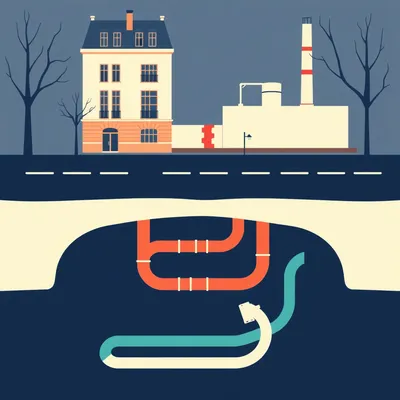
District cooling is the big one for dense urban areas. Instead of every building running its own chiller, you have a central plant producing chilled water and distributing it through insulated pipes. Paris has been expanding its district cooling network using water from the Seine. Singapore has one of the largest underground district cooling systems in the world — it serves Marina Bay and reduces per-capita cooling energy by about thirty to fifty percent compared to individual systems.
Thirty to fifty percent is not marginal.
It's enormous. And the efficiency comes from scale. A central plant can run large, high-efficiency chillers with variable-speed drives that match output to demand. Individual buildings can't justify that equipment. The central plant can also do things like thermal storage — making ice at night when electricity is cheap and clean, then using it for cooling during peak daytime hours.
Shifting the load to when the grid is less strained.
And when the carbon intensity of electricity is lower, if you've got nuclear or wind running at night. There's also phase-change materials — substances that absorb or release heat when they change phase, usually solid to liquid. You can embed them in ceiling tiles or wall panels. They melt during the day, absorbing heat and keeping the room cool, then re-solidify at night when temperatures drop. No electricity required for the cooling itself.
What about just building differently?
The Mediterranean figured this out centuries ago. Thick masonry walls that absorb heat during the day and release it at night. Small windows on sun-facing walls, larger openings on shaded sides. Courtyards that create convective airflow. Whitewashed surfaces that reflect solar radiation instead of absorbing it. Modern versions of these techniques — external shading, reflective cool roofs, night-flush ventilation — can reduce cooling loads by fifty to eighty percent before you even turn on a mechanical system.
So the technology exists. The building techniques exist. The refrigerant transition is underway. Why are we still having this conversation in airports with broken AC and sustainability posters?
Because all of that requires investment. District cooling needs infrastructure — pipes in the ground, central plants, maintenance crews. Passive building design needs architects who know how to do it and clients willing to pay for it. Refrigerant transitions need equipment replacement cycles that take ten to fifteen years. And in the meantime, the cheap option is to put up a poster and turn down the thermostat.
Or let the equipment fail and not fix it.
That's the other possibility Daniel raised — that it wasn't a policy choice at all, just deferred maintenance dressed up as virtue. Either way, the people inside the building pay the price.
I want to go back to something Daniel said about not being able to think about sustainability when he's overheating. That feels like the core of this. We're asking people to make long-term, prosocial decisions while their bodies are screaming at them to solve an immediate physical crisis.
The behavioral literature backs him up. Heat stress narrows time horizons. It increases irritability, which we covered in a previous episode, but it also reduces what psychologists call temporal discounting patience — your willingness to delay gratification for a larger future reward. When you're hot, you want relief now. The abstract benefit of reduced emissions in twenty fifty doesn't register.
Which means a sustainability policy that makes people miserable might actually reduce sustainable behavior overall. You've made someone suffer through a hot airport, and now they're less likely to support climate policy in general, because they associate it with personal misery.
There's a term for this in policy design — the sacrifice framing problem. If climate action is always presented as giving things up, taking things away, making do with less, people resist it. What actually works is reframing it as getting something better — more comfortable buildings that happen to use less energy, better air quality that happens to come from efficient systems, more livable cities that happen to be cooler.
The Athens airport could have been a showcase for that. Instead of a poster bragging about sustainability while passengers sweat, they could have invested in the things we're describing — reflective roofing, shaded glazing, efficient chillers running on low-GWP refrigerants — and been sustainable while keeping people comfortable.
And they could have told that story honestly. Here's what we did, here's why it works, here's how much energy it saves, and you don't have to suffer to notice.
Daniel's last question was whether there's a way to cool sustainably without inflicting misery. It sounds like the answer is yes — but it requires treating cooling as infrastructure, not a luxury to be rationed.
Cooling as a service, not a commodity. The distinction matters. When you treat AC as a box you buy and plug in, you get the cheapest box that meets minimum needs, installed badly, leaking refrigerant, running inefficiently for fifteen years. When you treat it as infrastructure, you get district systems, building-integrated design, professional maintenance, refrigerant recovery, continuous commissioning.
And the equity dimension. Daniel's family could eventually leave the airport. The counter staff couldn't. If we accept that cooling is necessary for human dignity in a warming world — and I think we have to accept that — then restricting it without providing alternatives isn't policy. It's neglect.
The Kigali Amendment shows that global coordination on the refrigerant side is possible. The district cooling examples show that the efficiency side is solvable. The passive building techniques show that we can reduce the load before we even turn on the machines. None of this is speculative. It's all deployed, it's all measured, it's all working somewhere.
It's just not working in the airport Daniel was stuck in.
And that's the gap between what we know how to do and what we're actually doing.
Hilbert's been quiet.

Nineteen ninety-eight. I spent six months running a shopping mall chiller plant in Phoenix, Arizona. Five thousand tons of cooling capacity — that's about sixty million BTUs an hour. The building code said we had to maintain seventy-two degrees Fahrenheit year-round. The energy model the architects submitted to get the building permit assumed seventy-eight. So we were legally required to use more energy than the building was designed to use.
The code required you to waste energy.
Every day. The chillers ran at part load constantly because the setpoint was lower than the design condition. Part load is less efficient. We burned more electricity, wore out the equipment faster, and nobody could change it because the code didn't have a mechanism for reconciling the design assumption with the operating requirement. Two different documents, two different numbers, no connection between them.
So the sustainability certification was based on the seventy-eight degree model.
The plaque by the entrance said energy-efficient design. Based on a number the building never operated at.
What does that have to do with Athens?
I don't think the Athens airport made a sustainability choice. I think they had a chiller plant that was designed for the climate loads of whenever it was built — nineteen ninety-five, two thousand, somewhere in there. Cooling load in Athens has increased maybe fifteen to twenty percent in the last decade. More hot days, higher peak temperatures. The equipment can't keep up. Fixing it means replacing chillers, which costs millions. Putting up a poster costs about forty euros.
The sustainability claim is covering for infrastructure that's undersized for the current climate.
That's what I'd bet. I saw it all the time. Building gets a green certification based on the design documents, five years later the equipment is limping along and the energy use is way above what was modeled, but the plaque is still there. Nobody comes back to check.
The certification becomes permanent while the performance degrades.
The mall in Phoenix had an Energy Star label from nineteen ninety-seven. I was there in ninety-eight and it was already meaningless.
What Daniel experienced might not even be deliberate policy. It might just be old equipment, a maintenance budget that doesn't cover replacement, and a sustainability branding effort that was never updated to reflect reality.
Could be both. Some sustainability manager decides to raise the temperature setpoint to save energy, doesn't realize the building was already running hot because the chillers are degraded, and now you've got a terminal at eighty-four degrees with a poster on the wall.
The counter staff are the ones who know.
Always. Ask the people who work there every day. They'll tell you exactly when it started, how bad it gets, and whether management cares. Sounds like the Athens staff were pretty clear about it.
The code problem you mentioned — the disconnect between design assumptions and operating requirements. Is that still happening?
Worse now. Energy codes keep getting stricter, which means design models keep getting more optimistic to hit the numbers. The gap between what the model says and what the building actually needs gets wider. Then the climate changes and the real cooling load goes up while the model is frozen in time.
The regulatory framework that's supposed to drive efficiency is actually creating a fiction that makes buildings less resilient.
I wouldn't go that far. But I'd say the certification is a snapshot of a design intent, not a measurement of performance. And people treat it like a permanent credential.
That's a problem that extends way beyond airports. Building energy ratings, green building certifications — most of them are based on design-phase modeling, not ongoing measurement. The EU's Energy Performance Certificate system is one of the few that requires periodic renewal, and even that's every ten years. A lot can degrade in ten years.
Compressor failure, refrigerant leaks, fouled heat exchangers, sensor drift. A chiller that was efficient when commissioned can be a pig five years later if nobody's maintaining it.
Hilbert, you said the Phoenix mall had five thousand tons of cooling. For context, what does that actually look like?
Three centrifugal chillers in a basement mechanical room. Each one about the size of a shipping container. The compressors drew so much current that starting one would dim the lights in the entire mall for half a second. We had to sequence them so they didn't all kick on at once and trip the main breaker.
And the refrigerant charge?
About twelve hundred pounds of R-11 per chiller. Low pressure centrifugal, so the leak rate was higher than a sealed residential system. We topped them off quarterly. The recovered refrigerant went into cylinders that sat in a storage room because the recycling contractor only came twice a year.
Twelve hundred pounds per machine, three machines, leaking quarterly.
The environmental impact of the leaks probably exceeded whatever energy savings the design model claimed. Nobody calculated that. It wasn't part of the certification.
R-11 is an old CFC — ozone-depleting and a potent greenhouse gas. It's been phased out under Montreal, but there's still legacy equipment running on it or on reclaimed stocks.
The Phoenix mall converted to R-123 eventually. Lower ozone depletion, still a greenhouse gas. The real fix was replacing the whole plant, which they finally did around twenty twelve. Twenty-five year old chillers running on obsolete refrigerant with a plaque from nineteen ninety-seven.
Daniel was in that airport for one day. The staff are in it every shift. The equipment is degrading. The climate is getting hotter. And the poster stays up.
The poster is the cheapest part of the whole system.
Where does this leave Daniel's question? Can we cool sustainably without inflicting misery?
The technology says yes. District cooling, low-GWP refrigerants, passive design, phase-change materials, smart controls — all of it exists, all of it works, all of it can be deployed at scale. The barrier isn't technical. It's that we've built a regulatory and economic framework that rewards putting up posters instead of replacing chillers.
A certification industry that measures design intent rather than operational performance.
The Kigali Amendment is the counterexample. It's binding, it's phased, it's monitored. It's actually working. If we can do that for refrigerants, there's no reason we couldn't do something similar for building cooling performance — actual measured energy use, actual indoor temperature data, actual refrigerant leak rates, reported and verified.
But that costs money and creates liability.
Yes. And the current system costs less and creates posters. That's the trade-off we're actually making, whether we admit it or not.
The open question I'm left with is what a right to cooling looks like. If we accept that mechanical cooling is necessary for human dignity in large parts of the world — and the projections say it is — then we need to design systems that deliver it without cooking the planet. That's not a technical problem at this point. It's a political and economic one.
It's a framing problem. As long as sustainability is presented as doing with less, people will resist it. The better pitch is doing better — more comfortable buildings, cleaner air, lower energy bills, more resilient infrastructure. The district cooling system in Singapore isn't a sacrifice. It's an upgrade.
Daniel's airport could have been that. Instead it was a hot box with a poster. The counter staff were suffering, the passengers were improvising fans, and the sustainability claim was hanging on the wall like a taunt.
The most sustainable airport in Greece, according to the poster.
According to the poster.
Thanks to Hilbert Flumingtop for producing, and for the chiller plant tour of nineteen ninety-eight Phoenix.
This has been My Weird Prompts. If you've got a weird prompt you want us to wrestle with — especially one about the strange trade-offs of modern life — email the show at show at my weird prompts dot com.
We'll be back soon.