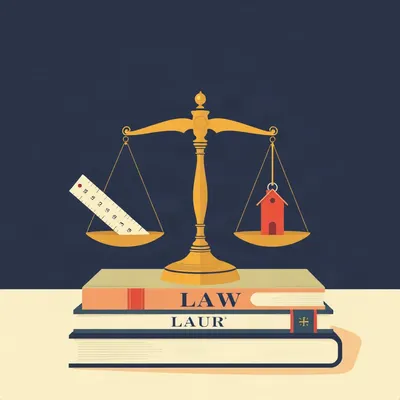
Daniel's been thinking about the strange life cycle of court cases. His prompt has three layers, and they all connect. First: as precedent piles up over centuries, the gaps in settled law should shrink, which ought to make trial outcomes more predictable, which ought to push everyone toward settlement. So why do tens of thousands of cases still go to trial every year? Second: what makes the tiny handful that become household names — Roe v. Wade, Donoghue v. Stevenson — break through when the vast majority of legally significant cases are never heard of outside the profession? Third: is the age of blockbuster precedents ending? As the remaining gaps get more technical, are we seeing fewer landmark cases that anyone who isn't a lawyer would care about?

That third question is the one that's been sitting with me since I read it. The idea that the legal system might be filling itself in so thoroughly that what's left to decide is... administratively important but culturally invisible.
The law equivalent of firmware updates.
Right. Nobody reads the release notes for Chevron deference. But the answer to all three, I think, sits in the gap between how precedent works in theory and how it actually functions in practice. So let's start with the puzzle underneath the whole thing. Why does anyone still go to trial?
Because the common-sense model says they shouldn't. Stare decisis — the doctrine that courts follow precedent unless there's a strong reason to depart — should, over time, make the law increasingly knowable. More cases decided means more questions answered. More answers means both sides can look at the same dispute and arrive at roughly the same prediction of what a judge would do. And if both sides agree on the likely outcome, settlement is rational. Trial is just burning money.
And that model isn't entirely wrong. The proportion of federal civil cases going to trial fell from about eleven percent in nineteen sixty-two to under two percent today. The absolute number is still in the tens of thousands annually, but the trend is real. Marc Galanter called this the vanishing trial, and it's one of the most documented phenomena in empirical legal studies.
So Daniel's intuition is directionally correct. Trials are rarer. The puzzle is why any remain at all.
Because precedent is almost never perfectly on point. And this is the thing that the common-sense model misses. The model treats precedent like a database — you query it with your facts, it returns an answer. But that's not how it works. Cornell's Legal Information Institute defines stare decisis in a way that actually contains the whole problem: courts follow precedent unless there is a strong reason to depart. And they distinguish, overrule, and narrow precedent constantly. It's not a fixed set of rules. It's an interpretive practice.
So the database is alive and it changes its mind.
And every case brings facts that are at least slightly novel. New technology, new business models, new social arrangements that don't fit neatly into old boxes. The Oyez archive shows that in every Supreme Court term, you get cases where both sides agree on what the governing precedent is. They just disagree, fundamentally, on whether it applies to these facts. That gap is where trials live.
So even in a heavily settled area of law, you can still end up in court because the facts are weird enough that nobody knows which box they go in.
But there's a second mechanism that's maybe more important, and it's about incentives. Even when both sides privately agree on the likely outcome, they may value that outcome completely differently.
Give me an example.
A plaintiff with a strong case sues for damages. The defendant's lawyers look at the same precedent and agree — the plaintiff probably wins. But settling means writing a check, and writing a check means admitting fault. For a hospital, a pharmaceutical company, a big employer, that admission creates reputational harm, it invites copycat lawsuits, it affects regulatory relationships. The cost of settlement isn't just the dollar amount. It's everything that comes with saying "we were wrong."
Whereas fighting and losing costs more in legal fees, but you get to say you fought.
And sometimes that's worth millions. The ABA's research on settlement dynamics identifies this divergent valuation as the single biggest driver of trial. Two parties read the same cases, agree on the law, but place wildly different price tags on the same outcome. That gap — they call it the trial zone — is where cases go to verdict. The wider the gap, the more likely trial becomes.
So precedent doesn't eliminate the trial zone. It just defines its boundaries.
Right. And here's the third piece, which I think is the most counterintuitive. Some cases are brought precisely because precedent is clear and unfavorable.
Wait. You sue because you know you're going to lose?
You sue because you want to lose. Strategically. You want to create a vehicle to challenge the precedent itself. You want to get to the appellate level, ideally the Supreme Court, and ask them to overrule it. Brown v. Board of Education was engineered this way. The NAACP Legal Defense Fund spent years building a litigation strategy specifically designed to challenge Plessy v. Ferguson. They knew they'd lose at the trial level under existing precedent. That was the point.
So the clarity of the precedent is the weapon. You walk into a courtroom, lose exactly as expected, and then appeal on the grounds that the precedent itself is wrong.
And if you win at the top, the case that was a guaranteed loss becomes the new precedent. That's not a bug in the system. That's how the system updates itself. The ABA's landmark cases database shows several of the most famous twentieth-century cases were built this way — litigation as architecture, not dispute resolution.
Which means the common-sense model has it exactly backwards in these cases. The predictability of the outcome isn't a reason to settle. It's the reason to file.
And that brings us to the fourth mechanism, which is maybe the simplest. Precedent creates bargaining chips, not predictions. Both sides read the same cases and come away with different probability estimates. One side sees a seventy percent chance of winning. The other side sees a forty percent chance of losing. Neither is irrational. The cases are ambiguous enough to support both readings.
And if your estimate of your own odds is higher than the other side's estimate of your odds, you're going to trial.
That's the trial zone again. The wider the divergence in those subjective probability estimates, the harder it is to settle. And precedent doesn't always narrow that gap. Sometimes it widens it, because both sides can point to different lines of cases, different factual analogies, different interpretive frameworks. The law is a set of stories, not a set of equations.
That's a better way to put it than I was going to. So the vanishing trial is real — trials are a much smaller fraction of cases than they were sixty years ago — but the mechanisms that keep them alive are structural. Novel facts, asymmetric incentives, strategic overruling, and divergent readings of the same material. None of those go away just because the case reporters get thicker.
And that's before you even get to the human element. Some litigants just want their day in court. They want to be heard. They want a judge to look at the other side and say "you're wrong." No settlement provides that. The ABA's research is clear that this is a real factor, even if it's hard to quantify.
Alright. So trials persist because precedent is fuzzier than it looks, incentives are asymmetric, and some people just want to fight. That's the first question. The second one is what makes a tiny handful of those trials famous. And I want to start with a case Daniel mentioned that I'd never heard of before he brought it up.
Donoghue v. Stevenson.
Nineteen thirty-two. A woman finds a decomposed snail in a bottle of ginger beer. She sues the manufacturer. There's no contract between them — she didn't buy the bottle, a friend bought it for her. Under the law at the time, that should have been the end of it. No contract, no duty.
And instead it created the entire modern law of negligence. The House of Lords held that a manufacturer owes a duty of care to anyone who might reasonably be affected by their product. Lord Atkin's neighbor principle — you must take reasonable care to avoid acts or omissions that you can reasonably foresee would injure your neighbor — that's still the foundation of tort law across the common law world.
And everyone who studies law knows the snail. The facts are unforgettable. But here's what I want to poke at. There are hundreds of cases that settled equally significant doctrinal gaps and nobody outside the profession has ever heard of them. So legal significance alone doesn't make a case famous.
No, it doesn't. What makes a case break through is something closer to cultural resonance. The case resolves a question the public already cares about. The legal gap and the social gap coincide. Brown v. Board — segregation wasn't just a legal question, it was the central moral crisis of the country. Roe v. Wade — abortion wasn't just a constitutional puzzle about privacy, it was a live, raging cultural debate. Miranda v. Arizona — whether police have to tell you your rights touches every cop show, every crime drama, everyone's sense of what's fair.
Same-sex marriage. Obergefell.
These cases became shorthand for something bigger than their legal holdings. And that's the second filter. Narrative simplicity. The famous cases have facts you can tell in one sentence. A snail in a bottle. A woman denied an abortion. A man not told he could remain silent. A child who had to walk past a white school to get to a Black one. The facts become the principle.
It really is. Donoghue v. Stevenson would be a footnote in first-year torts if it were just called "the neighbor principle case." But it's the snail case. Everybody remembers the snail.
So you need both. A live cultural nerve and a story you can tell at a dinner party. Most legally significant cases have neither.
Most legally significant cases are about things like... whether a federal agency's interpretation of an ambiguous statute deserves judicial deference. That's Chevron. Foundational for administrative law. Arguably one of the most important Supreme Court decisions of the late twentieth century. Nobody's ever heard of it.
I've heard of it.
You're a sloth who reads case law for fun. You're not the median voter.
Fair. So that brings us to Daniel's third question. If the pipeline of landmark cases depends on unsettled questions that the public cares about, and the biggest ones — segregation, abortion, marriage equality — have been resolved, are we seeing fewer blockbuster precedents? And are the ones we do get more obscure?
There's a structural fact here that matters. The Supreme Court's merits docket has shrunk dramatically. In the nineteen eighties, the Court was deciding a hundred and fifty to a hundred and seventy cases per term. Today it's more like sixty to seventy. So the raw number of opportunities to create a landmark has fallen by more than half.
But that doesn't tell you whether the landmark rate per case has changed.
Right. And there's a decent argument that it hasn't. The Court is taking fewer cases, but it's being more selective. The cases it does take tend to be the ones with the biggest stakes. So the importance per case may be stable or even rising.
But the character of those cases has shifted.
That's the nuance hypothesis. As the big constitutional questions get settled — and I'm not saying they're all settled, but the major ones have been addressed — the remaining gaps are in areas that are enormously consequential but technically dense. Administrative law. Patent eligibility. Standing doctrine. Federal preemption. These are huge within the profession. They determine how the regulatory state functions. They're invisible outside it.
Chevron deference, qualified immunity, the major questions doctrine — these are the landmarks of the last forty years and they're not exactly water-cooler material.
Qualified immunity is actually a perfect example. Whether police officers can be sued for constitutional violations affects millions of people. It's been the subject of massive public protest. And yet the doctrine itself — the two-prong test, the clearly established law standard — most people couldn't describe it if you asked them. The case names don't stick the way Miranda does.
So the public perception that courts are less important might just be a function of the issues becoming more technical, not courts becoming less powerful.
I think that's exactly right. The Court just decided major cases on social media content moderation in the twenty twenty-five term. Those are novel questions — the First Amendment meets algorithmic curation. There's no precedent that directly controls. The holdings will shape how the internet functions for decades. And most people will never know the case names.
Because "the platform liability case" doesn't have a snail in it.
It doesn't. And the facts are complicated. Content moderation at scale involves machine learning models, terms of service, Section two thirty — you can't reduce it to a single vivid image the way you can with a decomposing gastropod in a beverage.
Though I'd watch someone try.
Would I. But here's the counter-argument to the nuance hypothesis, and I think it's strong. New technology creates new gaps. The internet, artificial intelligence, encryption, genetic data, autonomous vehicles — these aren't just variations on old legal questions. They're things the common law has never had to deal with. The landmark pipeline may not be drying up. It may be shifting from social issues to technology issues.
Which would mean the next Roe v. Wade might be about whether a large language model's training data infringes copyright, or whether an autonomous vehicle's decision algorithm counts as a product or a service.
Or whether an AI system can be an inventor for patent purposes. That's already being litigated in multiple jurisdictions. The UK Supreme Court said no. The US Federal Circuit said no. But the questions keep coming. And they're the kind of thing that could eventually produce a household-name case, because the facts are memorable — the AI that invented something — and the cultural stakes are enormous.
The pipeline isn't empty. It's just filling with different stuff.
The stuff is weirder. Which is good for us, honestly.
We're in the weird prompts business.
But I want to add one more layer to Daniel's question about whether landmark cases are declining. There's a measurement problem. We judge what's a landmark retrospectively. Marbury v. Madison wasn't famous when it was decided. It barely made a ripple. It took decades for judicial review to become the cornerstone of American constitutional law. So we might be living through the landmark cases of the twenty-twenties right now and not know it.
The snail of the future is out there, decomposing quietly in a bottle nobody's opened yet.
That's a grim image and I'm keeping it.
To pull all this together for Daniel: trials persist because precedent is an interpretive practice, not a database — novel facts, asymmetric incentives, strategic overruling, and divergent readings keep the trial zone alive. Cases become famous when they hit a live cultural nerve and have facts you can tell in a sentence. And the landmark pipeline probably isn't drying up — it's shifting toward technical and technological questions that are just as consequential but harder to narrate.
Which means the gap between what's legally important and what's culturally visible is widening. And that's its own kind of problem. If the public can't name or understand the cases that structure their lives, the legitimacy of the system erodes in a different way than if the courts were doing nothing important at all.
The courts are doing plenty. They're just doing it in a language fewer people speak.

Nineteen ninety-seven. I was a paralegal at a boutique litigation firm in Hartford. Twelve lawyers, wood paneling, the whole thing. My job was to organize the precedent library. Physical room. Bound case reporters floor to ceiling. The senior partners treated those volumes like they were scripture. You didn't dog-ear a page. You didn't leave a volume open face-down. One partner — name was Mulligan — would literally wash his hands before handling the Connecticut Reports.
That's... reverent.
He was a strange man. But here's what I learned in that room. You're both talking about precedent as if it's a set of rules. It's not. It's a set of stories that lawyers tell judges. And the better storyteller wins. I watched Mulligan take a case that was clearly settled against him. The precedent was a brick wall. He walked into court and argued that the brick wall was actually a fence. The judge bought it. That case is now in the reporters as a new precedent.
The trial zone is actually a storytelling zone.
Always was. The facts don't speak for themselves. Somebody has to arrange them. The lawyer who can say "this case isn't like that case, it's like this other case" and make it stick — that's the whole game. Mulligan wasn't the smartest lawyer in Hartford. He was the best at finding the one fact that made the analogy work.
Which means precedent doesn't eliminate uncertainty. It manages it by providing the raw material for competing narratives.
That's a fancier way of saying what I just said. But yes. The system isn't designed to produce certainty. It's designed to channel disagreement into a structured argument. Two stories go in, one story comes out, and that story becomes the next round's raw material.
Did Mulligan ever lose?
All the time. He'd come back to the office, put the volume back on the shelf, and say "they told a better story." Never "the law was against us." Always the story.
That reframes the whole discussion. If precedent is a set of stories, then the question isn't whether the law is predictable. It's who gets to tell the story, and how well.
Whether the judge likes the story. Don't forget that part. Judges are people. They have priors. Mulligan knew which judges responded to which kinds of analogies. He kept notes. I typed them.
Of course you did.
I still have the notes. Somewhere. The point is, you asked why cases go to trial when precedent should make outcomes predictable. The answer is that precedent doesn't make outcomes predictable. It makes arguments possible. Those are different things.
I think that's actually a more honest description of what stare decisis does than most of what you read in law reviews.
Law reviews are written by people who've never had to convince a judge that a brick wall is a fence. Mulligan had. He was right about half the time. The other half, the wall stayed a wall. But half is enough to keep the whole thing running.
Half is a lot more than zero, which is what the common-sense model would predict.
The common-sense model was written by somebody who never met Mulligan.
If you take one thing from this episode, I think it's Hilbert's reframing. Precedent isn't a database of answers. It's a library of stories that lawyers use to build new stories. That's why trials persist, that's why some cases break through and most don't, and that's why the landmark pipeline isn't drying up — the stories are just getting more complicated.
The one sharpening sentence I'd add: the gap between what's legally important and what's culturally visible is widening not because courts are doing less, but because the stories they're telling are harder to summarize at a dinner party. The snail is still in there somewhere. You just need a better flashlight.
Which leaves an open question that I can't stop thinking about. If precedent is a set of stories, what happens when AI can generate and test legal arguments at scale? Does the trial zone shrink because both sides can simulate thousands of narrative framings and converge on the most persuasive one? Or does it expand because AI generates novel analogies no human lawyer would think of, widening the gap between competing readings?
The next landmark case might not be about what the law says. It might be about who gets to tell the story — the lawyer, the algorithm, or the judge who has to decide which story to believe.
That's a question with a snail in it, if you squint hard enough.
This has been My Weird Prompts. Thanks to our producer Hilbert Flumington for keeping the tapes rolling and the case reporters dusted.
If you've got a weird prompt — and Daniel, you clearly do — email the show at show at my weird prompts dot com.
We'll be back soon.