
Pixels, Prompts, and Latent Space: The Science of AI Image Generation
AI image generation went from novelty to professional tool in under two years. Six episodes unpacked the technology, the workflows, and the remaining limitations.
How Diffusion Models Work
- The Jigsaw Beneath the Magic explained the fundamental mechanism: diffusion models learn to reverse the process of adding noise to images. Starting from pure noise, they iteratively denoise toward a coherent image guided by a text prompt embedded in the same latent space. The hosts made this surprisingly intuitive by comparing it to sculpting — removing noise instead of removing marble.
ComfyUI: The Power User’s Tool
- ComfyUI: Power, Polish, & The AI Creator’s Frontier introduced the node-based workflow system that serious AI artists use. Unlike simple prompt-in-image-out interfaces, ComfyUI exposes every step of the generation pipeline as a visual node graph. The learning curve is steep, but the control is unmatched.
Precision with ControlNet
- Architectural AI and From Sketch to Studio demonstrated ControlNet’s ability to constrain generation using reference images — edge maps, depth maps, pose skeletons, and architectural plans. This transforms image generation from “make me something like this” to “make me exactly this composition with this style.” The architectural applications are particularly compelling: generating photorealistic renders from floor plans and sketches.
The Text Problem
- Pixels, Prompts & Pseudo-Text tackled one of AI image generation’s most visible failures: text rendering. Diffusion models produce convincing pseudo-text that looks like letters but isn’t. The episode explained why — text operates at a different level of abstraction than visual patterns — and explored emerging solutions including dedicated text-rendering modules and post-generation compositing.
The Local AI Renaissance
- The Future of Local AI surveyed the state of running image generation locally. With models like SDXL and Flux running on consumer GPUs, the quality gap between local and cloud-based generation has shrunk dramatically. The hosts compared the major models, GPU requirements, and the trade-offs between speed, quality, and VRAM usage.
AI image generation is no longer magic — it’s engineering. These episodes provide the technical foundation for understanding what these tools can do, what they can’t, and how to get the most out of them.
Episodes Referenced
#19 AI Images: The Jigsaw Beneath the Magic Dec 4, 2025

#20 Architectural AI: Precision with ControlNet & ComfyUI Dec 4, 2025
#31 ComfyUI: Power, Polish, & The AI Creator's Frontier Dec 7, 2025
#46 Pixels, Prompts & Pseudo-Text: AI's Word Problem Dec 10, 2025
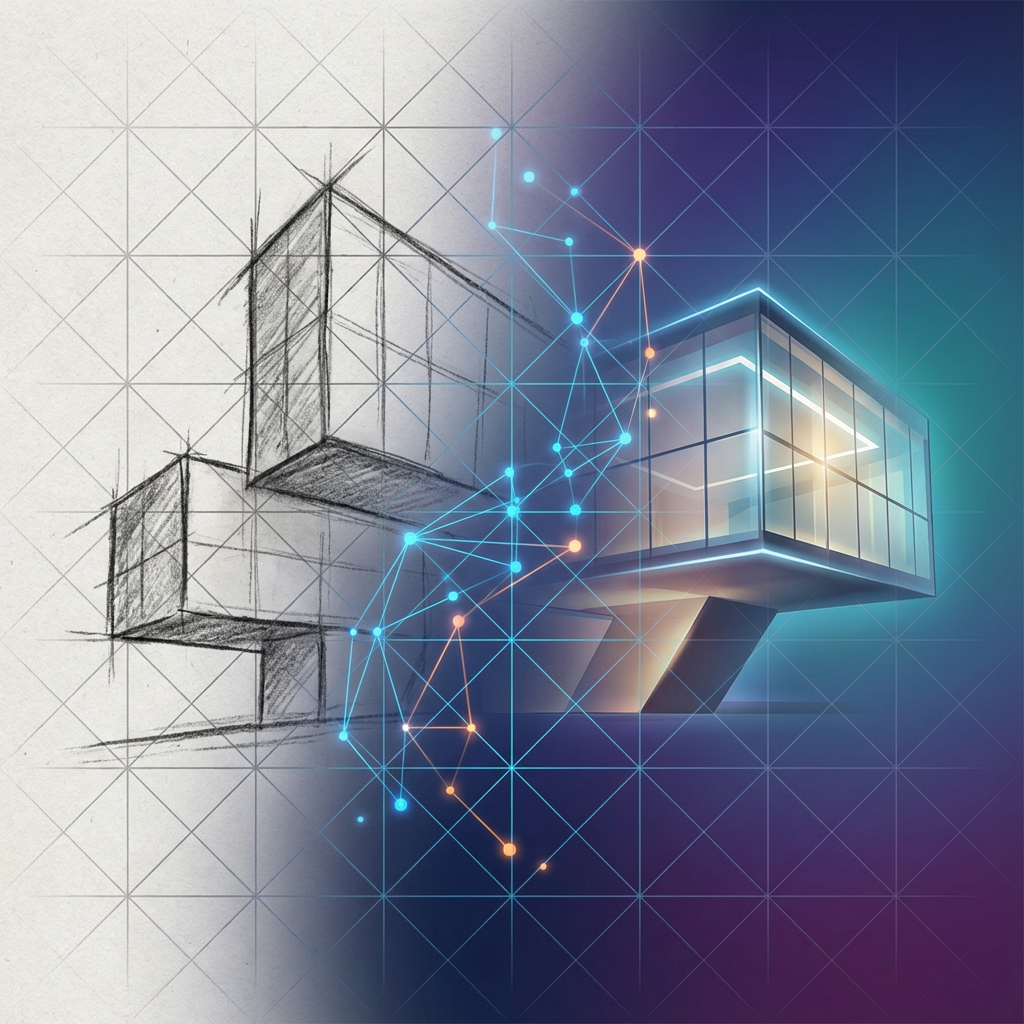
#47 From Sketch to Studio: AI & Control Nets in Design Dec 10, 2025

#75 The Future of Local AI: Stable Diffusion vs. The New Guard Dec 23, 2025