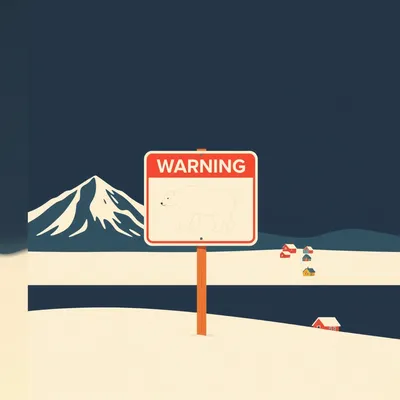
Daniel sent us this one — he's asking about Svalbard, which he calls one of the most fascinating and remote places on the planet, and honestly, that's underselling it. The core questions are: how do you actually get there, what do flights cost, is there really a limit on how long you stay, and what's the deal with the visa-free claim? Can you just show up without a passport? And then the practical stuff — accommodation costs, internet quality, whether alcohol rationing is real, what you need to know about polar bear safety, and what to pack to stay warm. There's a lot of ground to cover.

The thing that hooks people immediately — Svalbard is one of the only places on Earth where you have to carry a rifle outside town. Not a suggestion, not a best practice. It's the law. If you walk past the polar bear warning signs at the edge of Longyearbyen without a high-powered rifle and a flare gun, you are breaking Norwegian regulation. That's not performative. There are roughly three thousand polar bears on the archipelago and about twenty-five hundred humans. The bears outnumber the people.
Which is a ratio most tourism boards leave off the brochure.
They do, actually. Visit Svalbard's website leads with the Northern Lights and glacier tours. The mandatory rifle requirement is in the fine print. But before we get to the polar bears and the ration cards, let's actually understand what Svalbard is — because it's not quite a country, not quite a territory, and definitely not what most people expect.
Most people think it's just northern Norway. It's not. It's governed by the Svalbard Treaty of 1920, which is this wonderfully weird piece of international law. Norway has sovereignty, yes, but the treaty gives citizens of all signatory nations — and there are over forty of them now — equal rights to live and work there. It's a demilitarized zone. No military bases, no naval installations. And the tax and visa rules are completely separate from mainland Norway.
The treaty was signed February ninth, 1920, and went into effect in 1925. The original signatories were the countries that had been mining coal up there — Norway, Sweden, the Netherlands, Britain, the U., and a handful of others. Russia still maintains a mining settlement at Barentsburg today, which is a whole other layer of strangeness — a Russian company town operating on Norwegian sovereign territory under a century-old treaty. And here's the key quirk: Norway can't impose visa requirements on Svalbard itself. The archipelago is outside the Schengen Area. So anyone from any country can legally be on Svalbard without a visa. That's the claim everyone's heard.
It's technically true, and functionally almost useless. But let's get to that. Geography first — Svalbard sits at seventy-eight degrees north. Longyearbyen, the main settlement, is at seventy-eight degrees thirteen minutes north latitude. That's about halfway between the northern tip of mainland Norway and the North Pole. To put that in perspective, if you stood at the North Pole and walked south, Longyearbyen is only about thirteen hundred kilometers away. That's roughly the distance from New York to Chicago. About twenty-five hundred people live there. There's a university center, a hospital, a church, a couple of hotels, bars, restaurants, and the Global Seed Vault buried in the permafrost a few kilometers outside town.
The Seed Vault is its own entire episode. But the point is, this is not a research station like Antarctica where everyone rotates out. People live there. Kids are born there — well, not anymore, actually. The hospital in Longyearbyen stopped delivering babies in the 1990s because there's no full maternity ward. Pregnant women fly to Tromsø about a month before their due date. But people do live full lives on Svalbard. There are retirees, families, people who've been there for decades. I read about one woman who moved there in the 1970s to work at the coal mine, met her husband there, raised kids there — well, raised them until they had to leave for high school, because there's no secondary school beyond a certain age — and she's still there. That's a full life at seventy-eight degrees north.
That's the thing that separates Svalbard from, say, an Antarctic base. McMurdo Station has a bar and a bowling alley, but nobody retires there. Nobody's grandmother lives at McMurdo. Svalbard has grandmothers. It has people who remember when the coal mine was the only reason anyone was there at all.
With that legal framework in mind, let's tackle the first practical question everyone asks: how do you actually get there, and do you really not need a visa?
Here's where the fine print turns into a trap. There are exactly two commercial airlines that fly to Svalbard Airport in Longyearbyen — SAS and Norwegian Air. Both depart from Tromsø, Norway. That's it. There are no direct flights from anywhere else. No London to Longyearbyen, no New York to Svalbard. You must go through mainland Norway. And mainland Norway is in the Schengen Area. So you need a Schengen visa to get to Tromsø in the first place, unless you're from a visa-exempt country like the U., Canada, UK, Australia, and so on.
The visa-free status of Svalbard is real on the island, but it's a locked door if you can't reach it. There was a case in 2024 of an American citizen who was denied boarding in Oslo because their Schengen visa had expired. They assumed, reasonably, that Svalbard's visa-free status meant they could just transit through. Norwegian immigration said no. You need valid Schengen status to board the flight in Tromsø. Once you land in Longyearbyen, there's no passport control at all. No one stamps your passport. No one asks for a visa. But you can't get there without clearing the Schengen hurdle first.
That's the visa transit paradox, and it's the single most misunderstood thing about Svalbard travel. I've seen travel blogs claim Svalbard is a visa-free paradise where anyone can show up. And that's true if you're already in the Schengen zone legally. It's not true if you're, say, a citizen of a country that needs a Schengen visa and you think Svalbard is a workaround. Norwegian border police in Tromsø will check your documents before you board. They're checking for Schengen compliance, not Svalbard compliance. Svalbard doesn't care.
Wait — how does that actually work at the airport in Tromsø? Because I've heard there's a separate gate for the Svalbard flight. Is there a special checkpoint?
There is, and it's weirdly specific. At Tromsø Airport, the Svalbard flight departs from a gate that's technically outside the Schengen zone. You go through a passport check to exit Schengen, even though you're still in Norway. It's the same process as leaving the Schengen Area for, say, a flight to London. But here's the thing — when you return from Longyearbyen to Tromsø, you go through Schengen entry passport control. You're re-entering the zone. So if your visa expired while you were in Svalbard, you hit a wall at that entry checkpoint. You're standing in a Norwegian airport, technically on Norwegian soil, but you can't legally enter Norway. It's a bureaucratic limbo that plays out in a single corridor at Tromsø Airport.
What does visa-free actually mean in practice? For an American or a Canadian or a Brit, it's seamless. You fly to Oslo, connect to Tromsø, fly to Longyearbyen. No extra paperwork. For someone from a country that needs a Schengen visa, you need that visa — and once you have it, Svalbard adds nothing extra. The visa-free status is, practically speaking, a quirk that mainly benefits people who overstay in Schengen, then go to Svalbard, then discover they can't get back to the mainland without re-entering Schengen.
Which is another trap. You can stay on Svalbard indefinitely — there's no legal time limit — but if your Schengen visa expires while you're there, you're stuck. You can't fly back through Tromsø without a valid visa. People have gotten stranded this way. The Governor of Svalbard, the Sysselmester, has dealt with cases of people who arrived legally and then couldn't leave. There was a widely reported case a few years ago of a man who overstayed his Schengen visa, fled to Svalbard thinking he'd found a loophole, and then spent months trying to negotiate a way back to the mainland. Eventually he had to be repatriated to his home country directly from Longyearbyen, which required diplomatic coordination. Svalbard is not a legal escape hatch. It's more like a roach motel for visa overstayers — you can check in, but you can't check out.
Let's talk flights. Tromsø to Longyearbyen, about three hours in the air. What's the damage?
Round-trip flights run between three hundred and eight hundred dollars, depending on the season. Summer, June through August, is peak — that's when you get the midnight sun, the slightly less brutal temperatures, and the cruise ship tourists. Winter, November through February, can drop as low as two hundred fifty dollars round-trip, sometimes even less on SAS sales. For context, that three-hour flight from Tromsø can cost as much as a round-trip from New York to London, which runs about six hundred dollars on average. It's an expensive three hours.
That's before you've even bought a coffee in Longyearbyen, which, by the way, will cost you about eight dollars.
Everything is expensive. Svalbard has no agricultural production — everything is flown or shipped in. There's a single grocery store in Longyearbyen, the Svalbardbutikken, and the prices make Oslo look like a bargain bin. A liter of milk is about four dollars. A frozen pizza, fifteen dollars. A beer at a bar, twelve to fifteen dollars. This is not a budget destination. I saw a photo someone posted of their grocery receipt from the Svalbardbutikken — a loaf of bread, a block of cheese, some cold cuts, and a six-pack of soda. It came to the equivalent of sixty-three U.That's a sandwich-and-a-soda grocery run for the price of a nice dinner in most cities.
You can't exactly comparison shop. There's one grocery store. That's the market. You pay what they charge or you don't eat.
And it's not price gouging — it's the actual cost of logistics. Everything that arrives in Longyearbyen either comes by air freight or on a cargo ship that only runs during the ice-free months. The shipping season is roughly June through October. Anything that runs out in November has to be flown in until the next summer. That's why fresh produce in winter is both scarce and astronomically priced. A head of lettuce in January can run you ten dollars or more, and it won't be a particularly good head of lettuce.
You've made it to Longyearbyen. Now the real questions start: where do you sleep, can you get online, and why is there a ration card for vodka?
A basic guesthouse room runs a hundred fifty to two hundred fifty dollars a night. The Radisson Blu Polar Hotel, which is the nicest option in town, starts around three hundred dollars a night and goes up from there. If you're staying longer term — say you've taken a job in tourism or research — monthly rentals through employers are subsidized but still run a thousand to fifteen hundred dollars a month for a small apartment. And here's the catch: you cannot buy property in Longyearbyen unless you've lived there for at least one year. Most housing is owned by the state or by employers. The private market barely exists. Short-term rentals are scarce. If you're visiting, you book through Visit Svalbard or one of the few hotels and guesthouses, and you do it months in advance for summer.
This is not a place where you can just show up and wing it. There's no hostel culture, no couch-surfing scene. The housing stock is limited by geography — Longyearbyen is squeezed between mountains and a fjord. There is literally no more land to build on without hitting permafrost or protected wilderness. It's like a tiny city-state where the physical boundaries are absolute. You can see the edge of town from pretty much anywhere in town.
That creates this strange density. You've got twenty-five hundred people living in what is essentially a few square kilometers of habitable land, surrounded by wilderness that wants to kill you. It's got the physical constraints of an island village and the social dynamics of a small town, but with the infrastructure of a much larger place because of the research and tourism money flowing through.
Internet, surprisingly, is excellent. Longyearbyen has fiber optic connections via the Svalbard Undersea Cable System, which was laid in 2004 and upgraded to ten gigabits per second in 2016. That cable runs from Longyearbyen to mainland Norway. Speeds are comparable to what you'd get in Oslo — a hundred to five hundred megabits per second is typical. I've seen speed tests from people in Longyearbyen pulling three hundred megabits down, which is better than a lot of rural America. There's satellite backup, but the fiber is the primary connection. Winter storms can cause outages, and when the cable goes down, it takes days to repair because you're dealing with Arctic conditions and a cable buried under the seabed.
You can work remotely from Svalbard, which is a genuinely odd sentence. You're at seventy-eight degrees north, polar bears are wandering past the outskirts of town, and you're on a Zoom call with decent latency.
The latency is about thirty to forty milliseconds to mainland Norway, which is fine for video calls. To the U.East Coast, you're looking at maybe eighty to a hundred milliseconds. It's not ideal for competitive gaming, but for remote work, it's completely fine. This is one of those things that breaks people's mental model — they imagine Svalbard as this disconnected Arctic outpost, and in some ways it is, but the internet is better than what you'd get in many rural parts of Europe. There are people in Longyearbyen who work remote tech jobs for companies in Oslo or London. They do their standup meetings, push code, attend virtual conferences — all from a town where stepping outside without a rifle is illegal. The contrast is almost absurd.
Now, the alcohol rationing. This is real, and it's one of the most Googled facts about Svalbard. What's the actual system?
Every resident of Longyearbyen gets a rationing card. The monthly limit is two liters of spirits, twenty-four cans of beer, and one and a half liters of wine. That's per person, per month. The system was introduced in the 1920s to curb excessive drinking during the long polar night — the four months when the sun never rises and depression and isolation hit hard. It's enforced at the state-run store. You show your card, they stamp it, you get your allocation. If you hit your limit, you're done until next month.
This applies to residents only. Tourists can drink freely at bars and restaurants without any rationing card. You can also buy alcohol at the airport duty-free shop when you land in Longyearbyen — limited quantities, but no ration card required. So if you're visiting for a week, you can have a beer with dinner every night and it's fine. The rationing is a permanent-resident thing, not a visitor thing. That's a common misconception.
The other misconception is that the rationing is some kind of puritanical Norwegian policy. It's not. Mainland Norway has no such system. This is Svalbard-specific, and it dates back to the coal mining era when isolated workers in total darkness for months would drink themselves into serious trouble. The rationing card is a harm reduction measure born of a very specific environment. And it still exists because the polar night still exists. People still live through four months of darkness. That hasn't changed.
Here's a question — how do they actually enforce it? Is there a database? Do the bars scan your card?
No, the rationing card is only for purchasing alcohol at the state store to consume at home. Bars and restaurants are not part of the rationing system. So technically, a resident could hit their monthly limit at the store and then go to a bar and keep drinking. The rationing controls supply to the home, not consumption overall. It's designed to prevent people from stockpiling bottles and drinking alone in the dark for weeks on end — which was a genuine problem in the mining days. The bar is a social environment, and that's considered safer. There's a logic to it. It's not about total abstinence. It's about channeling drinking into social spaces where there's some degree of informal oversight.
Which brings us to the thing everyone actually wants to know about but is slightly afraid to ask: polar bears. What does someone who's never been need to know?
The polar bears of Svalbard are not a theoretical threat. They are an active, daily reality. There are roughly three thousand polar bears across the archipelago, and they are protected but dangerous. The last fatal attack was in August 2020 — a Dutch researcher was killed at his campsite near Longyearbyen. Before that, a British tourist was killed in 2011 while camping with a group. These are not ancient history. They are recent events.
The law is unambiguous. It is illegal to leave the settlement boundary of Longyearbyen without a high-powered rifle and a flare gun. Not a suggestion, not a guideline for expeditions. If you're walking past the polar bear warning signs — which are literal signs with a picture of a polar bear and text in Norwegian and English — you must be armed. The Governor of Svalbard, the Sysselmester, enforces this. If you're caught outside town without a rifle, you can be fined.
The mandatory safety course is not optional either. Before any expedition — even a day trip — you need to take a course that covers polar bear behavior, how to use a flare gun, and when lethal force is legally justified. The rule is: you try to scare the bear off first. Flare gun, shouting, making yourself big. If the bear charges, you shoot to kill. There is no warning shot. A polar bear that's charging is not going to stop because you fired into the air. You aim for the chest, and you keep firing until it drops. That's the reality.
Here's the thing that surprises people — polar bears don't necessarily see humans as prey in the way a lion might. But they are apex predators with no natural fear of humans, and they are always hungry. A polar bear that hasn't eaten in a week is going to investigate anything that moves. And if it decides you're food, you have seconds to react. They can run at forty kilometers an hour. You are not outrunning a polar bear. The rifle is not a backup plan. It is the plan.
For most visitors, the practical answer is: you don't go outside town without a guide. The tour operators in Longyearbyen provide armed guides who carry rifles and know what they're doing. You don't need to become a marksman. You book a guided snowmobile trip, a dog sledding tour, or a glacier hike, and the guide handles the safety. But if you're the kind of person who likes to wander off alone, Svalbard is not the place.
I've heard stories about tourists who rented a car in Longyearbyen, drove to the edge of town, saw the polar bear sign, and just kept going because they thought it was like a "beware of dog" sign — a legal formality. It's not. People have been fined on the spot.
The bears are most active near the coast and on the sea ice, but they do come close to Longyearbyen. There are polar bear sightings near the town several times a year. The Svalbard Alert app provides real-time notifications of bear sightings, and you should absolutely download it if you're visiting. If a bear is spotted near town, the Sysselmester sends out a helicopter to scare it away — they don't shoot bears unless there's an immediate threat to human life. Polar bears are a protected species under Norwegian law and under the Svalbard Treaty. Every bear that's killed in self-defense triggers an investigation. You don't just shoot a bear and go about your day. There's a legal process, and you have to justify that lethal force was the only option.
Let's talk about staying warm, because this is not the kind of cold where you can tough it out with a hoodie. What's the packing list?
The layering system is everything. Base layer: merino wool against your skin. No cotton — cotton kills in the Arctic because it holds moisture and loses all insulating properties when wet. Mid layer: fleece or down, something that traps heat. Outer shell: windproof and waterproof. The wind in Svalbard is the real enemy. The average winter temperature in Longyearbyen is around minus fourteen Celsius, which is about seven degrees Fahrenheit. That's cold but manageable. Add a thirty-knot wind coming off the glaciers, and the wind chill can drop to minus forty Celsius in minutes.
Here's an analogy that helps. If you've ever been skiing in Colorado or the Alps and thought, "this isn't so bad," then the wind stopped and you were fine — Svalbard is the opposite of that. The wind never stops. It funnels down the valleys and across the fjord. You're not dealing with still, dry cold. You're dealing with a constant, penetrating wind that finds every gap in your clothing. The difference between a sealed cuff and a loose cuff is the difference between a pleasant walk and frostbite in twenty minutes.
Insulated boots rated to at least minus thirty Celsius — minus twenty-two Fahrenheit — are not optional. Frostbite on toes is one of the most common injuries for unprepared visitors. And here's a specific that most packing lists miss: mittens, not gloves. When your fingers are together in a mitten, they share heat. In gloves, each finger is isolated and freezes faster. A balaclava to cover your face, goggles for wind protection, and a headlamp are mandatory from October to February. The sun literally does not rise for four months. It's not twilight. It's not dim. It's night. Twenty-four hours a day.
The polar night runs from roughly late October to mid-February in Longyearbyen. Conversely, the midnight sun runs from late April to late August. If you're visiting in summer, you don't need the headlamp or the extreme cold gear — summer temperatures average about six degrees Celsius, forty-three Fahrenheit — but you do need good waterproof layers because the snowmelt creates a lot of slush and mud. And the polar bears are still there year-round, so the rifle rule applies in all seasons.
What about the cat ban? This seems like an odd detail, but it's real.
Cats are banned in Longyearbyen. The reason is ecological — cats are non-native predators, and Svalbard has a fragile bird population. The archipelago is a major breeding ground for Arctic terns, barnacle geese, and several species of gull. A single house cat could devastate a nesting colony. Dogs are allowed — there's a big sled dog culture in Longyearbyen — but they must be on a leash year-round, again to protect wildlife. If you're moving to Svalbard, you can bring a dog. You cannot bring a cat. There was a case a few years ago of someone who smuggled a cat into Longyearbyen, and the Sysselmester ordered it removed. They take this seriously.
Like adopting a feral cat.
Except the cat gets deported. And it's not just cats, actually. There's a broader principle here. The Svalbard Environmental Protection Act is one of the strictest in the world. You can't pick a flower. You can't take a rock. You can't disturb any cultural remains older than 1946 — which covers most of the old mining structures and whaling stations scattered across the archipelago. The entire place is treated as a living museum and a protected ecosystem simultaneously. The cat ban is just the most memorable example of a much larger regulatory framework.
After all that, the big question is: should you go? And if so, what do you actually need to know before you book that flight?
Let's break it down concretely. First, the visa thing. If you're from a visa-exempt country — United States, Canada, UK, Australia, New Zealand, most of Europe — you don't need a visa for Svalbard, but you do need a valid passport. You will show it in Tromsø when you board the flight. Norwegian immigration checks your Schengen status. Once you land in Longyearbyen, no one checks anything. But you absolutely cannot show up without a passport and expect to board a flight in mainland Norway. The visa-free status applies to the island, not the journey.
Second, if you're from a country that requires a Schengen visa, you need that visa. Svalbard does not offer a backdoor into Europe. Get the Schengen visa, fly to Oslo, connect to Tromsø, then fly to Longyearbyen. And make sure your Schengen visa is valid for the entire period you plan to be in Svalbard plus your transit back through Tromsø. If your visa expires while you're on the island, you're in a bureaucratic nightmare. And I want to emphasize this because I've seen the question on forums: "Can I fly to Svalbard, then take a boat to mainland Norway to bypass the Schengen entry?" The answer is no. There is no passenger ferry service from Svalbard to mainland Norway. The only way back is by air, through Tromsø, with a passport check. There's no sneaking in by sea.
Plan on at least three hundred dollars a night for accommodation and food. A guesthouse room at two hundred dollars, plus meals and maybe one beer at fifteen dollars, and you're at three hundred before you've done anything. Guided tours — which you'll need if you want to see anything outside town — run anywhere from a hundred dollars for a short snowmobile trip to several hundred for a full-day expedition. Svalbard is not a cheap destination. Bring as much as you can from mainland Norway — snacks, toiletries, any gear you don't want to pay Arctic markup on. There's a reason Norwegians who move to Svalbard pack their suitcases like they're provisioning for a siege.
Fourth, polar bear safety. Do not leave Longyearbyen without a guide or a rifle. The mandatory safety course should be booked before you arrive — you can arrange it through Visit Svalbard or your tour operator. Download the Svalbard Alert app. Read the safety guidelines on the Governor of Svalbard's website. And take the polar bear warning signs seriously. Those signs are not decorative. They are not photo opportunities. They are the legal boundary between civilization and a food chain where you are not at the top.
Fifth, the practical stuff. The internet is good enough for remote work. Alcohol is rationed for residents but not for visitors — you can drink at bars and restaurants freely. The cat ban is real. Housing is scarce and expensive. And the weather is no joke — pack merino wool, windproof layers, insulated boots, mittens not gloves, and a headlamp if you're visiting in the dark season.
There's one more thing worth mentioning, and it's about the long-term picture. You asked about limits on how long you can stay. There is no legal time limit. You can live on Svalbard indefinitely. But you must have a means of support — a job, savings, something. Norway provides no social welfare on Svalbard. No unemployment benefits, no housing assistance. If you run out of money, the Sysselmester can order you to leave. And finding work isn't easy — the economy is built on tourism, research, and a shrinking coal mining industry. The Russian settlement at Barentsburg still operates, but that's a whole separate world with its own dynamics.
Barentsburg is worth a footnote. It's a settlement of about four hundred people, mostly Russian and Ukrainian, run by the state-owned mining company Trust Arktikugol. It has a Soviet-era feel — Lenin bust, Cyrillic signage, a hotel that looks like it hasn't been renovated since Brezhnev. You can visit on a day trip from Longyearbyen, but it's a strange experience. You're on Norwegian soil, but you're in what feels like a Russian company town from the 1970s. The geopolitical weirdness of Svalbard is never more visible than when you're standing in Barentsburg looking at a statue of Lenin while Norwegian tour guides chat with Russian miners.
If you do manage to make a life there, you're living in one of the fastest-warming places on Earth. Svalbard is warming at roughly six times the global average. The sea ice is retreating. The permafrost is thawing — there are buildings in Longyearbyen that are literally sinking because the ground beneath them is no longer frozen solid. The famous Global Seed Vault had to undergo a multi-million-dollar renovation in 2019 after meltwater seeped into its access tunnel. That's the Seed Vault — the thing designed to survive the apocalypse — getting threatened by water that wasn't supposed to be liquid. And as the ice disappears, polar bears are spending more time on land, closer to human settlements. The bear-human interaction rate is going up, not down.
Which brings us to the open question that sits underneath all of this. The Svalbard Treaty is a hundred years old — it was signed in 1920, and its centennial passed in 2020 with relatively little fanfare. But Norway proposed in 2025 to extend its territorial zone around Svalbard, which could change fishing and tourism rights. The treaty was written for a world where Svalbard was a frozen coal outpost, not a warming tourist destination with fiber internet and a growing international community. As the Arctic opens up — new shipping routes, new resource extraction, new geopolitical competition — the treaty's frozen-in-time legal framework is going to be tested. How does a demilitarized zone governed by a 1920 agreement handle a twenty-first century Arctic?
That's the tension. Svalbard is simultaneously one of the most legally frozen and physically thawing places on the planet. The rules haven't changed much in a century. The ice has.
Now: Hilbert's daily fun fact.

In the 1980s, a single surviving field notebook from a 1930s German expedition to Papua New Guinea contained the only known documentation of a salamander species that can regenerate its spinal cord after complete severing — a discovery that sat unexamined in a Munich archive for fifty years before a graduate student found it while researching something else entirely.
That's the most Hilbert fact we've had in weeks. A grad student rummaging through a Munich archive and accidentally unlocking spinal cord regeneration.
Fifty years in a box.
If Svalbard catches your interest, the concrete next step is the Norwegian Polar Institute website and the Governor of Svalbard's page — both have current travel advisories, safety requirements, and practical guidance. This has been My Weird Prompts. I'm Corn.
I'm Herman Poppleberry. Thanks to our producer Hilbert Flumingtop. You can find every episode at myweirdprompts.
If you enjoyed this, leave us a review wherever you listen. It helps more than you'd think. We'll be back next week.