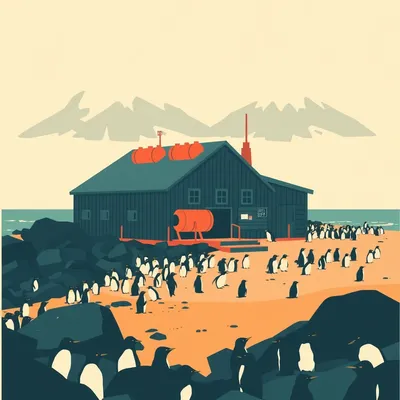
Daniel sent us this one — he's been browsing Google Maps and stumbled on South Georgia and the South Sandwich Islands. This tiny archipelago between Argentina and Antarctica. On the map it looks empty, no permanent residents. And he's wondering — has it always been uninhabited? Who are the scientists who periodically show up to study there? And what's the deal with those enormous penguin colonies? It's a good question. Because if you zoom in on satellite view, the place isn't empty at all.

It's teeming. Millions of penguins, seals covering the beaches, and a handful of scientists who rotate through on seasonal assignments. South Georgia is roughly a hundred and seventy kilometers long, about thirty kilometers wide at its broadest point. The South Sandwich Islands sit another eight hundred kilometers southeast — they're a volcanic arc, eleven main islands, all uninhabited now and mostly uninhabitable. Total land area for the whole territory is about three thousand nine hundred square kilometers. And you're right, Google Maps says no permanent population, and that's technically true today. But it wasn't always.
The "uninhabited" label is doing a lot of work.
It's doing heroic work. Because from nineteen oh four to nineteen sixty-five, South Georgia had a thriving whaling industry. The main station was Grytviken, founded by a Norwegian whaler named Carl Anton Larsen. At its peak, Grytviken alone had over two thousand people living and working there. They built a church in nineteen thirteen that still stands. They had a cinema, a floating dock, massive oil storage tanks. There were other stations too — Leith Harbour, Stromness, Husvik. This was an industrial operation.
I think for a lot of people, the word "whaling station" conjures up something small — a few sheds on a dock, maybe a dozen guys with harpoons. But two thousand people? That's a town.
It was a proper town. And not just Grytviken — between all the stations, you're looking at a combined population that would have made South Georgia one of the most densely populated places in the Southern Ocean outside of the Falklands. They had a soccer league. They had a newspaper printed in Norwegian. The Grytviken cinema showed films shipped in from Europe, months late but still. These weren't temporary camps — people lived there for years, raised families in some cases. There are records of children being born at Grytviken.
Children born on a whaling station in the sub-Antarctic. That's a detail that really drives home how permanent this was.
The infrastructure reflected that. The floating dock at Grytviken could handle ships up to fifteen thousand tonnes. The oil storage tanks held tens of thousands of barrels. There was a hydroelectric plant. This was a serious capital investment. Larsen and his backers didn't build a camp — they built a factory town.
You had two thousand people living on what is now described as an uninhabited island, processing whales on an industrial scale.
They ran out of whales. Between nineteen oh four and nineteen sixty-five, the Grytviken station alone processed over a hundred and seventy-five thousand whales — blue whales, fin whales, humpbacks. The shore-based model meant they didn't need factory ships. They'd bring the whales right into the harbor, flense them on the slipways, render the blubber into oil, and ship it out. But the catch rates collapsed. By the early sixties, there weren't enough whales left to make it profitable. The station closed in December nineteen sixty-five, and that was it.
The whales were functionally gone.
And that's not even the first wave of exploitation. Before the whalers, there were the sealers. Captain James Cook discovered South Georgia in seventeen seventy-five — he claimed it for Britain, named it after King George the Third, and noted the staggering number of fur seals. Within a decade, sealing ships from Britain and America descended on the island. By the nineteen thirties, fur seals had been hunted from an estimated population of millions down to maybe a few hundred individuals. The species was effectively gone from South Georgia.
There's a pattern here.
And it gets worse. The whaling and sealing ships brought rats. Norway rats, specifically, that had stowed away on the vessels. They got ashore at Grytviken and other landing sites, and they spread across the entire island. South Georgia had no native land mammals — the ground-nesting birds had evolved with zero defense against rodent predators. The rats ate eggs, chicks, everything. The South Georgia pipit, the island's only endemic songbird, was pushed to the brink of extinction. The petrel populations collapsed.
Humans show up, strip the ocean of whales and seals, accidentally introduce rats that devour the bird colonies, then leave. And now the place gets described as "pristine sub-Antarctic wilderness.
There is nothing pristine about South Georgia's history. But here's where the story turns. In twenty eighteen, the South Georgia Heritage Trust completed what they called the South Georgia Habitat Restoration Project. It cost ten million pounds. They used helicopters to drop three hundred tonnes of rodenticide bait across one thousand square kilometers of the island. It was the largest rat eradication ever attempted on an island. And it worked. By twenty twenty, South Georgia was declared entirely rat-free.
They air-dropped poison across a thousand square kilometers of sub-Antarctic island from helicopters.
Three helicopters, flying in some of the worst weather on the planet. The logistics were absurd. They had to time the drops for the brief window when the rats were hungry and the snow had melted enough for the bait to reach the ground. They had to avoid contaminating water sources. And they had to cover every single square meter where rats might be — because if they missed a single pregnant female, the whole thing would fail.
How do you even plan something like that? I'm trying to picture the operational challenge. You've got an island shaped like a mountain spine, glaciers coming down to the sea, and you need to guarantee complete coverage.
They divided the island into baiting blocks and used GPS-guided flight paths with overlapping swaths to ensure no gaps. The helicopters flew in what's called a "racetrack" pattern — back and forth, back and forth, like mowing a lawn but from the air and over terrain that includes three-thousand-meter peaks. They had to stage fuel depots across the island. The pilots were from New Zealand, experienced in alpine flying, and even they said it was the hardest flying they'd ever done. There's a documentary about it called "The Rat Eradication" — the footage of helicopters threading through mountain passes in near-zero visibility is genuinely terrifying.
They did this for how long?
The main baiting phase took three field seasons — twenty eleven, twenty thirteen, and twenty fifteen. Then two years of monitoring to confirm zero rat activity before they could declare success in twenty eighteen. So from start to finish, nearly a decade of work.
But the payoff is measured in birds.
Bounced back from near-extinction to thousands of breeding pairs. The South Georgia pintail, a duck species, also recovered. Petrels and prions are returning to nest. And the fur seals — remember, down to a few hundred in the nineteen thirties — there are now over four million fur seals on South Georgia.
From a few hundred to four million. That's not recovery, that's a full-scale reoccupation.
It's one of the most dramatic species recoverals ever documented. And it happened because the exploitation stopped and the invasive predators were removed. That's the lesson here — ecosystems can rebound, but you have to actually stop the damage and actively undo what you did.
That's the human story. But you mentioned the scientists who are there now. Who are they, and what are they actually doing?
The British Antarctic Survey operates a research station at King Edward Point, which is right next to Grytviken. It's a year-round station, but the crew is tiny — four to eight people during the winter, maybe ten to twenty in summer. They're studying marine biology, glaciology, climate monitoring. And then there's the South Georgia Museum at Grytviken, which opens from November to March. Two to four seasonal curators live there, maintaining the old whaling station buildings and running the museum for visitors from cruise ships.
The winter crew is eight people, maximum. On an island a hundred and seventy kilometers long.
In total darkness for much of the winter, with katabatic winds that can hit a hundred knots. They're monitoring ocean temperatures, tracking glacier retreat, studying the krill populations. Which brings me to the really important part — the krill.
Tiny crustaceans, about six centimeters long, that form the foundation of the entire Southern Ocean food web. Everything eats krill — whales, seals, penguins, fish, seabirds. And South Georgia sits right in the middle of some of the richest krill fishing grounds on the planet. In twenty twelve, the British government established the South Georgia Marine Protected Area, which was expanded in twenty twenty-four to cover one point two four million square kilometers. It's one of the largest MPAs in the world.
That's where the scientists come in — they're monitoring whether the protection is actually working.
The British Antarctic Survey runs an annual Krill Survey using their research vessel, the Discovery. They use echosounders to estimate krill biomass across the Scotia Sea. And the data from the twenty twenty-five to twenty twenty-six season is concerning. Preliminary numbers suggest a fifteen percent decline in krill density near the Antarctic Peninsula, linked to warming sea surface temperatures.
Fifteen percent decline. And krill is what the penguins eat.
The seals, and the whales. If krill populations collapse, the entire ecosystem unravels. And this is why South Georgia matters — it's not just a curiosity on Google Maps, it's a sentinel for climate change in the Southern Ocean. What happens to krill there tells us what's coming for the entire Antarctic ecosystem.
I want to pause on krill for a moment, because I think most people hear "krill" and picture whale food and not much else. But you're describing an animal that is functionally the single most important species in the Southern Ocean.
It really is. Think of krill as the currency of that ecosystem. Everything is denominated in krill. A blue whale eats about four tonnes of krill per day during feeding season. A single chinstrap penguin needs about a kilogram per day. Multiply that by one point two million pairs on Zavodovski, plus chicks, and you're looking at thousands of tonnes of krill consumed by one penguin colony in a season. And that's before you factor in the seals, the fish, the squid, the albatrosses. The total krill biomass in the Southern Ocean is estimated at somewhere between three hundred and five hundred million tonnes, which sounds like a lot until you realize how many mouths are feeding on it.
A fifteen percent decline isn't just a statistic. It's a hole in the food budget of every predator in the region.
The decline isn't uniform. Krill depend on sea ice for their early life stages — the larvae feed on algae that grow on the underside of the ice. As sea ice extent shrinks, krill recruitment drops. So you get these compounding effects: warmer water, less ice, fewer krill, hungrier predators, lower breeding success. It's a cascade.
Alright, let's talk about the penguins. Because Daniel's prompt mentioned the colonies, and the numbers here are staggering.
They're absurd. South Georgia hosts the largest king penguin colony in the world at Salisbury Plain — over two hundred thousand breeding pairs. That's just one colony. Andrews Bay has another hundred and fifty thousand pairs. Gold Harbour has tens of thousands more. And then there are the macaroni penguins — about one million pairs on the island.
Two hundred thousand breeding pairs means at least four hundred thousand adult birds in one location, plus chicks.
King penguins have this unusual breeding cycle. It takes fourteen to sixteen months to raise a single chick, so they don't breed on an annual schedule. They're breeding year-round. At any given moment, Salisbury Plain is covered in adults, eggs, and chicks at various stages of development. The noise, the smell — it's apparently overwhelming.
I've seen photos. It looks like a penguin-themed music festival that never ends.
That's not far off. I've talked to someone who visited Salisbury Plain, and she described the experience as "your senses stop being able to process it after about ten minutes." The sound alone — hundreds of thousands of king penguins vocalizing, each pair identifying each other by call — is apparently like standing inside a stadium crowd that never stops cheering. And the smell is ammonia and guano and krill breath, so thick you can taste it.
There's a phrase.
The South Sandwich Islands have their own spectacle. Zavodovski Island — which is an active volcano, by the way — hosts an estimated one point two million pairs of chinstrap penguins. That's the largest chinstrap colony on Earth. The island is basically a volcano surrounded by penguins.
A volcano surrounded by penguins. That's a sentence I didn't expect to hear today.
Mount Asphyxia, on Zavodovski, last erupted in twenty sixteen. The penguins live on the slopes of an active volcano. The South Sandwich Islands are all volcanic — Mount Belinda on Montagu Island erupted continuously from two thousand one to two thousand seven. In nineteen sixty-four, an eruption on Zavodovski created an entirely new lava delta.
These penguins are nesting on active volcanoes, in the middle of the Southern Ocean, hundreds of kilometers from anywhere, eating krill that's declining because the water is warming. That's the setup.
They're swimming farther and diving deeper to find food. Scientists have satellite-tagged king penguins at St. Andrews Bay and tracked them diving to depths of three hundred meters. They travel up to five hundred kilometers from the colony to forage for lanternfish and squid. A twenty twenty-four study in Nature Climate Change found that king penguin chick survival rates dropped by twenty percent during warm-phase years of the Southern Annular Mode.
Twenty percent drop in chick survival. That's catastrophic over multiple seasons.
And the mechanism is straightforward — warmer water means krill move deeper or shift southward, so the parents have to travel farther. Longer foraging trips mean chicks get fed less often. Less food means lower survival. It's a direct climate impact, measurable and observable right now.
The penguins aren't just a spectacle. They're a measuring stick.
They're an indicator species. When the penguins are struggling, the whole system is under stress. And South Georgia gives us this incredibly concentrated, observable population where we can track these changes in real time.
I want to go back to something you mentioned earlier — the Marine Protected Area. One point two four million square kilometers. That's enormous. How does that actually work in practice?
It's a zoning system. There are no-take zones where all fishing is prohibited, and there are sustainable-use zones where krill fishing is permitted but heavily regulated. The krill fishery in the Southern Ocean is managed by CCAMLR — the Commission for the Conservation of Antarctic Marine Living Resources. And the South Georgia government issues its own licenses with additional restrictions.
It's not a pure wilderness preserve. There's still commercial activity.
Krill is harvested for omega-three supplements and aquaculture feed. The global krill fishery takes about three hundred thousand tonnes per year, and a significant portion of that comes from waters near South Georgia. The MPA model is trying to balance conservation with economic use — protect the core foraging areas while allowing limited fishing in designated zones.
The scientists are monitoring whether that balance is actually working.
That's the key question. The new autonomous underwater gliders that BAS is deploying in the twenty twenty-six to twenty twenty-seven season will help answer it. These are unmanned vehicles that can operate for months, mapping krill distribution in three dimensions. They'll give us real-time data on where the krill are, how the populations are shifting, and whether the no-take zones are actually protecting the critical areas.
How does an underwater glider actually work? I've heard the term but I don't think I understand the mechanics.
They're remarkable machines. They don't use propellers — instead, they change their buoyancy. The glider takes on a small amount of water to become heavier than seawater and sink, then expels it to become lighter and rise. Wings convert that vertical motion into forward movement, so they trace a sawtooth path through the water column. Because they're not running a motor constantly, they can operate for months on a single battery charge. They surface periodically to transmit data via satellite and receive new instructions. It's incredibly elegant engineering — basically a data-collecting fish that never sleeps.
You deploy one of these near South Georgia and it just... patrols for months, measuring krill?
Measuring krill, temperature, salinity, chlorophyll levels. It builds a three-dimensional picture of the water column. And because it's autonomous, it can operate through the winter when no research vessel could safely be there. That's the game-changer — we've never had continuous winter data from this region before.
The technology is getting better at the same time the problem is getting worse.
That's the race. And South Georgia is the ideal laboratory because it's isolated, it's protected, and it has this incredibly dense concentration of wildlife that makes the data meaningful. You can measure changes there that would be lost in the noise elsewhere.
I want to ask about the human experience of this place. You mentioned the winter crew — four to eight people, total darkness, hundred-knot winds. What's daily life actually like for them?
It's structured around the research. They're monitoring instruments, collecting samples, maintaining the station. King Edward Point has a lab, living quarters, a communications room. They're in regular contact with BAS headquarters in Cambridge. But the isolation is real. The last ship leaves in March or April, and the next one doesn't arrive until October or November. If something goes wrong, there's no quick extraction.
It's like wintering over at the South Pole, but with more penguins and fewer people.
The South Pole station has a gym, a sauna, a greenhouse. King Edward Point is more spartan. The winter crew is small enough that everyone has to be able to do multiple jobs. The mechanic might also be the radio operator. The marine biologist might also be the cook.
What's the psychological toll of that? Eight people, months of darkness, no way out?
BAS has a rigorous selection process. They're not just looking for technical skills — they're screening for psychological resilience, conflict resolution, the ability to live in close quarters without driving each other crazy. There's a medical screening too — everyone has to have their appendix removed before wintering over, because there's no surgeon on site. If you get appendicitis in July, you're in serious trouble.
They preemptively remove your appendix?
It's standard for overwintering staff at remote Antarctic and sub-Antarctic stations. The Australian Antarctic Division requires it, BAS requires it. It sounds extreme until you consider the alternative, which is a medical emergency with no evacuation possible for six months.
That's one of those details that really brings home how remote this is. You're not just far from a hospital — you're on a different planet, logistically speaking.
They're living next to the ruins of a whaling station.
So your daily view is rusting industrial equipment and whale bones.
Grytviken is literally next door. The old flensing plan, the rusting oil tanks, the whale bones scattered on the beach. The church is still there — it holds services for visiting cruise ships during the summer season. The cemetery has the grave of Ernest Shackleton, who died on South Georgia in nineteen twenty-two during his final expedition.
Shackleton is buried there.
He had a heart attack on his ship in Grytviken harbor. His body was being sent back to England, but his wife wired back and said bury him in South Georgia. So he's there, in the whalers' cemetery, looking out over the harbor. It's become a pilgrimage site for Antarctic tourists.
That's a remarkable detail. The greatest polar explorer of the heroic age, buried on an island most people have never heard of.
His grave is maintained by the museum curators. The South Georgia Museum is housed in the old whaling station manager's villa. It covers the natural history, the whaling era, the Shackleton connection, and the modern research. It's open to visitors from cruise ships, which have become a significant part of South Georgia's story.
There are cruise ships going there?
Several dozen per summer season. It's not mass tourism — the ships are small expedition vessels, carrying maybe a hundred to two hundred passengers. They're strictly regulated. You can't just wander around. You have to be with a guide. You have to decontaminate your boots before landing to avoid introducing seeds or pathogens. The biosecurity protocols are intense.
You can visit, but the place isn't being turned into a theme park.
The South Georgia government — and yes, there is a South Georgia government, based in Stanley in the Falklands — is very deliberate about this. They limit visitor numbers, they designate specific landing sites, and they enforce strict environmental standards. The revenue from tourism helps fund the museum and the conservation work.
That's a model that a lot of fragile ecosystems could learn from. Limited access, high standards, revenue reinvested in conservation.
It works because South Georgia is so remote and so tightly controlled. You can't just fly there — there's no airstrip. You arrive by ship, and you've already been through extensive permitting. The barrier to entry is high enough that the people who make it are serious about the experience.
I want to circle back to the South Sandwich Islands. You said they've never had permanent human habitation.
They're even more remote, more volcanic, and more hostile. The South Sandwich Islands are a volcanic arc — eleven main islands stretching over about five hundred kilometers. Most of them are active volcanoes with glaciers on their summits. The weather is appalling. The seas around them are some of the roughest on the planet. There's no sheltered harbor, no flat land for buildings. The British Antarctic Survey has occasionally established temporary field camps, but nothing permanent. Zavodovski Island, with its one point two million chinstrap penguins, has been visited by research vessels maybe a dozen times in the past century.
It's one of the least-visited places on Earth.
It's a British Overseas Territory. The UK maintains sovereignty, but the only regular human presence is the occasional research visit. Argentina disputes British sovereignty over both South Georgia and the South Sandwich Islands — they call them Islas Georgias del Sur and Islas Sandwich del Sur. In nineteen eighty-two, Argentina briefly occupied South Georgia as part of the Falklands War. The British retook it within a few weeks.
There's a geopolitical dimension here too.
The British military maintains a small presence in the region, but South Georgia itself is demilitarized. The focus is entirely on research and conservation. The territorial dispute is dormant, but it's not resolved.
Which connects to something we've covered before — these remote territories matter because of what they represent in international law and resource claims.
The MPA and the krill fishery give South Georgia economic and strategic significance that goes beyond its tiny land area. Whoever controls the islands controls a massive swath of ocean and the resources in it.
To summarize what we've covered so far — South Georgia went from an untouched ecosystem to a whaling industrial hub that nearly wiped out whales and seals, then to an abandoned ghost town, and now to a cutting-edge research station and conservation success story. And the South Sandwich Islands have always been a volcanic wilderness covered in penguins.
That's the arc. And the conservation success is real and measurable. The fur seal recovery from a few hundred to four million. The rat eradication. The pipit bouncing back. The MPA expanding to one point two four million square kilometers. These are tangible outcomes from sustained investment and political will.
The penguins are the canary in the coal mine for what's happening with climate change in the Southern Ocean.
The krill decline is the warning signal. If krill populations continue to drop, everything above them in the food web is at risk. And because South Georgia has such concentrated, well-studied populations, it's the place where we'll see the effects first and most clearly.
What can someone do with this information? Daniel found this place on Google Maps and got curious. What's the takeaway for the listener who's never heard of South Georgia before today?
The first takeaway is that large-scale ecological restoration is possible. The rat eradication project, the fur seal recovery — these prove that if you remove the invasive species and stop the exploitation, ecosystems can rebuild themselves within decades. That's hopeful. The second takeaway is that the MPA model — combining no-take zones with regulated sustainable fishing — is a template that could work elsewhere. It's not perfect, but it's better than the alternatives.
The third takeaway is that curiosity about a random dot on a map can open up an entire world of history, ecology, and geopolitics. South Georgia looks empty on Google Maps, but it's one of the most dramatic stories of exploitation and recovery on the planet.
You can follow this story. The South Georgia Heritage Trust has a website with updates on conservation projects. The British Antarctic Survey publishes its krill survey data and research findings. You can track the next research season, watch for the autonomous glider deployments, and see what the scientists find.
If you want to find your own South Georgia, Google Maps has that Explore feature. Pick a random speck of land in the middle of an ocean, zoom in, and start asking questions. You'll be surprised what you find.
The world is full of places like this — remote, overlooked, but dense with stories. South Georgia is just one of them.
What's next for South Georgia? What are the open questions?
The big one is how the ecosystem responds to continued warming. The twenty twenty-six to twenty twenty-seven research season will deploy those autonomous underwater gliders I mentioned — they'll give us the most detailed krill distribution maps ever produced. That data will help determine whether the MPA zones are in the right places and whether the krill fishery is truly sustainable. The other question is about the South Sandwich Islands. They're so understudied that we're still discovering new species in the deep waters around them. There's a research expedition planned for twenty twenty-seven that will use remotely operated vehicles to explore the benthic communities.
There are probably species down there that no human has ever seen.
The Southern Ocean deep sea is one of the least-explored environments on Earth. Every time they send an ROV down, they find something new.
The penguins will keep doing what they're doing, volcanoes and all. One point two million chinstraps on Zavodovski, nesting on the slopes of an active volcano, diving for krill in some of the roughest seas on the planet. It's absurd and magnificent.
It really is. And that's why this place matters. It's not just a dot on a map. It's a living laboratory, a conservation success story, and a warning system all at once.
This has been the first in what I think will be a series — exploring random places on Google Maps that turn out to be far more interesting than they appear. Next time, we're looking at the Gobi Desert's hidden lakes — a chain of freshwater oases in Mongolia that show up as blue dots in a sea of sand.
That's going to be a fascinating one. Mongolia has these ancient lake systems that have been shrinking for decades, and they're critical for the migratory birds that cross Asia.
Before we get there — Hilbert, I believe you have something for us.
Now: Hilbert's daily fun fact.

In the nineteen sixties, a lightning strike on a beach near Invercargill on New Zealand's South Island created a fulgurite — a glass tube formed when lightning fuses sand — that measured four point nine meters in length. For comparison, the tallest modern skyscraper, the Burj Khalifa, is eight hundred and twenty-eight meters. That fulgurite was less than zero point six percent of the Burj Khalifa's height, which is roughly the proportional difference between an average human and a single grain of rice.
...right.
That was a lot of math for a glass tube in the sand.
This has been My Weird Prompts. I'm Corn.
I'm Herman Poppleberry. Our producer is Hilbert Flumingtop. If you enjoyed this episode, please leave us a review — it helps other curious people find the show.
Find us at myweirdprompts dot com for every episode, or search My Weird Prompts on Spotify. We'll be back soon with the Gobi Desert.