Daniel wrote in with a question that starts small and then spirals. He rents an apartment in Jerusalem, south-facing balcony, same as his last place, and he's been looking at those little USB solar panels and solar-powered string lights and thinking, okay, that's cute, but what if I actually tried? What if I wanted to wring every possible watt out of that balcony? Could you store it? Could you wire it into the building's supply somehow? And he's upfront that this is irresponsible and would violate a lease, but he's asking as a hypothetical, with one practical carve-out. If there were a way to keep a weatherproof battery outside to charge phones, run speakers, keep low-draw devices alive, that might be useful. So the question is, what's the ceiling for solar capture when you don't own the roof?

Two thousand kilowatt-hours per square meter per year. That's what Jerusalem gets in solar irradiation, roughly double what Germany averages. And Daniel is standing on a south-facing balcony in the middle of that, looking at decorative fairy lights, and wondering if he's leaving money on the table. Or watts on the railing.
He's not wrong to wonder. The sun is doing the work either way. The question is whether the building, the lease, and the electrical code will let him catch any of it.
And that's the whole episode, really. The physics are generous. The institutions are not. So let's map both.
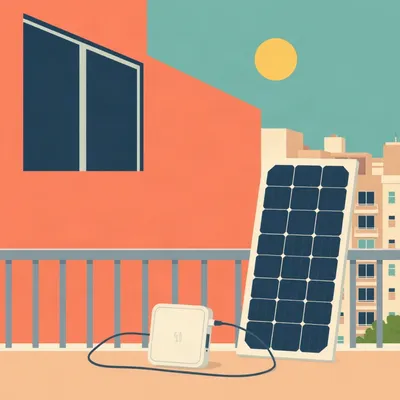
Start with the hardware, because there's a whole product category in Europe that answers Daniel's question directly. They're called balcony power plants, and in Germany they're legal, plug-and-play, and you don't need an electrician.
Right, the German term is Steckersolar, plug-in solar. The setup is almost absurdly simple. One or two panels, each maybe three hundred to four hundred watts, mounted on the balcony railing or stood against the wall. They feed into a micro-inverter, a little box about the size of a hardback book, and that inverter has a cable that just plugs into a standard wall socket. That's the entire installation. You hang the panel, you plug in the cable, and your apartment starts consuming solar power before it pulls from the grid.
And the German rules cap the output at eight hundred watts. That's the legal ceiling. Above that you need a proper electrician and grid approval. Below that, you register with the grid operator and you're done. No landlord permission required in most cases, because it's treated as a household appliance, not a building modification.
The micro-inverter is the clever part. A traditional solar array runs direct current from the panels down to a central inverter that converts it to alternating current for the house. A micro-inverter does that conversion at the panel, so the cable coming out of it is already normal household AC. That's why it can plug into a wall socket safely. The inverter constantly monitors the socket and shuts off the instant it loses grid power, which is the anti-islanding protection that keeps line workers from getting zapped during an outage.
So the hardware is real, it's mature, and in Berlin you can buy a complete kit at the hardware store for a few hundred euros. The question is what it actually produces on a Jerusalem balcony.
This is where the physics gets interesting. A rooftop panel in Jerusalem, tilted at about thirty-one degrees, facing south, gets the full brunt of that two thousand kilowatt-hours per square meter per year. A balcony panel is different. First, it's usually vertical or nearly vertical, because it's hanging on a railing or leaning against a wall. At our latitude, a vertical south-facing panel captures maybe seventy to eighty percent of what an optimally tilted panel gets. That's not bad, actually. The bigger losses come from shading. The balcony has a ceiling above it, side walls, a railing, maybe the neighbor's laundry. The panel's own depth means the back edge shades the front edge in the morning and evening. And if there's any building across the street, the reflected light is all you get for part of the day.
So what's the realistic annual output?
For a single four-hundred-watt panel on a reasonably unobstructed Jerusalem balcony, you're looking at three hundred to five hundred kilowatt-hours per year. That's enough to run a fridge for maybe four to six months, or keep a laptop going for a few hours every day. It is not enough to meaningfully dent an apartment's electricity bill. A typical Israeli apartment pulls something like five to eight thousand kilowatt-hours a year. The balcony panel is offsetting single-digit percentages.
Which is the first misconception to kill. Balcony solar is not a bill-reduction strategy. It's something else. We'll get to what it actually is.
Before that, Daniel asked about storage, and this is where the product category has moved fast. The new generation of balcony kits comes with integrated batteries. Anker has the Solix line, Zendure makes similar units. These are weatherproof boxes that sit on the balcony floor, next to the panel, and they store one to two kilowatt-hours. The panel charges the battery during the day, and then you either draw from it in the evening or the inverter sends it back into the apartment's circuits when the sun isn't shining.
And one to two kilowatt-hours is what, in practical terms?
It's a phone charged roughly a hundred times. It's a laptop for a full workday. It's a small fan running overnight. It is not an air conditioner, not a washing machine, not a kettle. Those draw two to three kilowatts in a burst, which would drain the battery in minutes. The battery is for low-draw, persistent loads. Which is exactly the use case Daniel described, phones, speakers, maybe a router.
And these units are weatherproof? They're designed to sit outside through rain and dust?
They are. The Anker Solix and Zendure units are rated for outdoor use, IP65 or better, and they're built into the balcony ecosystem with the inverter and charge controller integrated. You plug the panel into the box, the box into the wall, and the whole thing just sits there. In Germany people leave them out year-round, through snow. In Jerusalem the bigger concern is dust and heat, and lithium batteries degrade faster in high heat, so a shaded spot on the balcony matters.
Now the irresponsible part. Daniel asked about wiring into the building's supply. What's the actual answer?
Technically, a micro-inverter can backfeed through a wall socket. That's the entire premise of the German balcony kit. The inverter pushes power into the circuit, and any device drawing from that circuit uses the solar power before the grid. If you're producing more than you're using, the excess flows backward through the meter and out into the building. In Germany with a proper bidirectional meter, you get credited for that export, or more commonly you just don't get paid and the grid absorbs it. The system is designed for that.
But in a rented Jerusalem apartment, the meter is not yours.
Right, and that's where it falls apart. In most Israeli apartment buildings, each unit has its own meter, but the wiring between the meter and the apartment is the landlord's, and the meter itself belongs to the Israel Electric Corporation. Plugging a solar inverter into a socket that backfeeds through a meter you don't own is, at minimum, a billing problem. The meter may not be bidirectional, so it either doesn't register the export at all, or worse, it registers the export as consumption and charges you for the privilege of giving power away. Some older mechanical meters do exactly that. The disc spins forward no matter which way the current flows.
So you could literally pay the electric company for the power you generate.
Yes. And that's before we get to the safety issues. If the building has old wiring, if there's a shared neutral, if the circuits aren't properly isolated, backfeeding can energize parts of the building you don't intend to. During a power outage, a properly designed inverter shuts off instantly, but a cheap one, or a miswired one, can keep feeding the circuit while line workers think it's dead. That's the scenario that gets people killed. The anti-islanding protection is not optional, and it's not something you verify by plugging a thing into a wall and hoping.
And even in Germany, where this is legal, the rule is that the balcony kit feeds only the renter's own circuit, behind their own meter. You're not allowed to backfeed the building's common supply or a neighbor's circuit. So the legal version of this is already narrower than what Daniel is imagining.
Israel doesn't have the legal version at all. The Israel Electric Corporation requires professional installation and grid approval for any solar connection, and a renter can't get that without the landlord's consent and probably a building committee vote. There's no simplified balcony solar regulation here. The same hardware that is a no-brainer in Berlin is a gray-market hack in Jerusalem.
So the legal ceiling is lower than the technical ceiling. The technical ceiling is maybe eight hundred watts through a plug. The legal ceiling in Israel is zero, unless you go through a process that a renter essentially cannot complete.
And the physical ceiling is higher than both. If you ignored every rule, what could you actually capture on a Jerusalem balcony? This is the fun hypothetical. Say you covered the railing with panels, put a vertical array against the wall, laid panels flat on the floor where the sun hits. A typical Jerusalem balcony is maybe four or five square meters of usable surface. You could squeeze in one and a half to two kilowatts of peak capacity if you were completely shameless about it. That's still less than a single American wall circuit. And you'd be violating fire codes, lease terms, and probably the building's insurance policy all at once.
Two kilowatts peak, and how much energy over a year?
Maybe fifteen hundred to two thousand kilowatt-hours if the orientation is good and the shading is minimal. Which is starting to be real. That's a third of a typical apartment's consumption. But you'd need a five-kilowatt-hour battery to time-shift it, because the sun peaks at midday when nobody's home, and without storage you're generating power that just flows back into the grid and, in Israel, possibly gets billed to you as consumption.
So the maximum practical capture, if you threw caution out the window, is maybe a third of your electricity. And the cost of doing it in hardware alone would be several thousand dollars, plus the battery, plus the risk of eviction and a fire. That's the ceiling.
And that's the thing about Daniel's question. The ceiling is not set by the sun. It's set by the fact that he doesn't own the roof, the meter, or the wiring. The sun would happily give him two thousand kilowatt-hours per square meter per year. The building says no.
Let's talk about what the value actually is, because it's not the electricity bill. Daniel hinted at this. He said a weatherproof reservoir for phones and speakers might actually be useful. That's the real use case.
Resilience. Jerusalem has brownouts, rolling outages in heat waves, the occasional longer blackout. A four-hundred-watt panel with a two-kilowatt-hour battery is a tiny off-grid island. It can keep a router running indefinitely, charge phones forever, run a fan overnight, power a laptop through a workday. During a blackout, that's the difference between sitting in the dark and having lights, communication, and a cold drink.
And the economics of that are completely different from the bill-offset math. If you're buying this to save money on electricity, the payback period is absurd. A balcony kit with a battery costs maybe eight hundred to twelve hundred dollars. It generates maybe fifty to eighty dollars of electricity per year at Israeli rates. That's a ten-year payback, and the battery will probably degrade before you break even.
Ten years, and that's being generous. The battery loses capacity every year, especially in Jerusalem heat. The round-trip efficiency of lithium-ion is about ninety percent, so you lose a tenth of the energy just charging and discharging. The panel degrades maybe half a percent per year. The economics only work if you value the resilience separately. If a blackout costs you a day of work, or a fridge full of food, or just the peace of mind of knowing the router stays up, then the math changes. But you're not buying electricity. You're buying insurance.
And there's a cultural angle here that I keep coming back to. Israel pioneered solar water heaters. Eighty-five percent of households have them. They're on every roof, the passive black panels with the water tank. That was a regulatory mandate from the nineteen seventies, and it stuck because it's simple, passive, and requires no grid integration. The sun heats water, the water rises into the tank, done. No inverter, no meter, no utility approval.
And that's the contrast. Israel went all-in on solar thermal because it's a plumbing problem, not an electrical problem. The moment you move to photovoltaics, you're in the domain of the Israel Electric Corporation, building committees, meters, grid stability, and the whole thing stalls. The same country that put a solar water heater on almost every roof can't figure out how to let a renter hang a panel on a balcony.
Because the bottleneck was never the sun. It's ownership. A rooftop solar array on an apartment building requires the building committee to agree, the landlord to pay, and the benefits to be split among all the tenants. Nobody wants to be the one who fronted the money so the neighbor on the top floor gets the credit. So nothing happens. Daniel with a balcony is a microcosm of that exact problem. He's got the sun, he's got the surface area, he's got the willingness. He doesn't have the roof, and he doesn't have the meter.
And in Germany, the regulatory answer was to make balcony solar so small and so safe that it doesn't trigger any of those ownership questions. Eight hundred watts, plug into your own socket, register with the grid operator, done. The grid is designed for distributed feed-in, the meters are bidirectional, and the whole thing is treated as a consumer appliance. That's why it took off. Germany installed something like half a million of these in a couple of years.
Israel could do the same. The sun is better, the need is real, the hardware is off-the-shelf. But the regulatory path doesn't exist, and until it does, every renter who wants this is either buying a portable power station and pretending it's a camping accessory, or doing something that violates a lease and possibly the electrical code.
Which brings us to the portable power station, because that's the version of this that actually works in Israel right now. Jackery, EcoFlow, Bluetti, these are big battery boxes with inverters built in, designed for camping and emergency backup. They're not wired into anything. You charge them from a wall socket, or from a folding solar panel, and then you plug your devices into them directly. No grid connection, no meter, no landlord involvement.
And that's the weatherproof reservoir Daniel was asking about. A five-kilowatt-hour unit with a folding panel is a completely self-contained solar system. It sits on the balcony, the panel folds out, the box charges during the day, and in the evening you run an extension cord from it to whatever needs power. It's not integrated into the apartment, but it's legal, it's safe, and it answers the actual use case.
The catch is cost per kilowatt-hour. A five-kilowatt-hour portable station is fifteen hundred to two thousand dollars. The folding panel adds another few hundred. You're paying a premium for the portability and the self-contained design, and the solar input on most of these units is limited, maybe four hundred to eight hundred watts, so charging a five-kilowatt-hour battery from a single panel takes a full day of good sun. It works, but it's not fast.
The battery is heavy. A five-kilowatt-hour unit weighs fifty kilos or more. You're not carrying it in and out every day. It lives on the balcony, which means it needs to be weatherproof, which most of these are, but also protected from the Jerusalem summer heat, which is brutal on lithium cells.
The heat is the silent killer. A lithium battery sitting on a Jerusalem balcony in August is baking at fifty degrees Celsius, and that accelerates degradation dramatically. Every ten degrees above about twenty-five Celsius roughly doubles the rate of capacity loss. So a battery that would last ten years in a climate-controlled room might last four or five on a hot balcony. That's a real cost that nobody puts in the marketing materials.
We've got three tiers. The decorative tier, USB panels and solar lights, which work fine and are basically toys. The integrated tier, a balcony kit with a battery, which is what Daniel actually wants but isn't legal in Israel. And the portable tier, a power station with a folding panel, which is legal, useful, and expensive per watt.
Then the fourth tier, which is the hypothetical maximum, covering every surface with panels and running a five-kilowatt-hour buffer, which is technically possible, physically constrained to about a third of an apartment's consumption, and legally insane.
I want to circle back to something you said earlier about the meter. The idea that an old mechanical meter could charge you for exported power. That's the kind of detail that sounds like a bug but is actually a feature of how little anyone planned for this. The entire grid architecture assumes power flows one way, from the utility to the consumer. Every piece of equipment, the meters, the transformers, the protection relays, was designed around that assumption. Distributed generation breaks the assumption, and the grid's response is not graceful.
That's the second-order problem that Germany solved and Israel hasn't. When you have half a million households feeding power back into the grid, the utility has to manage voltage on lines that were never designed for bidirectional flow. Feed-in can push local voltage too high, which trips inverters and annoys neighbors. Germany dealt with this by updating the grid codes, requiring inverters to throttle when voltage rises, making the meters bidirectional, and building the whole regulatory apparatus. Israel's grid is smaller, more isolated, and has different problems, security, demand peaks, water desalination loads, and the institutional will to rework all of that for balcony solar just isn't there.
The answer to Daniel's question, what's the most you could do, is unsatisfying. The most you could do technically is about two kilowatts peak and maybe a third of your annual consumption. The most you could do legally is nothing. The most you could do practically is a portable power station and a folding panel, which gives you resilience but not integration.
The most you could do in Germany is eight hundred watts, plug-and-play, with a battery, and it's just a normal Tuesday. Same sun, same hardware, completely different answer.
The sun is not the bottleneck. The grid is. And the grid is not a technical problem, it's an institutional one. Israel proved it could do solar thermal on every roof because that was a plumbing mandate. It hasn't done solar electric on balconies because that's an electrical mandate, and the electrical system is owned by a utility that has no incentive to make it easy.
The other thing I keep thinking about is what this does to the renter's relationship with the building. Daniel's prompt has this undercurrent of, I know this is against the rules, but what if. And the answer is that the rules are the entire game. The physics are permissive. The lease is not. The fire code is not. The utility's interconnection rules are not. A renter who wants solar has to either stay within the portable power station lane, which is useful but limited, or become the person who rewires the balcony and hopes nobody notices.
The person who rewires the balcony and hopes nobody notices is also the person who, when something goes wrong, has no insurance, no permit, and no defense. The building burns down, the insurance company asks who installed the electrical modification, and the answer is, the tenant, with a micro-inverter from the internet and a dream. That's not a hypothetical. That's how you lose everything.
The responsible version of the irresponsible hypothetical is actually pretty clear. If you want solar on a rented balcony in Jerusalem, buy a portable power station, get a folding panel, keep the battery out of direct sun, and use it as an off-grid accessory. Don't backfeed the building. Don't touch the wiring. Don't plug an inverter into a wall socket. The moment you connect to the grid, you've crossed from camping equipment into electrical infrastructure, and that's a different legal and safety universe.
Yet, the fact that Daniel even has to ask this question is the indictment. He's standing on a south-facing balcony in one of the sunniest cities in the world, and the best legal answer is, buy a camping battery. That's not a failure of imagination. That's a failure of regulation.
Hilbert: The inverter wasn't stolen. It was borrowed from a sound system that was being thrown out anyway.
I'm sorry?
Hilbert: The inverter. You said stolen. It wasn't stolen. It was a spare from a PA rig that got scrapped after a tour. I asked the road manager, he said take it. So I took it.
I didn't say stolen.
Hilbert: Somebody said stolen. Doesn't matter. The point is, late nineties, I was doing sound for a band that played outdoor festivals in the Negev, and we ran the whole mixing desk off a car battery and a fifty-watt panel. The inverter was the weak link. Sandstorm got into it, shorted the thing, and we finished the set on a generator that sounded like a lawnmower. But for about four hours, we ran a full sixteen-channel desk on sunshine and a car battery. That's when I got interested.
You got interested in portable power because a sandstorm killed your inverter.
Hilbert: I got interested because it worked until it didn't. Which is more than most things.
You've built something for your apartment since then.
Hilbert: I have a deep-cycle marine battery and a folding panel on my balcony in Tel Aviv. Hundred-watt panel, maybe a hundred twenty. It charges the battery through a charge controller, and I run a fan off it during blackouts and charge the e-bike. It's not wired into anything. It just sits there.
And the landlord?
Hilbert: Saw it once. Asked if it was legal. I told him it was a scientific instrument.
A scientific instrument.
Hilbert: He nodded and walked away. I think he was more worried I was cooking meth than generating electricity. The battery weighs twenty kilos, by the way. I haul it inside every winter because the rain gets under the balcony awning and I don't trust the charge controller in the damp. So every November I'm carrying a marine battery through my living room like I'm moving a small coffin.
That undercuts the romance of the off-grid island somewhat.
Hilbert: The off-grid island has a carrying handle. That's the honest version.
But the fan and the e-bike, that's the resilience use case. You're not offsetting your bill. You're just not sitting in the dark.
Hilbert: The fan matters more than the e-bike. August in Tel Aviv, the power goes out, the air stops moving, and you're lying there in the dark listening to your own heartbeat. The fan runs all night off that battery. I've done the math, it pulls about forty watts, the battery's got maybe a kilowatt-hour of usable capacity, that's twenty-five hours of fan. More than enough. The e-bike is just because the panel's there and the battery's there and why not.
The entire value is psychological.
Hilbert: I know I can keep a fan running for a day. That's not psychological, that's a fan. But the knowing is the part that matters. The grid goes down and I don't panic. I go out to the balcony and plug in the fan. It's a tiny off-grid island in a city that's all grid. That's worth the twenty kilos.
The landlord thinks you have a scientific instrument.
Hilbert: I do have a scientific instrument. It's a hundred-watt solar panel with a charge controller and a deep-cycle battery. That's a science experiment. The fact that it also runs a fan is incidental.
I want to know what happens when the battery finally dies and you have to explain to the landlord why the scientific instrument is going to the recycling center.
Hilbert: I'll tell him the experiment concluded.
The thing about Hilbert's setup is that it's the portable power station approach, but built from components. A marine battery, a folding panel, a charge controller. It's cheaper per kilowatt-hour than a Jackery, and it's repairable. If the charge controller dies, you replace the charge controller. If the battery dies, you replace the battery. The integrated units are more polished but they're a black box when something fails.
The marine battery is lead-acid, not lithium. Heavier, lower energy density, but more tolerant of heat and overcharging. For a balcony in Tel Aviv, that might actually be the better chemistry. It just requires the carrying handle.
Hilbert: And the back.
The practical answer to Daniel's question is sitting on Hilbert's balcony. A hundred-watt panel, a deep-cycle battery, a charge controller, and a fan. No grid connection, no landlord permission, no fire hazard. Just a scientific instrument that happens to keep the air moving when the power dies.
The theoretical answer is two kilowatts peak and a third of your consumption, if you're willing to risk eviction and a fire. The gap between those two answers is the entire story of solar in rental housing.
Which leaves the open question. As these balcony kits get cheaper and the batteries get more integrated, do cities like Jerusalem adapt, or do renters keep improvising? Germany legalized the thing and half a million households bought in. The hardware is the same in Jerusalem. The sun is better. The only missing piece is a regulatory category that says, this small, safe, plug-in solar system is allowed.
I think the next decade is going to see solar-ready balconies as a rental amenity. Some apartments already advertise EV chargers in the parking garage. It's not hard to imagine a listing that says, south-facing balcony with pre-wired solar hookup. The landlord installs the micro-inverter and the bidirectional meter, the tenant brings the panel, and the building committee gets a cut of the feed-in credit. That's a solvable coordination problem.
Until then, the answer for Daniel is the scientific instrument. A portable power station or a component build, a folding panel, and the understanding that he's not powering his apartment. He's powering a fan, a router, a phone. That's the ceiling, and it's not nothing.
Daniel's hypothetical isn't crazy. It's just ahead of the rules. The sun is already doing the work. The grid is the only thing standing in the way.
Thanks to our producer, Hilbert Flumingtop, for keeping the show running and apparently for running a small off-grid power station on his balcony.
This has been My Weird Prompts, the human-AI collaboration podcast. If you've got a weird prompt, email us at show at my weird prompts dot com.
We'll be back soon.