Daniel sent us this one. He's asking about the Western Wall in Jerusalem, and here's the thing, most people have seen a thousand photographs of it, but almost nobody can explain what a retaining wall actually means in this context. He's asking what the wall really is, whether it's the sole remaining artifact of the Temples, did it serve both Temples, how old are those stones, and when we're standing there looking at it, what are we actually seeing? This is one of those questions where the reverence and the engineering sit right next to each other, and they don't always get along.

They really don't. And here's why this matters right now. There's ongoing archaeological work around the Temple Mount, there are renewed debates about access and authenticity, and yet the public understanding of what this structure actually is remains remarkably thin. Most people think they're looking at a wall of the Temple itself, and that's just not what's there.
What exactly are we looking at when we see those massive stones? Let's start with the basics.
The Western Wall is the western retaining wall of the Temple Mount platform. It is not, and never was, a wall of the Temple building itself. The Temple stood on top of the platform, roughly in the center. The wall we see is what held the platform up.
Which raises the obvious question. If it's just infrastructure, why is it the holiest site in Judaism?
That's the tension we're going to unpack. The short answer is yes, it is the sole remaining direct artifact of the Second Temple period, but with important caveats. It is not an artifact of the First Temple. Solomon's Temple stood on a smaller, different platform. The visible Western Wall dates to Herod the Great's expansion, which began around twenty BCE. But the holiness attached to it only after the Temple was destroyed in seventy CE. Before that, it was just engineering.
The most visited religious site in Israel, and it started as a retaining wall for a parking lot, essentially.
A very ambitious parking lot. But yes, that's the frame. Today we're going to walk through what a retaining wall actually is, what those stones are, how old they are, and whether they served both Temples. The answer to that last one is going to surprise some people.
To understand the wall, we first need to understand what a retaining wall actually does, and why Herod needed one.
Imagine you've got a hillside, and you want to build something flat on top of it. A house, a plaza, a temple complex. You have two choices. You can cut into the hill, excavating downward to create a level surface. Or you can build outward, constructing a wall and filling the space behind it with earth and rubble, creating an artificial platform. That's a retaining wall. It retains the fill.
Like what you see in any hillside subdivision where someone's leveled a lot for a house. The concrete wall holding back the dirt behind the backyard, that's a retaining wall. Just with slightly less historical significance.
Exactly the same principle. Herod the Great had a problem. The natural hilltop of Mount Moriah, where the Temple had stood since Solomon's time, was too small for his ambitions. He wanted a monumental complex, something that would rival the great building projects of the Roman world. So he didn't just build a Temple. He built an enormous artificial platform, expanding the available space by constructing massive retaining walls on all four sides and filling the interior.
The Temple Mount as we know it, that vast open plaza with the Dome of the Rock in the middle, that's essentially a giant box filled with dirt, and the Western Wall is one face of the box.
That's exactly what it is. The platform measures about four hundred eighty five meters north to south, and about three hundred meters east to west. The Western Wall ran the full length of that western face, roughly four hundred eighty five meters. What we see today at the plaza, that's about sixty meters. Barely more than ten percent of the original.
Most of the wall is hidden.
Most of it is behind buildings in the Muslim Quarter, or underground, accessible through the Western Wall Tunnels. But we'll get to that.
Let's talk about the stones themselves. Because when you stand in front of that wall, the scale is the first thing that hits you.
The visible portion includes stones that weigh between two and five tons each, which is already impressive. But then there's the master course. This is the course of stones that sits above the lower courses, and it contains the Western Stone.
The famous one.
Thirteen point six meters long, three point three meters high, and an estimated four point three meters deep. The estimated weight is five hundred seventeen tons.
Five hundred seventeen tons. For context, that's roughly the weight of a fully loaded Boeing seven forty seven.
It is one of the largest building stones ever used in human history, and it's not even the largest on the Temple Mount. There are stones in the foundations, below current ground level, that are even bigger. But the Western Stone is the largest visible one.
How do you move a five hundred seventeen ton stone in twenty BCE?
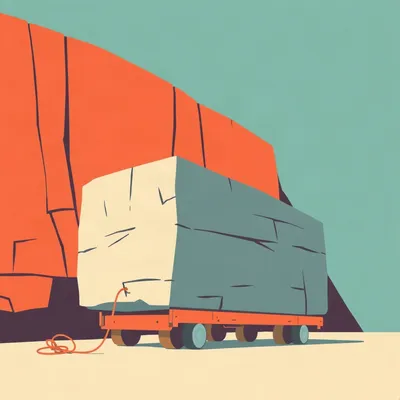
This is where the engineering gets genuinely fascinating. The quarries were located north of the city, in an area now called Ramat Shlomo. The stone was cut from the bedrock using a technique where they'd carve channels around the block, then drive wooden wedges into the channels, soak them with water, and let the expanding wood split the stone. Once it was free, they'd use iron levers to lift it slightly and place rollers underneath.
Wooden logs, yes. Then teams of oxen or human laborers would haul the stone on a prepared road, probably with a slight downhill grade. For the five hundred seventeen ton stone, you're looking at hundreds of men, maybe more. When they reached the construction site, they'd use earthen ramps to slide or roll the stones up to the required height. The higher the wall got, the higher the ramp had to go.
There's some debate about whether they also used wooden cranes, Roman-style treadwheel cranes, for the smaller stones.
Yes, for the two to five ton stones, Roman crane technology would have been feasible. For the five hundred ton monster, probably not. That was brute force and ramps. There's a comparison worth making here to Baalbek in Lebanon, where the Roman temple complex uses stones even larger than the Western Stone, some over eight hundred tons. Same era, same construction tradition. Herod was operating within the Roman engineering vocabulary of his time.
Now the age question. How old are those stones? Because when people visit, they think they're looking at something from the time of Solomon. That's the mental image. Ancient, ancient, ancient.
That's the first major misconception to clear up. The lowest visible courses, the ones with the massive finely cut blocks, those date to Herod's expansion. Construction began around twenty BCE and took roughly eighty years to complete, finishing well after Herod's death in four BCE. Those stones are about two thousand fifty years old.
Second Temple period, not First.
Exclusively Second Temple. The First Temple, Solomon's Temple, was destroyed by the Babylonians in five eighty six BCE. The Second Temple was completed in five fifteen BCE, but it was a much more modest structure on a smaller platform. Herod's project was a complete rebuild and expansion of everything, the Temple itself and the platform it stood on. When we look at the Western Wall, we are looking at a Herodian structure from the first century BCE.
The prompt asks whether it served both Temples. And the answer there gets a little more nuanced.
The visible wall did not serve the First Temple. The First Temple stood on a smaller platform that was largely contained within the natural topography of the hill. Herod's retaining walls were built to create a much larger platform that enveloped and expanded beyond the original. So the Western Wall as a structure did not exist during the First Temple period.
However, below the current ground level, the wall incorporates stones from earlier periods. The lowest courses of the wall, the ones now buried, include stones from the Hasmonean period, second to first century BCE, which predate Herod. And there is archaeological evidence that some of the foundational elements may date back even earlier, possibly to the First Temple period.
The wall sits on earlier foundations, but the wall itself is not a First Temple artifact.
The distinction matters. If someone tells you the Western Wall was part of Solomon's Temple, they're wrong. If they tell you it may rest on foundations that go back that far, they're on slightly firmer ground, but the visible structure is Herodian. There's no ambiguity on that point.
That's a whole separate story. Because the wall wasn't holy when it was built.
Not at all. During the Second Temple period, the Western Wall was just the western boundary of the Temple platform. It was infrastructure. The holy site was the Temple itself, which stood on top of the platform. Jews would ascend to the Temple for pilgrimage festivals, they'd offer sacrifices, they'd pray in the courtyards. Nobody was praying at the retaining wall.
The destruction in seventy CE. The Romans under Titus destroyed the Temple, burned it to the ground, and tore down much of the structure. The platform remained, because it's hard to demolish a mountain of earth held in place by retaining walls, but the Temple itself was gone. For centuries after that, Jews were largely banned from Jerusalem, and when they were allowed access, they were prohibited from going up onto the Temple Mount itself.
Because the Romans, and later the Byzantines, and later the Muslims, all built their own structures up there.
The Temple Mount became the site of a Roman temple to Jupiter, then a Christian church, then the Dome of the Rock and Al-Aqsa Mosque. Jews were excluded from the platform for most of the last two thousand years. The closest accessible point to where the Holy of Holies had stood was the Western Wall, at the base of the platform.
The holiness is a product of proximity and exclusion. It became sacred because it was the closest you could get.
And that's a post-destruction development. The wall's sanctity is not inherent to the structure itself. It's a function of history, of loss, of longing. The wall became the focus of Jewish prayer because it was the nearest accessible point to the site of the destroyed Temple. For centuries, Jews would come to a narrow alley in front of the wall, often under hostile conditions, to lament the destruction. That's why for hundreds of years, it was called the Wailing Wall.
A term that's fallen out of favor, for good reason.
Yes, it's considered pejorative now. It reduces the significance to the act of mourning, when the wall is also a site of celebration, of national identity, of continuity. But the name reflects the historical reality of what happened there for centuries.
Now that we know how the wall was built and why it became holy, let's talk about what we're actually seeing today, and what we're not seeing.
This is where it gets complicated. When you stand in the Western Wall plaza today, you're looking at about sixty meters of exposed wall. But as I mentioned, the original Herodian retaining wall ran about four hundred eighty five meters. Most of it is hidden.
The Muslim Quarter of the Old City was built right up against the wall over the centuries. If you walk along the Western Wall Tunnels, which run north from the plaza, you can see the continuation of the Herodian wall underground, beneath the streets and houses above.
That includes Wilson's Arch.
Wilson's Arch is a spectacular section. It's an ancient stone arch that supported a bridge leading from the Upper City to the Temple Mount during the Second Temple period. The arch itself is Herodian, and underneath it you can see the original street level from the first century, complete with massive stone paving blocks. The Western Wall continues north past the arch, and in the tunnels you can see stones just as large as the ones in the plaza, in some cases larger.
The plaza is just a tiny window onto a much larger structure.
A tiny window that was itself artificially created. Before nineteen sixty seven, there was no plaza. The wall was approached through a narrow alley in the Mughrabi Quarter, a neighborhood of about a hundred thirty five Palestinian homes built right up to the wall. The space in front of the wall was about three meters wide.
That's barely enough for a small crowd.
After Israel captured the Old City in the Six-Day War in June nineteen sixty seven, the government made a decision to demolish the entire Mughrabi Quarter, displacing the residents, to create the open plaza we see today. This happened within days of the war ending.
The iconic image of the Western Wall, the wide open space with the wall rising above, that's a nineteen sixty seven creation.
The stones are ancient. The plaza is modern. And that's another layer of the wall's story that most visitors don't realize. They think they're standing in an ancient space, but the configuration of the site is barely sixty years old.
Let's talk about the stones themselves, because not all of them are Herodian.
This is the second major misconception. People look at the wall and assume all the stones are original, from the time of the Temple. They're not. The lower courses, the massive blocks with those distinctive carved margins, those are Herodian. The technical term is marginal drafting. Each stone has a smooth raised boss in the center, surrounded by a finely chiseled margin around the edges. It's a distinctive Herodian style that you see throughout the Temple Mount complex.
Above the Herodian courses, the stones get smaller and rougher. Those are later repairs. The wall has been damaged and rebuilt multiple times over two thousand years. There are stones from the Byzantine period, the Umayyad period, the Mamluk period, the Ottoman period. Each era added its own layer.
It's a composite artifact.
That's a perfect word for it. The wall is a physical record of Jerusalem's history, layer upon layer, each generation adding to or repairing what came before. The Herodian base is the foundation, but the wall as it stands today is the work of many hands across many centuries.
Which raises an interesting question about authenticity. If most of the visible wall isn't actually Herodian, in what sense is it the original wall?
The lower courses are the original. The sections that people touch, the sections where prayers are placed, those are Herodian stones, two thousand years old, in their original position. The upper sections are later, but they're built on top of the original structure. It's not a reconstruction. It's a continuation.
Like a building that's been renovated so many times that only the foundation is original, but nobody would say it's a different building.
And the foundation, in this case, is the part that matters most. The massive Herodian blocks at the bottom are what define the wall, both visually and historically.
Now there's a phenomenon people talk about, the wall weeping. What's actually happening there?
This is a natural phenomenon that's been given spiritual significance. The wall doesn't weep. What happens is that moisture from the earth fill behind the wall seeps through the porous limestone. You'll see patches of dampness, sometimes even water trickling down the face of the stones, especially after rain. The fill behind the wall is saturated with groundwater, and the stone acts like a sponge, slowly releasing it.
It's essentially a drainage issue.
It's hydrology, not theology. But I understand why people interpret it differently. When you're standing in front of a two thousand year old wall that's the focus of centuries of prayer and longing, seeing water trickle out of the stones feels significant. The tradition of placing written prayers in the cracks of the wall is related. People write their prayers on small pieces of paper and wedge them between the stones.
Which creates its own engineering problem.
Twice a year, before Passover and before Rosh Hashanah, the Western Wall Heritage Foundation removes the accumulated notes. They use wooden sticks to extract them, and the notes are then buried on the Mount of Olives, because Jewish law prohibits destroying anything with God's name written on it. But the sheer volume is enormous. Millions of notes per year.
I've seen photos of the removal process. It's like cleaning out a very spiritual gutter.
That's the Corn description I was waiting for.
Let me ask you about something the prompt touches on. The Little Western Wall. We've discussed it before. How does it relate to what we're talking about?
The Little Western Wall is a section of the western retaining wall that's actually closer to where the Holy of Holies would have been than the main Western Wall plaza. It's located in a small courtyard in the Muslim Quarter, and it's a much less visited site. But here's the key distinction. The Little Western Wall is not part of the main retaining wall. It's a separate structural element, a section of the wall that was exposed at a different point along the western face.
It's closer to the Holy of Holies.
It's closer to the site of the Temple itself, yes. But it's less accessible, less known, and less visited. The main Western Wall became the focal point not because it was the closest point, but because it was the most accessible point for centuries. The Little Western Wall was hidden behind buildings for most of that history.
The holiness isn't purely about geometry. It's about access, history, and the accumulated weight of practice.
That's the key insight. The Western Wall became the Western Wall not because someone calculated which stone was closest to the Holy of Holies, but because it was the place where Jews could actually go, for centuries, to pray. The sanctity is a product of lived experience, not architectural measurement.
Let's circle back to the retaining wall concept, because I think there's still a mental gap for a lot of people. They hear retaining wall and think of a garden terrace. But this is a retaining wall for what amounts to an artificial mountain.
The scale is hard to grasp. The Temple Mount platform is about thirty five acres. That's roughly the size of fifteen city blocks. The fill inside it, behind the retaining walls, is estimated at several million cubic meters of earth and rubble. The walls aren't just holding back a little bit of dirt. They're holding back an artificial hill that was constructed to create a level surface on top of a natural hill.
The walls themselves are not just stacked stones. There's engineering sophistication here.
The stones are laid without mortar, which is remarkable. They're cut so precisely that they fit together with almost no gap. But behind the visible face, the wall is much thicker. It extends back into the fill, with the stones interlocking and stepping backward, creating a structure that resists the outward pressure of the earth behind it through sheer mass and geometry.
It's a gravity wall. The weight of the stones themselves resists the pressure of the fill.
And that's why the stones are so massive. You need that weight to counteract the force of millions of cubic meters of earth pushing outward. A thinner wall would have collapsed long ago. The Romans understood this intuitively. They'd been building retaining walls and platforms for centuries by Herod's time.
The fact that it's still standing after two thousand years, in an earthquake zone, suggests they knew what they were doing.
Jerusalem sits on the Dead Sea Transform, the same fault system that produced the great earthquake of the Jordan Valley. The Temple Mount has survived multiple major earthquakes over two millennia. The retaining walls have been damaged and repaired, but the core structure has held. That's not luck. That's engineering.
Where does that leave us? Here's what I want listeners to take away from this episode.
First, when you look at the Western Wall, or when you see images of it, understand what you're looking at. It's a retaining wall, not a wall of the Temple. The Temple stood on top of the platform, not against the wall. This distinction clarifies both the archaeological significance and the religious significance.
The wall is holy because of what it supported, not because of what it was.
It's holy because it held up the platform on which the Temple stood, and because after the Temple's destruction, it became the closest accessible point to the site of the Holy of Holies. That's a chain of meaning that developed over centuries.
The wall is not a pristine relic. It's a composite artifact. The lower courses are Herodian, two thousand fifty years old. The upper courses are later repairs from the Byzantine, Umayyad, Mamluk, and Ottoman periods. The plaza in front of it was created in nineteen sixty seven. The wall has been damaged, rebuilt, cleaned, and modified across its entire history.
That doesn't diminish it. If anything, it enriches it. The wall is a physical record of Jerusalem's history. Every stone tells a story about who was in power, who cared enough to repair it, and how the city changed over two millennia.
The wall's holiness is a product of history, not original design. Understanding this doesn't reduce its importance. It deepens it by showing how meaning evolves across time. The wall wasn't built as a holy site. It became one through centuries of prayer, exclusion, longing, and return.
Here's a practical thing you can do. Next time you see an image of the Western Wall, look at the stone courses. Notice the difference between the massive Herodian blocks at the bottom, with their distinctive carved margins, and the smaller, rougher stones above. That visual clue tells the entire story. The big blocks at the bottom are the original Herodian wall. Everything above them is later history.
It's a timeline in stone. You don't need to read a book. You just need to look.
If you're ever there in person, take a moment to walk north from the plaza into the Western Wall Tunnels. You'll see Wilson's Arch, the original Herodian street level, and the continuation of the wall stretching far beyond the exposed section. It gives you a sense of the true scale of the structure.
There's one more question I want to leave listeners with.
If the Western Wall is a retaining wall, not a Temple wall, does that change how we think about other holy structures that are actually infrastructure? The walls of Jericho. The ramparts of Masada. The great platforms of Baalbek. How many sacred sites are ultimately just the engineering that made the sacred possible?
That's a provocative question. The holy relies on the practical. The Temple couldn't have existed without the platform, and the platform couldn't have existed without the retaining walls. The infrastructure makes the sacred possible, and when the sacred is destroyed, the infrastructure becomes sacred in its place.
The scaffolding becomes the memorial.
And that pattern repeats across history. The aqueducts of Rome, the great wall of China, the pyramids. They start as engineering projects in service of something else, power or worship or defense, and over time they become symbols in their own right. The Western Wall is perhaps the purest example of that transformation.
Ongoing excavations, the Pilgrimage Road, the Western Wall Tunnels, they keep revealing new layers. The story of the wall is not finished.
It's not. Every few years, archaeologists uncover something new, a section of the wall that was hidden, a street from the Second Temple period, a drainage channel that tells us about daily life. The wall is still giving up its secrets.
Now, Hilbert's daily fun fact.

Iceland issued a stamp in nineteen fifty nine depicting a postal worker on skis, commemorating the winter mail routes across the highlands. At the time, Iceland had one postman for every one thousand two hundred citizens, the highest ratio of postal workers to population in Europe during the Cold War.
Of course there are.
One postman for every twelve hundred people. That's a lot of mail.
This has been My Weird Prompts. If you've got a question that needs this kind of deep dive, the kind where a retaining wall turns into a two thousand year meditation on engineering and holiness, send it to us. We're at myweirdprompts.
Or find us on Spotify, wherever you listen. We'll take your weirdest prompt and build an episode around it.
Until next time.