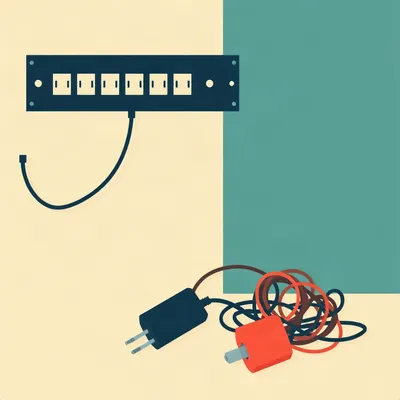
Daniel sent us this one — he's looking at the rat's nest of AC adapters behind his rack and asking the obvious question: there has to be a better way. He's got Raspberry Pis, routers, various DC devices all plugged into a UPS, but the wall-wart sprawl is ugly, it wastes space, and it's just... His question is basically, can you build a single AC-to-DC breakout panel that distributes power at the right voltage per output, instead of living in brick city? And the answer is absolutely yes — this is a solved problem in telecom, it's just weirdly underused in home labs.

The thing is, once you see the alternative, you can't unsee it. Picture a typical rack right now — you've got maybe eight, ten, fifteen little black bricks crammed onto a power strip, some of them blocking adjacent outlets because they're too wide, the whole mess sagging under its own weight, blocking airflow through the rear of the rack. It's not just ugly. It's genuinely a thermal problem and a fire hazard.
The wall-wart tumbleweed. Nature's least elegant power topology.
Here's the core of what Daniel's asking. His UPS outputs a hundred and twenty volts AC. But almost everything small in that rack — the Raspberry Pi, the cable modem, the network switch — actually runs on low-voltage DC. Five volts, nine volts, twelve volts, nineteen volts. So the default solution is: take that clean AC from the UPS, convert it to DC inside each individual brick, and then deliver it to the device. Every single device gets its own little conversion stage, its own little heat output, its own little failure point.
Which is like having a separate gasoline refinery in every car instead of one refinery feeding a network of gas stations. The redundancy is pointless.
The alternative is what's sometimes called a centralized DC distribution system. You take one high-quality AC-to-DC power supply — something like a Mean Well LRS-three-fifty-twelve — and you mount it in the rack. It converts AC to a single DC voltage once, at high efficiency. Then you run that DC voltage to a fused distribution panel, and from there you branch out to all your devices. If a device needs a different voltage than what your main PSU puts out, you drop a tiny DC-to-DC converter on that specific branch. That's the whole architecture.
One conversion stage instead of fifteen. And that's the moment where the efficiency math starts getting interesting.
Right, let's put numbers on this. A typical cheap wall-wart runs at about sixty to seventy percent efficiency under load — that's per Energy Star test data. So if your device needs ten watts, the brick is pulling maybe fourteen to sixteen watts from the wall, and the difference — four to six watts — is heat. Just radiated into your rack. A Mean Well LRS-three-fifty series, by contrast, is rated at eighty-eight percent typical efficiency. For that same ten-watt load, you're pulling about eleven-point-four watts, and only one-point-four watts is heat.
Per device, you're shaving off a few watts of waste. Multiply by ten or fifteen devices and suddenly you're talking real numbers.
Let's walk through a concrete build, because I think that's what Daniel's really after — what does this actually look like in a rack? Say you've got a one-U shelf. You mount a Mean Well LRS-three-fifty-twelve on it. That's a twelve-volt, twenty-nine-amp power supply — about three hundred and fifty watts total capacity — and it costs around forty dollars. It's an open-frame unit with a built-in fan, active power factor correction, and a little trim potentiometer so you can tweak the output voltage slightly. From that PSU, you run thick wires — maybe twelve AWG — to a fused distribution block. Something like a Blue Sea Systems five-oh-two-five, which is a six-circuit fuse block originally designed for marine and RV electrical systems. It takes ATO blade fuses, the same kind in your car, and gives you screw terminals for each circuit.
You've got one big twelve-volt rail feeding six individually fused outputs. And from there you can branch out.
Output one goes directly to a twelve-volt PoE switch — no conversion needed, just a barrel connector or screw terminals. Output two goes through a Traco Power TSR one dash twenty-four-fifty — that's a tiny switching regulator, about the size of a postage stamp, that takes twelve volts in and puts out a clean five volts at one amp. Costs about ten dollars. That powers a Raspberry Pi five. Output three goes to a twelve-volt-to-nineteen-volt boost converter for something that needs laptop-level voltage — maybe a small NUC or a monitor. All of this fits in one U of rack space.
The fusing is the part that makes this safe rather than sketchy. You size each fuse to the device on that circuit — so a Raspberry Pi on a two-amp fuse, a switch on a five-amp fuse. If something shorts, the fuse pops and only that device goes down. The rest of the rack stays up.
That's the critical safety point. Some people hear "open-frame power supply" and "screw terminals" and think this is some kind of mad-scientist setup. But a fused distribution block with proper terminal covers is really no more dangerous than the fuse panel in your car. Probably less so, honestly — you're working with twelve volts, not a hundred and twenty. The main PSU has overcurrent and short-circuit protection built in. Add a terminal cover, mount everything securely, use properly crimped ring terminals, and you've got something that's arguably safer than a power strip sagging under the weight of fifteen wall-warts.
The bar is low. The wall-wart tumbleweed is already a fire hazard. This is an upgrade on safety, not a compromise.
Now, let's talk about the efficiency cascade in more detail, because this is where the real payoff lives. Daniel mentioned UPS runtime as a concern — keeping things online during outages. And this architecture directly extends your UPS battery life.
Walk me through the math on that.
Take a hypothetical homelab — eight Raspberry Pis, two PoE switches, and a cable modem. Eleven devices, each with its own wall-wart. The bricks are pulling about a hundred and thirty watts total from the UPS, because they're all running at maybe sixty-five to seventy percent efficiency. Now you rip all that out and replace it with one Mean Well PSU and a distribution panel. The same devices, same load, but now the AC-to-DC conversion happens once at eighty-eight percent efficiency. Total draw at the wall drops to about a hundred and five watts.
You're saving roughly twenty-five watts just by eliminating redundant conversion stages. That's a meaningful chunk of a UPS battery budget.
On a typical fifteen-hundred-VA UPS with a healthy battery, that twenty-five-watt difference could extend runtime from twenty-two minutes to about twenty-eight minutes. That's twenty-five percent more uptime during an outage. And the flip side is heat. Each of those wall-warts is dissipating maybe two to five watts as heat. Eleven bricks at three watts each is thirty-three watts of heat being dumped into your rack. The single PSU, even at eighty-eight percent efficiency on a hundred-watt load, is dissipating about twelve watts. So you've gone from thirty-three watts of waste heat to twelve.
That's where the cooling argument gets real. In a dense rack, dropping twenty watts of heat load can lower internal temperatures by two to four degrees Celsius. Which means your case fans spin slower, which means less noise, which means your spouse stops asking why the closet sounds like a data center.
The marital acoustics improvement is an underrated benefit of good power design.
I'm serious. Noise is the thing that gets home-lab projects exiled to the garage. Heat and noise are the same problem, and wall-warts make both worse.
Let me address a misconception I see a lot. People look at this and think, "Well, I need five volts for the Pi, twelve volts for the switch, nine volts for the router — so I need three separate power supplies." That's not true. You pick one main voltage — almost always twelve volts, because it's the most common in networking gear and it's high enough to step down efficiently — and then you use tiny buck converters for the oddball voltages. A buck converter takes a higher DC voltage and steps it down to a lower one with typically ninety-plus percent efficiency. They're cheap, they're tiny, and they're dead reliable. A Traco TSR one series regulator is literally a drop-in replacement for a classic seventy-eight-oh-five linear regulator, but it switches instead of burning the excess voltage as heat.
One twelve-volt PSU plus a handful of five-dollar buck converters covers basically every low-voltage device in the rack. Five volts, nine volts, twelve volts — all from one rail.
Nineteen volts for laptops or mini PCs just needs a boost converter instead of a buck. Same concept, just stepping up instead of down. The point is, you're not buying a PSU per voltage. You're buying one PSU and a few converters. That's what makes the economics work.
Let's talk cost, because Daniel's going to want to know if this actually saves money or if it's just an aesthetic upgrade.
It breaks even faster than most people expect. A Mean Well LRS-three-fifty-twelve is about forty dollars. A Blue Sea Systems fuse block is about twenty-five dollars. Add maybe fifteen dollars for fuses, wire, terminals, and a couple of buck converters. So you're in for about eighty dollars total. A single decent-quality wall-wart — not the garbage that comes free with a Raspberry Pi, but something from a reputable brand — costs ten to fifteen dollars. So if you're replacing five or six bricks, you're already at break-even. And most home-lab racks have way more than six bricks.
At ten or fifteen devices, you're saving money. Plus you're getting better efficiency, lower heat, longer UPS runtime, and a rack that doesn't look like a dumpster behind an electronics store.
The economics get even better if you're starting from scratch. If you're building a new rack and you'd otherwise be buying a PDU plus a pile of wall-warts, the centralized DC approach is cheaper from day one. A basic switched PDU like an APC AP seven-nine-hundred still requires every device to have its own brick. You're paying for the PDU and you're paying for the bricks. The breakout panel approach eliminates both.
Alright, let's get into the gotchas, because nothing is ever as simple as the brochure makes it sound.
Three main things to watch for. First: ground loops. When you have multiple devices sharing a common DC ground through the distribution panel, you can get noise coupling between them. This mostly matters if you've got sensitive analog gear — software-defined radios, audio interfaces, anything with a preamp. The fix is isolated DC-to-DC converters on those specific branches. They're a few dollars more expensive than non-isolated ones, but they break the ground path and eliminate the hum.
If you're running an SDR dongle for ADS-B tracking or whatever, spend the extra five bucks on an isolated converter for that branch.
Second gotcha: inrush current. A three-hundred-and-fifty-watt power supply has big input capacitors. When you first plug it in, those caps look like a dead short for a fraction of a second, and the PSU can pull a huge current spike — sometimes forty or fifty amps. If your UPS is already near its limit, that inrush can trip the overload protection and shut everything down.
Which is a deeply ironic failure mode. The device you installed to keep everything running during an outage is the thing that knocks everything offline when power comes back.
The fix is simple: plug the PSU into the UPS, power it on, let it stabilize, then power on your loads. Or use a UPS with a sequenced outlet group that staggers power-on. Some PSUs also have a soft-start feature that limits inrush, but the Mean Well LRS series doesn't — you have to manage it externally.
The third gotcha?
Voltage drop over long DC runs. This one bites people because they're used to AC, where a six-foot extension cord loses basically nothing. At twelve volts DC, the math is different. On eighteen AWG wire at twelve volts and two amps over six feet, you lose about zero-point-six volts. That means your device sees eleven-point-four volts instead of twelve. For a twelve-volt switch, that's probably fine — most gear tolerates plus or minus five percent. But if you're feeding a buck converter that's stepping down to five volts, and the buck converter is already getting eleven-point-four instead of twelve, its output might sag below four-point-eight volts. And five-volt devices — especially Raspberry Pis — get cranky below about four-point-seven-five volts.
The undervoltage lightning bolt of shame on the Pi. You never want to see that.
The fix is straightforward: use thicker wire for longer runs. Fourteen AWG or twelve AWG instead of eighteen AWG. Or place your step-down converter close to the device, not close to the distribution panel, so the long run happens at twelve volts where the drop matters less. Or — and this is the elegant solution — use the trim potentiometer on the PSU to bump the output to twelve-point-five volts, compensating for the drop across the whole system.
Measure at the device end under load, not at the distribution panel. That's the rule.
Multimeter at the barrel connector while everything is running. If you're seeing less than four-point-eight volts at a five-volt device, you've got a problem.
We've covered the architecture, the efficiency, the cost, and the failure pattern. What I want to know is: why isn't this standard? Every homelab YouTuber has a rack tour with the same sad tangle of bricks behind it. This isn't exotic technology — Mean Well PSUs and Blue Sea fuse blocks are commodity parts. The wiring is simpler than crimping Ethernet.
I think there are two reasons. One is that people just don't know it's an option. They see wall-warts as a fact of life, not a design choice. The second is that the commercial alternatives are priced for enterprise. A proper rack-mount DC distribution system from a company like Pakedge or WattBox costs hundreds of dollars, and at that price point, the DIY approach looks like a hack. But the DIY approach — with a Mean Well PSU and a marine fuse block — is functionally the same thing. Telecom companies have been doing centralized DC distribution for decades. Telephone central offices run on a negative forty-eight volt DC bus with battery backup. The whole industry standardized on this because it's more reliable and more efficient than a thousand individual power supplies.
It's one of those things where the prosumer market just hasn't caught up to what the pros figured out thirty years ago.
It's starting to shift. I'm seeing more forum threads on Reddit's r/homelab and the ServeTheHome forums where people are sharing their DC distribution builds. The parts are accessible, the knowledge is out there, and the results speak for themselves. A clean one-U power shelf with labeled circuits and no bricks — it's the kind of thing that makes you want to open the back of your rack just to look at it.
The cable management equivalent of a well-organized toolbox. Satisfying on a deep level.
Alright, let's get practical. If Daniel — or anyone listening — wants to do this, what's the actual weekend plan?
Step one: inventory everything. Write down every DC device in your rack, its voltage, its maximum current draw, and its connector type. Group them by voltage. You'll probably find that eighty percent of them are twelve volts, and the rest are five or nine. That tells you your main PSU voltage — almost certainly twelve volts — and how many buck converters you need.
Step two: size your main PSU. Add up the total wattage of all your devices, add a twenty percent safety margin, and buy a PSU that can handle it. For most home labs, a three-hundred-and-fifty-watt unit like the Mean Well LRS-three-fifty-twelve is plenty. If you're running more than about two hundred and eighty watts continuous, step up to the five-hundred-watt version. Don't run these at a hundred percent rated load continuously — they'll get hot and loud.
Step three: pick your distribution. A Blue Sea Systems five-oh-two-five gives you six fused circuits, which is enough for most small racks. If you need more, they make a twelve-circuit version. Use ATO blade fuses sized to each device — the fuse should be rated for about one hundred and twenty-five percent of the device's maximum current draw.
Step four: buy your converters. For five-volt devices, the Traco TSR one series is great — they're pin-compatible with old linear regulators but they're switching, so they don't get hot. For nine-volt or nineteen-volt devices, you'll need adjustable buck or boost modules. Something like a DROK mini adjustable converter — they're a few dollars each on Amazon, and you set the output voltage with a tiny trim pot and a multimeter.
Step five: build it on a bench first. Mount everything to a one-U shelf or a piece of plywood. Wire the AC input to the PSU — and for the love of safety, use a proper IEC connector with a fuse and a switch, not bare wires into a wall outlet. Wire the DC output from the PSU to the distribution block's main terminals. Then wire each circuit from the fuse block to its device or converter. Use crimped ring terminals or ferrules, not bare wire under screw terminals. Label every single cable.
Labeling is not optional. Six months from now, when something goes down and you're troubleshooting at two in the morning, you will not remember which fuse feeds which device. A label maker is the best ten-dollar investment in this whole project.
Step six: test. Power it up on the bench with no loads first. Measure voltage at the distribution block. Then connect one device at a time, measuring voltage at the device end under load. If anything is low, adjust the PSU trim pot or shorten your wire runs. Once everything is stable, then rack it.
One more thing: document it. Take a photo of the finished panel with the fuse ratings visible. Write down which circuit goes to which device. Tape a cheat sheet inside the rack door. Future you will be grateful.
The whole thing is maybe four hours of work if you're taking your time. Faster if you've done it before. And the result is a rack where the power distribution is as clean as the network cabling.
Now, I want to zoom out for a second, because Daniel's question points toward something bigger. The trend in power delivery is moving toward USB-C Power Delivery — a single cable that can negotiate anything from five volts to twenty volts at up to a hundred watts, or even two hundred and forty watts with the newer extended power range spec. And I can't help but wonder: what does a DC distribution panel look like in a USB-C PD world?
Instead of screw terminals and buck converters, you'd have a USB-C PD hub — one DC input, a bunch of USB-C outputs, and each device negotiates its own voltage. The panel becomes smart.
And we're already seeing the beginnings of this. PoE double-plus — that's the latest Power over Ethernet standard — delivers sixty watts at forty-eight volts over Cat six-A cable. The line between power distribution and data distribution is blurring. A future rack might have a single DC bus carrying, say, forty-eight volts, with smart PD controllers at each device port negotiating the final voltage. No manual configuration, no fuse blocks, no trim pots. Just plug in a device and the rack figures out what it needs.
The rack becomes a power router, not just a power strip. And that's where this whole approach is heading — centralized, efficient, intelligent DC distribution. What Daniel's asking about is the DIY version of that future, available today with off-the-shelf parts.
It's a satisfying project. There's something about opening the back of your rack and seeing a clean panel with labeled circuits instead of a shameful tangle of bricks. It's the difference between something that grew by accident and something that was designed.
The sloth approves. Clean lines, minimal waste, everything in its place. This is the power distribution equivalent of good cable management. And the fact that it saves you money, extends your UPS runtime, and drops your rack temperature — that's just the universe rewarding good engineering.
Now: Hilbert's daily fun fact.

In nineteen forty-three, volcanologists measuring fumarole gases at the Furnas volcano in the Azores recorded a carbon dioxide concentration of ninety-eight point two percent by volume — a reading that, when re-measured with modern gas chromatography in two thousand nineteen, was found to have been overestimated by nearly four percent due to the era's chemical absorption tubes absorbing trace hydrogen sulfide as if it were CO2.
Four percent measurement error from dissolved rotten-egg gas. Science marches on.
The open question we're left with — and this is where I think Daniel's prompt naturally leads — is whether the USB-C PD ecosystem eventually makes all of this screw-terminal-and-fuse-block work obsolete. If every small device in five years ships with USB-C PD input, the breakout panel of the future is just a powered USB-C hub with a single DC input. But until then, the Mean Well plus Blue Sea approach is the cleanest, most efficient way to get clean DC power to a rack full of mismatched devices. One PSU, one panel, no bricks. That's the takeaway.
If you build one, send us a photo. We want to see the before and after. This has been My Weird Prompts. Thanks to our producer Hilbert Flumingtop. You can find show notes and more at my weird prompts dot com.
Until next time.