Daniel sent us this one about seaports — he's pointing out that air freight gets all the attention but it's actually the minority of global freight, and he wants to know how major seaports actually function day to day. He's also asking specifically about Israel's ports at Ashdod and Haifa, what they've meant for the country historically, and whether cargo like cars requires special handling facilities at a port. That last part is almost quaint because the answer is so obviously yes, but the machinery behind that yes is genuinely wild. So where do we start — the sheer scale?

Let's do the scale first, because if you don't anchor there, nothing else makes sense. Maritime shipping moves about eighty percent of global trade by volume. More than eleven billion tons of goods per year. Air freight, by comparison, is less than one percent by tonnage. It's about thirty-five percent by value, because you fly the iPhones and the vaccines, but by sheer physical mass, the ocean is everything. If ships stopped tomorrow, the world has about forty days of inventory for most goods before shelves go empty.
That's the buffer between us and chaos.
That's the buffer. And that's why the port is the chokepoint that makes or breaks economies. A port isn't a parking lot for boats. It's a logistics engine that has to take a floating warehouse the size of four football fields, unload it, sort the contents, clear customs, and get everything onto trucks or trains, ideally within twenty-four to forty-eight hours. Every hour a ship sits idle at berth costs the operator somewhere between fifty thousand and a hundred fifty thousand dollars.
A port is less a parking lot and more a digestive system. The ship eats at one end and the trucks come out the other.
That is exactly right. And like a digestive system, if anything backs up, the whole organism gets sick. We saw this during the pandemic. The port of Los Angeles and Long Beach together handle about forty percent of US container imports. In late twenty twenty-one, they had over a hundred ships waiting at anchor. The average wait time went from less than a day to more than ten days. That backup alone added something like one to two percentage points to US inflation, according to some estimates.
Because everything was sitting in the water instead of on shelves.
And it cascaded. Ships couldn't unload, so they couldn't return to Asia to pick up the next batch, so container prices from Shanghai to Los Angeles went from around two thousand dollars to over twenty thousand dollars per container. The spot rate hit twenty-five thousand at one point.
Twenty-five thousand dollars to ship one box.
One forty-foot box. And that cost got passed through to everything inside it — furniture, electronics, toys, auto parts. So the port is this invisible layer of the economy that nobody thinks about until it seizes up, and then suddenly your couch delivery is six months late and costs twice as much.
Let's get into the actual machinery. Daniel asked how a modern port operates. What does it look like on the ground?
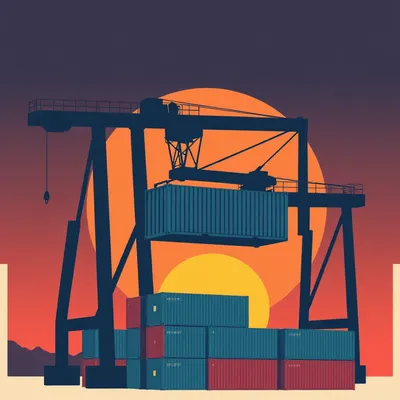
Let's walk through a container ship arriving. The ship docks. Immediately, a row of gantry cranes — these are the giant structures you see in every port photo, they're about a hundred meters tall, they weigh about two thousand tons each — they start unloading. A modern gantry crane can move about thirty to forty containers per hour. The biggest ones can do fifty. The operator sits in a small cabin and looks straight down through a glass floor. It's one of the most skilled jobs in logistics — you're picking up a forty-foot box that weighs up to thirty tons, and you're placing it on a truck chassis with centimeter precision, often in wind and rain.
These cranes are manned? I'd assumed they were automated by now.
It's mixed. Some of the newest ports — Rotterdam's Maasvlakte Two terminal, the new terminal at Shanghai's Yangshan port — have fully automated stacking cranes and guided vehicles. But the ship-to-shore cranes, the ones that actually reach out over the water and grab containers off the vessel, those are still mostly human-operated. The automation is coming, but it's hard because every ship is different, the containers are in different positions, the vessel is moving slightly with the tide. A human operator can adapt to that in real time in a way that machine vision still struggles with.
The container comes off the ship.
It lands on a terminal tractor, or sometimes an automated guided vehicle, which shuttles it to the stacking yard. The stacking yard is this massive grid of containers, stacked up to five or six high. And here's where the real sorting happens. Some containers are transshipment — they're not even entering the country, they're just switching ships. Singapore handles something like eighty-five percent transshipment. The box arrives from Shanghai, sits in the yard for maybe eight hours, then gets loaded onto a smaller feeder ship bound for Jakarta.
Singapore is the hub-and-spoke model applied to global freight.
It's the Atlanta airport of the ocean. And the thing that makes this work is the container numbering system. Every container in the world has a unique identifier — four letters and seven digits. The first three letters identify the owner, the fourth is always U for freight containers, then six digits plus a check digit. So when that box comes off the ship, it's scanned optically, the system knows exactly where it is in the yard at all times, and the yard cranes — which are often automated now — stack and retrieve it based on the schedule.
The check digit is a nice touch. Even shipping containers have built-in error correction.
And the system is managed by something called a Terminal Operating System, or TOS. It's the software brain of the port. It decides where every container goes in the yard, optimizes crane movements to minimize travel time, and sequences the loading of outgoing vessels so they're balanced — you can't put all the heavy containers on one side of the ship or it lists.
The Tetris algorithm, except the stakes are a capsized vessel.
I haven't even mentioned customs yet. While the container is sitting in the yard, customs clearance is happening. Most countries use some form of risk-based screening — the manifest data is submitted before the ship even arrives, and algorithms flag high-risk containers for physical inspection. The rest get cleared electronically. In a modern port, maybe two to five percent of containers get physically opened. The rest flow through based on data.
Two to five percent. That's a lot of trust in paperwork.
It's a lot of trust in data, and it's also just math. You can't open eleven billion tons of cargo. You'd need an army. So you use intelligence, scanning, and risk profiling. Some ports have drive-through X-ray portals for trucks and containers — they look like the scanners at airport security, but big enough to drive a semi through.
Alright, so that's the container side. But Daniel specifically asked about cargo that can also travel by air — he mentioned cars. Does that require different handling?
A container port and a roll-on roll-off terminal are completely different animals. Cars don't go in containers. They go on specialized ships called RoRo vessels — roll-on, roll-off. These ships have internal ramps, like a floating multi-story parking garage. The cars are driven on at the origin port, parked in tight rows, and driven off at the destination. A single RoRo vessel can carry eight thousand cars.
Eight thousand cars on one ship.
At the port, you need a massive paved storage area, because those cars sit until they're distributed to dealerships. The port of Zeebrugge in Belgium is the largest car-handling port in the world — it processes something like two point eight million vehicles per year. They have over two hundred hectares of paved storage. It looks like an infinite parking lot from satellite photos.
The handling facility isn't cranes and stacking yards. It's drivers, inspection bays, and a lot of asphalt.
Vehicle processing centers. When a car arrives from the factory, it's not ready to go to a dealership. It needs to be inspected for transport damage, it needs accessories installed — sometimes the floor mats, the roof racks, the regional navigation software. Some ports have full vehicle modification facilities. Cars come in, they get washed, they get software updates, they get regional badging, and then they're loaded onto car carriers for distribution.
The port is the final assembly line.
For some manufacturers, yes. And that's also true for other specialized cargo. Bulk grain terminals are completely different again — they use pneumatic systems and conveyor belts and giant silos. Liquid bulk, like crude oil, uses pipelines and storage tanks. A port isn't one facility. It's a collection of specialized terminals, each purpose-built for a cargo type. Containers, RoRo, dry bulk, liquid bulk, break-bulk — which is the catchall for stuff that doesn't fit in containers, like steel beams or wind turbine blades.
Wind turbine blades. Those must be a nightmare to handle.
They're up to a hundred and seven meters long now, for the latest offshore turbines. You can't put that in a container. They're shipped on specialized vessels, unloaded with heavy-lift cranes, and they require enormous laydown areas at the port. The logistics of moving a hundred-meter blade from the port to a wind farm site inland is its own entire industry. Some ports have had to completely reconfigure their road access to accommodate these things.
The port is this constantly evolving machine, and the physical shape of it changes as the economy changes. Which brings us to the Israel part of Daniel's prompt. Ashdod and Haifa. Let's talk about them.
Israel has four commercial seaports — Haifa, Ashdod, Eilat on the Red Sea, and the newer Bay Terminal in Haifa, plus a couple of smaller ones. But Ashdod and Haifa are the two main ones, and they handle well over ninety percent of Israel's container traffic. Haifa is the older port, dates back to the British Mandate period, really expanded in the nineteen thirties. Ashdod opened in nineteen sixty-five, specifically because after the nineteen forty-eight war, Israel needed a deep-water port on the Mediterranean that wasn't as close to a border — Haifa is only about forty kilometers from Lebanon.
Ashdod was built as a strategic redundancy.
And it's now the larger of the two. Ashdod handles about sixty percent of Israel's container traffic. It's the economic gate for the center of the country — everything for Tel Aviv and Jerusalem flows through Ashdod. Haifa handles the north, and it's also the main port for bulk cargo like grain and chemicals.
These ports have mattered in ways that go far beyond commerce. Haifa was the entry point for a lot of the clandestine immigration during the British Mandate — the Aliyah Bet ships.
Between nineteen thirty-four and nineteen forty-eight, Haifa was the main arrival point for Jews trying to enter Palestine, both legally and illegally. The British ran the port and they controlled immigration. Some of the most dramatic moments of that era happened in Haifa harbor — ships being turned away, passengers being transferred to detention camps in Cyprus. The port was the physical threshold of the Jewish state before the state existed.
Then after independence, the ports became the intake valve for mass immigration. In the nineteen fifties, ships were arriving in Haifa with hundreds of thousands of new immigrants from North Africa and the Middle East. The port was the first piece of Israel most of them ever saw.
It wasn't just immigration. During the Yom Kippur War in nineteen seventy-three, the US ran an emergency airlift and sealift to resupply Israel — Operation Nickel Grass. Most of the heavy equipment came by sea into Haifa. Tanks, artillery, ammunition. The port was a military necessity as much as a commercial one. And that's still true. The Israeli Navy has facilities at both Haifa and Ashdod. In a conflict, the ports become strategic infrastructure.
Now we're in the middle of a conflict, day one hundred and three with Iran, and the ports are very much part of that picture.
Both Haifa and Ashdod have been targeted by rocket fire in previous rounds. Haifa in particular is within range of Hezbollah's rocket arsenal from southern Lebanon. The port has hardened facilities, but the vulnerability is real. In the current conflict, there have been Houthi attacks on shipping in the Red Sea, which has essentially shut down Eilat's port for the duration. That puts even more pressure on the Mediterranean ports.
The Houthis have been hitting cargo ships with anti-ship missiles and drones since late twenty twenty-three. That's over two years now.
It's completely reshaped global shipping routes. Container ships that used to go through the Suez Canal and into the Red Sea are now rerouting around the Cape of Good Hope. That adds about ten days and a million dollars in fuel costs per voyage. For Israel, it means Eilat is basically mothballed, and everything has to come through Ashdod and Haifa. The ports have had to absorb that surge.
They've managed?
Israel invested heavily in port infrastructure over the last decade. In twenty twenty-one, the new Bay Terminal in Haifa opened, which is operated by a Chinese company, SIPG — Shanghai International Port Group. That was controversial, geopolitically. The US raised concerns about Chinese state-owned companies operating strategic Israeli infrastructure. But the terminal is running, and it added significant capacity.
There's a whole geopolitical layer to ports that most people miss. The operator of the terminal isn't just a logistics company — it's a sovereign interest.
That's true everywhere. DP World, based in Dubai, operates terminals in dozens of countries. China's COSCO has stakes in ports from Greece to Peru. The port of Piraeus in Greece is majority-owned by COSCO. The port of Djibouti is a geopolitical flashpoint because it sits right at the mouth of the Red Sea and hosts military bases from multiple countries — the US, China, France, Japan. Ports are chess pieces.
When Daniel asks how Israel's ports have been instrumental to the functioning of the state, the answer is: economically, demographically, militarily, and now geopolitically. They're the point where Israel touches the world, and that makes them both a lifeline and a vulnerability.
Let's talk about the economic side more concretely. Israel is an island economy in practice. It has land borders with Egypt, Jordan, Syria, Lebanon, and the Palestinian territories, but the volume of overland trade is tiny compared to maritime trade. Something like ninety-nine percent of Israel's imports and exports by volume go through the sea. The country is completely dependent on its ports.
That's a startling number. Ninety-nine percent.
It's an island economy without the island. And the ports are the single point of failure. If Ashdod and Haifa were both disrupted for an extended period, Israel would run out of food, fuel, raw materials, everything. The strategic grain reserves exist precisely because of this — Israel maintains emergency stocks of wheat and other staples, but those are measured in weeks or months, not years.
The forty-day global buffer you mentioned earlier — for Israel it might be even tighter because there's no overland fallback.
And that's why port security is taken extremely seriously. The ports are classified as critical national infrastructure. They have layers of physical security, maritime patrols, underwater surveillance. The threat model includes everything from terrorism to cyberattacks on the terminal operating systems.
Cyberattacks on port systems. That's a vector I hadn't thought about.
It's a huge concern. In twenty seventeen, the Maersk shipping line was hit by the NotPetya ransomware attack. They lost their entire IT infrastructure — booking systems, terminal operating systems, everything. It cost them an estimated three hundred million dollars. For about a week, they were running operations with WhatsApp and spreadsheets. That was the wake-up call for the entire maritime industry.
The world's largest shipping company, reduced to WhatsApp and spreadsheets.
They got through it, but only barely. If a state actor targeted multiple port operators simultaneously, the disruption would be catastrophic. The US Coast Guard has been running exercises on this exact scenario. Maritime cybersecurity is now a major subfield.
Let's shift back to the physical side for a moment. Daniel asked whether cargo that can travel by air — cars, for instance — needs specific handling. We covered RoRo and car terminals. But what about mixed-use ports? Can Ashdod handle a car carrier and a container ship at the same dock?
They're completely separate terminals. Ashdod has multiple specialized piers. The container terminal is one area with the gantry cranes and the stacking yard. The RoRo terminal is a different pier with ramps and vehicle storage. The bulk terminal is another area entirely, with silos and conveyor systems for grain and other dry bulk. They don't mix because the equipment and the flow are totally different.
Each terminal is basically its own business unit?
In many ports, different terminals are operated by different companies under concession agreements. The port authority — in Israel's case, the Israel Ports Company — owns the land and the basic infrastructure, the breakwaters and the dredged channels. But the superstructure, the cranes and the yards and the systems, are often operated by private terminal operators who bid for multi-decade concessions.
The landlord model.
The landlord model is the dominant one globally. The port authority is the landlord, the terminal operators are the tenants. It creates competition within the port. At Ashdod, for example, the new container terminal that's being developed will be operated by a different company than the existing terminal, so they'll compete for shipping lines. That keeps prices down and efficiency up.
Competition inside a single port. That's elegant.
It's also relatively new for Israel. For decades, the ports were run as government monopolies, and they were notorious for inefficiency and labor disputes. The reform process started in the early two thousands and really accelerated in the last decade. The ports have been partially privatized, the unions have been restructured, and productivity has improved significantly. But it's still a work in progress.
What does port labor look like now? Is it still the old-school longshoreman model?
It's changed enormously. The classic image of the longshoreman is the dockworker with a hook, manually unloading break-bulk cargo — crates and barrels and sacks. That world is largely gone. The containerization revolution in the nineteen sixties and seventies reduced the labor force on the docks by something like ninety percent. A ship that used to take a hundred men a week to unload could now be handled by a dozen men in a day.
Containerization as the original automation.
It was the biggest labor displacement event in the history of logistics. And it completely reshaped port cities. San Francisco's waterfront was once lined with docks and warehouses and thousands of longshoremen. After containerization, the port moved across the bay to Oakland, where there was space for stacking yards. San Francisco's piers became tourist attractions and office space. The same story played out in London, in New York, in dozens of cities.
The physical shape of cities was determined by the shape of cargo handling.
The shape of the labor movement. The longshoremen's unions were some of the most powerful in the world. On the Waterfront, the Marlon Brando film, that was about the New York docks. The union dynamics were brutal. Today's port workers are skilled equipment operators and systems managers, and the unions are still significant — the International Longshore and Warehouse Union on the US West Coast, for example, is a major political force. But the workforce is a fraction of what it was.
We've talked about how a port functions, the specialized handling, the Israeli ports specifically, the geopolitics, the labor history. What haven't we covered?
Port automation is accelerating. The fully automated terminals in Rotterdam and Shanghai and Los Angeles use autonomous stacking cranes, autonomous trucks, remote-operated ship-to-shore cranes. The new terminal at the port of Long Beach, the Long Beach Container Terminal, is almost entirely automated. It can handle three point three million containers per year with about half the workforce of a conventional terminal.
This is the tension — efficiency versus employment.
It's the same tension as every other industry facing automation. The port operators argue that automation is necessary to stay competitive, to handle larger ships, to reduce turnaround times. The unions argue that it destroys good jobs. Both are right. The question is how you manage the transition, and nobody has a perfect answer.
The ships themselves keep getting bigger.
The largest container ships today, the Ultra Large Container Vessels, can carry over twenty-four thousand TEUs — twenty-four thousand twenty-foot container equivalents. That's more than double the capacity of the largest ships just fifteen years ago. When one of these arrives at a port, it's a massive logistical event. You need deeper channels, taller cranes, longer berths, more yard space. Ports are constantly dredging to stay ahead of the ship sizes.
The port is in a perpetual arms race with the ships.
And many ports lose that race. Smaller ports simply can't handle the mega-ships, so they get bypassed. The shipping lines consolidate on hub ports, and the smaller ports become feeder ports. It's a winner-take-most dynamic.
Which brings us back to Ashdod and Haifa. Where do they fit in that hierarchy?
They're regional ports, not global hubs. They don't compete with Rotterdam or Singapore. But they're critical for the Eastern Mediterranean. Ashdod handles about one point six million TEUs per year, Haifa about one point three million. For context, Rotterdam handles about fifteen million. So they're an order of magnitude smaller. But for Israel's economy, they're everything.
The Bay Terminal, the new one in Haifa — is that aimed at making Haifa a regional transshipment hub?
That was the vision. The idea was that Haifa could compete with Port Said in Egypt and Limassol in Cyprus for transshipment traffic — containers that arrive on mega-ships from Asia and get redistributed to smaller ships serving the Eastern Med. The Bay Terminal was designed for that, with deep water and modern cranes. Whether it succeeds depends on a lot of factors — security, geopolitics, the willingness of shipping lines to call there. But the infrastructure is in place.
The Chinese operator, SIPG — they have experience running transshipment hubs. Shanghai is the busiest container port in the world.
Shanghai handled over forty-seven million TEUs in twenty twenty-three. It's in a different universe. So SIPG knows what they're doing. The question is whether the geopolitical friction will limit the terminal's potential. The US has been pretty clear that it's uncomfortable with Chinese control of strategic Israeli infrastructure. But for now, the terminal is operating and adding capacity.
Let's zoom out for a moment. If someone listening wants to understand what a modern port actually is, what's the single most important thing to grasp?
That a port is an information system with a physical layer. The containers, the cranes, the ships — those are the hardware. But the software is what makes it all work. The terminal operating system, the customs clearance platforms, the booking systems, the tracking APIs — that's the nervous system. Without it, you just have a pile of metal boxes by the water. The port of the future is a data center that happens to have cranes attached.
A data center with cranes. That's the essence of the thing.
The data is getting richer. Ports are deploying digital twins — virtual models of the entire terminal that update in real time with sensor data. You can watch every container move, predict bottlenecks before they happen, simulate different stacking strategies. The port of Rotterdam has a digital twin that covers the entire port area — over a hundred square kilometers. They can run what-if scenarios for weather events, ship arrivals, labor shortages.
The port becomes a simulation of itself, and the simulation runs ahead of reality to optimize it.
And that's not science fiction. It's operating now. The next step is connecting the port's digital twin to the ship's digital twin, and to the trucking company's logistics platform, and to the warehouse management system at the destination. End-to-end visibility. The container becomes a data object that traverses a series of physical nodes, and everyone in the chain can see where it is and when it will arrive.
The internet of things, but the things are forty-foot steel boxes full of televisions.
The promise of that visibility is huge. Right now, supply chains are surprisingly opaque. A manufacturer in China might not know exactly where their shipment is until it arrives at the destination port. With end-to-end tracking, you can reroute shipments mid-journey, adjust production schedules, optimize inventory. The efficiency gains are measured in billions of dollars.
The vulnerability, of course, is that a fully digital port is a fully hackable port.
The NotPetya attack was a preview. A sophisticated adversary could do much worse. Imagine a ransomware attack that locks the terminal operating system of a major port during peak season. Every container in the yard becomes unfindable. Ships can't unload. Trucks can't pick up. The backlog cascades globally within days. This is a scenario that keeps maritime security people up at night.
There's no real backup. You can't run a modern port with clipboards anymore.
You can't. The scale is too large. Maersk managed for a week with spreadsheets, but that was an emergency patch. If multiple ports went down simultaneously, or if the attack targeted the shipping lines' booking systems rather than a single terminal, the manual fallback would collapse. The complexity has outstripped the ability to run things by hand.
Which is a theme across modern infrastructure, really. We've built systems that can't be operated manually anymore.
We've built them to be efficient, not resilient. The just-in-time supply chain eliminated inventory buffers, which saved money, but it also eliminated the slack that used to absorb disruptions. The forty-day buffer I mentioned — that's the global average. For some industries, it's much less. Auto manufacturing operates on hours of inventory, not weeks. A port disruption measured in days can shut down a car factory.
The Toyota production system, applied to the global economy.
The Toyota system works beautifully when everything runs smoothly. But it's brittle. We've optimized for the sunny day scenario. The pandemic, the Suez Canal blockage in twenty twenty-one, the Red Sea crisis — those are reminders that the sunny day is not guaranteed.
The Ever Given. That was a single ship, stuck sideways in a canal, and it held up something like ten billion dollars of trade per day.
For six days. Four hundred ships backed up. And the canal is only about three hundred meters wide at that point. One ship, one pilot error, one sandstorm, and the global supply chain seized up. It was a perfect illustration of how concentrated the chokepoints are. The Suez Canal, the Panama Canal, the Strait of Malacca, the Strait of Hormuz — if any of those close, the shipping routes have to go the long way around, and the cost and delay ripple through everything.
The Red Sea crisis is effectively a partial closure of the Suez route.
Ships that would transit the Suez are going around Africa. That's about three thousand five hundred extra nautical miles from Shanghai to Rotterdam. It adds about ten days and burns about a thousand extra tons of fuel. And it's been going on for over two years now. The shipping industry has adapted — rates are up, schedules are adjusted — but it's a permanent drag on efficiency.
Which circles back to Ashdod and Haifa. They're at the eastern end of the Mediterranean, so they're directly affected by anything that happens in the Suez.
They're at the receiving end of that route. When ships come through Suez, Ashdod and Haifa are among the first major ports they reach. If Suez is disrupted, those ports feel it immediately. And if the disruption is security-related — if there's a threat to shipping in the Eastern Med — then the ports themselves become harder to reach. Insurance rates go up. Some shipping lines may skip the call entirely.
The port's viability is tied to the stability of the entire maritime corridor that feeds it.
That's true for every port, but it's especially acute for Israel because there's no Plan B. If the Mediterranean route becomes too dangerous or too expensive, Israel doesn't have an alternative. The land routes through Jordan and Egypt are limited. Eilat on the Red Sea is already compromised by the Houthi threat. The country lives or dies by the Mediterranean approaches.
That's a sobering thought to end on. But I think it also underscores why Daniel's question matters. Ports aren't just infrastructure. They're the sinews of national existence. Ashdod and Haifa have been the intake valves for people, for goods, for weapons, for ideas — for the entire project of building and sustaining a state. Understanding how they work is understanding how the country works.
The same is true for every coastal nation. The port is where the domestic economy meets the global one. It's the interface. Get the port right, and trade flows and the economy grows. Get it wrong, and you get congestion, inflation, shortages, and vulnerability. It's one of those things that's invisible when it works and catastrophic when it doesn't.
The glockenspiel of national sovereignty.
I'm not sure that metaphor tracks, but I respect the attempt.
It works if you think about it. A glockenspiel is precise, metallic, and everyone ignores it until it's missing from the mix.
I'll allow it.
And now: Hilbert's daily fun fact.

In the nineteen tens, Suriname's population was approximately eighty-six thousand people — roughly the same as the number of officials employed by the Tang dynasty's Department of State Affairs in the eighth century.
That is a deeply unsettling ratio.
I have follow-up questions I'm not sure I want answered.
This has been My Weird Prompts. Thanks to our producer Hilbert Flumingtop for the fact and the existential unease. You can find every episode at myweirdprompts.If you enjoyed this, leave us a review wherever you listen — it helps. We'll be back next week.