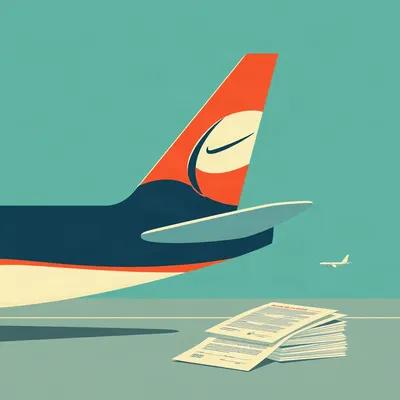
Daniel and Hannah flew back from Athens to Tel Aviv a few weeks ago. Booked with Arkia, but the plane said Hi-Fly on the safety card and the crew's uniforms didn't match anything on their boarding passes. Daniel did what Daniel does — started asking questions about the operator. Then Hannah asked the question that made this episode. Why is flying a wide-body on long-haul considered the prize? Is it actually harder, or is it just status?
So here's the full prompt. Daniel wants to know what kind of pilot works for an ACMI operator like Hi-Fly — these are the ghost airlines that lease aircraft and crew to other carriers. How is cabin crew life different when you're a white-labeled service operator, wearing one company's uniform while serving another airline's passengers? The career angle: First Officers at ACMI operators can get early exposure to wide-body aircraft like the A330, years before they'd touch one at a legacy carrier. Is that a savvy career accelerator — log your hours on type, then jump to Emirates or Qatar? And then Hannah's question, which is the sharp one. Do airlines actually require more seniority to fly bigger aircraft, and if so, why? Is an A330 more complicated than an A320, or is this just layman's logic that a bigger plane needs more experience? And from a pilot's standpoint, why is long-haul wide-body flying desirable in the first place? Presumably it's not just prestige.

Hannah's question is the one that cuts through the whole thing, because it sounds obvious until you actually think about it. Bigger plane, more passengers, more engines — surely you want the more experienced pilot up front. That's the assumption. And the airline industry has built an entire career ladder on it.
But you're already making a face.
I'm making a face because the assumption is mostly wrong. Not entirely wrong — there are real differences — but the seniority system that gates access to wide-body aircraft is not fundamentally about competence. It's about allocating desirable jobs fairly among a unionized workforce. The fact that ACMI operators routinely put five-hundred-hour First Officers in the right seat of an A330 and they fly safely tells you most of what you need to know.
So let's map the traditional ladder first, then break down where Hannah's question lands, then get into the ACMI anomaly.
The traditional path at a legacy carrier — Delta, Lufthansa, El Al — works like this. A new pilot gets hired, goes through initial training, and is assigned to the most junior equipment and base available. That's usually a narrow-body — an A320 family aircraft or a 737 — flying domestic or short-haul routes. They start as a First Officer, build hours, and accrue seniority. Seniority is calculated by date of hire. Not flight hours, not skill ratings, not check-ride performance. The day you joined the airline.
Which means the pilot hired on a Tuesday has priority over the pilot hired on Wednesday for the rest of their career.
For the rest of their career. It's a union-negotiated system designed to remove favoritism and management discretion from career progression. Every month, pilots submit bids for their preferred base, equipment, and schedule. The bids are awarded in seniority order. Wide-body long-haul slots are consistently the most bid-on positions, so they go to the pilots who've been at the airline the longest.
So it's a queue, not a competency gate.
It's a queue. The airline doesn't assess whether you're ready for a 777. They assess whether you've waited long enough. The type-rating training comes after you win the bid, and it's the same training whether you've been at the airline five years or twenty. You pass the check ride, you're qualified. The seniority part is purely about who gets the slot.
And the desirability — Hannah's question about why pilots want this — let's get into that before we tackle whether it's harder. Because I think the reasons surprise people.
They do, and they're mostly not about the flying itself. A typical A320 First Officer at a European low-cost carrier flies seventy to ninety hours a month across fifteen to twenty flying days. That's four or five legs a day. Takeoff, climb, descent, landing — repeat, repeat, repeat. Quick turns at the gate, maybe twenty-five minutes. Different airports, different approaches, different weather, high workload throughout.
Sounds exhausting just hearing it.
An A330 First Officer on long-haul flies the same seventy to ninety hours a month, but across four to six flight legs. You might do two round trips in a month. The rest of the time you're at cruise altitude, the autopilot is flying, and you're monitoring systems, managing fuel, talking to oceanic control. The workload per flight hour is dramatically lower.
And the destinations are different.
The short-haul pilot is doing Manchester to Barcelona and back, twice a day. The long-haul pilot has a three-day layover in Bangkok or Miami. Per diem pay on those layovers adds up. The schedule is more predictable — you know your roster weeks in advance. You're not getting called at five in the morning for a reserve assignment. Quality of life is simply better.
Plus the pay scales. Wide-body aircraft have higher maximum takeoff weights, which in many airline contracts translates directly to higher pay rates for the crew.
At most legacy carriers, pilot pay is calculated partly by aircraft weight and speed. A 777 captain makes more than an A320 captain for the same flight hours because the contract says the bigger plane pays a higher rate. So you're working fewer legs, getting better layovers, and earning more per hour. That's the prize. The prestige is real but it's downstream of the material benefits.
So Hannah's question — is a wide-body actually harder to fly — the answer is mostly no, and in some ways it's easier.
This is the part that surprises people. An A330 at cruise is arguably easier to manage than an A320 doing its fourth leg of the day into London City with a crosswind and a short runway. Wide-body aircraft have more systems redundancy. You lose a hydraulic system on an A330, you've got two more. You've got multiple generators, multiple air conditioning packs, multiple everything. The automation is more sophisticated. The flight management computer handles most of the navigation workload.
And the handling characteristics — this is the part that really undermines the bigger-is-harder assumption.
The A330 and the A320 share a common type rating. They're both Airbus fly-by-wire aircraft with nearly identical cockpit layouts, identical control laws, identical systems philosophy. A pilot qualified on one can transition to the other with a differences course — not a full type rating course. The aircraft handles the same way. The sidestick feels the same. The automation behaves the same. The physical size of the aircraft is almost irrelevant to the pilot flying it.
Because you're not steering it like a bus. You're commanding a flight control computer.
You're commanding a flight control computer that interprets your inputs and moves the control surfaces accordingly. The computer doesn't care whether the aircraft is thirty-nine meters long or sixty-four meters long. It applies the same control laws. The pilot's experience of flying the aircraft is essentially identical.
So where is the genuine additional complexity?
Ground handling, mostly. Taxiing a sixty-meter wingspan around a congested airport requires more awareness. The landing flare is different because the geometry is different — you're higher off the ground, the sight picture changes. Emergency procedures on a wide-body involve managing more systems and coordinating a larger cabin crew. And long-haul operations bring their own challenges: fatigue management across multiple time zones, extended-range twin-engine operations rules, oceanic crossing procedures, fuel management for very long sectors.
But these are all trainable. They're not inherent barriers that require a decade of experience to overcome.
None of them require a decade of experience. They require proper training and a professional attitude. Which is why an ACMI operator can take a five-hundred-hour First Officer, put them through the same A330 type rating course that a legacy airline would use, pair them with an experienced Captain, and operate safely.
ACMI — Aircraft, Crew, Maintenance, and Insurance. The lessor provides all four. Arkia sells you the ticket, but Hi-Fly provides the plane, the pilots, the cabin crew, the maintenance program, and the insurance. The flight operates under Hi-Fly's air operator certificate, not Arkia's. The crew follow Hi-Fly's standard operating procedures. The safety card in your seat pocket has Hi-Fly's logo. But the boarding pass says Arkia, the meals are Arkia's catering, and the cabin announcements say welcome aboard Arkia flight whatever.
And this exists because airlines need surge capacity. Arkia needed to stand up long-haul routes quickly due to the collapsed availability of flights to and from Israel. They don't have a wide-body fleet sitting around. Hi-Fly does.
Hi-Fly operates five wide-body aircraft as of twenty twenty-six — A330s and A340s. They're one of several ACMI specialists. Air Atlanta Icelandic has been doing this since nineteen eighty-six. Titan Airways in the UK. These are airlines whose entire business model is being other airlines when other airlines can't be themselves.
The global ACMI market was valued at about five point two billion dollars in twenty twenty-five. This isn't a niche.
It's not a niche at all. And it creates a strange career path that doesn't exist in the legacy world. A pilot graduates flight school, does a year as a flight instructor building hours, and applies to Hi-Fly. Hi-Fly needs A330 First Officers right now because they just won a contract to operate Hajj charters or summer seasonal flights for a carrier that's short on capacity. They can't compete with Emirates on salary or benefits. So what do they offer? Early wide-body time. You will log multi-engine turbine hours on an A330 type rating before your peers at Ryanair have even upgraded to Captain on the 737.
And that type rating is portable.
Completely portable. After two or three years at Hi-Fly, you've got two thousand hours on type, a wide-body type rating on your license, and actual long-haul operational experience. You apply to Emirates or Qatar Airways, and your application looks more impressive than the pilot who spent five years doing Dublin to Stansted six times a day. You've leapfrogged them.
The trade-offs being lower pay, less job security, and no real base stability.
The pay gap is significant. ACMI operators typically pay below legacy carrier rates. The contracts can disappear — Hi-Fly wins a six-month contract to cover a route, and when it ends, you might be sitting at home without a roster until the next contract comes in. You might be based in Lisbon one month and Dubai the next. There's no seniority protection — if the company downsizes, you're out. The smart play is exactly what Daniel suggested: use it as a stepping stone. Get your hours, get your type rating, then move to a carrier with a real career path.
But some pilots stay.
Some pilots stay, and that's the part I find interesting. There are pilots who prefer the ACMI lifestyle. They like flying to a different city every week. They like the variety of operating for different client airlines with different procedures and different passenger demographics. They'd be miserable flying the same three routes for twenty years at a legacy carrier. It's aviation's gig economy, and for a certain personality type, the unpredictability is the appeal.
Let's talk about cabin crew, because Daniel asked specifically about that, and it's a different experience entirely.
Cabin crew life at an ACMI operator is... I think disorienting is the right word. You're wearing a Hi-Fly uniform, but you're serving Arkia meals on an Arkia flight. The passengers think they're on Arkia. The announcements say Arkia. But your employment contract is with Hi-Fly, your safety procedures are Hi-Fly's, and next week you might be wearing the same uniform on a TAP Air Portugal flight serving Portuguese meals to passengers who think they're on TAP.
The psychological disconnect of being a ghost crew.
And there's no base stability. A flight attendant at a conventional airline typically has a home base — they know where they'll start and end their trips. An ACMI flight attendant might be positioned anywhere. One month they're doing Lisbon to New York for TAP, the next month Tel Aviv to Bangkok for Arkia. Different meal services, different safety briefings, different passenger expectations, different languages. You're constantly adapting.
The regulatory framework is different too.
ACMI crews typically work under their home country's labor laws and the regulations of the state where the operator holds its air operator certificate. Not the leasing airline's country. So a Hi-Fly crew working an Arkia flight is operating under Portuguese regulations — Hi-Fly is Portuguese-registered — not Israeli regulations. That can mean different rest requirements, different duty day limits, different pay structures. It's not necessarily worse, but it's different, and it adds another layer of complexity to an already complicated job.
And the career progression for cabin crew at an ACMI operator is... what? There's no seniority system to climb because the contracts are too short.
It's flat. You're not bidding for better routes because the routes change with every contract. You're not building seniority toward a wide-body position because you're already on wide-bodies. The career advancement is mostly about moving to a legacy carrier where the stability and benefits are better. ACMI cabin crew work tends to be a way to get experience and then leave, or it's a lifestyle choice for people who like the variety and don't mind the insecurity.
So we've got two parallel stories here. For pilots, ACMI is a career accelerator — a way to skip the seniority queue and get wide-body time early. For cabin crew, it's more of a holding pattern. Interesting work, but without the career structure of a conventional airline.
And both of those stories circle back to Hannah's original question about why wide-body flying is gated behind seniority in the first place. Because if ACMI operators can safely put junior crews on wide-bodies, the seniority requirement at legacy carriers starts to look less like a safety measure and more like a negotiated privilege.
The union would say it's both. Seniority allocates desirable jobs fairly, and as a byproduct, it ensures that long-haul crews tend to be more experienced. But the experience is a side effect, not the purpose.
And there's a genuine argument that experience matters on long-haul in ways that aren't about handling the aircraft. Fatigue management across multiple time zones is a real skill. Decision-making when you're hours from a diversion airport is different from short-haul where you're never more than thirty minutes from a runway. An experienced Captain has usually developed better judgment about when to divert, when to press on, how to manage a deteriorating situation with limited options.
But that's Captain experience, not seniority. A pilot who's been flying narrow-bodies for fifteen years has excellent judgment. They just haven't been doing it over the Pacific.
The judgment transfers. The specific procedural knowledge for extended-range operations — that's trained. You do an ETOPS course, you learn the fuel management rules, you learn the diversion planning. It's not something you absorb through osmosis by sitting in the right seat of a 737 for a decade.
So the system works, but for reasons that are largely unrelated to the stated justification.
The system works for allocating desirable jobs without management favoritism. That's what it's for. The safety case is real but secondary. And the ACMI operators prove this by existing — if wide-bodies required fifteen years of experience to fly safely, Hi-Fly would be falling out of the sky. They're not.
Let me ask you something. If the seniority system is about allocation, not competence, does the growth of ACMI operators put pressure on that system? If a pilot can get two thousand hours of A330 time at Hi-Fly and then apply to Delta, does Delta's seniority system still make sense?
That's the tension. At most legacy carriers, seniority resets when you join. You could have ten thousand hours of wide-body command time at Hi-Fly, and when Delta hires you, you start at the bottom of the seniority list. You'll be assigned to whatever equipment and base is available to the most junior pilot. Your previous experience counts for nothing in the bidding system.
Which seems insane.
It seems insane from the outside. From inside the system, it's the only way to prevent experienced pilots from jumping the queue and taking slots that junior pilots have been waiting years for. The union protects the queue. But it creates a disincentive for experienced ACMI pilots to move to legacy carriers — they'd be taking a massive seniority hit.
So the ACMI career path and the legacy career path are almost incompatible. You pick one.
You pick one, or you do ACMI early and legacy later, accepting that you'll start over. The pilots who do best in the ACMI-to-legacy transition are the ones who move early — two or three years in, with a type rating and some hours, but not so established that starting over feels like a demotion.
Let's talk about the aircraft themselves for a moment, because I think there's a specific misconception worth naming. The idea that a bigger plane is harder to fly — where does that even come from?
It comes from cars, I think. A bus is harder to drive than a sedan, so a 777 must be harder to fly than a 737. But aircraft don't work like ground vehicles. The control inputs are mediated by computers. The physical size of the aircraft doesn't translate to heavier control forces or more difficult handling. An A380 handles like an A320 in normal law — the flight control computers make sure of it.
The difference is in the margins. Crosswind landings, engine-out scenarios, rapid depressurization — the things that test the edges of the envelope.
And even there, the wide-body often has advantages. An A340 has four engines — lose one, you've got three left. A 737 has two — lose one, you've got one. The redundancy math favors the bigger aircraft. Engine-out on a twin wide-body like the A330 is more demanding than on a quad, but the training covers it thoroughly. Every type rating course includes extensive simulator time for engine failures, fires, depressurizations, and every other emergency you can reasonably anticipate. A newly type-rated A330 First Officer has demonstrated competence in all of those scenarios before they ever carry a passenger.
So what's the actual hardest part of flying a wide-body?
Honestly? Managing the fatigue on ultra-long-haul sectors. A fifteen-hour flight with four pilots means you're taking rest breaks in a crew bunk, trying to sleep when your body says it's midday, then waking up and being sharp for the approach and landing. That's difficult. But it's not an aircraft handling challenge — it's a human factors challenge. And the solution is proper crew augmentation and rest facilities, not fifteen years of seniority.
Let's circle back to Daniel's specific experience. He flew Hi-Fly on an Arkia ticket from Athens to Tel Aviv. That's a relatively short long-haul — what, two hours?
About two hours. Short enough that it's basically a medium-haul route operated with a wide-body because that's what Hi-Fly had available. The A330 is overkill for Athens to Tel Aviv in terms of range, but if the aircraft is sitting in Athens and the contract says fly to Tel Aviv, you fly to Tel Aviv.
The crew on that flight — they might have been based anywhere. They might have done a long-haul sector the day before.
They might have positioned in from Lisbon. The lack of visibility into the crew's schedule is part of the ACMI model. The passenger sees an Arkia flight. The reality is a Hi-Fly crew who may have flown in from a different continent the previous day, operating under Portuguese regulations, following Hi-Fly procedures, wearing Hi-Fly uniforms, serving Arkia catering.
It's a remarkable amount of invisible infrastructure to make a two-hour flight happen.
It works. The system is strange and opaque from the outside, but it's well-regulated and safe. Hi-Fly operates under EASA oversight. Their aircraft are maintained to the same standards as any European carrier. Their crews are licensed and trained to the same requirements. The difference isn't safety — it's business model and career structure.

I dispatched for Air Atlanta Icelandic in the early two thousands. Reykjavik. Six months.
I didn't know that.
Nobody does. We had a contract wet-leasing a 747 to a Saudi carrier for Hajj charters. The crew were a mix of Eastern European pilots and Filipino cabin crew. None of them had met before the first flight. They showed up in Jedda, introduced themselves in the crew bus, and operated a fully loaded 747 to Dhaka the same afternoon.
That's... a lot of trust in the training system.
The training system works. What doesn't work is the idea that ACMI is just a stepping stone. Some of those pilots had been doing it for twenty years. They liked showing up in a different country every week, flying a different route, never knowing what the next contract would be. One of them told me he'd worked for seven different client airlines in the past year. He said he'd be bored to death flying the same Frankfurt to New York run for Lufthansa until he retired.
Aviation's gig economy.
That's what it is. And the pilots who thrive in it are the ones who'd be miserable at a legacy carrier. They don't want a base. They don't want a predictable schedule. They want variety and they're willing to trade pay and security for it. The career accelerator thing is real for the young ones, but the lifers are a different breed.
The contract you mentioned — the Hajj charters — how did that work logistically?
The Saudi carrier needed capacity for about six weeks. We positioned the aircraft from Reykjavik to Jedda with a full crew. Then we had a backup crew that flew in the cabin as passengers on every leg. Full flight crew — Captain, First Officer, Flight Engineer — sitting in business class, getting paid, watching movies. Contract required twenty-four-hour readiness. If the operating crew timed out or got sick, the backup crew was there.
A whole extra crew just sitting there.
Three guys. Every leg. For six weeks. My brother-in-law was the Flight Engineer on that contract. He said it was the best money he ever made. Read twelve novels. Still talks about it.
That's an extraordinary operational cost. The airline was paying for a crew that, most of the time, did nothing.
Built into the contract. The Saudis wanted absolute reliability during Hajj. They paid for it. That's the ACMI business — you pay for certainty. The aircraft, the crew, the maintenance, the insurance, and if you want a backup crew sitting in 3A through 3C eating the catering and not working, you pay for that too.
Your brother-in-law — did he stay in ACMI?
He did twelve years. Flew for three different operators. Retired now. Lives in Gdansk. He'd tell you the same thing — the variety was the point. He flew Hajj charters, UN peacekeeping rotations in Africa, seasonal tourist flights for a Scandinavian carrier, evacuation flights out of Lebanon. Never the same month twice. He said legacy pilots were flying the same three cities for thirty years and calling it a career. He called it a prison sentence.
That's a strong opinion.
He's not a reliable source on most things. But on this, he's right. The industry sells the seniority ladder as the only respectable path. ACMI is looked down on — wet-lease gypsies, they call them. But the ACMI pilots are flying more varied operations, handling more unusual situations, and adapting to more different procedures than a legacy pilot who's done the same route for a decade. The stigma is about status, not competence.
The stigma is part of what keeps the seniority system intact, isn't it? If ACMI experience were treated as equivalent, the queue would break.
The queue would break overnight. That's why the unions hate it.
The next time I board a flight and the crew's uniforms don't match the airline on my ticket, I'm looking at someone who's either gaming the system to fly an A330 before they turn thirty, or someone who's been doing this for twenty years and wouldn't trade it for anything.
Both of those pilots are probably excellent at their jobs.
The 747 we had on that Hajj contract had a hydraulic leak in the number three system on the third rotation. The Captain was a Romanian who'd been flying ACMI for fifteen years. He'd seen the same leak on three different aircraft types across four different operators. He had it diagnosed before maintenance even got the manual out. That's the kind of experience you can't get flying the same route for thirty years.
The misconception that most people hold about this topic — I think it's that wide-body aircraft are significantly harder to fly than narrow-bodies, and that's why airlines require seniority for them.
The reality, as we've walked through, is almost the opposite. At cruise, wide-bodies are often easier to manage — more automation, more redundancy, fewer legs per month, less exposure to the high-workoad phases of flight. The seniority requirement is about allocating desirable jobs, not about competence. The fact that ACMI operators safely put junior crews on wide-bodies is the proof.
The open question I'm left with — as ACMI operators grow, and Hi-Fly has gone from two wide-bodies in twenty twenty to five now, will the traditional seniority system face real pressure? If a pilot can shortcut to wide-body command time through the ACMI path, the pay-your-dues model starts to look less like a necessity and more like a choice. An expensive choice for the pilots who wait.
I think the pressure is already there, but it's diffuse. The legacy carriers aren't changing their seniority systems — the unions won't allow it. What's changing is the career calculus for new pilots. The ACMI path didn't exist as a viable option a generation ago. Now it does. And some percentage of pilots are going to look at spending ten years on a 737 waiting for a wide-body slot and decide they'd rather fly an A330 next year, even if it means less pay and no base.
The hidden career ladder behind the mismatched uniform.
Every time you see it, there's a story.
Thanks to Hilbert Flumingtop for producing, and for the brother-in-law in Gdansk who read twelve novels on someone else's dime.
This has been My Weird Prompts. If you've got a weird prompt about the hidden structures of travel, technology, or the systems we take for granted, email the show at prompts at my weird prompts dot com.
We'll be back soon.