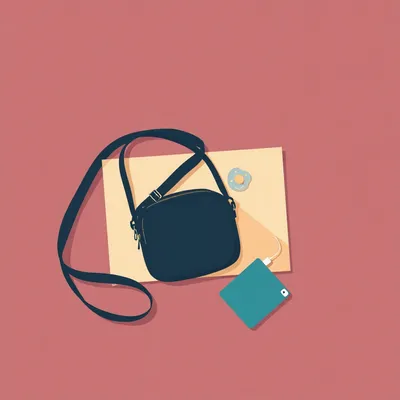
Daniel sent us this one — he's in the middle of moving apartments with his wife and one-year-old son, and his hands are never free. He's constantly reaching for his phone, a power bank, keys, measuring tape — but his pockets can't hold it all, and anything not physically on his body might as well not exist because, well, ADHD.

The ADHD piece is huge here. It's not just about storage capacity. It's about working memory offloading. When you're in a high-transition state — moving, parenting, coordinating delivery drivers — anything you set down for even thirty seconds enters a cognitive black hole.
The thing Daniel's really asking is: what do you actually wear to carry all this stuff without looking like you're about to inspect a boiler? He's thirty-seven. He bought one of those leather phone holsters once and immediately felt like a fifty-year-old building manager from nineteen ninety-four.
The aesthetic trap is real. The market splits into two camps — tactical gear with MOLLE webbing that screams "operator," or corporate leather belt clips that scream "dad's friend Bob at the hardware store." Neither works for a guy who just wants to look normal at IKEA while his phone stays accessible and his keys don't vanish into the moving-box abyss.
We're going to find the actual good stuff today. Organizers that work for ADHD brains — things stay attached, nothing falls out, you don't need two hands to access anything. They look like normal accessories, not a utility belt.
We're not doing a survey of everything that exists. This is a filter. Three criteria: actually functional for hands-free carry, compatible with a forgetful brain, and won't make you look like you're cosplaying as mall security. If it doesn't hit all three, it's out.
Let's start with the thing nobody thinks about. The belt itself. Most of us are wearing fashion belts — thin leather, single-layer webbing — and they're fine for holding up pants. But the moment you clip anything to them, they twist. They can't handle the load.
This is where the Grip6 belt comes in. It's made from a single layer of nylon webbing — no buckle bulge, which matters because a bulky buckle creates a pressure point when you're leaning against a counter or carrying boxes. And it's rated for a hundred and fifty pounds of load capacity. A standard leather belt might hold thirty pounds before it starts deforming. You clip a phone, a multi-tool, and a power bank to a fashion belt, and within an hour it's sagging off your hip like a sad rope.
A hundred and fifty pounds. That's a whole person.
It's overkill for what we're talking about, but that's the point. The belt doesn't even notice a phone and a pouch. It stays rigid, stays flat, doesn't rotate. And visually it's just a matte nylon strap — black or coyote brown, no tactical buckles, no MOLLE loops. It looks like a normal belt.
Step one is forty dollars on a belt that can actually function as a platform. That's the foundation. Everything else clips to it, and if the foundation's wrong, the whole system fails.
Now the phone — this is the hardest thing to carry because it's the thing you access most often, and it's the thing that looks the most ridiculous in a holster. The problem with most phone belt clips is they're either too bulky or too flimsy. The clip mechanism matters way more than the holster material.
What actually works?
The Nite Ize Steelie system. It uses a ball-and-socket magnetic mount. You stick a thin metal plate inside your phone case, and the belt clip has a neodymium magnet with a socket that grabs the ball on the phone side. One-handed attachment, one-handed removal, and the phone rotates three hundred sixty degrees while it's mounted. The magnets are rated for over four pounds of pull force.
What does that mean in practice?
It means your phone won't fall off unless you deliberately yank it. You can bump into a doorframe, wrestle a box through a hallway, pick up a squirming one-year-old — the phone stays put. And because it's magnetic, there's no flap, no buckle, no snap. You just pull it off when you need it and snap it back when you're done.
That's the ADHD design principle right there. Don't make me open a flap. Anything that requires two hands to access gets abandoned within a week. If accessing your phone requires unclipping a latch while holding a baby, you'll just shove the phone in your pocket and drop it three times a day.
The Steelie looks fine. The belt clip is a small black disc, maybe an inch and a half across. It doesn't read as a holster. It reads as a phone mount. The whole system costs about twenty-five dollars and works with any phone case.
We've got the belt, we've got the phone mount. But Daniel also mentioned keys and a power bank. Keys are the worst. They're sharp, they jangle, they're always at the bottom of whatever container you put them in, and they're the easiest thing to lose because they're small and you take them out constantly.
The KeySmart Nano is the solution here. It holds two to four keys flat — they fan out like a pocket knife — and it has a built-in loop for a Tile or AirTag tracker. You clip it to a belt loop and tuck it inside your pocket, so it's not dangling externally. The keys don't jangle because they're compressed. And if you do set it down somewhere, you can ping it from your phone.
The AirTag integration is the ADHD insurance policy. You will leave your keys on the kitchen counter. You will not remember until you're already outside with a box in your hands and the delivery driver is calling. Being able to ping them from your phone turns a five-minute panic search into a ten-second fix.
It's thirty bucks. The cost of never having to dump out every moving box looking for your keys.
Now the power bank. Daniel's coordinating with delivery people all day, his phone's draining, and he can't just plug into a wall because he's moving through rooms constantly. But most belt-mounted power banks are bricks. They're too heavy, they bulge, and suddenly you've got this rectangular tumor on your hip.
The Anker Nano Power Bank solves this. Five thousand milliamp-hours, which is enough for about one full phone charge, and it's approximately ten millimeters thick. Most power banks in this range are twelve to fifteen millimeters. Those extra two to five millimeters make the difference between "invisible under a shirt" and "what is that thing on your belt.
Ten millimeters is basically the thickness of the phone itself.
The Nomatic EDC Belt Pouch, which Gear Patrol highlighted in their twenty twenty-five roundup, has a specific external pocket designed for a slim battery like the Anker Nano. It keeps the battery flush against your body, no bulge, and you can charge your phone from the pouch without removing anything.
Let's talk about that pouch, because this is where things get interesting. The phone is on the magnetic mount, the keys are in the KeySmart clipped inside the pocket — but you still have a power bank, maybe a small multi-tool, a measuring tape, earbuds. You need a catch-all.
The Alpaka Zip Clutch is the one that keeps coming up. It's a slim horizontal pouch that attaches via a belt loop — not a clip, which is important because belt loop attachment means it can't accidentally detach. It holds a phone, keys, AirPods, and a slim power bank. The front pocket is a magnetic flap, not a zipper, so you can slide your phone in and out one-handed without looking.
Magnetic flap, not a zipper. Again, the one-hand access thing. Zippers require two hands — one to hold the pouch steady, one to pull the zipper. If you're holding a box or a toddler, that's not happening. A magnetic flap you just push through.
The material is matte black hypalon and sixteen eighty D ballistic nylon. It looks like a tech accessory, not a tool pouch. It's the difference between "I work in software and I'm moving apartments" and "I am here to fix your cable.
Which brings us to the style question directly. Daniel's core fear is looking like a building manager. What's the actual difference between "design-conscious dad" and "guy who inspects fire extinguishers"?
Material and color. Avoid black leather and shiny brass hardware — that's the building manager uniform. Go for matte black nylon, Cordura fabric, or waxed canvas. Coyote brown and olive green read as outdoor gear, not security uniform. The Nomatic and Alpaka products use matte finishes and technical fabrics that look like they came from a tech company, not a hardware store.
Shiny brass is the giveaway. If your belt clip has a polished gold-toned buckle, you've crossed over. It doesn't matter how functional it is.
Avoid anything with external elastic loops or visible rivets. Those are tool belt signifiers. The Alpaka Zip Clutch has clean lines, hidden stitching, magnetic closures — it could pass for a small designer pouch if you didn't know what it was.
Now we've got a system. Grip6 belt as the platform. Nite Ize Steelie for the phone. KeySmart Nano for keys. Anker Nano power bank in an Alpaka Zip Clutch or Nomatic pouch. Everything stays on your body, everything is accessible with one hand, and you don't look like you're about to repair a furnace.
There's an alternative worth comparing. The sling bag approach. Something like the Aer City Sling Two — one point five liter capacity, strap design that keeps the bag high on your chest rather than swinging to your hip. It holds everything we just listed plus a small screwdriver set, and you can take it off and set it down without undoing your belt.
That's the tradeoff though, isn't it? The sling bag is one more thing to forget. With the belt system, everything is attached to the thing you're already wearing. You put your belt on in the morning, and your entire carry system is deployed. You don't have to remember to grab a bag.
For ADHD specifically, that's a meaningful difference. The belt system reduces the number of discrete objects you have to track. It's not "phone, keys, wallet, power bank, bag" — it's "belt.Everything else lives on it.
Daniel's prompt mentioned he's always mislaying whatever he doesn't have on his body. That's the key insight. The belt system makes your body the storage location. You can't leave your body on the kitchen counter.
You can, but then you have bigger problems.
But the principle holds. The goal isn't to carry everything — it's to carry the minimum that prevents you from having to go back inside. For a moving day, that's phone, keys, power bank, measuring tape, and one multi-tool. Everything else can stay in a backpack. Over-carrying is the enemy of actually using the system.
That's the meta-takeaway we should land on. Daniel's real question isn't "what gear should I buy?" It's "how do I stop losing things during the most chaotic week of my year?" The gear is just the answer to that question. Start with a forty-dollar belt, add a twenty-five-dollar magnetic phone mount, and you've solved eighty percent of the problem for sixty-five dollars.
The rest is optimization. But that core setup — belt plus phone mount — that's the thing that changes the experience from "constantly patting your pockets in a panic" to "your phone is always exactly where you expect it to be.
You don't look like a building manager.
That part's important.
There's a deeper thing here that I think Daniel's prompt is really getting at, and it's not just about gear. It's about the cognitive architecture of a moving day. You're switching between physical and digital tasks constantly. One minute you're disassembling a bookshelf, the next minute you're texting a delivery driver, then you're measuring a doorway, then you're on a video call with your wife because she's at the new place and needs to show you something. Your brain is context-switching every ninety seconds.
Every switch is an opportunity to put something down and forget where you put it. That's the ADHD tax. It's not that you're careless. It's that your working memory is already running at capacity just managing the move itself. There's no spare cognitive bandwidth for "where did I leave my keys.
Working memory offloading is the clinical term. The idea is that you externalize objects into the environment so your brain doesn't have to track them. A belt system is a working memory prosthetic. Your body becomes the external hard drive.
Which is why pockets fail so spectacularly in this scenario. Pockets seem like they should work. They're on your body. But they're shallow, they're inconsistent across different pants, and retrieving something from a pocket requires conscious effort. You have to remember the thing is in there, identify which pocket, contort your hand past whatever else is in there, and pull it out. It's a multi-step retrieval process.
If you're holding a box, you can't do any of that. You have to set the box down. Which means you're now three steps removed from the thing you needed, and the box is on the floor, and your phone is ringing, and the one-year-old is heading toward the stairs.
The magnetic mount changes the retrieval cost entirely. It's one motion. You see the phone, you grab it, you pull. You don't have to look down, you don't have to free up a hand, you don't have to remember which pocket. The phone is always in the same place, always facing the same direction, always accessible.
That consistency is what ADHD brains need. Not more pockets. Not a bigger bag. Predictable location, minimal steps to access, no decisions required.
That's the functional side. But let's sit with the aesthetic problem for a minute, because Daniel didn't just ask "what works." He asked "what works without making me look like a fashion disaster." And the reason most EDC solutions fail that test is that they're designed for enthusiasts.
The EDC community — and I say this with love — they're optimizing for a different thing. They want modularity, they want attachment points, they want to carry a pen, a flashlight, a pry bar, a second flashlight, a notebook, a backup knife. The aesthetic that emerges from that is maximalist by definition.
The corporate side is the opposite failure mode. It's not maximalist, it's just... The leather phone holster with the embossed logo. The padded nylon pouch that came free with something. It's gear that signals "I have given up.
There's a third category that's emerged in the last few years though, and this is where the Alpaka and Nomatic stuff sits. I'd call it "stealth carry." The products are designed to be invisible. They sit flat, they use matte finishes, they don't have external branding or visible hardware. You could walk through IKEA, through a coffee shop, through a co-working space, and nobody would clock that you're carrying a full EDC setup.
The matte black hypalon on the Alpaka Zip Clutch — that's a material that reads as "tech accessory" rather than "tool pouch." It's the same visual language as a laptop sleeve or a minimalist wallet. Nobody sees it and thinks "that guy owns a stud finder.
The filter really is: does this product look like it belongs in a tech office or on a construction site? If it's the latter, skip it. Doesn't matter how functional it is. Daniel's not going to wear it.
The three circles we're filtering through — functional for hands-free, compatible with a forgetful brain, and doesn't make you look like mall security — they're not equally hard to satisfy. The first two have plenty of options. It's the third one that eliminates ninety percent of the market.
Which is why the specific recommendations we landed on are so narrow. There aren't fifty good options. There are maybe five. And they all share the same design language: matte, flat, magnetic, no visible branding, no shiny hardware.
That narrowness is actually helpful. Daniel doesn't need a hundred choices. He needs someone to say "buy these three things and stop thinking about it." Decision fatigue is part of the ADHD problem too.
Let's dig into the belt itself a little more, because I think most people hear "reinforced nylon belt" and picture something with a giant plastic quick-release buckle that clicks when you sit down.
The tactical diaper bag aesthetic.
The Grip6 avoids that entirely. The buckle is a friction-lock system — a flat piece of aluminum that grips the webbing. No prongs, no holes, no bulge. You can adjust it to the millimeter, which matters when you're adding and removing pouches throughout the day and the belt needs to stay exactly where you set it.
The no-holes thing is bigger than it sounds. Standard belts have holes spaced about an inch apart, so you're always between sizes. Too loose and the whole system sags. Too tight and you're cutting off circulation while you're bent over a box.
The friction lock means infinite adjustability. You cinch it to exactly the tension that keeps everything stable without digging in. And because there's no buckle bulge, you can lean against a counter or a moving truck gate without a metal lump pressing into your hip.
Which is the kind of thing you don't think about until hour four of moving day and your belt buckle has left a bruise.
Now on the phone mount — there's a specific detail about the Nite Ize Steelie that makes it work for the ADHD use case beyond just the magnetic attachment. The ball-and-socket joint means the phone rotates freely while mounted. You can swing it from portrait to landscape without detaching. So if you're watching a video call while assembling furniture, you just rotate the phone ninety degrees and keep going.
That's the thing Daniel's doing constantly — video calls with his wife while she's at the new place, coordinating in real time. The phone is a walkie-talkie, a camera, a measuring tool, and a payment device, all in the same five-minute window. If you have to re-clip it every time you switch modes, you'll just stop clipping it.
Then it ends up face-down on a moving box under a roll of packing tape. The Steelie's rotation eliminates that friction. You mount it once and it stays mounted while you rotate, tilt, whatever.
There's a failure pattern with magnetic mounts though that I want to address, because I know Daniel's going to worry about it. What happens when you walk past something metal? Does the phone try to leap off your belt and attach itself to a filing cabinet?
It doesn't, and the reason is the magnet orientation. The Steelie uses a neodymium magnet array where the pull force is directional — it's strongest perpendicular to the mount face and drops off sharply at angles. A filing cabinet or a refrigerator door is a flat steel surface. The magnet isn't oriented to grab it from the side. You'd have to press the mount directly against the surface for it to stick.
The phone isn't going to randomly fly off and attach itself to a doorframe.
And the four-plus-pound rating is conservative. Independent testing shows the actual detachment force is closer to six pounds in ideal conditions. Your OnePlus Nord 3 weighs about six ounces. You've got a safety factor of roughly sixteen times.
That's the kind of margin I like. Now let's talk about the power bank situation, because there's a design problem here that most pouches get wrong. A power bank generates heat when it's charging your phone, and if it's stuffed into a sealed pocket with no airflow, it gets hot. Hot enough to be uncomfortable against your body, hot enough to degrade the battery over time.
This is why the Nomatic EDC Belt Pouch's external battery pocket is a design feature worth paying attention to. It's positioned on the outside face of the pouch, away from your body, with a breathable mesh panel. The battery gets airflow, your hip doesn't get cooked, and the cable can route through a small pass-through to your phone.
The Anker Nano specifically? Five thousand milliamp-hours at ten millimeters thick — is that the actual measured thickness or the marketing number?
Multiple reviewers have calipered it at between nine point eight and ten point two millimeters. It's genuinely the slimmest five-thousand-milliamp-hour bank on the market as of this year. Anker managed it by using a lithium-polymer cell instead of the standard eighteen-sixty-five cylindrical cell. Flat battery, flat pouch, flat profile.
The eighteen-sixty-five is the cylinder that looks like an oversized AA battery. Those are cheap and energy-dense, but they force the power bank to be at least eighteen millimeters thick. You can't get around the geometry.
Eighteen millimeters is visible under clothing. Ten millimeters isn't. That's the difference between "I'm carrying a power bank" and "you can't tell I'm carrying anything.
Which loops back to the style filter. The whole system only works if it's invisible enough that Daniel actually wears it. A power bank that creates a visible rectangular outline under his shirt is a power bank that stays on the dresser.
The pouch decision is where things get personal. Belt-mounted versus sling bag — it depends on what kind of day you're having. If you're in and out of one apartment all day, the belt system wins. Everything's on you, nothing to set down, nothing to forget. But if you're bouncing between locations — old place, new place, hardware store, IKEA — the sling bag starts making more sense.
Because you're taking breaks. You sit down in the car, the belt pouch digs into your hip, you unbuckle it, and now it's on the passenger seat and you're walking into IKEA without your phone.
That's exactly the failure pattern. The Aer City Sling Two solves this by riding high on the chest — the strap design keeps it against your sternum, not swinging at your hip. One point five liters of capacity. Holds everything we've listed plus a small screwdriver set. And you can take it off and set it on the table at lunch without undoing your belt.
The downside is it's one more discrete object. With the belt system, your carry setup is integrated into something you're already wearing. The sling bag is an additional thing you have to remember to grab. For ADHD brains, that's a real tradeoff.
The hybrid approach is actually what I'd recommend for Daniel's specific situation. Belt system for the core items — phone on the Steelie, keys in the KeySmart Nano clipped inside the pocket. That stuff never leaves your body. Then the Alpaka Zip Clutch on the belt for the power bank, measuring tape, and a multi-tool. If you need to carry more — screwdriver set, spare batteries, snacks for the kid — that goes in a sling bag that lives by the door.
The belt is the always-on layer, and the sling bag is the optional expansion. That way if you forget the bag, you still have phone, keys, and power bank. You're not dead in the water.
The Zip Clutch specifically — the magnetic front pocket is the feature that makes it work for Daniel's OnePlus Nord 3. It's a six point seven inch phone, which is on the larger side for a pouch, but the Alpaka's horizontal orientation means it slides in without forcing you to angle it. The magnetic flap snaps shut automatically when you let go. You don't have to remember to close it.
That auto-close matters more than people realize. If closing the pouch is a separate action, you'll skip it, and then your power bank slides out when you bend over to pick up a box.
The belt loop attachment on the Alpaka — it's a sewn-in loop, not a clip. A clip can pop off if you snag it on a doorframe or a box corner. A sewn loop physically cannot detach without tearing the fabric. For someone who's moving through tight spaces all day, that's the difference between "my pouch is always with me" and "I just retraced my steps through three floors looking for a black pouch that fell off somewhere.
The clip failure is the kind of thing you don't think about until you're on your hands and knees in a stairwell with your phone flashlight out.
Now on the style side — and this is where Daniel's building-manager anxiety really lives — the material choices on these products are doing specific work. The Nomatic pouch uses hypalon, a synthetic rubber originally developed for inflatable boats. It's matte, slightly textured, doesn't reflect light. Next to black leather, leather looks like a costume piece. Hypalon looks like something an industrial designer specified.
The sixteen eighty D ballistic nylon on the Alpaka — that D number is denier, a measure of fiber thickness. Sixteen eighty is heavy-duty but not stiff. It conforms to your body instead of sticking out like a cardboard box.
Compare that to the thousand-denier Cordura on military gear. That stuff is practically abrasive. It's designed to survive being dragged across concrete. It also looks like it belongs on a deployment, not on a dad at IKEA.
The denier sweet spot for "normal person carry" is somewhere in that six hundred to sixteen eighty range. Tough enough to survive a move, refined enough to not look like you're expecting mortar fire.
Color is the final filter. Coyote brown and olive green — these read as outdoor recreation colors. They signal "I hike" or "I camp," not "I patrol." Black is fine if it's matte. But avoid any shade of khaki or tan that could be mistaken for a uniform color. And never, under any circumstances, high-visibility orange or yellow. That's the construction worker beacon.
The high-vis thing is fascinating because it's useful — you can find your pouch in a dark moving truck — but the social signaling completely overrides the utility. You can't wear a fluorescent yellow pouch to a coffee shop without people assuming you came from a job site.
Which brings us back to the core filter. The question isn't "does this work." The question is "will Daniel actually wear this tomorrow, and the day after, and the day after that." A system that works perfectly but makes you feel self-conscious is a system that stays in the drawer.
That's the honest answer to when a belt system beats a sling bag. If you'll wear the belt system every day because it's invisible under a shirt, it wins. If you'll leave the sling bag on the hook by the door because it feels like one more thing to carry, the sling bag loses — no matter how much it holds.
If I'm building Daniel a shopping list — and I think that's what he actually needs here, not more options, just a list — it's three items. Grip6 belt, about forty dollars. Nite Ize Steelie mount, about twenty-five. Alpaka Zip Clutch, that runs around sixty. Total investment somewhere around a hundred twenty-five dollars.
That gets you phone on the magnetic mount, keys in the KeySmart Nano clipped inside your pocket, power bank and measuring tape and multi-tool in the pouch. Everything has a designated home on your body. Nothing gets set down on a random box and forgotten.
The KeySmart Nano is another thirty, so call it a hundred fifty-five all in. For context, that's less than most people spend on a single pair of sneakers. And it solves a problem that costs you real time and real stress every single day of a move.
The ADHD rule here — and I'm being completely serious — is that if something doesn't have a designated home on your body, it will be lost within twenty minutes. Not might be. The moving-day chaos accelerates the timeline. Normally you might lose your keys once a week. During a move, it's three times before lunch.
Every time you lose something, you pay the ADHD tax twice. Once in the time spent searching, and once in the cognitive interruption. You were mid-task, you had momentum, and now you're derailed. Getting back to the task costs more than the search itself.
The hundred fifty-five dollars is buying you something very specific. It's buying you the ability to stay in flow. You don't break stride. Phone rings, you grab it off the magnet, you talk, you snap it back, your hands never stop doing whatever they were doing.
Now the -takeaway, and this is where I want to push back on the entire EDC mindset a little bit. The goal is not to carry everything. The goal is to carry the absolute minimum that prevents you from having to go back inside.
That's the distinction. Daniel's not asking "what's the maximum I can carry." He's asking "what do I need to not have to retrace my steps through three floors of an apartment building while the delivery driver honks outside.
For a moving day, that list is brutally short. Phone, keys, power bank, measuring tape, one multi-tool. Everything else — the spare screwdrivers, the box cutter refills, the extra charging cables — lives in a backpack by the door. You grab it when you need it, you put it back, it doesn't ride on your body all day.
Over-carrying is the enemy of actually using the system. If your belt setup weighs four pounds and jangles when you walk, you'll take it off at lunch and never put it back on. The system has to be light enough that you forget you're wearing it.
That's where the specific product choices matter. The Grip6 belt weighs about three ounces. The Steelie mount is under an ounce. The Anker Nano is three point five ounces. The Alpaka pouch empty is about four ounces. You're looking at roughly twelve ounces total for the whole setup, distributed around your waist. That's less than a can of soda.
Compare that to the leather holster Daniel tried and rejected. Those things are easily half a pound before you even put the phone in. They're thick, they're stiff, they broadcast their presence constantly.
The prescription is: start with the belt. Forty dollars, five minutes to adjust it, and suddenly every pouch and holster you try works better because the platform is solid. Then add the phone mount. Twenty-five dollars, and you've solved the thing you access most often. Those two items alone — sixty-five dollars — fix eighty percent of the daily frustration.
If that's all you do, you're already in a better place than you were. The pouch and the key organizer are optimization. The belt and the phone mount are the foundation.
The mistake people make is buying the pouch first. They get a nice Alpaka or Nomatic, clip it to a flimsy fashion belt, and then wonder why the whole thing sags and twists and feels terrible. The belt is the thing that makes everything else work. You can't skip it.
It's the boring purchase. Nobody gets excited about buying a belt. But it's the one that determines whether the whole system succeeds or fails.
Here's the final thought I want to leave Daniel with, and it's the thing that gets lost in all the gear reviews and product roundups. The best carry system is the one you actually use. A two-hundred-dollar organizer you leave on the dresser because it's too bulky or too conspicuous is worse than a thirty-dollar pouch you wear every day without thinking about it.
Phone mount second. Use that for a week and see what's actually missing before you buy anything else. The goal isn't to optimize your carry on day one. It's to build something you'll still be using on day ninety.
If you find yourself thinking "I should probably get the pouch too, and the key organizer, and maybe a second power bank for the car" — stop. That's the gearhead impulse. Daniel's in the middle of a move. He needs something that works tomorrow, not a research project that takes three weeks.
The sixty-five-dollar starter setup does more for your daily sanity than a three-hundred-dollar full kit that arrives after the move is over.
Now: Hilbert's daily fun fact.
Hilbert: During the Cold War, Japanese pigment chemists in Hokkaido developed a synthetic vermillion called shuiro that was so precisely engineered it was used to calibrate military optical instruments — the exact wavelength of red it reflected served as a reference standard for lens alignment.
I don't know what to do with that.
I'm now going to spend the rest of the day wondering what other colors were secretly running defense contracts.
This has been My Weird Prompts. Thanks to our producer Hilbert Flumingtop. If you want to send us your own question — maybe something less existentially troubling than military-grade vermillion — email the show at show at my weird prompts dot com.