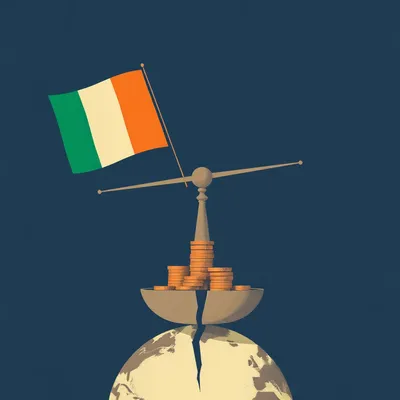
Daniel sent us this one, and it's a follow-up to something we've been tracking. The EU Commission is investigating Ireland's role as a transshipment hub for components used in Russian weapons systems striking Ukrainian civilians. And the Irish prime minister is heading to Brussels not to defend the moral imperative of stopping that trade, but to argue that doing so would cost Irish jobs. The prompt asks whether this is a pattern, whether there's a genuine philosophical debate here about states holding moral positions at the cost of domestic jobs, or whether Ireland has essentially invented its own convenient interpretation of morality. And honestly, the question lands at a moment when the evidence of that pattern is piling up.

It is a pattern, and the pattern has become almost impossible to miss once you start looking for it. The prompt mentions three cases, and I want to lay them out quickly because the pattern is only visible when you see them side by side. First, the EU Commission investigation. In June 2026, the Commission released preliminary findings showing that Irish-registered companies exported roughly three hundred and forty million euros worth of dual-use electronics and precision machinery components to Russia in 2025 alone, routed through intermediaries in Kazakhstan, Kyrgyzstan, and Armenia. That's a four hundred percent increase from 2021 levels. These are not consumer goods. These are components that have been traced to Iranian-designed Shahed drone variants and Kh-101 cruise missile guidance systems used in strikes on Kyiv's energy grid and Kharkiv's residential areas.
The Taoiseach's response to this is to go to Brussels and talk about jobs.
Two thousand three hundred direct jobs in the Irish tech logistics sector, up to eight thousand indirect jobs, according to the Irish Department of Enterprise's estimate from May 2026. That's his argument. Not "we need to investigate how this happened," not "we are horrified that Irish-registered companies may be facilitating war crimes." The argument is "this would cost jobs.
Which brings us to the second case, the basketball one.
Basketball Ireland withdraws from a scheduled friendly against Israel's national team. The stated reason is moral objection to the treatment of Palestinian athletes. And I want to be careful here because the moral objection may be entirely sincere. But the domestic political debate that followed is what matters for the pattern. Opposition TDs, who you would expect to hold the government accountable, didn't argue that collective punishment in sports is wrong. They argued that Irish basketball should not shoot itself in the foot. Their concern was damage to Ireland's international standing in basketball, player development pathways, potential loss of FIBA funding. FIBA, by the way, didn't impose sanctions but issued what they called a strongly worded warning about politicizing sport.
"Should not shoot itself in the foot." That's the phrase that actually got used.
And then the third case, which is unfolding right now. The Football Association of Ireland is pushing to have Hungary host the September 2026 Israel match instead of Dublin. The justification is either security concerns or the economic cost of domestic unrest, depending on which spokesperson you ask. Same rhetorical structure. The moral position is a given, but the debate is entirely about what it costs to hold it.
The through line is: we hold a moral position, provided the bill lands on someone else's desk.
That's the question. The prompt asks whether this is a coherent moral philosophy or a post-hoc rationalization. And I think the prompt's author sees it as the latter, which I understand. But I do think there's a genuine tension here that's worth taking seriously before we dismiss it entirely.
Alright, walk me through the tension.
The tension is this. Every state has a primary obligation to its own citizens. That's the social contract. If a government knowingly destroys two thousand three hundred jobs to take a moral stance, even a correct one, it is imposing real harm on real people who didn't sign up for that sacrifice. Those workers didn't choose to export dual-use components. They took jobs in logistics. The moral failure, if there is one, sits with the companies and the regulators, not with the warehouse workers. So there is a version of this argument that says: the state's job is to fix the regulatory failure and enforce the law, not to immiserate its own citizens in the process. That's the defensible version.
That's not the version Ireland is making.
No, it's not. The version Ireland is making is: we cannot afford to enforce our own stated moral commitments because it would cost jobs. That's different. That's not "we need to manage the transition carefully." That's "the cost of doing the right thing is the reason not to do it.
That's where the basketball case becomes so revealing, because it's the cleanest example of the pattern. There's no sanctions complexity, no dual-use export controls, no supply chain opacity. It's a basketball game. The moral calculus is straightforward. Either you believe sports should not be used as a form of collective punishment, or you don't. But the Irish debate wasn't about that question at all.
That's what makes it the perfect specimen for understanding the pattern. The moral position was treated as a settled premise. Nobody in the political mainstream questioned it. But the entire debate was about costs. What does this do to our FIBA standing? What does this do to player development? What does this do to funding? The morality was free. The costs were not.
The costs, in that case, were speculative and relatively minor.
No one was losing their job over a basketball friendly. The worst-case scenario was a FIBA sanction that would have been manageable. But the framing was identical to the Ukraine case, where the stakes are measured in lives. That's the tell. The rhetorical structure doesn't change when the moral stakes escalate. It's the same argument at a different volume.
Which suggests the argument isn't actually about the stakes at all.
It suggests the argument is a template. And templates are for convenience, not for moral reasoning.
Let's contrast this with how other small European states handle similar dilemmas, because that's where the pattern really snaps into focus. You mentioned Slovenia.
They hosted an Israeli under-twenty football match despite massive protests. The government explicitly framed it as honoring FIFA's non-discrimination principles. They absorbed the domestic political cost. They didn't pretend the cost didn't exist. They said: this is our obligation under the rules we agreed to, and we will bear the consequences.
They banned Russian oligarch yachts from docking in Valletta's port. That decision cost the port an estimated twelve million euros in annual servicing revenue. The Prime Minister stated plainly that neutrality does not mean indifference to mass atrocities. Twelve million euros is real money for Malta. It's a small economy. But they made the choice and they owned it.
What's the difference? Slovenia and Malta are also small states with open economies. They also have citizens who need jobs. Why do they frame these decisions differently?
I think the difference is that Slovenia and Malta are being honest about what they're doing. They're making a tradeoff and accepting the cost. Ireland is making the same tradeoff but claiming there is no tradeoff. The framing is: we hold this moral position, but unfortunately, economic reality prevents us from acting on it. That's not a tradeoff. That's having your principles and eating them too.
"Having your principles and eating them too." I'm going to let that one sit there.
It's a mixed metaphor and I'm not apologizing for it.
Let me introduce a concept here that I think helps clarify what's happening. I've been thinking about this as moral cost accounting. The idea is that states implicitly calculate the price of a moral stance and only take it when the price is below some threshold. This is distinct from realism, where morality is irrelevant, and distinct from idealism, where morality is absolute. Ireland appears to be practicing a form of threshold consequentialism, where the moral action is the one that doesn't cross a domestic economic pain threshold.
That's a useful framework. And it raises two questions. Where is that threshold set, and who sets it?
The threshold, based on the evidence we have, appears to be set at approximately zero. The basketball case involved negligible costs and the government still framed it as a cost problem. The football case involves security costs that other countries routinely absorb. The Ukraine case involves real economic costs, but they're dwarfed by the moral stakes. In none of these cases does the government say "this is worth the cost." It always says "the cost makes this impossible.
Which suggests the threshold isn't a threshold at all. It's a veto.
That's exactly what I'm getting at. If the threshold is zero, it's not a moral calculus. It's a rhetorical device.
Let me push back on myself here, because the prompt does acknowledge that I raised some parallels. And I think there is a version of this that's more defensible than the Irish version. Switzerland continued to export precision machinery to Russia through 2023 and 2024 despite knowing the end use, justifying it on neutrality and economic necessity grounds. Switzerland is not an EU member. Switzerland has a different legal framework. But the moral logic is similar. "We have an economic model that depends on being a reliable trading partner, and we cannot sacrifice that model for a moral stance.
Switzerland at least is consistent. Switzerland has been neutral in that particular way for centuries. It's baked into their national identity. Ireland claims to be a principled actor on the world stage. Ireland positions itself as a moral leader on Palestine, on nuclear disarmament, on climate justice. You can't claim the moral high ground and then invoke Swiss-style neutrality when the bill arrives.
No, you can't. And that's the contradiction at the heart of this. Ireland wants the reputational benefits of moral leadership without the material costs. That's not a philosophy. That's a marketing strategy.
Let's move to the Ukraine case specifically, because it's materially different from the basketball and football cases. This isn't about symbolic sports diplomacy. This is about active complicity in ongoing war crimes.
The EU Commission's June 2026 report is worth quoting directly here. It found that Irish-registered companies exported dual-use electronics and precision machinery components that have been definitively traced to Shahed drone guidance systems and Kh-101 cruise missile navigation units. These are the weapons that have been hitting Kyiv's energy infrastructure and Kharkiv's residential neighborhoods. The report explicitly notes, and I'm quoting the language, that "reasonable grounds exist to believe that Irish export control authorities were aware of the diversion risk since at least Q3 2024.
So for nearly two years, the Irish government has known, or had reasonable grounds to know, that Irish-based companies were part of the supply chain for weapons killing Ukrainian civilians. And the response, two years later, is to argue about jobs.
This is where the moral calculus shifts from "should we bear a cost for a symbolic stance" to "should we bear a cost to stop being an accessory to war crimes." Those are not the same question. The first is a question about the price of virtue signaling. The second is a question about the price of basic legal and moral compliance.
There's a legal dimension here that most coverage misses. Under the Rome Statute, Article 25, paragraph 3, subparagraph C, individuals and corporate officers can be held liable for aiding and abetting war crimes if they knowingly provide substantial assistance. The key word is "knowingly." The EU Commission's finding that Irish authorities were aware of the diversion risk since Q3 2024 transforms this from a regulatory failure to a potential legal liability.
This is the part that I don't think the Irish government has fully internalized. If the EU Commission refers this to the European Court of Justice, and if the court finds Ireland in breach of its sanctions enforcement obligations, the financial penalties could be enormous. Under EU Regulation 2024 slash 1743, the Commission can impose fines of up to five percent of daily turnover for non-compliance with sanctions regulations. For Ireland, given the scale of the tech logistics sector involved, that could mean billions in penalties. Far more than the two thousand three hundred jobs they're trying to protect.
The pragmatic economic argument may actually be economically irrational when the full risk picture is considered.
That's the irony. The "we're just being practical" argument isn't practical. It's short-term thinking that ignores the legal exposure they're accumulating. If the European Court of Justice drops a multi-billion euro fine on Ireland, the same politicians who argued about protecting jobs will have destroyed far more of them.
That's before we even get to the reputational damage. Ireland has built its economic model on being a reliable, rules-based jurisdiction for tech and finance. If it becomes known as a jurisdiction that winks at sanctions evasion, that model starts to crack.
The IDA, Ireland's foreign investment agency, has spent decades marketing Ireland as a place where the rules are clear and consistently enforced. That's the entire value proposition. Undermine that, and you're not just losing two thousand three hundred logistics jobs. You're potentially losing the next big tech campus, the next pharmaceutical investment, the next financial services hub.
Let me address one of the misconceptions that floats around this topic. There's a tendency to frame Ireland's position as simply "neutrality." But Ireland is not neutral in the legal sense regarding Ukraine. It has joined EU sanctions regimes. It has provided non-lethal military aid. The neutrality framing is a rhetorical cover for selective enforcement.
That's an important point. Military neutrality, which Ireland claims, is about not joining military alliances and not participating in armed conflict. It has nothing to do with sanctions enforcement. EU sanctions are economic measures adopted under the Common Foreign and Security Policy, which Ireland signed up to when it joined the EU. This isn't a neutrality issue. It's a compliance issue.
The selective enforcement is what reveals the pattern. Ireland is happy to enforce sanctions when it's cheap and easy. When it costs something, suddenly there's a problem.
Which brings us back to the basketball case. The reason the basketball case matters so much is that it shows the pattern operating in a domain where there are no legal complexities, no supply chain opacity, no dual-use classification debates. It's just a moral choice. And the government still used the same cost-based argument to justify inaction.
Or rather, to justify action framed as inaction. The boycott was the action. But the debate about the boycott was framed entirely in terms of costs. That's the sleight of hand.
The moral decision was taken. The boycott happened. But the political discourse treated the moral dimension as irrelevant. What mattered was whether Irish basketball could afford it.
Let's address the question directly. Is there a genuine debate about whether states should hold moral positions at the cost of domestic jobs?
I think there is a genuine debate, but it's not the debate Ireland is having. The genuine debate is about how to balance competing obligations. A state has obligations to its own citizens and obligations to the international community. Those obligations sometimes conflict. Working through that conflict honestly means acknowledging both sides, being transparent about the tradeoff, and accepting responsibility for the choice.
What Ireland is doing instead?
Ireland is denying that the tradeoff exists. The framing is: we hold this moral position, but circumstances prevent us from acting on it. That's not balancing competing obligations. That's using one obligation as an excuse to ignore the other.
There's another misconception worth addressing. The job loss estimates are treated as fixed, objective constraints. They're not. The Irish government could invest in retraining and economic diversification. It could enforce the sanctions while simultaneously supporting affected workers through transition programs. The choice isn't "jobs or morality." The choice is "manage the transition or use workers as a human shield against moral accountability.
Using workers as a human shield. That's sharp.
It's what's happening. The government is saying: if you force us to be moral, these workers will suffer. The implicit threat is that the EU would be responsible for those job losses. But the EU didn't create the situation where Irish companies are exporting components for cruise missiles. The Irish regulatory failure created that situation. The workers are being used as hostages in a negotiation where the hostage-taker is also the one claiming the moral high ground.
Let me bring in another parallel that I think is instructive. When the U.imposed sanctions on Chinese telecom companies in the late 2010s, there were real job losses in American communities that supplied those companies. The political debate was messy. But the U.government didn't argue that the job losses made the sanctions impossible. It argued that the national security imperative justified the cost and that the cost should be managed through domestic policy. That's the honest version of this argument.
The dishonest version is Ireland's version, where the cost is invoked not as something to be managed but as a reason to not act at all.
And the dishonesty compounds when you notice that the same government that says "we can't afford to enforce sanctions because of jobs" is perfectly willing to impose costs on its own citizens for other moral positions that don't involve economic pain. Ireland has been one of Europe's most vocal states on Palestinian rights. That's a moral position with essentially zero domestic economic cost. It's cheap morality.
That's the phrase that ties all three cases together. The basketball boycott cost almost nothing and the government still balked at the cost. The football relocation will cost something but not much. The Ukraine sanctions enforcement would cost real money and real jobs, and the government is treating it as unthinkable. The pattern is that Ireland's moral positions are inversely proportional to their cost.
That's not a moral framework. That's a budget.
Let's talk about the counterargument that the prompt acknowledges you raised. The idea that there are parallels to other states making similar tradeoffs. I want to give that its due.
The strongest parallel is Switzerland, which I mentioned. Switzerland has a centuries-old tradition of neutrality that includes economic neutrality. It continued to export precision machinery to Russia through 2023 and 2024 despite knowing the likely end use. The Swiss argument is that their economic model depends on being a reliable trading partner to all sides, and that abandoning that principle would undermine the foundation of Swiss prosperity.
Switzerland is not an EU member. Switzerland has a different legal framework. And Switzerland has been consistent about this for a very long time. You may disagree with the Swiss position, but it's not hypocritical in the way the Irish position is.
No, it's not. Switzerland says: we are neutral, and neutrality means we trade with everyone, and that sometimes produces uncomfortable outcomes. That's a coherent position. You can argue against it, but you can't accuse it of internal contradiction. Ireland says: we are a principled moral actor on the world stage, and also we cannot afford to enforce our principles when they cost money. That's not coherent.
There's a legal dimension to the Swiss comparison that breaks down even further. Switzerland is not bound by the EU's Common Foreign and Security Policy. Ireland signed up to the sanctions regime. Ireland has a legal obligation to enforce it. Switzerland doesn't.
The Swiss parallel actually undermines the Irish position rather than supporting it. It shows what a genuine neutrality-based argument looks like, and it highlights how Ireland's argument is something else entirely.
What about the other parallel the prompt mentions? The idea that "it's reasonable to hold a moral position so long as it doesn't come at your own economic harm." You apparently cast that as a reasonable position.
I think I was trying to be charitable, and I want to explain why. There's a version of that position that is reasonable. If you're a small state with a fragile economy, you have limited capacity to absorb economic shocks for moral purposes. Recognizing that limitation isn't inherently unreasonable. It's just acknowledging reality. The problem is when that recognition becomes a blanket exemption from moral accountability.
The reasonable version is: "we have limited capacity, so we have to be selective about which moral battles we fight." The unreasonable version is: "we have limited capacity, so we fight no moral battles that cost anything.
And Ireland is clearly in the second camp, because the basketball case shows that even trivial costs are treated as disqualifying.
Let's push this into more concrete territory. For listeners who work in policy, advocacy, or journalism, what's the analytical tool here? How do you spot this pattern when it shows up in other contexts?
I think there are three questions to ask whenever a government says "we cannot take a moral position because it would cost X jobs." First, is the moral position actually costly, or is this a manufactured tradeoff? In the basketball case, the costs were speculative and minor. The tradeoff was manufactured.
Who benefits from framing it as a tradeoff? In the Ukraine case, the beneficiaries are the companies doing the exporting and the politicians who don't want to have a difficult conversation with those companies. The costs are borne by Ukrainian civilians who have no voice in Irish politics.
What is the actual cost of not taking the moral position, and who bears that cost? In the Ukraine case, the cost of inaction is measured in civilian lives. Those lives are being lost right now. The jobs that might be lost are hypothetical and manageable. The asymmetry is staggering.
That third question is the one that almost never gets asked in the Irish political debate. The costs of inaction are invisible to Irish voters because they're borne by people in Kharkiv and Kyiv. The costs of action are highly visible because they're borne by Irish workers. The political incentives are completely misaligned with the moral calculus.
Which is exactly why the pattern exists. It's not a bug. It's a feature of how democratic politics interacts with foreign policy. Politicians are accountable to their own voters, not to Ukrainian civilians. If a moral position imposes visible costs on voters and invisible benefits on foreigners, the political math pushes against it.
The pattern isn't unique to Ireland. It's a general problem of democratic foreign policy. What makes Ireland distinctive is the gap between its self-presentation as a moral leader and its behavior when morality has a price tag.
That's the core of it. Every state faces this tension. Not every state claims to be a beacon of principled foreign policy while systematically avoiding the costs of those principles.
Let me raise one more dimension that I think is underexplored. The Rome Statute liability question. If the EU Commission refers this to the European Court of Justice and the court finds that Irish officials knowingly allowed sanctions evasion to continue, those officials could potentially face individual legal exposure. We're not just talking about fines against the state. We're talking about the possibility that individual government officials could be found to have aided and abetted war crimes.
That's a dramatic claim. Walk me through the legal reasoning.
Article 25, paragraph 3, subparagraph C of the Rome Statute establishes individual criminal responsibility for anyone who "aids, abets, or otherwise assists in the commission or attempted commission of a crime, including providing the means for its commission." The EU Commission has found reasonable grounds to believe that Irish export control authorities were aware of the diversion risk since Q3 2024. If that awareness continued and no effective action was taken, then the knowing provision of substantial assistance is arguably established.
The counterargument would be that awareness of a risk is not the same as intent to assist. The Irish officials would argue they were negligent, not complicit.
That's the defense. But the Rome Statute also covers what's called "willful blindness." If you have reason to know and you deliberately avoid confirming what you suspect, that can satisfy the knowledge requirement. The question is whether Irish officials actively avoided investigating the diversion risk because they didn't want to know the answer.
That's a question of fact that would need to be established through investigation. But the mere existence of the question changes the political calculus significantly. You can argue to your voters that protecting jobs is worth some moral discomfort. It's much harder to argue that protecting jobs is worth potential individual criminal liability.
Which brings me to the open question I want to leave listeners with. If the EU Commission does refer Ireland to the European Court of Justice, and if the Irish government is forced to choose between sanctions compliance and domestic jobs, which will it choose? The answer will tell us whether the economic necessity framing was genuine or just a convenient excuse.
I suspect we know the answer already. When the choice becomes between jobs and legal penalties that would destroy far more jobs, the government will enforce the sanctions. Which means the current position isn't about protecting workers. It's about avoiding a politically difficult decision until external pressure makes it unavoidable.
That's the definition of a post-hoc rationalization. The moral position isn't guiding the decision. The decision is being made on political grounds, and the moral language is being retrofitted to justify it.
Let me broaden this out, because I think the Irish case is a preview of a global dilemma. We are entering an era where supply chain transparency and sanctions enforcement are becoming the primary battlegrounds of international law. Small states that have built their economies on being logistics and financial intermediaries, Ireland, Singapore, the UAE, Luxembourg, will face increasing pressure to choose between their economic model and their stated values.
The Irish pattern is the canary in the coal mine.
And the question is whether other states will learn from Ireland's example, either as a model to emulate or as a cautionary tale.
Given what we've laid out, I'd say it's a cautionary tale. The Taoiseach's argument, that a moral position cannot come at the cost of domestic jobs, is only coherent if you believe that a state's primary moral obligation is to its own citizens. That is a defensible position. It's called communitarianism, or patriotic priority, or various other names in political philosophy. But it's not the position Ireland claims to hold. Ireland claims to be a principled actor on the world stage, committed to human rights, international law, and the rules-based order. You cannot claim that identity and then invoke economic necessity whenever those principles become expensive.
The gap between the claim and the behavior is where the real story lives.
It's a gap that's getting harder to ignore. The EU Commission report has put hard numbers on it. Three hundred and forty million euros in dual-use exports. Components traced to specific weapons systems. Awareness of the diversion risk since Q3 2024. This is no longer a story about abstract principles. It's a story about specific components in specific weapons killing specific people, and a government that says stopping that flow would cost too much.
The moral cost accounting framework you introduced earlier is useful here. Every state has a threshold beyond which it will not go to uphold its principles. The question is whether that threshold is set honestly, transparently, and consistently. Ireland's threshold appears to be set at zero, but that fact is obscured by a rhetorical fog of principled language and economic anxiety.
The fog is the point. The purpose of the rhetorical structure, "we hold this moral position but cannot afford to act on it," is to make the threshold invisible. To make it seem like the government is being forced into a tragic choice by circumstances beyond its control, rather than making a deliberate choice to prioritize short-term economic comfort over legal obligations and human lives.
If listeners take one thing from this episode, I'd want it to be that analytical lens. When you hear a government say it cannot take a moral position because of economic costs, ask the three questions. Is the tradeoff real or manufactured? Who benefits from framing it as a tradeoff? And who bears the cost of inaction?
Then ask the fourth question, the one that ties it all together. Is this government applying the same threshold consistently across different moral claims, or does the threshold mysteriously drop to zero whenever the costs are real?
In Ireland's case, the answer is clear. The threshold is zero. The moral positions are cheap. And the pattern is now documented in enough detail that it cannot be dismissed as coincidence or misinterpretation.
The Taoiseach goes to Brussels this month. The EU Commission has its preliminary findings. The European Court of Justice referral is a real possibility. The next few months will tell us whether Ireland's moral cost accounting survives contact with actual accountability.
That's the question we'll leave with. When the pressure becomes unavoidable, when the choice is no longer between jobs and morality but between jobs and massive legal penalties, which way does Ireland go? The answer will tell us everything about whether the economic necessity framing was a genuine constraint or a convenient story.
If you found this exploration of moral cost accounting useful, share it with someone who thinks foreign policy is just about interests. It's also about the stories states tell themselves to make their interests feel like principles.
And now: Hilbert's daily fun fact.

In the 1840s, European geographers widely attributed Tibet's salt trade to caravan routes crossing the Himalayas from the Indian subcontinent. It wasn't until the 1920s that researchers corrected this: Tibet's salt actually came from vast internal salt lakes on the Changtang plateau, and the caravans were exporting salt out of Tibet, not importing it in. The entire direction of trade had been reversed in the Western imagination for eighty years.
Europe spent eight decades getting the arrows backward on a map and nobody checked.
Cartography as wishful thinking. There's probably a metaphor in there somewhere.
This has been My Weird Prompts. Thanks to our producer Hilbert Flumingtop for the fact and the production. You can find every episode at myweirdprompts dot com, or search for us on Spotify. If you want to support the show, leave a review wherever you listen. It helps more than you'd think.
We'll be back next week. Until then, check your maps.