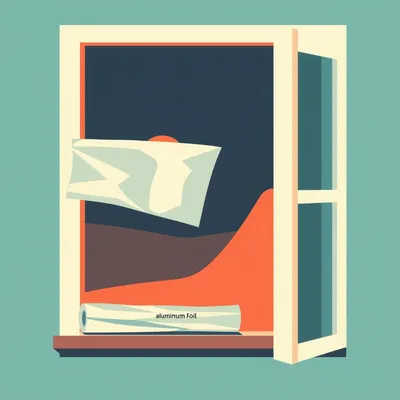
Daniel sent us this one — the UK just hit thirty-eight degrees Celsius in London on May twenty-fifth, smashing the previous May record, and social media is absolutely flooded with people taping aluminum foil to their windows. The claim is that this tinfoil hack can drop indoor temperatures by five to ten degrees and function as a kind of passive air conditioning. The counter-claim is that it might trap heat, crack your windows, or turn your flat into a mold factory. So the actual question is: does this work? And if you're willing to live in the dark, could it genuinely substitute for air conditioning?

Right, so let's start with the sheer scale of this. Only three percent of UK homes have air conditioning. Compare that to ninety percent in the United States, sixty percent in Japan. So when a heatwave hits — and this is the third one in as many weeks — you've got tens of millions of people with no mechanical cooling, staring at single-pane windows that are basically transparent radiators, and a roll of kitchen foil costs about ninety-nine pence. It's a mass experiment in low-tech thermal management happening in real time.
The videos are oddly satisfying. People crinkling foil, taping it meticulously to window frames, that moment when the room goes dark and they point a thermometer at the glass. It's DIY ASMR for the climate crisis.
I saw one where someone used an infrared camera and the window just vanished. It went from a blazing white rectangle to... Which is actually exactly what the physics predicts, and that's where I want to go first. Because the core question here — does this work — depends entirely on what you mean by "work.
Are we talking temperature reduction, energy savings, or just the subjective feeling of not being slowly roasted?
The answer turns out to be yes, with caveats. Let's walk through the mechanism. Standard single-pane glass — which is still in something like sixty percent of UK homes, especially pre-war housing stock — transmits about eighty percent of incident solar radiation. Most of that energy is in the visible and near-infrared spectrum, wavelengths between roughly zero point four and two point five micrometers. So sunlight hits the glass, eighty percent of it sails right through, and now your sofa, your floor, your walls are absorbing that energy and re-radiating it as heat. Your room becomes a slow cooker.
The foil intercepts that before it gets past the glass.
Polished aluminum has a reflectivity of eighty-eight to ninety-seven percent across the solar spectrum. The shiny side reflects about ninety-two percent of visible light and about ninety-five percent of near-infrared. For context, that's significantly better than white paint, which manages about eighty percent, or commercial reflective window films which typically land between seventy and eighty-five percent. Kitchen foil is an optical marvel for this purpose. It's basically a mirror that costs less than a pound.
The physics checks out at the first pass. Sunlight hits foil, sunlight bounces back out through the glass, room stays cooler. But here's where I get suspicious — because every cooling solution I've ever encountered has a cascade of consequences. Heat doesn't disappear, it just goes somewhere else. So where's the catch?
The catch is in the distinction between reflectivity and emissivity, and in the placement. So foil has extremely low emissivity in the thermal infrared range — that's wavelengths of eight to fourteen micrometers, which is the heat that objects radiate. Emissivity of about zero point zero three to zero point zero five. That means it doesn't re-radiate absorbed heat well. Which sounds great, right? It's not going to emit heat into your room.
It's a double-edged sword depending on where you put it. If the foil is on the interior side of the glass, the sunlight still has to pass through the glass first. The glass absorbs some of that energy — single-pane glass absorbs maybe fifteen to twenty percent of incident solar radiation — and heats up. Now you've got hot glass, and the foil is reflecting the light back out, but it's also sitting right against or near that hot glass. If there's no air gap, you get conductive heat transfer from the glass to the foil, and from the foil into the room.
The foil becomes a radiator instead of a reflector.
The foil itself heats up and then conducts that heat to the indoor air. This is why the air gap is absolutely critical. If you mount the foil with a two to five centimeter air gap — say, on cardboard spacers or a frame — you create what's called a radiant barrier system. It's the same principle as those shiny emergency blankets. The air gap breaks the conductive path, and the low emissivity of the foil means very little heat radiates across the gap into the room.
There's actual research on this, right? Not just TikTok experiments.
Yeah, a twenty twenty-three study from the University of Cambridge Department of Architecture tested exactly this. They put interior reflective foil with a two centimeter air gap on single-glazed test cells and measured peak indoor temperature. The result: a reduction of four point seven degrees Celsius compared to uncovered windows. That's not nothing. That's the difference between a thirty-one degree bedroom and a twenty-six degree bedroom. One is miserable, the other is...
Which is the emotional core of British summer, really. "Tolerably miserable" is the national aspiration.
There's more recent data too. The Building Research Establishment — the BRE — ran an experiment in twenty twenty-five using a nineteen-thirties semi-detached house in Oxford, south-facing bedroom, thirty-two degree day. With foil on the window, peak indoor temperature dropped from thirty-one degrees to twenty-seven point five. So we're consistently seeing that four to five degree reduction in real-world conditions, not just lab settings.
Okay, so the headline finding is: foil works, air gap matters, expect about four to five degrees of cooling. But the BRE study also found something else, didn't they? Something about humidity.
Humidity rose from fifty-five percent to seventy-two percent. And that's the first of the knock-on effect that nobody in the viral videos mentions. When you seal up a window with foil, you're also sealing off ventilation. In a typical UK home, trickle vents in windows provide background ventilation, and people open windows for fresh air. Foil blocks all of that. So you're reducing temperature but increasing humidity, and high humidity makes a space feel much warmer than it actually is — it's why thirty degrees in London feels worse than thirty degrees in Madrid.
The wet-bulb problem. Your body can't cool itself through sweat evaporation when the air is saturated.
And there's another issue with humidity. In UK summer conditions, relative humidity is often sixty to eighty percent. When you put cold foil against warm indoor air — or more precisely, when the foil reflects heat away and the glass behind it stays cool — you create a temperature differential. Warm moist air hits the cold surface between the foil and the glass, and you get condensation. Water droplets form. They sit there. They seep into wooden window frames. And now you've got mold.
You've traded a hot room for a cool, damp room that's slowly rotting your window frames and potentially your lungs.
Which is a very Corn way of putting it, but yes, essentially. The foil hack solves one problem and creates two more. That doesn't mean don't do it — it means do it intelligently. Take the foil down at night. Let the window breathe. Wipe down any condensation in the morning. These are manageable trade-offs if you understand them.
Most people watching a thirty-second TikTok aren't getting the "take it down at night" caveat. They're putting foil up in June and leaving it there until September.
That brings us to the next problem, which is the light issue. Foil blocks essentially all visible light. You're creating a cave. And that has real psychological and physiological consequences. There was a twenty twenty-four study in Lighting Research and Technology that looked at daytime light exposure and sleep quality. They found that exposure to less than fifty lux during daytime — which is typical of a foil-covered room — reduced sleep quality by eighteen percent in participants. Your circadian rhythm needs bright light during the day to properly regulate melatonin production at night.
You're cooler during the day but sleeping worse at night, when it's also still hot.
And there's the energy paradox too. If you block all natural light, you turn on artificial lights. LED bulbs produce about three to five watts of heat per eight hundred lumens. That's not much, but it's not zero. Incandescents produce about sixty watts of heat for the same light output. So in a home that still has older bulbs, you're actively heating the room to replace the light you just blocked. It's a small effect with LEDs, but it's real, and it's the kind of thing that eats into your four-degree temperature reduction.
The incandescent case is almost comical. You install foil to block solar heat, then turn on a sixty-watt heat lamp to see your sandwich.
I mean, the sandwich is important.
Let's talk about the window-cracking question, because that's the one that seems to scare people the most. Viral posts warn that foil will cause thermal stress and shatter your glass.
This is mostly a misconception, but it has a grain of truth. The concern is that foil reflects heat back into the glass, the glass gets superheated, and then it cracks. But here's what actually happens: the glass absorbs solar energy regardless of whether foil is there. Without foil, some of that energy heats the glass, and some transmits into the room. With foil, the transmitted portion is reflected back out through the glass, which means the glass actually absorbs a bit more energy on the way out. But — and this is the key — foil on the interior also shades the glass from the indoor side, which reduces the temperature differential across the pane.
The net effect is...
The glass temperature doesn't change dramatically. What actually cracks windows is rapid thermal stress — like cold rain hitting a sun-heated pane, or someone spraying a hot window with a garden hose. Foil might slightly mitigate that by reducing the peak glass temperature, but the difference isn't large enough to make foil a window-saver or a window-killer. The cracking risk is basically unchanged.
The "foil will shatter your windows" panic is mostly unfounded.
The one exception is if you have old, already-damaged glass with existing micro-cracks or chips. In those cases, any thermal cycling — foil or no foil — could cause failure. But the foil itself isn't the culprit.
Let's zoom out from the window and look at the room as a whole system, because foil doesn't exist in a vacuum — literally. We've been talking about blocking solar gain, but a room is also gaining heat from occupants, appliances, cooking, and conduction through walls and the roof.
Foil only addresses one heat pathway: direct solar radiation through windows. It does nothing for the other pathways. If your top-floor flat has a poorly insulated roof absorbing sun all day, your ceiling is radiating heat into the room regardless of what's on your windows. If you're running a gaming PC that draws five hundred watts, that's a five-hundred-watt space heater running in your room. Foil doesn't help with any of that.
This is where the "air conditioning" framing falls apart. Foil reduces radiative heat gain. That's one component of cooling. But air conditioning does multiple things: it actively removes heat from indoor air, it dehumidifies, it circulates air, and it filters particulates. Calling foil "passive air conditioning" is a category error. It's like calling an umbrella a "passive shower.
That's actually a perfect analogy. An umbrella keeps you dry from above, but if you're standing in a puddle, your feet are still wet. Foil is a sun umbrella for your window, not a refrigerator for your room. And the numbers bear this out. That BRE study showed a four-degree reduction. A properly sized air conditioning unit in the same room would deliver a ten to fifteen degree drop, plus humidity control. They're not in the same league.
Although — and I want to push on this a bit — for someone in a rental flat who can't install a split system and can't afford a portable unit that costs three hundred pounds plus the electricity to run it, a four-degree drop for ninety-nine pence is meaningful. It's not air conditioning, but it's not nothing.
And I think that's what makes this hack so compelling. It's not that it's a perfect solution — it's that it's an accessible one. The barrier to entry is essentially zero. Everyone has foil, or can get it. Everyone has tape. You can do it in ten minutes. In a country where only three percent of homes have AC, and where the housing stock is among the least heat-adapted in Europe, foil is a rational response to a systemic failure.
Let's talk about that systemic failure for a moment, because I think it's the deeper story here. UK homes were designed for a climate that no longer exists. They're built to retain heat. Thick insulation, small windows, heavy brick construction — all optimized for keeping warm in a damp, cool maritime climate. And now that climate is producing thirty-eight degree days in May.
The UK's Climate Change Committee recommended mandatory overheating mitigation in new homes by twenty twenty-five. It's now twenty twenty-six, and those regulations still haven't been implemented. New builds are going up right now with the same inadequate passive cooling measures. We're locking in future heat vulnerability.
The existing stock is even worse. You mentioned single-pane glass. Single-pane windows have a U-value of about five point seven watts per square meter per Kelvin. That's a measure of how much heat they transmit. Modern double-glazed low-E windows — which have been required in new UK builds since the twenty twenty-two building regulations update — achieve U-values of about one point two. That's nearly five times better at resisting heat transfer. But retrofitting every pre-war home in Britain with double glazing would cost tens of billions of pounds and take decades.
That's just windows. External shading — shutters, awnings, brise-soleil — is almost nonexistent in UK residential architecture. Go to Spain, Italy, Greece, and external shutters are standard. They block solar radiation before it even reaches the glass. That's the most efficient approach, because you're stopping the heat at the perimeter. Interior solutions like foil are always playing catch-up — the energy has already entered the building envelope.
There's a nice parallel here with what we discussed about soundproofing. The principle is the same: stopping energy at the boundary is always more effective than trying to manage it after it's inside. An external shutter is the acoustic barrier of thermal management.
The foil hack essentially simulates an external shutter, but on the wrong side of the glass. If you could put the foil on the outside, it would be dramatically more effective. The sunlight would hit the foil, reflect away, and never interact with the glass at all. No glass heating, no conduction issues, no condensation between foil and pane.
Exterior foil is impractical. Wind, rain, aesthetics, the fact that your neighbors will think you've lost your mind.
Or that you're running a grow operation. Which is actually a real association in the UK — foil on windows is often seen as a sign of cannabis cultivation. There are probably people hesitating to try this hack because they don't want a police visit.
That's the most British concern imaginable. "I'm roasting alive, but I don't want the neighbors to think I'm growing weed.
There are exterior alternatives, though. External roller shutters, for instance. They cost maybe a hundred to two hundred pounds per window, but they block heat before it reaches the glass, they provide security, and they can be rolled up when you want light. For a hundred to two hundred pounds, it's an investment, but it's a real solution rather than a hack.
For the DIY crowd, there's a middle ground. Corrugated plastic sheets — the stuff sold as Correx — with reflective Mylar glued on. You can build a removable reflective panel that sits outside the window, or inside with a proper air gap, for about twenty to thirty pounds per window. It's more durable than foil, less prone to tearing, and you can take it down and put it up easily.
Mylar has similar reflectivity to aluminum foil, but it's designed for this purpose — it's what they use in grow tents, ironically. And the corrugated plastic provides a built-in air gap because of the flutes. So you're getting the radiant barrier effect without needing to engineer a separate spacer system.
If we're giving practical advice to someone who's watching these viral videos and thinking about trying it, what's the evidence-based version of the tinfoil hack?
First, exterior placement is best if you can manage it. Even just foil taped to the outside of the frame, not the glass — the frame is more durable and you're less likely to damage anything. But I recognize that's not feasible for a lot of people, especially in flats above the ground floor.
Second, if you're doing interior placement, the air gap is non-negotiable. Cardboard spacers, a wooden frame, even just taping the foil to a piece of cardboard and leaning that against the window — anything that creates two to five centimeters of dead air space between the foil and the glass. Without the gap, you're making a conductor, not a reflector.
Third, shiny side out. Now, I want to address a misconception here. People obsess over which side faces out. The shiny side reflects about ninety-two percent, the dull side about eighty-eight percent. The difference is negligible for this application. The shiny side is slightly easier to clean and slightly less prone to oxidation, but if you accidentally put the dull side out, you're losing maybe four percent reflectivity. It's fine. Don't redo it.
The foil orientation anxiety is the thermal equivalent of worrying about which way to hang toilet paper. It matters, technically, but not enough to fight about.
Fourth, take it down at night. This serves three purposes: it allows radiative cooling as the outdoor temperature drops, it vents accumulated humidity, and it lets you sleep in a room that isn't a lightless box. Night ventilation is a massively underappreciated cooling strategy. A twenty twenty-four study from Loughborough University found that foil plus night ventilation reduced peak indoor temperatures by seven point two degrees Celsius, compared to four point one degrees for foil alone. That's a seventy-five percent improvement just from opening windows at night.
That's a huge delta. So the foil is doing half the work, and the ventilation strategy is doing the other half. Which brings us back to the systemic issue — many UK homes aren't designed for cross-ventilation. Single-aspect flats with windows on only one wall can't create airflow. You open the window and the air just...
That's where the New Zealand comparison is instructive. Kiwis have been using reflective foil on windows for decades during summer — it's a standard practice, not a viral hack. But they almost always combine it with cross-ventilation: opening windows on opposite sides of the house to create a pressure differential that drives airflow. UK homes, particularly flats, often lack that second opening. So you're getting the foil benefit without the ventilation benefit, and you end up with the humidity problem we discussed.
The foil hack travels well, but the architectural context doesn't.
And that's a pattern you see with a lot of viral life hacks. They're extracted from a system where they work because of supporting practices, and then they're dropped into a different system where those supports don't exist. The hack gets blamed when it underperforms, but the real issue is the missing context.
Let me ask you something about the commercial alternative, because you mentioned those 3M window films earlier. The Prestige Series reflects ninety-seven percent of infrared. That's comparable to foil. But it costs fifteen to twenty-five pounds per square meter installed, versus foil at about fifty pence per square meter. Is there any reason, other than cost, that someone would choose foil over a proper film?
A few reasons. Window films are semi-transparent — they let visible light through while blocking infrared and UV. So you keep your view, you keep natural light, you avoid the cave problem. They're also durable — a good film lasts ten to fifteen years. Foil tears, crinkles, looks terrible, and needs to be replaced regularly. But film requires careful installation to avoid bubbles, and it's semi-permanent. If you're renting, your landlord might not allow it. Foil is removable in thirty seconds.
Foil is the renter's solution. Low commitment, low cost, low aesthetic standards.
There's dignity in that. The "poor man's air conditioning" framing can be condescending, but there's real ingenuity here. People are using available materials to solve an immediate problem using sound physics principles. The fact that it's not a perfect solution doesn't make it a bad one.
Although I do want to circle back to something you said earlier about the humidity trade-off, because I think it's the most overlooked aspect of this whole discussion. The BRE study found humidity rose from fifty-five to seventy-two percent. That's not just uncomfortable — at seventy-two percent relative humidity and twenty-seven degrees, you're approaching conditions where dust mites thrive, where mold spores germinate, and where you start to feel sticky even at moderate temperatures.
For people with respiratory conditions — asthma, allergies — that humidity spike can be harmful. The foil is solving a heat problem but creating an air quality problem. It's a trade-off that might be worth it for a few days during a heatwave peak, but as a long-term strategy, it's problematic.
Which brings us to the question of what "long-term" even means now. If the UK is hitting thirty-eight degrees in May, and this is the third heatwave in as many weeks, we're not talking about a three-day anomaly anymore. This is the new normal. The foil hack was designed as an emergency measure, but people are starting to treat it as a seasonal installation.
That's where the regulatory failure becomes acute. The UK's building stock isn't going to retrofit itself. External shading, reflective roofing materials, heat pumps with reverse-cycle cooling, improved ventilation design — these are systemic solutions that require policy, investment, and time. In the meantime, people are MacGyvering their way through heatwaves with kitchen supplies.
There's something almost poignant about it. The world's fifth-largest economy, and its citizens are taping baking foil to their windows to avoid heatstroke. It's not a failure of individual ingenuity — it's a failure of collective adaptation.
It's not just the UK. Look at the Pacific Northwest heatwave of twenty twenty-one, where temperatures hit forty-six degrees in British Columbia and hundreds of people died, in large part because homes weren't designed for heat. As climate zones shift, the mismatch between building design and actual conditions is going to become a global public health crisis.
If we're thinking about this from a listener's perspective — someone in a UK flat, south-facing windows, no AC, watching the mercury climb — what's the optimal strategy, given everything we've discussed?
Layer your approach. Foil on the windows during the hottest hours — say, ten in the morning to six in the evening — with a proper air gap, shiny side out, on the exterior if possible. Take it down at night. Open windows on opposite sides of the flat if you have them, or use a fan to force ventilation if you don't. Close windows and curtains or foil again once the outdoor temperature rises above the indoor temperature in the morning. That's the basic rhythm.
If you can spend a bit of money, what's the upgrade path?
For twenty to thirty pounds, build those Correx and Mylar panels I mentioned. More durable, better air gap, easier to put up and take down. For a hundred to two hundred pounds per window, external roller shutters or retractable awnings — these are the gold standard for passive cooling and they'll pay for themselves in comfort over a few summers. For a few hundred pounds, a portable air conditioning unit — but be aware these are energy-hungry and you need to vent the exhaust hose out a window, which creates its own sealing challenges.
For the truly committed, move to a ground-floor flat with north-facing windows and thick stone walls.
The nuclear option.
I do want to touch on one more misconception before we wrap up the technical discussion. There's a persistent belief that foil can actually make a room hotter by trapping heat between the glass and the foil, creating a kind of oven effect. We've sort of addressed this, but I want to nail it down.
The oven effect would require two things: the foil absorbing heat and then re-radiating it into the room, and the space between foil and glass being sealed so heat can't escape. The first doesn't happen much because foil's absorptivity is low — it reflects most energy. The second doesn't happen because the foil-and-glass sandwich isn't airtight, and any heated air between them rises and escapes out the top if there's any gap at all. You'd need a hermetically sealed cavity to create a genuine oven, and kitchen foil taped to a window frame is not that.
The oven fear is physics-illiterate.
It misunderstands how heat transfer works in this configuration. The dominant mechanism here is radiation, not convection or conduction. The foil is reflecting radiant energy. The small amount of convective heating in the air gap is trivial compared to the radiant energy being rejected. You can measure this — point an infrared thermometer at the room-side surface of properly installed foil and it'll be close to room temperature. If it were an oven, it would be hot to the touch.
Let's talk about the shiny-side thing one more time, because I know someone listening is still going to worry about it. You said the difference is about four percentage points of reflectivity. But is there any scenario where it actually matters?
If you're in a situation where every fraction of a degree counts — say, a server room, or a medical facility, or a greenhouse where temperature control is critical — then yes, orient the shiny side toward the heat source. The slightly higher reflectivity and slightly lower emissivity add up over large surface areas. But for a bedroom in a UK terrace house? The four percent difference translates to a temperature effect so small you couldn't measure it with a household thermometer. The air gap matters enormously. The orientation of the shiny side is in the noise.
The viral videos that emphasize "shiny side out" are technically correct but practically overstating the stakes.
They're optimizing for views, not for thermal performance. "Make sure you have a two-centimeter air gap using cardboard spacers" doesn't make for as catchy a TikTok as "shiny side out or your house explodes.
The attention economy versus the thermal economy.
The thermal economy always loses.
Alright, let's pull this together. The foil hack: does it work? Yes, within limits. You can expect a four to five degree Celsius reduction in peak indoor temperature if you install it properly with an air gap. That's meaningful. It's not air conditioning, and calling it that is misleading. It's a radiant barrier that addresses one heat pathway — direct solar gain through windows — and does nothing for humidity, air circulation, or internal heat sources.
The downsides are real but manageable: complete loss of natural light with circadian and psychological impacts, increased humidity with potential condensation and mold issues, and the aesthetic reality of living in what looks like a conspiracy theorist's bunker. Most of these can be mitigated by removing the foil at night and combining it with ventilation strategies.
The broader story here is that the tinfoil hack is a symptom. It's a rational individual response to a collective failure to adapt the built environment to a changing climate. The UK's housing stock is optimized for a world that no longer exists, and until policy catches up — mandatory overheating standards, retrofit incentives, external shading requirements — people are going to keep reaching for the kitchen drawer.
The physics is elegant, honestly. A ninety-nine pence roll of aluminum foil, applied with basic understanding of radiative heat transfer, can make a uninhabitable room survivable. That's not nothing. It's a testament to human ingenuity under constraint. The tragedy is that the constraint exists at all.
One open question I want to leave listeners with: as heatwaves intensify, we're going to see more of these low-tech adaptations emerge. The foil hack, the wet sheet in front of a fan, the frozen hot water bottle. At what point do these stop being clever hacks and start being evidence of systemic negligence? The UK's Climate Change Committee recommended mandatory overheating mitigation in new homes by twenty twenty-five. It's now twenty twenty-six, and nothing's been implemented. The tinfoil is doing the work that building regulations should have done.
That's the real takeaway. If you're putting foil on your windows today, it'll help. But the long-term solution isn't better foil placement — it's retrofitting the housing stock with external shading, reflective roofing, and heat pumps that can reverse cycle for cooling. The foil is a bandage on a broken bone.
Now: Hilbert's daily fun fact.

In the seventeen-eighties, British explorers in Nepal documented a traditional game called "dhop" played on frozen lakes with curved wooden sticks and a ball made of yak hair — an early form of field hockey that likely shares a distant etymological root with the Amharic word "genna," the name for Ethiopia's traditional Christmas hockey game. The linguistic bridge appears to be a Persian term for "curved stick" that traveled both east and west along trade routes.
...right.
Yak hair hockey.
This has been My Weird Prompts, produced by the inestimable Hilbert Flumingtop. If you enjoyed this episode, leave us a review wherever you get your podcasts — it helps more people find the show. Find all two hundred episodes at myweirdprompts dot com. I'm Corn.
I'm Herman Poppleberry. Stay cool out there. Or at least, you know, four to five degrees cooler.