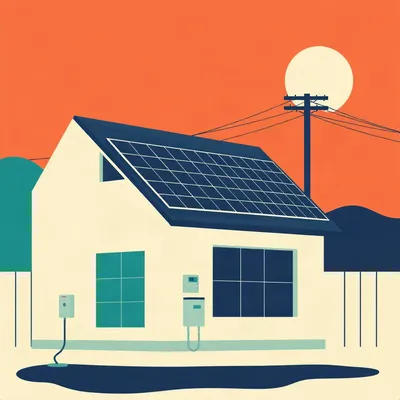
Daniel's been turning over a question about solar that's been nagging at him since we last talked about who gets to participate in the energy transition. His understanding of the standard model is this: a household puts panels on the roof, generates electricity, feeds it back through an outbound meter, and that generation gets offset against what they consume. Fine. But he's been wondering whether there's a second model. One where the generated energy doesn't do a round trip through the grid at all. His imagined version: the panels feed a step-up transformer, then a load balancer, and the load balancer prioritizes self-generated power, with the grid only kicking in as fallback when generation falls short. He's explicit that he's not an electrical engineer and suspects parts of this might be misfounded. So the actual question underneath the hardware is: is there any system that comes as close as feasibly possible to this self-consumption-first model for someone who prefers it over the grid round trip?

And the honest answer is yes, with one piece of hardware swapped out and one piece added. But before we get there, the instinct Daniel's describing is the foundation of an entire category of systems that most people don't know exists because the net metering model has so thoroughly dominated the conversation.
Right. Net metering treats the grid as a free battery. You push power out during the day when you're at work and the panels are cranking, your meter runs backward, and at night you pull back what you need. The bill nets out. It's elegant. It's also a regulatory construct, not a law of physics, and it assumes the utility wants your power and will credit you fairly for it.
The second model, the one Daniel's reaching for, is self-consumption first. Solar powers the house directly, surplus goes somewhere local, and the grid becomes the emergency contact rather than the trading partner. That's not science fiction. It's what hybrid inverters do every day. But the path there is different from what he imagined, and there's a regulatory wall in the middle of it that most people don't see until they're standing in front of it.
So let's correct the technical premise first, because Daniel asked us to, and then we can look at what actually exists, what it costs, and why the grid-feedback model persists despite the appeal of going it alone.
The step-up transformer is the part that doesn't belong. Residential solar in the US, and in most of Europe and Israel, operates at two hundred forty volts split-phase. That's what your house already runs on. The inverter's entire job is to match grid voltage and frequency exactly, so the power it produces is indistinguishable from what's coming down the street. It doesn't need to step anything up. A step-up transformer is what you'd use to feed medium-voltage distribution lines, thousands of volts, which is utility territory. That's the gear on poles, not the gear in your garage.
So Daniel's mental model has a transformer doing work the inverter already does.
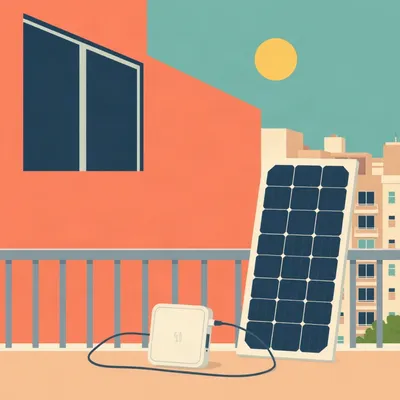
And the load balancer he's imagining, that's real, but it's not a separate box. It's the hybrid inverter. Sometimes called bidirectional or multi-mode. SMA's Sunny Boy and Sunny Island architecture does this, Enphase's IQ8 microinverters do it, Sol-Ark builds it into their whole product line. The inverter is monitoring the home's load profile second by second, deciding where every watt goes.
So the balancing function is real, it's just not called a load balancer, and it's not downstream of a transformer. It's the inverter itself.
Right. And here's the thing Daniel's instinct got right but the hardware got wrong. The inverter can prioritize solar for on-site loads all day long. That part is trivial. The problem is what happens when solar output exceeds what the house is drawing at that moment. The surplus has to go somewhere. Electricity is not patient. You can't just not use it.
That's the part people miss. The panels are producing whether or not the kettle is on. If you're generating six kilowatts at noon and the house is pulling two, there are four kilowatts looking for a home. Without a battery, the only sink available is the grid. So pure self-consumption-first without storage is physically impossible. You can consume first, but the surplus still exports.
Which is exactly why the battery is the missing piece in Daniel's model. Tesla's Powerwall has a mode called Self-Powered, and it is the closest commercial realization of what he's describing. Solar powers the house first. Surplus goes into the battery. Only when both solar and battery are exhausted does the system draw from the grid. The grid becomes the fallback, exactly as he wanted. Not a partner in a round trip.
So his model exists, but the hardware is a hybrid inverter plus a battery, not a transformer plus a load balancer. And the battery is not optional in that architecture. It's the thing that makes self-consumption possible at all.
Now the regulatory wall. Every grid-tied inverter in the US has to comply with UL 1741 and IEEE 1547, which mandate anti-islanding. When the grid goes down, your inverter must shut down. It cannot keep feeding power into your house wiring, because that wiring is physically connected to the grid, and if the grid is down, a lineman is out there trying to fix it. If your inverter keeps pushing power out, it backfeeds the line and can kill someone.
That's the detail that reframes everything. Daniel's model says grid as backup only. But the grid isn't just a fallback. It's a safety interlock. The inverter is legally required to stop working when the grid stops working, unless you have additional hardware that physically disconnects you from the grid and forms an island.
Which is the other piece of the SMA architecture, by the way. The Sunny Island is literally called that because it can form an island. It disconnects from the grid and keeps running off battery and solar. But that's a more expensive, more complex system, and it's still not what most people install.
So let's sit with the corrected picture. Daniel asked for a system where solar feeds the house directly, surplus is managed locally, and the grid is only touched when generation falls short. The answer is: yes, this exists, it's called a hybrid inverter with battery storage, and Tesla's Self-Powered mode is the best-known implementation. But there's a catch he didn't anticipate, which is that the grid connection is not optional in the way he hoped. It's a mandatory safety partner even when you're not buying power from it.
And that's the hardware reality. But the hardware only matters if the economics and regulations cooperate, and that's where the picture gets interesting.
Because here's the thing. Without a battery, self-consumption-first is strictly worse than net metering in most jurisdictions. You're giving away surplus during peak solar hours, when you're not home to use it, and then buying back at full retail rate at night. You've avoided the round trip, but you've also avoided being paid for your exports. That's a terrible trade.
The battery changes the math, but batteries are still expensive. In most markets, the payback period on a solar-plus-storage system stretches to eight to twelve years. That's not terrible, but it's longer than solar alone was five years ago, and it requires you to have the capital up front. The people who most want to avoid the grid round trip are often the people least able to front the cost of a battery.
Meanwhile, the regulatory ground is shifting under both models. Net metering is being rolled back or reduced in a lot of places. California's NEM 3.0 slashed export rates so hard that batteries became nearly mandatory for new solar installations to make economic sense. Other states are moving toward net billing, where your exports are credited at a lower rate than your consumption, or time-of-use rates that change the value of every kilowatt-hour depending on when you push it out.
Which means Daniel's question isn't landing on stable ground. The model he's asking about, self-consumption-first, was a niche preference five years ago. Now, in California, it's basically the default, because exporting power barely pays. The economics did what the philosophy couldn't. People are being pushed into self-consumption not because they dislike the round trip, but because the round trip stopped paying.
And that's where the deeper question surfaces. What is the grid for, if not a shared battery? Daniel's model is essentially, I'll handle myself, thanks. But the grid's economics depend on distributed generation feeding in. The fixed costs of maintaining the poles, the wires, the substations, those don't go away when households stop exporting. They get spread over fewer kilowatt-hours, which raises rates for everyone still connected.
This is the utility death spiral. As more people install solar and batteries and reduce their grid dependence, the remaining customers, who are disproportionately renters and lower-income households, absorb a larger share of the fixed costs. Rates go up. That makes solar and batteries even more attractive to the people who can afford them, which accelerates the cycle. It's not a hypothetical. It's been debated in regulatory proceedings for a decade.
So Daniel's preference for self-consumption isn't just a personal choice. At scale, it's a policy problem. The grid is a shared resource, and the people who leave it, or mostly leave it, still rely on it as the safety interlock we talked about. They still need it to be there when the battery is empty and the sun isn't shining. But they're paying less into it.
The practical sweet spot that's emerging is self-consumption-first with smart export. The system prioritizes home use and battery storage, but when the battery is full and export prices are favorable, it still pushes surplus to the grid. It's not Daniel's pure model. It's a compromise. But it's the one that actually works economically and politically. You get most of the self-sufficiency, and the grid gets some of the distributed generation it needs to stay solvent.
And the renter problem Daniel raised in his prompt, that's still unsolved. Community solar and virtual net metering are the emerging answers, where you subscribe to a share of a solar farm somewhere else and get credits on your bill. But they're marginal. And the self-consumption model doesn't help renters at all. It requires even more control over the physical premises than net metering does. You need the panels, the inverter, the battery, all installed on property you don't own.
So the person who prefers Daniel's second model is, by definition, a homeowner with capital and roof access. The renter is excluded from both models, but the self-consumption model excludes them more thoroughly, because there's no version of it that works through a subscription.
Which brings us to the question neither model fully answers. What happens to the people who can't put panels on their roof at all? And what happens to the grid when the people who can put panels up decide they'd rather not share?
I keep thinking about the fact that Daniel's instinct, the round trip is wasteful, is actually correct in a narrow sense. Every time you push power out and pull it back, there are losses. Transformer losses, line losses, conversion losses. It's maybe five to eight percent of the energy, gone. So his intuition that local consumption is more efficient is right. The problem is that the alternative, local storage, has its own losses and its own costs, and it's only recently that the economics have started to make sense.
And the grid does something else that a battery can't. It aggregates. It smooths. It lets one household's surplus cover another household's demand in real time. A battery is a single household's buffer. The grid is everyone's buffer. That's the part that gets lost in the self-consumption framing. The round trip isn't just about you. It's about the fact that your noon surplus is exactly what your neighbor's air conditioner wants at noon.
Which is why the death spiral is so dangerous. If everyone optimizes for themselves, the shared resource degrades, and everyone's worse off, including the people who thought they were escaping. You still need the grid. You just need it less often, but when you need it, you need it to be there.
Where does that leave Daniel's actual question? Is there a system that comes as close as feasibly possible to the self-consumption-first model? Yes. Hybrid inverter, battery, Self-Powered mode. The transformer and the separate load balancer were the wrong hardware, but the instinct was right, and the system he's imagining is not only feasible, it's becoming the default in places where net metering has been rolled back.
The grid as pure fallback, that's the part that doesn't quite work the way he hoped. Not because the technology can't do it, but because the safety regulations won't let it. The grid is a mandatory partner, even when you're not buying from it, because the wires are shared and the linemen need to know they're dead.
The grid as emergency contact rather than trading partner, that's the phrase. But the emergency contact still has to be on the line.

SMA Sunny Island. Four thousand eight hundred dollars for the inverter alone, not counting the battery bank.
That's the islanding hardware I was talking about.
I had one. Early two thousands, Arizona, rental property I owned. Grid-tied array on the roof, before the utility had any mechanism to credit small exports. There was no net metering yet. I watched the meter spin backward during the day and forward at night, and the bill came out the same as if I'd never installed the panels.
You were giving power away.
Every afternoon. The array was sized for the daytime load, which meant it was oversized for what the tenant actually used, because the tenant was at work during the day. So the surplus just went out to the street. No credit, no offset, nothing. At night, the house pulled from the grid at full retail. I was running a small unsubsidized power plant for the utility.
That's the pre-net-metering world. The historical default Daniel's asking about.
It's what people did before the billing structure existed. You either disconnected entirely, or you ate the loss. I eventually disconnected the export and ran the system purely for self-consumption. Meant the panels only did anything when the sun was up and someone was home to use it. After dark, useless.
You lived Daniel's model, and it was worse.
It was the only option. I put a lead-acid battery bank in the garage. Eight batteries, flooded cells, had to check the water level every month. The whole rack weighed more than my car. Lasted four years before the capacity dropped enough that it wasn't worth the maintenance.
Lead-acid. That's the part people forget. The lithium batteries we talk about now, the Powerwall, the Enphase, those didn't exist in the early two thousands. The only storage option was lead-acid, and it was heavy, toxic, and short-lived.
I sold the property eventually. The tenant complained about the inverter hum in the utility closet. It was right next to the bedroom wall. I offered to move it, but the quote came back at two thousand dollars for the rewiring, and I decided it wasn't worth it.
The renter bore the annoyance of the hardware and got none of the benefit.
He got a lower bill, actually. The self-consumption did offset his daytime use on weekends. But he didn't see it that way. He heard the hum every night.
That's the detail that loops back to Daniel's original point. Renters are excluded from the energy transition, except when they're not excluded from the costs. They get the noise, the closet space, the maintenance visits, and the benefit goes to the owner.
The owner in this case was Hilbert, who discovered that the model he'd installed didn't work because the regulatory framework didn't exist yet. Now the regulatory framework exists, and it's being dismantled. We're going backward, in a sense.
The utility never did figure out how to credit me. I called them twice. The first time they told me the meter wasn't designed for it. The second time they offered to install a second meter at my expense, which would have cost more than the panels.
The round trip Daniel wants to avoid, that's actually the thing that made rooftop solar viable for small property owners. Net metering was the subsidy that made the math work. Without it, you're back to Hilbert's world, oversized arrays and lead-acid batteries and giving away your noon surplus.
That's the inversion. The round trip isn't waste. It's the mechanism that lets distributed generation participate in the grid at all. Daniel's instinct was that the round trip is inefficient, and in a narrow sense he's right. But the alternative, the self-consumption model, only works if you can afford the battery, and the battery only pays for itself if export rates are bad enough that avoiding the round trip is worth more than the round trip pays.
I kept the charge controller. It's in a box somewhere.
The charge controller. That's the piece that regulated the charging current from the panels to the lead-acid bank. Without it, the batteries would overcharge and boil off the electrolyte.
It was a Trace. Solid unit. Never failed.
Trace Engineering. That's a name that doesn't exist anymore. They got bought out by Xantrex, and then the whole off-grid inverter market consolidated.
I paid six hundred dollars for it in nineteen ninety-eight. Still works, as far as I know.
The fact that a charge controller from nineteen ninety-eight still works while the battery bank it was charging died after four years tells you everything about where the weak point is in these systems.
It's the storage. It's always the storage. The panels last twenty-five years, the inverter lasts ten to fifteen, and the battery is the consumable. Lithium is better than lead-acid, but it's still the part that wears out first.
The tenant never knew what the system was doing. He just knew the closet hummed. I don't think he ever looked at the bill closely enough to notice the offset.
Which is the renter problem in miniature. The benefit is invisible, the annoyance is audible, and the person experiencing the annoyance isn't the person making the decision.
Daniel's question, is there a system that comes close to the self-consumption-first model, the answer is yes, and Hilbert's story is the proof that it predates the question. But the reason it didn't stick, the reason net metering displaced it, is that the round trip is actually the cheaper way to do distributed solar, as long as the utility is willing to play along.
The utility's willingness to play along is exactly what's eroding. NEM 3.0, net billing, time-of-use rates. The regulatory framework that made the round trip attractive is being dismantled, and the self-consumption model is becoming the default again, not because it's better, but because it's the only one left.
We're not choosing between two models. We're watching the pendulum swing back toward the model Hilbert was forced into twenty years ago, except now the batteries are better and the inverters are smarter and the economics are still brutal.
The one thing I'd want a listener to take from this is that the grid isn't just a backup, and it isn't just a trading partner. It's the safety interlock that makes all of this legal, and the shared resource that makes it affordable. Daniel's instinct, consume first, export only surplus, that's not wrong. It's just not a way to escape the grid. It's a way to change your relationship with it.
The relationship is changing whether anyone wants it to or not. The question is whether the regulations can keep up with the hardware, or whether we're all going to end up like Hilbert, watching the meter spin backward and getting nothing for it.
The open question I keep coming back to is what happens when net metering is gone and batteries are cheap enough that self-consumption becomes the default for anyone with a roof. Does the grid become a backup service that everyone pays a fixed fee for, like insurance? And who pays for the poles if the people with solar have mostly stopped buying energy?
That's the death spiral made concrete. The grid becomes a fixed cost with a shrinking customer base, and the people left on it are the ones who can't afford to leave. That's not a stable equilibrium.
No, it's not. And it's the thing Daniel's question brushes up against without quite naming. He wants a system where the grid is fallback only. But fallback only still requires the grid to exist, to be maintained, to be staffed. Someone has to pay for the linemen who need the anti-islanding protection to work.
The answer to Daniel's question is yes, the system exists, it's a hybrid inverter and a battery, and it's called self-consumption-first. But the grid isn't going anywhere, and the round trip he wanted to avoid is actually the thing that's been subsidizing his ability to avoid it.
Thanks to Hilbert Flumingtop for producing, and for the charge controller that's still in a box somewhere.
This has been My Weird Prompts, the human-AI collaboration podcast. If you want to send us your own weird prompt, email us at show at my weird prompts dot com.
We'll be back soon.