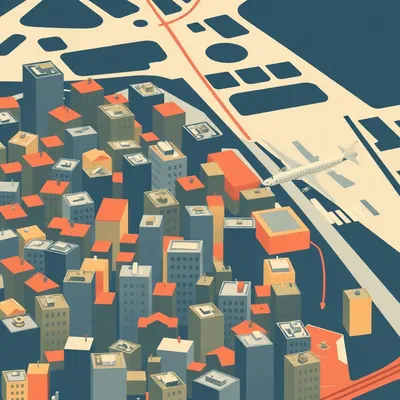
Daniel sent us this one — he's asking about the Dahiyeh neighborhood in Beirut, which the IDF has been striking for weeks now. The conventional line is that Iran's drawing a red line around Beirut because the airport lets them smuggle weapons to Hezbollah. But that explanation doesn't hold up. If the airport were the real concern, the red line would be at the runway, not wrapped around three square kilometers of dense urban neighborhood. So what's actually driving this? What's beneath the stated rationale?

The timing matters. As of right now, we've seen at least fourteen confirmed IDF strikes on Dahiyeh since January, and Iran keeps signaling retaliation without executing it. The gap between the rhetoric and the action is where the real strategic logic lives.
If the red line is real, why aren't they enforcing it? If it's a bluff, why keep drawing it? The contradiction is the story.
Let's define the thing first. Iran's position is that attacks on Beirut — and Dahiyeh specifically — will trigger a direct Iranian military response. Not just a Hezbollah rocket barrage. A response from Iran proper. That's the escalation threshold they've communicated, both publicly and through back channels.
The surface-level explanations are what you'd expect. Dahiyeh is dense — half a million people in about three square kilometers, one of the tightest urban footprints in the Middle East. There are hospitals, schools, the airport right there. It's political symbolism — strike the capital, you strike the state. Then there's the logistics argument: the Beirut-Rafic Hariri airport handled eight point three million passengers in twenty twenty-three, plenty of civilian cover for cargo.
All true, none sufficient. The airport is a logistics node — but logistics nodes can be relocated, rerouted, hardened. Iran's been running weapons through Syria, through sea routes, through overland corridors for years. Losing the airport would hurt. It wouldn't be existential.
The real question is: what's in Dahiyeh that can't be replicated somewhere else?
Command and control. And this is where the layered defense doctrine comes in — Iran's defense-in-depth architecture. If you want to understand why Dahiyeh matters, you need to see where it sits in the stack.
Walk me through the layers.
Layer one is forward defense — proxies and militias in Syria, Iraq, Yemen, Gaza. The idea is to fight Israel and American interests as far from Iranian borders as possible. Layer two is layered deterrence — that's Hezbollah, the crown jewel, positioned in Lebanon with precision-guided munitions and the ability to strike deep into Israel. Hezbollah is the second-strike capability, the thing that makes Israel pause before hitting Iran directly. Layer three is strategic depth — Iranian territory itself, the sanctuary, protected by everything in front of it.
Dahiyeh sits at the seam of layers one and two.
It's not just a neighborhood. It's the physical location where forward defense connects to deterrence. Hezbollah's Shura Council — the seven-member body that makes operational decisions — at least three members maintain primary residences in Dahiyeh. The operational planning centers are there. The liaison architecture with Iran's Quds Force is embedded there. This is where Iranian officers coordinate directly with Hezbollah commanders in real time.
It's the brain stem.
It's the brain stem, the spinal cord, and a significant chunk of the nervous system. And here's the thing about command and control infrastructure — unlike weapons stockpiles or training camps, you can't just dig a new one. The institutional knowledge, the relationships, the communication protocols, the trust networks — those are built over decades and they're physically concentrated in Dahiyeh.
Which means if Israel destroys that node, they're not destroying inventory. They're destroying coordination capacity. The ability to connect Iranian strategic intent to Hezbollah operational execution.
That's the nightmare scenario for Tehran. Without that coordination architecture, Hezbollah doesn't disappear — but it becomes operationally independent. It starts making decisions based on its own calculus, its own threat perception, its own interests in Lebanese politics. Iran loses the steering wheel.
There's an irony there. Iran needs Hezbollah strong enough to deter Israel, but not so autonomous that it acts without permission. Dahiyeh is the leash.
It's a mutual hostage situation, really. Hezbollah needs Iran for funding, weapons, political cover. Iran needs Hezbollah for forward deterrence. Dahiyeh is the physical manifestation of that dependency. If Israel levels the command and control capability, Hezbollah doesn't cease to exist — it just stops being Iran's proxy and becomes something more like an independent actor with a massive rocket arsenal.
Which might actually be more dangerous from Israel's perspective, but it's a strategic disaster from Iran's. They lose the ability to calibrate.
Calibration is everything in Iranian doctrine. This is the key misconception most coverage misses. People look at Iran's red lines and say, well, they didn't respond, so the red line was a bluff. That's not how Iran operates. Their response doctrine involves calibrated, delayed retaliation. The absence of an immediate response isn't weakness — it's the signal that they're still deciding where on the escalation ladder they want to land.
How does that work in practice? If you're an Iranian national security advisor looking at fourteen strikes on your most valuable forward asset, what's the actual decision process? Are you in a room with a whiteboard listing response options ranked by visibility?
That's closer to the truth than you might think. The Iranian system has a structured escalation ladder — it's not formalized in a single document, but it's deeply embedded in how the Supreme National Security Council operates. They categorize responses by what they call "visibility bands." Band one is fully deniable — cyber attacks routed through third-country servers, proxy strikes where the fingerprints are scrubbed. Band two is attributable but indirect — Hezbollah launches rockets but Iran maintains plausible distance. Band three is attributable and direct but limited — Iranian territory is used, but the target is military and the strike is telegraphed. Band four is overt and unconstrained — that's the war nobody wants.
The fourteen strikes haven't triggered a response because they haven't crossed whatever internal threshold moves the needle from band two to band three.
And the threshold isn't just about physical damage. It's about whether the command and control architecture is actually degraded. Israel can drop bombs on Dahiyeh and make rubble, but if the Shura Council is still meeting, if the Quds Force liaisons are still coordinating, if the communication protocols are still functioning — then the red line hasn't been crossed in Iran's internal calculus. The strikes are theater until they hit the thing that actually matters.
The physical destruction is almost secondary. It's about whether the coordination function is interrupted.
Think of it like a corporate headquarters. You can bomb the cafeteria, the parking garage, the lobby. The stock price dips, there's bad press, but the C-suite is still making decisions. It's only when you take out the boardroom that the company stops functioning. Iran is watching to see whether Israel is hitting the boardroom or just the parking garage.
The Soleimani precedent is instructive here.
It's the perfect case study. January twenty twenty — the US kills Qasem Soleimani, Iran's most important military commander. That crossed what Iran considered an absolute red line: no attacks on senior Iranian officials. Iran's response? Then they launched ballistic missiles at Ain al-Asad airbase in Iraq. They telegraphed the strike through back channels so the US could evacuate personnel. Zero American casualties. But the message was received: we will respond kinetically, from Iranian territory, with our own missiles. Deterrence restored without triggering war.
The response was designed to be survivable.
Designed to demonstrate capability and resolve while giving the other side room to de-escalate. That's the Iranian playbook. So when we see them drawing a red line around Dahiyeh and then not responding to strikes, the correct read is not "bluff." It's "they haven't decided the threshold has been crossed yet.
The Soleimani case is actually a perfect illustration of the visibility bands you mentioned. That was a band three response — attributable, direct, from Iranian territory, but limited and telegraphed. They climbed the ladder exactly one rung above where they'd been operating.
They climbed it deliberately, slowly, with maximum signaling. The delay wasn't indecision. The delay was the signal. It said: we are choosing this response carefully. We are not being dragged into escalation by emotion. We are in control of the pace.
Which brings us to the signaling asymmetry problem. If Israel can normalize strikes on Beirut — if Dahiyeh becomes just another target set — the entire ladder of escalation collapses.
This is the thing. The distinction between proxy war and direct war depends on there being zones that are treated differently. Gaza is one category. Southern Lebanon is another. Beirut is supposed to be a third — the capital, the political center, the place where the rules are different.
Once Beirut is treated like any other battlefield, Iran loses the ability to escalate gradually. There's no rung left above "they're bombing our command center" except "we launch from Iranian soil." The ladder goes from rung four to rung ten with nothing in between.
Iran's entire strategic posture depends on having lots of rungs. They don't want a binary choice between doing nothing and launching a full-scale missile barrage. They want calibrated options: cyber attacks, proxy strikes in third countries, attacks on Israeli assets abroad, limited kinetic strikes that demonstrate capability without triggering all-out war.
Let me push on that, though. What happens if Israel intentionally compresses the ladder? What if the strategy is precisely to eliminate those intermediate rungs so that Iran faces exactly that binary choice — and then banks on Iran choosing "do nothing" because the alternative is catastrophic?
That's the Israeli gamble. And it's not a crazy one. If you're sitting in Tel Aviv, you look at Iran's behavior over the past decade and you see a pattern: they talk big, they draw lines, and when those lines are crossed, they find a way to respond that doesn't escalate. The Israeli bet is that this pattern holds — that Iran's preference for calibration is so strong that they'll absorb more damage than anyone expects rather than risk a direct war.
That's a bet, not a certainty. And the problem with betting on your adversary's restraint is that restraint is a choice, not a law of physics. It can change.
It can change in a single meeting. The supreme leader could wake up one morning, look at the domestic pressure, look at the IRGC's frustration, look at the erosion of deterrence credibility, and decide that the cost of not responding has finally exceeded the cost of responding. That's the cliff edge nobody can see until they're over it.
The February twenty twenty-five strike on the IRGC facility in Damascus is a good example of the non-Dahiyeh playbook.
Israel hits an IRGC facility in Syria. Iran's response? A cyber attack on Israeli water systems. Deniable, asymmetric, below the threshold of war, but unmistakably a response. Dahiyeh is different because it's not deniable. You can't hack your way to compensating for the loss of your forward command node. The response has to be visible.
That's the bind. If the response is too visible, it triggers the war Iran has spent forty years avoiding. If it's too deniable, it signals that the red line wasn't real, and Israel keeps striking.
Which is why they're stalling. Every day they don't respond, they're buying time to figure out what a calibrated Dahiyeh response even looks like.
If Dahiyeh is so valuable, why hasn't Iran already responded to the strikes? The answer takes us into the domestic politics of Tehran.
This is where it gets fascinating. Dahiyeh is not just a military asset. It's a symbol of Iran's ability to project power into the Arab world. For forty years, the Islamic Republic has sold its population and its security establishment on the idea that Iran is a regional power — not a isolated pariah, but the leader of an "axis of resistance" that stretches from Tehran to the Mediterranean.
Dahiyeh is the Mediterranean endpoint of that axis.
It's the proof of concept. It's where Iranian money, Iranian training, Iranian weapons, and Iranian ideology produced a military organization that can threaten Israel from its northern border. If Dahiyeh is destroyed without an Iranian response, what does that say to the IRGC rank and file? What does it say to the hardliners who've been arguing that engagement with the West is weakness?
The internal rivalry angle is underappreciated. Iran's security establishment isn't monolithic.
Not even close. You've got the IRGC Quds Force, which built Hezbollah and sees it as their legacy project. You've got the regular army, the Artesh, which has always resented the resources poured into proxy forces. You've got the intelligence ministry, which runs its own parallel networks. You've got the political leadership, which has to manage the economic consequences of sanctions and the domestic legitimacy crisis.
Each of those factions reads the Dahiyeh red line differently.
For the Quds Force, it's existential. This is their life's work. For the Artesh, it's a chance to say "we told you so" — pouring billions into foreign adventures while Iran's conventional military atrophies. For the politicians, Dahiyeh is a bargaining chip in nuclear negotiations. Every faction is watching to see whether the supreme leader will actually authorize a response, and what kind.
The Artesh angle is worth pulling on for a second. How much resentment are we actually talking about? Give me a sense of the resource disparity.
It's staggering. Conservative estimates put IRGC funding at roughly two to three times the Artesh budget, despite the Artesh being responsible for defending Iran's territorial integrity — the thing that's actually in the constitution. The Artesh has aging Soviet-era airframes, tanks from the Shah's era that have been retrofitted six times over, and a navy that's essentially a coastal defense force. Meanwhile, the Quds Force has moved precision-guided munitions, drone technology, and advanced missile systems to Hezbollah. Every time an Artesh general watches a Hezbollah propaganda video showing missile guidance systems his own units don't have, the resentment deepens.
The Artesh isn't exactly rooting for a successful Quds Force defense of Dahiyeh.
They'd never say it publicly, but there are absolutely Artesh commanders who would view a Quds Force humiliation in Dahiyeh as a corrective — as evidence that Iran's security strategy has been lopsided and needs rebalancing toward conventional defense. That doesn't mean they want Israel to win. It means they want the supreme leader to conclude that the proxy strategy has hit its limits.
Which means the supreme leader isn't just managing a conflict with Israel. He's managing a civil war inside his own security apparatus.
That's the real decision matrix. It's not "will Iran respond." It's "what response satisfies the IRGC base without triggering a war that collapses the economy.
We've covered the military and political logic. But there's a third layer that rarely gets discussed — how the Dahiyeh red line fits into Iran's nuclear negotiation strategy.
This is the shadow game. As of early twenty twenty-six, Iran is in indirect talks with the US over a new framework to replace the JCPOA. The Dahiyeh red line is partly a bargaining chip. Iran is signaling: we will trade restraint on Beirut for sanctions relief.
The logic being: you want us to stop arming Hezbollah? That's worth something. You want us to pull back our forward defense posture?
If Israel keeps striking Dahiyeh, Iran loses that leverage. You can't trade something you've already lost. So the red line is also about preserving negotiating assets. Every day Dahiyeh stands, it's worth something at the table. Every strike that degrades it reduces Iran's bargaining position.
Which creates a perverse incentive. Iran needs Dahiyeh intact not just for military reasons, but because its destruction would weaken their hand in nuclear talks. The red line is defensive in multiple dimensions.
It connects to the Russia and China angle. Iran is watching how Moscow and Beijing react to Israeli strikes on Iranian proxies. Russia has its own interests in Syria — they've been coordinating with Israel on deconfliction for years. China has Belt and Road investments and energy deals that depend on regional stability.
A weak response on Dahiyeh signals to both that Iran can't protect its own assets.
That undermines negotiations on arms deals, infrastructure projects, energy contracts. If you're a Chinese state-owned enterprise looking at a multi-billion dollar investment in Iranian infrastructure, and you see Israel destroying the neighborhood that houses Iran's most important proxy force without any meaningful response, you start recalculating your risk exposure.
There's an interesting parallel here with how insurance markets work. If your house gets burgled and you don't file a claim, the insurer doesn't think you're stoic — they think you're a soft target and they raise your premium anyway. Iran is in the same position. Not responding doesn't look like restraint to Beijing and Moscow. It looks like incapacity.
And incapacity is contagious in the perception of allies. If Iran can't protect Hezbollah's command center in Beirut, can it protect Chinese personnel in Khuzestan? Can it guarantee Russian radar installations in Syria? The credibility of every security guarantee Iran has issued gets marked down.
The Dahiyeh response isn't just about Israel. It's about Iran's credit rating as a security guarantor across its entire network of relationships.
That credit rating has been under pressure for a while. The April twenty twenty-four exchange is worth revisiting as a benchmark here. Iran launched about three hundred drones and missiles at Israel. Ninety-nine percent were intercepted, according to Israeli and US sources. But the scale was unprecedented — it was the first direct Iranian attack on Israel from Iranian territory.
The response was carefully choreographed. Tehran telegraphed it for days. They used slow-moving drones that gave Israel and the US hours of warning. They launched from positions that were easily tracked. The goal was never to overwhelm Israeli defenses. The goal was to demonstrate that they could reach Israeli territory if they wanted to.
The October twenty twenty-four Israeli strikes on Iranian air defenses were the counter-test. Israel demonstrated it could degrade Iran's ability to protect its own airspace. Both sides have been probing each other's red lines, calibrating what's acceptable.
Dahiyeh is the next test in that sequence. But it's a harder test for Iran because the asset is not on Iranian soil. The response has to be visible enough to matter, but not so visible that it invites Israeli strikes on Iran proper.
That geographic wrinkle changes everything. When the Soleimani strike happened, Iran could respond from its own territory because the provocation was on its own personnel. The symmetry was clean. With Dahiyeh, the provocation is in Lebanon, but the red line was drawn by Iran. So does a response from Iranian territory look proportionate, or does it look like Iran is escalating a Lebanese fight into a regional war?
That's the optics trap. If Iran responds from Iranian soil to a strike on Lebanese soil, Israel can frame it as Iranian aggression rather than Iranian retaliation. Iran loses the moral high ground it's carefully cultivated in the Arab world.
Which is probably why they're so stuck. The cleanest response — visible, kinetic, from Iranian territory — is also the riskiest diplomatically. The safer responses — cyber, proxy, deniable — don't demonstrate enough resolve to restore deterrence. They're caught between two bad options and they're hoping a third one materializes.
We have multiple overlapping games. Military deterrence, domestic faction management, nuclear negotiations, great-power relationships. The Dahiyeh red line sits at the intersection of all of them.
That's why the conventional explanation — it's about the airport, it's about civilian cover — misses the point entirely. The airport is a secondary concern. The primary asset is the command and control infrastructure that cannot be relocated. The secondary asset is the signaling architecture that allows Iran to manage escalation. The tertiary asset is the political symbolism that keeps the axis of resistance coherent.
What should analysts and decision-makers actually watch for?
The key indicator is not whether Iran responds kinetically. It's what kind of non-kinetic response they mount first. Cyber attacks on Israeli infrastructure. Proxy strikes on Israeli embassies or tourists in third countries. A diplomatic walkout from the nuclear talks. Those are the signals that Iran considers the red line crossed — they're testing Israel's tolerance before escalating to something visible.
The timeline matters. If Iran doesn't respond within seventy-two hours of a major strike, history suggests they're still calibrating. But if the response comes within hours, that's a different signal entirely — that means the decision was pre-authorized, and the escalation ladder has already been climbed.
For investors and risk managers, the Dahiyeh red line creates a volatility cluster. Lebanese sovereign debt, Beirut real estate, Israeli defense stocks — these all move on whether Iran responds and how. If Iran does not respond to a major strike within seventy-two hours, expect a de-escalation rally. That's the pattern from previous threshold tests.
Can we put some numbers on that? What did the April twenty twenty-four exchange do to those markets?
Israeli defense stocks spiked about twelve percent in the forty-eight hours after the drone launches, then gave back most of those gains when it became clear the response was choreographed and contained. Lebanese sovereign bonds — which were already trading at distressed levels, around six cents on the dollar — dropped another fifteen percent on the uncertainty. Beirut real estate, which had been showing tentative recovery signals, saw transaction volume collapse by roughly forty percent in the following quarter. The pattern is consistent: the initial shock moves markets sharply, and then the character of the response determines whether those moves stick.
If you're managing a portfolio with Middle East exposure, the seventy-two hour window after a major Dahiyeh strike is your decision window. By hour seventy-three, you should know whether you're in a de-escalation rally or a sustained risk-off environment.
That's the pattern. And it's held through at least four threshold tests since twenty twenty.
For policy watchers, the real red line is not Dahiyeh itself. It's the command and control architecture inside it. If Israel can surgically destroy that without mass civilian casualties, Iran's response will likely be muted — they'll find a deniable way to respond and move on. But if civilian casualties spike, the red line becomes self-enforcing through Arab public opinion. Iran can't afford to look indifferent to dead civilians in Beirut.
That's the paradox. The more precise Israel's strikes, the more room Iran has to calibrate. The more indiscriminate the damage, the less flexibility Iran has. Civilian casualties compress the decision space.
Which means the humanitarian dimension, which everyone assumes is just window dressing, actually shapes the strategic calculus in a very concrete way.
It's not that Iran cares about Lebanese civilians in any meaningful humanitarian sense. It's that civilian casualties create a political cost that constrains Iran's options. They can't be seen shrugging off dead Arabs when their entire regional legitimacy is built on being the defender of the oppressed.
There's a grim irony there. The thing that might actually trigger the war — mass civilian casualties — is also the thing that makes the war harder for Iran to win politically. They'd be avenging dead civilians by starting a conflict that would kill more civilians. The propaganda victory evaporates on contact with the reality of a shooting war.
That's another reason they're stalling. They know that if they're pushed into a corner by civilian casualties, the response they're forced into might be strategically counterproductive. They'd be acting to satisfy a domestic and regional audience in the short term while creating a long-term disaster. Nobody wants to be the decision-maker who starts a war they know they'll lose just because they couldn't find a way to not start it.
Let me pull this together into something actionable. There are three things to watch. One: the character of any Iranian response. If it's cyber or third-country proxy, the red line was tested but not fully crossed. If it's kinetic from Iranian territory, the threshold has been breached and we're in a new phase. Two: the seventy-two hour clock. No response in three days means calibration is ongoing. Immediate response means pre-authorization. Three: the civilian casualty count. Low casualties give Iran room. High casualties take it away.
Watch the nuclear talks. If Iran walks out or suspends participation, that's a signal they're prioritizing the Dahiyeh response over diplomatic engagement. If they stay at the table while responding, they're managing both tracks simultaneously — which tells you they still see the red line as negotiable rather than absolute.
Here's the open question that keeps me up. What happens when both sides have drawn red lines that overlap? Israel says no Iranian entrenchment in Syria. Iran says no strikes on Beirut. These are mutually exclusive. The forward defense architecture that Israel is trying to dismantle is the same architecture that Iran has declared off-limits.
That's the structural instability. Both red lines can't hold simultaneously. One side has to blink, or both sides have to agree on an implicit boundary that neither has articulated yet. The next six to twelve months will determine whether Dahiyeh becomes a stable deterrence boundary — the kind of thing where both sides know where the line is and avoid crossing it — or the trigger for the first direct Iran-Israel war since the April twenty twenty-four exchange.
The difference between those two outcomes might come down to a single strike, a single miscalculation, a single building in a three-square-kilometer neighborhood that houses the fragile machinery of deterrence.
That's why the Dahiyeh red line matters. It's not about an airport. It's about whether the architecture that has prevented a direct Iran-Israel war for decades can survive the current pressure. If Dahiyeh falls, the ladder of escalation goes with it. And what comes after isn't calibrated. It's binary. Strike, counterstrike, war.
That's the real red line. Not a neighborhood in Beirut. The entire edifice of managed conflict.
And now: Hilbert's daily fun fact.

Honeybees in New Zealand's South Island have developed a distinct waggle-dance dialect that incorporates a longer vibration phase than their North Island counterparts, an unintended consequence of the Southern Alps creating isolated populations that evolved separate communication patterns over just a hundred and fifty years.
The bees are culturally distinct. Of course they are.
That's going to sit in my head all day.
This has been My Weird Prompts. Thanks to our producer Hilbert Flumingtop. If you want more analysis that goes past the headlines and into the strategic architecture, find us at myweirdprompts dot com or wherever you get your podcasts. Leave us a review — it genuinely helps.
Until next time, watch the seventy-two hour clock.