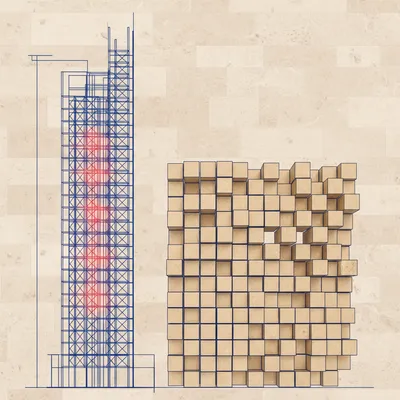
Daniel sent us this one — and it's a follow-up to something we've been chewing on. We've established that six-story urban fabric can actually house more people per hectare than forty-story towers, because towers bleed floor area into elevator cores, double-loaded corridors, fire stairwells, and HVAC shafts. The question now is: how did six stories become the historical default in the first place? And what real-world cities prove that this kind of mid-rise blanket development can replace car-dependent suburbs entirely? Because if the numbers hold, you could house vast populations without a single skyscraper.

The historical part is where this gets genuinely fascinating — because six stories wasn't chosen. It was imposed. By physics, by fire, by human legs, and by building codes that converged on the same number independently across continents. Before we even had zoning, we had a ceiling, and it was about eighty-five feet.
Eighty-five feet and a set of lungs.
Let's start with the most basic constraint: stairs. Before Elisha Otis demonstrated his safety elevator at the New York Crystal Palace exhibition in eighteen fifty-three, buildings taller than six stories were functionally absurd for anyone who wasn't a monk or a lighthouse keeper. People simply wouldn't climb more than about eighty steps on a regular basis. That's not a cultural preference — it's biomechanics. Six stories is roughly the point where the daily vertical commute becomes punishing.
The walk-up is not a charming retro typology. It's the maximum height at which a staircase is tolerable for daily use, and anything above that requires an elevator, which immediately changes the economics and the floorplate.
And the elevator didn't just make tall buildings possible — it made them worse in specific ways. A hydraulic elevator in a six-story building costs about forty percent less than a traction elevator in a high-rise and consumes fifteen to twenty-five percent less floor area. Once you go above six or seven stories, you typically need a traction elevator, which requires a machine room, deeper pit, heavier cables, more structural reinforcement. The elevator system alone can devour fifteen to twenty percent of your gross floor area in a forty-story tower.
The elevator giveth, and the elevator taketh away.
Before the elevator even existed, cities across the world independently arrived at five to seven stories as the practical maximum. This is not a coincidence. It's a convergence. Paris, Berlin, Vienna, New York, Barcelona — they all hit the same ceiling for overlapping reasons.
Let's walk through the Parisian model, because it's the most influential. Haussmann's boulevards.
Between eighteen fifty-three and eighteen seventy, Baron Haussmann essentially rebuilt Paris under Napoleon the Third. The building code he enforced standardized six-story buildings with ground-floor commercial space, five residential floors above that, and a servants' attic tucked under the mansard roof. The facade heights were regulated to match the width of the street — wider boulevards got slightly taller buildings, but the ceiling was essentially six stories with a roof pitch. And the densities this produced are staggering. The sixth arrondissement today achieves about four hundred fifty people per hectare. That's with no building over seven stories. Compare that to Houston, which houses about fifteen hundred people per square kilometer — fifteen per hectare. Paris is housing thirty times the density with no towers.
These Haussmann buildings are not cramped tenements. They're some of the most desirable real estate on earth.
The Haussmann typology created what we'd now call mixed-use walkable density. Ground floor retail means you have bakeries, cafés, bookshops at street level. The first residential floor — what the French call the entresol or mezzanine — was originally for shopkeepers. Then floors two through five for the bourgeoisie, with ceiling heights decreasing as you go up. The sixth floor under the roof was for servants. This vertical social stratification is problematic by modern standards, but the physical form is brilliant. It creates a continuous street wall, activates the ground plane, and achieves densities that modern tower-in-a-park developments can't match.
Because the tower-in-a-park wastes the ground. It's got a lobby, a driveway, maybe a sad patch of grass that nobody uses, and the building occupies maybe thirty percent of the lot. The Haussmann block builds on nearly the whole site, wraps around a courtyard, and the street is the public space.
The floor area ratio math is instructive here. A six-story building on sixty percent lot coverage achieves a floor area ratio of three point six. That's about two hundred dwelling units per hectare. A forty-story tower on twenty percent lot coverage — which is generous for a tower — achieves a floor area ratio of eight, but half of that gets eaten by elevators, corridors, and mechanical systems, so the net sellable area might be closer to a floor area ratio of four. You've built forty stories to get roughly the same net density as six.
Spent a fortune doing it.
Embodied a massive amount of carbon in the steel and concrete. But let me stay on the historical mechanism for a moment, because Paris wasn't the only city converging on six stories. Berlin's Gründerzeit blocks — the perimeter block buildings constructed between eighteen seventy and nineteen fourteen — typically reached five to six stories around inner courtyards. Some of these districts achieved six hundred people per hectare. That's denser than most Manhattan neighborhoods. Vienna's Ringstrasse, built in the eighteen sixties, standardized six-story buildings along the grand boulevard, and those remain among the most sought-after residential addresses in Europe.
All before widespread elevators.
All before elevators were common in residential buildings. And then there's the fire safety angle, which I think is underappreciated. Before steel-frame construction and modern fireproofing, six stories was the practical limit for firefighter ladder reach. Aerial ladders in the eighteen nineties maxed out at about eighty-five feet. That's roughly six stories to the windowsill of the top floor. Even today, many fire departments' standard aerial ladders top out around a hundred feet. The six-story threshold wasn't just about legs and elevators — it was about whether someone could rescue you from your bedroom window.
We've got human physiology saying six stories. Elevator economics saying six stories. Fire departments saying six stories. And then building codes codify it.
The American tenement tradition tells a parallel story. New York's Tenement House Act of eighteen seventy-nine — the so-called Old Law — regulated tenement design after reformers exposed conditions in buildings that packed too many people onto lots with no light or air. The eighteen seventy-nine law produced the famous "dumbbell" tenement, with narrow air shafts in the middle, typically five to six stories tall. Then the New Law of nineteen oh one improved things further — required larger courtyards, better ventilation, bathrooms in each unit — and the standard height remained five to six stories. The lawmakers understood that above six stories, you needed entirely different and more expensive construction methods.
The dumbbell tenement — named because the floor plan looks like a dumbbell, pinched in the middle where the air shaft cuts in.
And the air shaft was a compromise. Builders wanted to maximize lot coverage, reformers wanted light and air, and the dumbbell shape was the resulting compromise. It wasn't great — the shafts were often dark and became garbage chutes — but the height constraint was never seriously challenged. Six stories was the ceiling for a reason.
The history is clear: six stories is not an arbitrary preference. It's the emergent equilibrium of multiple independent constraints. But here's where I want to push. Christopher Alexander, in A Pattern Language from nineteen seventy-seven, makes an explicit recommendation: four to six stories is the ideal building height. And his reasoning goes beyond the technical constraints. He argues that anything taller alienates residents from street life. You can't recognize a face from the twentieth floor. You can't call down to your kid playing in the courtyard. The connection to the ground is severed.
Alexander's argument is essentially anthropological. He says that above four stories, people begin to lose a sense of connection to the street. By six stories, you can still see facial expressions, hear voices, feel like you're part of what's happening below. Above that, you're an observer, not a participant. And there's some empirical backing for this. Studies of social interaction in high-rises consistently show that residents above the sixth floor report fewer casual social contacts with neighbors, less sense of community, and more anonymity.
The high-rise as social isolation machine.
It's not deterministic — people form communities in towers all the time — but the form works against it. A six-story building with a stoop or a small front courtyard creates what urbanists call "eyes on the street." Jane Jacobs's phrase, of course. The threshold between private and public is permeable. In a tower, that threshold is a lobby with a doorman or a keycard. It's a hard boundary.
We've traced the origin story. Multiple independent constraints all pointing to the same number. Now let's get to the proof cases. You mentioned Paris. Let's go deeper on the numbers, and then hit Barcelona, Montreal, and Tokyo.
Paris intra-muros — the city within the Périphérique ring road — is a hundred and five square kilometers. It houses two point one million people. That's twenty thousand people per square kilometer. The entire city is essentially six-story urban fabric. There's Montparnasse Tower, which everyone hates, and a few clusters in the thirteenth arrondissement and La Défense outside the city proper, but the core of Paris is mid-rise continuous blocks. And it houses more people per square kilometer than any American city except maybe New York. Houston, by comparison, is about fifteen hundred per square kilometer. Los Angeles is about thirty-two hundred. Phoenix is around twelve hundred. Paris is housing six to fifteen times the density with no towers and no single-family detached homes.
Paris is not dense in a punishing way. It's one of the most visited cities on earth. People pay enormous premiums to live in that six-story fabric.
Because it's beautiful and functional. The street-level activation is nearly continuous. You're never more than a two-minute walk from a bakery, a café, a pharmacy, a green grocer. The ground floors are commercial, the upper floors residential, and the whole system works without parking podiums or elevator banks dominating the streetscape.
Barcelona's Eixample takes this even further.
The Eixample district was designed by Ildefons Cerdà in the eighteen sixties. His original plan called for blocks with buildings on only two or three sides, interior gardens, and a maximum height of four stories. What actually got built was denser — developers pushed to six and eight stories, built on all four sides of the blocks, and enclosed the courtyards. But the grid and the chamfered corners remained. The chamfered corners — those octagonal intersections — create small plazas at every crossing. It's a brilliant piece of urban design. And the density in the densest blocks reaches thirty-six thousand people per square kilometer. That's higher than almost any tower district on earth.
Thirty-six thousand per square kilometer. Let that land. That's with eight-story buildings at most.
The key is the block design. Cerdà mandated that twenty percent of the land be dedicated to public space. The courtyards inside the blocks were supposed to be gardens and public amenities. Over time, many got built over, but the city has been reclaiming them. The superblock concept Barcelona has been implementing — closing off groups of nine blocks to through traffic, creating pedestrian-first zones — is essentially returning to Cerdà's original vision. And the density supports it. You can't have walkable retail and frequent transit without density, and the Eixample delivers that density without towers.
Montreal is the one that surprises people, because it's in North America.
The Plateau Mont-Royal. About twelve thousand people per square kilometer. The dominant typology is the "plex" — duplexes, triplexes, and six-story walk-up apartment buildings. These are buildings with external staircases, often spiral staircases, which is a Montreal-specific adaptation to avoid heating common interior corridors. The Plateau achieves seventy percent non-car mode share — transit, walking, biking. In a North American winter. It's proof that you don't need cars for density, and you don't need towers for density, and you don't need a Mediterranean climate to make it work.
The external staircase is such a specifically Montreal thing. It's like the city collectively decided that interior corridors were a waste of space and heating dollars, so they just put the stairs outside.
It creates this distinctive streetscape — the wrought-iron staircases, the balconies, the street-level interaction. It's not for every climate, obviously. But it's a clever adaptation. The point is that Montreal's Plateau achieves densities that would be illegal to build in most of North America today. If you proposed a six-story walk-up on a residential street in most American cities, zoning would forbid it. Yet it's one of the most desirable neighborhoods in Canada.
Tokyo is the wildcard here, because it achieves high density with even lower buildings.
Tokyo is fascinating because it's not a six-story city in its residential districts — it's mostly two and three stories. But it achieves about fifteen thousand people per square kilometer through extremely efficient land use. Tiny lots, narrow streets, almost no setbacks, mixed-use everywhere. The key metric is building coverage and floor area ratio. Tokyo allows much higher lot coverage than most Western cities. You can build on nearly the entire lot, right up to the property line, with minimal side yards. The result is a city that feels low-rise and intimate but houses a staggering number of people.
Tokyo's six-story version exists in the "mansion" typology — the Japanese term for condominiums, which started appearing in the nineteen seventies and eighties. These are six-to-ten-story buildings on small lots, often with ground-floor retail, and they slot right into the existing fabric without dominating it.
The mansion buildings in neighborhoods like Shinjuku's backstreets or Nakano achieve very high densities without the tower-in-a-park alienation. They're built to the lot line, they have tiny footprints, and they stack units efficiently. The Japanese building code is actually quite permissive about height and coverage in many zones, which is why Tokyo doesn't have the "missing middle" problem that plagues American cities.
Let's name that problem explicitly. The "missing middle" is the gap between single-family detached homes and high-rise towers. It's the four-to-six-story apartment building, the triplex, the courtyard block, the row house. In most American and Canadian cities, this entire category is illegal to build across the vast majority of residential land.
This is where the zoning reform movement has been making real progress. Minneapolis in twenty eighteen became the first major American city to legalize triplexes and fourplexes citywide — effectively ending single-family-only zoning. Oregon did it statewide in twenty nineteen. Auckland, New Zealand did it in twenty sixteen with their Unitary Plan, which upzoned large swaths of the city for mid-rise development. The results in Auckland have been measurable: housing supply increased significantly, rent growth moderated, and the new construction was overwhelmingly mid-rise, not towers.
Because when you legalize six stories, you get six stories. When you only legalize towers in a few designated zones and single-family homes everywhere else, you get sprawl punctuated by glass needles.
The sprawl is the real enemy of housing affordability and environmental sustainability. A six-story building on a transit corridor can house two hundred families on a hectare. A typical American suburb houses maybe four to six families per acre — that's about ten to fifteen per hectare. You need twenty times the land, twenty times the road infrastructure, twenty times the sewer and water pipe length, twenty times the school bus routes, to house the same number of people.
Then people wonder why their property taxes keep going up. The infrastructure-to-taxpayer ratio is catastrophic in low-density sprawl.
There's a great study by Joe Minicozzi of Urban3 that visualizes this. He maps property tax revenue per acre against infrastructure cost per acre, and the pattern is consistent across North America. The downtown mid-rise blocks generate enormous tax revenue relative to their infrastructure footprint. The suburban single-family zones are net losers — the taxes they pay don't cover the long-term maintenance of the roads, pipes, and services they require. The six-story urban fabric is essentially cross-subsidizing the cul-de-sacs.
Which is a deeply conservative insight, by the way. Efficient use of public resources. Not overbuilding infrastructure you can't afford to maintain. The six-story city is the fiscally conservative city.
And yet the political coalition for zoning reform is bizarre. You have progressive urbanists arguing for density on environmental and equity grounds, and conservative fiscal hawks who should be arguing for it on tax-efficiency grounds, but often the conservatives are the ones defending single-family zoning as a property-rights issue. It's a strange inversion.
Property rights meaning the right to prevent your neighbor from building anything on their property that might change the character of your street.
Which is not really a property right — it's a veto right over other people's property. But let me pull us back to the core argument. We've now got four real-world proof cases. Paris: twenty thousand per square kilometer, six stories, no towers. Barcelona Eixample: up to thirty-six thousand per square kilometer, eight stories max. Montreal Plateau: twelve thousand per square kilometer, seventy percent non-car trips. Tokyo: fifteen thousand per square kilometer, mostly two to three stories but with six-to-ten-story mansion buildings integrated into the fabric.
Any one of these could be dismissed as a special case. Paris was rebuilt by an authoritarian planner. Barcelona had a visionary engineer. Montreal has a unique cultural attachment to urban living. Tokyo has a completely different regulatory tradition. But taken together, they demonstrate that the pattern is robust. Mid-rise continuous urban fabric reliably delivers high density, walkability, and quality of life across different cultures, climates, and regulatory regimes.
The counterargument is always "but Americans want single-family homes with yards." And some do. But we've made everything else illegal, so we have no idea what the actual demand curve looks like for mid-rise urban living. When you legalize it — when you actually allow six-story buildings on transit corridors — people move into them. The occupancy rates in new mid-rise buildings in Minneapolis and Auckland are very high. The demand is there. The supply has been artificially constrained.
The "revealed preference" argument is circular when you've banned the alternative.
It's like saying "people prefer cars" when you've built a world where walking is impossible and transit is terrible. The preference is revealed within a severely constrained choice set.
Let me try to synthesize what we've covered. The six-story urban form emerged from a convergence of constraints: human physiology sets the stair-climbing limit at about six stories. Firefighting equipment in the late nineteenth century maxed out at about eighty-five feet — also roughly six stories. Elevator economics change dramatically above six stories, because traction elevators are more expensive and space-hungry than hydraulic ones. Building codes in Paris, Berlin, Vienna, New York, and Barcelona all independently codified five-to-seven-story heights. And Christopher Alexander later argued from first principles that four to six stories is the optimal height for human social connection to the street.
Then the real-world data confirms that this form actually delivers. Paris houses two point one million people at twenty thousand per square kilometer. Barcelona's Eixample hits thirty-six thousand per square kilometer in its densest blocks. Montreal's Plateau achieves twelve thousand per square kilometer with seventy percent non-car mode share. Tokyo demonstrates that even lower-rise fabric can hit fifteen thousand per square kilometer. None of these cities rely on towers for their density. None of them require car-centric planning.
The implication is that any nation could house its population — at current global density levels — using six-story urban fabric without a single skyscraper. You'd need to build out rather than up in some areas, but the land consumption would still be a fraction of what car-dependent suburbs require.
The environmental implications are enormous. Mid-rise buildings use less embodied energy per square meter than high-rises, because they don't need the deep foundations, the heavy structural frames, the complex mechanical systems. They can be built with cross-laminated timber, which sequesters carbon rather than emitting it. They're easier to retrofit and renovate. They allow natural ventilation and daylighting that reduces operational energy. A six-story passive house standard building can approach net-zero energy use. A forty-story glass tower cannot.
The glass tower is fundamentally an energy sieve. It's a greenhouse with an HVAC system fighting the sun all day.
The glass tower persists not because it's efficient but because it's legible. A developer can put a glass tower rendering on a brochure and everyone understands "this is progress, this is modern, this is Dubai." A six-story courtyard block rendering looks like... Which is actually more desirable, but doesn't signal "future" in the same way.
The semiotics of development. The tower is a monument. The six-story block is just a building.
Monuments are what politicians want to cut ribbons in front of. Nobody cuts a ribbon in front of a six-story apartment building with a bakery on the ground floor, even though that building will house more people more affordably and generate more street life than the tower.
This brings us to the actionable question. What do we actually do with this information?
First, if you're involved in urban planning or local politics, push for form-based codes rather than density bonuses. A form-based code says "buildings on this street shall be six stories with ground-floor retail, built to the lot line, with setbacks above the sixth floor." It mandates the form that works. A density bonus says "you can build taller if you include some affordable units" — which incentivizes towers and often produces worse outcomes. The Parisian model works because it's mandatory. The street wall is continuous because the code requires it, not because developers voluntarily chose it.
Second, look up your city's zoning code. If buildings over three stories are banned in most residential zones — and in most North American cities, they are — that's the problem. Advocate for "gentle density" reforms that legalize four-to-six-story buildings along transit corridors, in commercial zones, and eventually in residential neighborhoods.
The third piece: support the missing middle zoning reform movement. Minneapolis twenty eighteen, Oregon twenty nineteen, Auckland twenty sixteen — these are the proof cases that reform is politically possible and produces measurable results. The Auckland Unitary Plan in particular is a model. They upzoned large areas, allowed mid-rise by right, and housing supply responded. Rents stabilized relative to other New Zealand cities. The sky didn't fall. Neighborhood character didn't collapse.
To the listener who's thinking "this is interesting but I'm not a planner or a politician" — the most impactful thing you can do is show up at public meetings when zoning changes are proposed. The people who show up are overwhelmingly opposed to change, because they're the ones who are comfortable with the status quo. If you support density, walkability, and housing affordability, your voice needs to be in the room.
The zoning board meeting is the most underrated lever of urban transformation. Twenty people in a church basement can determine the housing future of an entire city.
Let me leave us with the open question. If the evidence is this clear — if six-story urban fabric outperforms towers on density, cost, energy, and livability — why do developers and politicians keep pushing towers? Is it ego? Is it profit? Is it just institutional inertia?
I think it's all three. There's a profit incentive for towers in land-constrained markets where zoning artificially restricts supply — if you can only build tall on five percent of the land, you bid up the price of that land and then you have to build tall to make the pro forma work. But that's an artifact of the zoning, not a feature of the market. If you legalized six stories everywhere, the land value would spread out, the pro forma for mid-rise would pencil out, and the tower premium would shrink.
The tower is partly a symptom of the zoning disease, not a cure.
There's the ego factor. The starchitect renderings. The "tallest building in the city" press release. The Dubai-ification of urban ambition. It's hard to get a mayor excited about "we're going to build continuous six-story street walls with ground-floor retail." It's easy to get them excited about a sixty-story icon.
The icon that blocks the sun, empties its lobby onto an empty plaza, and houses fewer people per hectare than a Haussmann block.
As elevator technology improves — ThyssenKrupp's ropeless MULTI system, for example, which allows elevators to move horizontally as well as vertically — the floor area penalty for tall buildings may decrease. But the social costs remain. The energy costs remain. The alienation from street life remains. The six-story form may be the optimal human scale for centuries to come, not because our technology can't go higher, but because our psychology works best at this height.
The next time you see a rendering of a glass tower — in Jerusalem, in Dubai, in whatever city is currently in a height arms race — ask yourself: could six stories do the same job with less cost, less energy, and more street life? The data says yes.
Now: Hilbert's daily fun fact.

The term "cosmic ray" was coined in the nineteen twenties, but the first confirmed detection was in nineteen twelve by Victor Hess using a balloon — and the word "ray" itself comes from the Old French "rai," meaning "beam of light," which traces back to the Latin "radius," meaning "spoke of a wheel" or "staff." The Aleutian Islands, meanwhile, sit on the Ring of Fire and were formed by the subduction of the Pacific Plate beneath the North American Plate — a process that has nothing whatsoever to do with cosmic rays, but does produce spectacular volcanoes.
...right.
This has been My Weird Prompts. Our producer is Hilbert Flumingtop. If you enjoyed this episode, rate us five stars and tell a friend who thinks we need more skyscrapers. Find us at myweirdprompts dot com.
Until next time.