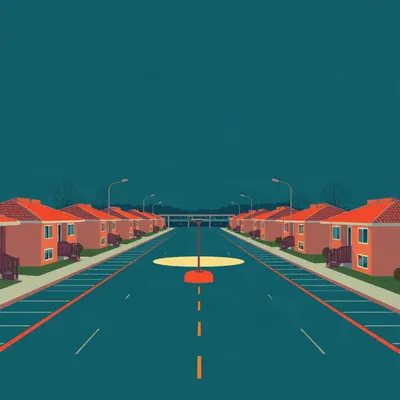
Daniel sent us this one — and it's basically a marital design dispute disguised as an urban planning question. He and Hannah both love walkable cities, but Daniel's realized he'd trade the corner café for peace and square footage every time. The noise, the cramped units, the constant street activity — it wears on him. Hannah thrives on it. So the question is: does walkability actually require that trade-off? Or have we just built it that way?

This is the right question at the right time. Because walkability advocates — and I count myself among them — have a blind spot here. We've spent years convincing people that density is good, that mixed-use is good, that street life is good. But we rarely stop to ask: good for whom? Good at what decibel level? Good in what square footage?
The urbanist version of "build me a chair nobody notices they're sitting in.
And Daniel is basically saying: I want the chair, but I'd also like to not hear my neighbor's television through the wall while sitting in it.
Let's get specific. What does walkability actually mean, concretely, and why does it so often come packaged with sensory overload and a scramble for space?
Walkability, as the planning world defines it, is straightforward. It's the fifteen-minute city concept — the idea that groceries, a pharmacy, a café, a hardware store, transit, maybe a park are all within a short walk. Usually defined as about half a mile or eight hundred meters. The metric you see everywhere is Walk Score, which rates addresses from zero to a hundred based on proximity to amenities.
Daniel gets this. He likes walking to the hardware store. What he doesn't like is feeling like he lives inside the hardware store.
And here's where the unspoken assumption creeps in. Walkability gets conflated with a very specific urban form. Mixed-use zoning with retail on the ground floor, apartments above. Minimal setbacks from the street. Narrow sidewalks with lots of foot traffic. The image is basically a Parisian boulevard or a Manhattan avenue.
The question becomes: is that the only way to get to a Walk Score of eighty-five? Or have we just stopped imagining alternatives?
That's the central question. And to answer it, we need to look at what actually creates the sensory burden Daniel's describing. Because it's not density itself. It's specific design choices layered on top of density.
Walk me through the mechanisms. What's actually making these neighborhoods loud and cramped?
Let's start with noise, because that's Daniel's number one complaint. A typical urban street with mixed traffic — cars, buses, delivery trucks — clocks in at seventy to eighty-five decibels during the daytime. For reference, the World Health Organization recommends residential noise levels below fifty-five decibels for comfort and below forty at night. Most walkable neighborhoods in North America and Europe blow past that by fifteen to thirty decibels.
Decibels are logarithmic, so that's not a small gap.
A ten-decibel increase is perceived as roughly twice as loud. So we're talking about environments that are four to eight times louder than what the WHO considers comfortable. And it's not just traffic. It's construction from infill development — which walkable neighborhoods attract precisely because they're desirable. It's delivery vehicles for all those ground-floor businesses. It's garbage trucks at six in the morning. It's the guy with the leaf blower.
The leaf blower is the unofficial municipal anthem of walkable America.
It really is. And then there's the building itself. A lot of walkable urban housing built in the last twenty years in the US is wood-frame construction over a concrete podium — five-over-one construction, it's called. Wood frame transmits sound far more than concrete or masonry. You hear your upstairs neighbor walking. You hear their music. You hear their conversations. The building code requires a certain STC rating — sound transmission class — but the minimum standards don't get you to real acoustic privacy.
You're paying a premium to live in a walkable neighborhood, and the construction quality is basically a drum.
A very expensive drum. And the unit sizes compound the problem. When you're in a seven-hundred-square-foot one-bedroom with thin walls, every sound from outside and from your neighbors is inescapable. There's no room to retreat. No second living area where you can close a door. No courtyard-facing bedroom that buffers street noise.
Daniel mentioned cramped living conditions specifically. What's driving that? Is it just land cost?
Land cost is part of it, but it's also zoning and developer incentives. In most US cities, minimum parking requirements eat up enormous amounts of space. A single parking space, including access lanes, takes about three hundred thirty square feet. Two spaces per unit — a common requirement — that's six hundred sixty square feet per unit just for cars. That's more than the size of many studio apartments.
We're subsidizing car storage in the very places we're supposedly designing to be walkable.
And then there are minimum lot sizes, setback requirements, floor area ratio limits — all of which constrain how much living space you can build on a given plot. The result is that developers maximize unit count to make the numbers work, which means smaller units. The "luxury" walkable developments you see in American cities often advertise rooftop pools and fitness centers and co-working spaces — amenities that take up square footage — while the actual apartments are shrinking.
The gym nobody uses is eating your living room.
And for someone like Daniel who works from home, that's a real problem. He's in that unit all day. He needs space. He needs quiet. The rooftop pool is irrelevant to him.
Let me play back what I'm hearing. The sensory burden of walkable neighborhoods comes from traffic noise on mixed-use arterials, construction from infill development, poor sound isolation in wood-frame buildings, and unit sizes that shrink because parking mandates and amenity spaces eat the square footage. That's the diagnosis. What's the treatment?
Let's start with the building envelope, because that's where the most immediate gains are. There's a concept called acoustic zoning within buildings. The idea is that you orient rooms by their noise sensitivity. Bedrooms face interior courtyards. Living rooms can face the street. You use double-glazed or even triple-glazed windows, which can reduce exterior noise penetration by twenty to thirty decibels compared to single-pane windows. You install mechanical ventilation with sound attenuation so you can keep windows closed without sacrificing air quality.
Which also handles the leaf blower problem.
The leaf blower problem is fundamentally a window problem. If your building envelope is good enough, the leaf blower becomes someone else's problem. And then there's the construction type. Concrete and masonry buildings have inherently better sound isolation than wood frame. In much of Europe and Asia, multi-family housing is built with concrete or brick. You don't hear your neighbors. In Vienna, for example, the social housing developments from the nineteen-twenties and thirties — the famous Gemeindebauten — used thick masonry walls and courtyard orientations that created remarkably quiet interiors despite being in a dense city.
The quiet walkable apartment exists. It's just not being built in the places Daniel's likely to look.
Not in North America, generally speaking. But there's a broader design principle here that goes beyond individual buildings. Let's talk about the Barcelona superblock model, because it's the best example of what I'd call acoustic urbanism.
Break that down.
Barcelona's Eixample district was designed in the eighteen-fifties by Ildefons Cerdà. It's a grid of blocks, each with a central courtyard. The original vision was that these courtyards would be green, quiet communal spaces. Over time, many got filled in with construction. But in the last decade, Barcelona has been implementing what they call superilles — superblocks. They take a three-by-three block area, restrict through-traffic to the perimeter, and reclaim the interior streets for pedestrians and green space. The interior courtyards within each block get restored.
What does that do to noise?
Measurements show that the interior courtyards are fifteen to twenty decibels quieter than the street-facing facades. That's the difference between a conversation at normal volume and having to raise your voice. It's the difference between sleep disruption and restful sleep. And the superblock streets themselves, with traffic restricted, see noise levels drop by five to ten decibels.
You can walk out your door into a quiet pedestrian street, walk two blocks to a bustling avenue with shops and cafés, and then retreat back to your quiet courtyard apartment. The gradient exists.
And that gradient is the key insight. Walkability doesn't require uniform sensory intensity across the entire neighborhood. You can have nodes of activity — the commercial streets, the transit stops, the plazas — connected by quieter residential streets. You can have buildings that face inward toward courtyards rather than outward toward traffic. You can have what I'd call sensory zoning within neighborhoods.
I like that. The idea that we plan for different acoustic experiences within the same walkable district, the way we plan for different land uses.
And some places are already doing this, even if they don't call it that. Let me give you a case study. Freiburg, Germany — the Vauban district. This is a neighborhood built in the nineteen-nineties on a former military base. It was designed from the ground up around two principles: car-free living and walkable access. Most streets are either car-free or car-limited, with traffic speeds capped at walking pace. Buildings are four to five stories, oriented around generous courtyards. There's a tram line that connects to the city center. Groceries, schools, cafés — all within a fifteen-minute walk.
The noise levels?
Daytime noise averages around sixty-five decibels. That's ten to twenty decibels lower than a typical mixed-use urban street. At night, it drops below fifty. For context, that's roughly the sound level of a quiet office or a refrigerator hum. You can sleep with your windows open in Vauban.
Yet you can still walk to get a loaf of bread.
In under ten minutes. The density is there — about fifty dwelling units per acre, which is comparable to many urban neighborhoods — but it doesn't feel dense in the oppressive sense. The courtyards provide visual and acoustic relief. The car-free streets mean children play outside. It's walkable urbanism without the sensory assault.
What's stopping us from building Vaubans everywhere? Why do American walkable developments so consistently fail on this front?
First, parking minimums. Most US cities still require off-street parking for new residential construction, which forces either above-ground parking structures that create noise and visual blight, or underground parking that adds enormous construction costs — costs that get passed on through smaller units or higher rents. Vauban has essentially no parking within the residential area. Residents who own cars park in a garage at the edge of the district and walk home.
Which is a political third rail in most American cities.
But it's also a choice, not a law of physics. The second issue is street design standards. American fire codes and traffic engineering manuals effectively mandate wide streets with large turning radii, which encourage higher speeds. Higher speeds mean more noise. A car traveling at thirty miles per hour produces about five decibels more noise than the same car at twenty miles per hour. That may not sound like much, but remember — five decibels is perceptually significant.
Thirty miles per hour is basically the default for any American arterial, even ones lined with apartments.
In Vauban and similar developments, the few streets that allow cars are designed as shared spaces — no curbs, no lane markings, textured surfaces that naturally slow drivers to walking pace. The design itself enforces the speed limit without signs or enforcement. The third issue is construction economics. Wood-frame five-over-one construction is cheap and fast in North America because we have a massive timber industry and a construction workforce trained in it. Concrete and masonry are more expensive up front, though they last longer and have lower maintenance costs.
The developer who builds the quiet concrete courtyard building is competing against the developer who builds the wood-frame noise box, and the noise box is cheaper to build. The market, left to itself, will produce noise boxes.
Unless policy intervenes. And this is where it gets interesting. Some cities are starting to incorporate acoustic standards into their building codes and zoning. For example, several European cities now require sound insulation performance that exceeds the minimum STC ratings common in North America. Vienna's building code mandates specific decibel limits for mechanical systems and requires acoustic testing before occupancy. In the Netherlands, noise standards for new housing near roads are strict enough that you essentially can't build street-facing bedrooms without mechanical ventilation and high-performance glazing.
The quiet walkable apartment isn't just architecturally possible — it's literally required by law in some places.
The trade-off Daniel's experiencing is real in most American cities, but it's a policy choice, not an inherent feature of urban life.
Let's talk about the other half of Daniel's complaint — the space issue. He wants square footage. He doesn't want to scramble for every square meter. Is that compatible with walkable density?
It is, and Tokyo is the proof. Let me give you some numbers. Across Tokyo's twenty-three wards — the urban core, one of the most walkable and transit-rich places on Earth — the average two-bedroom apartment is about seven hundred square feet. Many units have private balconies. You can find eight-hundred-square-foot apartments within a ten-minute walk of a train station for reasonable prices. Tokyo achieves this despite having some of the highest population density in the world.
First, Japan has no minimum parking requirements at the national level. If you want to build an apartment building with zero parking, you can. Second, lot sizes are small and irregular, which encourages the "missing middle" housing typology — duplexes, triplexes, small apartment buildings of four to six units — that uses land efficiently without requiring massive developer consolidation. Third, the zoning code is permissive about what you can build where. There's no single-family-only zoning across vast swaths of the city.
The missing middle isn't missing in Tokyo.
It's the default. And here's the crucial point: those small apartment buildings often have larger individual units than the big podium towers going up in American cities. Because they don't have to amortize the cost of a parking garage, a lobby, a gym, a pool, and all the other amenities that American developers use to justify high rents. The building is just apartments. The neighborhood provides the amenities — the parks, the cafés, the public baths, the convenience stores.
The city is your lobby.
That's the Tokyo model. And it works for a lot of people. Is it quiet? That depends on the street. Tokyo has plenty of noisy arterials, but it also has an intricate network of narrow residential streets — roji, they're called — that are essentially pedestrian-priority by default. Cars can technically use them, but they're so narrow and winding that through-traffic avoids them. A roji-facing apartment in a four-unit concrete building can be remarkably quiet.
Daniel could have his seven hundred square feet, his balcony, his walk to the hardware store, and his peace and quiet — he just needs to move to Tokyo.
Or we could build that here. The policy levers aren't mysterious. Eliminate parking minimums. Allow missing middle housing by-right in more zones. Adopt building codes with meaningful acoustic standards. Design streets for twenty miles per hour instead of thirty-five. Require courtyard orientation or acoustic buffering for units facing arterials.
You said "here" — you're in Jerusalem. Daniel and Hannah are in Jerusalem. Is any of this happening in Israel?
It's mixed. Israel has mandatory parking minimums, though they've been reduced in some areas near transit. The construction standard is concrete and block — you don't see wood-frame multi-family here, which is a point in Israel's favor acoustically. But unit sizes have been shrinking for years. The average new apartment in central Israel is about a thousand square feet for a four-room, which sounds generous until you realize that includes a fortified safe room and often awkward layouts. And street noise — Jerusalem's stone buildings reflect sound in ways that amplify the problem. You get canyon effects on narrow streets with stone facades.
Stone canyon acoustics. That's a whole subfield I hadn't considered.
It genuinely matters. A street lined with stone buildings can be three to five decibels louder than the same street with brick or stucco facades, just from sound reflection. Add in the fact that Jerusalem's topography means buses and trucks are constantly climbing hills in low gear, and you get noise profiles that are surprisingly intense for a city of less than a million people.
Daniel's complaints are not hypothetical. He's living them.
He's living them in one of the stone-reflector hill-climbing noise canyons of Jerusalem. And Hannah, as an architect, presumably knows all of this and still prefers the walkable urban experience, which tells you something about how subjective this trade-off really is.
That's the thing. Daniel's not wrong about the noise and the space. But Hannah's not wrong about preferring walkability anyway. They just have different weights on the same variables.
Urban policy has implicitly picked a side. It's optimized for people who tolerate or even enjoy the sensory intensity of dense walkable neighborhoods, and it's underserved the people who want walkability but with lower sensory load. Daniel's preferences aren't anti-urban. They're not suburban. He wants to walk to the hardware store. He just doesn't want to hear the hardware store from his bed.
The market segment that wants the quiet walkable apartment is probably enormous. Families with young children. Anyone with sensory sensitivities. Night shift workers who need to sleep during the day.
It's the majority of the population, honestly. The WHO estimates that noise pollution contributes to loss of over one million healthy life years annually in Western Europe alone, from cardiovascular disease, sleep disturbance, cognitive impairment in children, and general annoyance. This isn't a niche preference. It's a public health issue.
If the demand is there and the design solutions exist, why isn't the market providing it?
Partly path dependency. Developers build what they know how to build, and what the zoning code allows, and what their financing partners are comfortable underwriting. Partly regulatory inertia. Parking minimums, street design standards, and building codes change slowly. Partly a cultural blind spot in the urbanist movement itself, which has spent so long defending density against suburban sprawl that it's been reluctant to acknowledge density's downsides, even the fixable ones.
The movement that says "density is good" doesn't want to admit that a lot of density is also loud.
That admission feels like it gives ammunition to the sprawl advocates. But it shouldn't. The solution to loud density isn't low-density sprawl. It's quiet density. It's better buildings, better streets, better zoning. Acknowledging the problem doesn't undermine the case for walkability. It strengthens it, because it broadens the coalition of people who might actually choose to live in walkable places.
Let's get concrete for someone like Daniel — or any listener who's nodding along right now. If you're apartment hunting and you want walkability without the sensory overload, what do you actually look for?
A few specific things. First, don't just check Walk Score. Check ambient noise levels at different times of day. Go stand outside the building during morning rush hour, during the evening, on a Saturday night. There are apps that measure decibel levels with reasonable accuracy — use one.
Decibel-test the date spot.
Unromantic but essential. Second, check the building construction. Concrete or masonry is better than wood frame for sound isolation. Ask about the STC rating of the walls and floors — anything above fifty is good, above fifty-five is excellent. Most wood-frame buildings are in the forty-five to fifty range, which means you'll hear your neighbors.
Can you actually ask a landlord that?
You can ask. They may not know. But if they don't know, that's information in itself. Third, check the unit orientation. Does the bedroom face the street or a courtyard? Can you sleep with the window open? If the bedroom faces a busy street and there's no mechanical ventilation, you're choosing between noise and fresh air every night.
Fourth, square footage. What should people expect?
In a walkable urban neighborhood in North America, a one-bedroom below six hundred square feet is going to feel tight for anyone working from home. A two-bedroom below eight hundred fifty is tight for a couple. These aren't hard rules, but they're benchmarks. And remember that square footage numbers can be misleading — a well-designed six-hundred-square-foot apartment with good storage and a defined sleeping area can feel larger than a poorly-designed eight-hundred-square-foot unit where everything opens onto a single corridor.
The outdoor space question. Daniel didn't mention it explicitly, but private outdoor space seems like it would matter a lot for someone who's home all day.
It matters enormously. And this is where the missing middle typology shines. Duplexes, triplexes, and courtyard apartments can provide private patios, balconies, or small gardens at densities that still support walkable amenities. A four-unit courtyard building on a standard urban lot can give each unit a private balcony or patio and a shared courtyard, all within a five-minute walk of commercial streets. That's not a fantasy. That's a building type that exists all over Europe and parts of Asia and was common in American cities before zoning codes banned it.
We're not talking about something that faded away naturally. We made it illegal.
We made it illegal in huge swaths of American cities through single-family zoning. And we're only now, in the last five to ten years, starting to undo that. Minneapolis ended single-family zoning in twenty nineteen. Oregon did it statewide. California effectively did it with the duplex law. But these changes are recent, and the building stock hasn't caught up.
The quiet walkable apartment is legal again in some places, but it'll take decades to build enough of them to matter.
Which is why the policy piece matters so much. If you're an advocate pushing for better urban design, don't just push for density. Push for quiet density. Push for acoustic standards in building codes. Push for parking minimum reform. Push for street design that prioritizes twenty-mile-per-hour residential streets. Push for zoning that allows courtyard buildings and missing middle housing.
If you're a policymaker, consider what I'd call a sensory impact assessment. We do traffic impact studies. We do environmental impact reviews. We rarely assess how a new development or a street redesign will affect the sensory experience of the people who live there. What's the projected daytime noise level at the nearest bedroom window? What's the vibration profile from the adjacent light rail line? What's the shadow and wind impact on the courtyard where children play?
These are measurable, predictable, and mitigable. We just don't measure or predict or mitigate them as a matter of routine. And the result is walkable neighborhoods that repel exactly the people who might otherwise choose them.
Which brings us back to Daniel's original question. Is the trade-off fundamental? I think the answer we've arrived at is: no, but it's real until we change the rules.
The trade-off exists in the current building stock and the current regulatory environment. If you're apartment hunting today in most North American cities, you'll probably have to choose between walkability and quiet, or between walkability and space, or pay a massive premium to get both. But that's not because the laws of physics demand it. It's because the laws of zoning demand it. And laws can change.
The Barcelona superblock and the Freiburg Vauban and the Tokyo roji all prove that you can have walkable access with ambient noise levels ten to twenty decibels lower than a typical American mixed-use street. You can have seven-hundred-plus-square-foot apartments with private outdoor space in walkable neighborhoods. You can have buildings where you don't hear your neighbors.
The remote work revolution makes this more urgent, not less. Daniel's situation — spending most of the day at home, wanting to pop out for errands but needing peace and space while he's working — that's tens of millions of people now. The demand for quiet walkability is going to grow. The question is whether the market and the policy environment will respond.
Or whether we'll keep building noise boxes over parking garages and wondering why people with options choose to leave.
There's a provocative question lurking here. As remote work persists and more people have Daniel's preferences — space, quiet, walkable access but not walkable intensity — will development patterns actually shift? Or will market forces continue to prioritize the highest-return format, which is small units in high-density towers with lots of retail frontage?
I think it depends on whether remote workers organize as a political constituency around housing. Right now, the urbanist movement is dominated by people who love cities as they are — the density, the bustle, the street life. The quiet-walkability constituency is diffuse and doesn't have a coherent voice. But it's probably larger.
It's almost certainly larger. And if it finds its voice, we could see a shift in what gets built and where. Not away from walkability — toward a different kind of walkability. One that takes sensory experience and spatial comfort as seriously as it takes proximity to amenities.
If Daniel and Hannah are listening — and I assume they are, since Daniel sent the prompt — what's the takeaway for them specifically?
Daniel, your preferences are not anti-urban. You're not a secret suburbanite. You want walkable access with acoustic and spatial dignity, and that's a completely reasonable thing to want. The places that deliver it exist — they're just rare in the current market. When you're evaluating neighborhoods, use the metrics we talked about. Decibel measurements at different times. Building construction type. Square footage benchmarks. And Hannah, as an architect, you probably already know that the trade-off Daniel's feeling is a design problem, not a density problem. The building that gives him both walkability and peace is architecturally possible. It just needs a client willing to demand it and a code willing to allow it.
For everyone else: the next time you hear someone say they'd love to live in a walkable neighborhood if only it weren't so loud and cramped, don't tell them they're wrong about cities. Tell them they're right about the buildings we've built, and wrong about the buildings we could build.
That's the closing argument. Walkability and livability are not enemies. They've just been forced into separate corners by a century of bad policy. The reunion tour is long overdue.
Now: Hilbert's daily fun fact.

In nineteen fifty-three, the coronation of the Sultan of Damagaram, a traditional kingdom within what is now Niger, required the new ruler to be measured against a ceremonial spear that was exactly two point one meters long. If the candidate was shorter than the spear, he was deemed physically unfit and the succession passed to the next eligible male relative. The spear itself was last verified against a French meter stick in nineteen forty-eight and had reportedly shrunk by three centimeters over the previous century due to termite damage, meaning at least one sultan was crowned who would have been disqualified under the original specifications.
Termite-adjusted monarchy. That's a governance model I hadn't considered.
I have so many questions about the spear verification protocol. But I'm going to sit with them quietly.
This has been My Weird Prompts. Thanks to our producer, Hilbert Flumingtop, for the fact and the existential questions about termite-driven succession crises. If you've got your own walkability-versus-livability trade-off story, we'd love to hear it — send us a voice memo or text prompt. You can find us at myweirdprompts dot com or wherever you get your podcasts.
Until next time.