Daniel sent us this one — he's been renovating his new apartment while parenting a one-year-old, and somewhere in the chaos he bought a fifteen-dollar tactical belt off AliExpress. Now he's realizing he may have stumbled into an entire ecosystem. Belt widths, MOLLE clip compatibility, weight limits, clothing that actually fits these things. His core question is: when you outgrow a one-point-five-inch belt, what actually changes, and how do you build a system that doesn't require taking everything apart at the end of every day?

The ADHD angle here is the real throughline. Put something down, it's gone. The belt solves that — everything's on your body. But the moment the system itself becomes friction, the ADHD brain rebels and the whole thing falls apart. So this isn't just about gear. It's about designing a carry platform that reduces cognitive load.
Which is exactly why the cheap AliExpress belt worked so well for him initially — it removed friction. Now he's wondering if upgrading introduces new friction he didn't see coming.
Let's unpack what he actually bought and why it's both perfect and limiting.
The first thing to understand is that belt width isn't just about fit. It's about the whole ecosystem of clips, weight distribution, and clothing compatibility. They're all coupled, but not in obvious ways. It's like buying a new phone and realizing none of your old charging cables work anymore — except nobody tells you that upfront.
That's actually a perfect analogy, because just like USB-C versus Lightning versus Micro-USB, the belt width determines which accessories plug into your life. And the standard that won the civilian market is one-point-five inches. It fits nearly every pair of jeans, chinos, shorts, whatever you own. That's why Daniel's AliExpress belt worked immediately — he didn't have to think about whether it would thread through his belt loops. It just did.
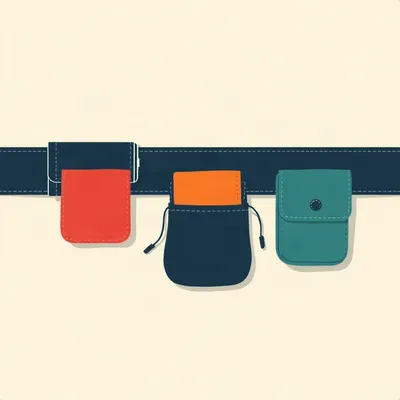
That's the hidden genius of starting at one-point-five. Zero friction to entry. But then you start adding pouches — a multi-tool, a tape measure, maybe a battery pack — and suddenly the belt's doing things it wasn't designed for. Daniel mentioned he's been carrying an impact driver holster. That's not a small ask of a fifteen-dollar belt.
Here's where the mechanics get interesting. The practical weight limit for a one-point-five-inch nylon belt, based on what the EDC forums have converged on, is about five to eight pounds distributed across the belt. Beyond that, you get sagging, twisting, and the belt digging into your hip. There's no official MIL-SPEC number for this, by the way. It's just community consensus from people who've pushed these things to failure.
How did they test that? Is someone out there hanging dumbbells off their belt and taking notes?
The everyday carry forums are full of people who've done exactly that. They'll load up a belt with weighted pouches, wear it for an eight-hour day, and document where it fails. It's citizen science for people who really, really care about not dropping their multi-tool.
I love that. So five to eight pounds. That sounds like a lot until you actually add up what you're carrying. A full water bottle is already two pounds. A decent multi-tool is close to a pound. Impact driver holster with the tool in it? You're at four pounds with two items.
And the real problem isn't even the raw weight. It's rollover.
When a heavy pouch creates torque that rotates the belt on your waist. Think of it like a lever. You've got this narrow strip of nylon sitting against your hip, and then you hang something dense off one side. The weight wants to pull outward and downward, which twists the belt. The pouch tips away from your body, the top edge of the belt digs into your hip, and suddenly you're constantly readjusting. A two-inch belt has more surface area to resist that rotation. That's the actual reason to upgrade — not just weight capacity, but stability under uneven loads.
The width isn't about the buckle or the webbing strength. It's about geometry. It's a leverage problem.
Geometry and stiffness. A two-inch belt with a polymer-reinforced inner layer — something like the Blue Alpha Gear MOLLE belt — can handle ten to fifteen pounds comfortably because it resists both sagging and twisting. The polymer layer acts like a spine. Without it, even a two-inch belt will eventually roll over under enough load.
If I buy a two-inch belt that's just nylon, no polymer reinforcement, I haven't actually solved the problem?
You've delayed it. You've got more surface area fighting the rotation, but without that rigid spine, the belt will still eventually yield. It's the difference between a paperback and a hardcover. Same width, completely different structural integrity.
Then there's the three-inch belt, which is basically a duty belt you wear over a uniform. At that width you're not even pretending it fits through normal belt loops. You need dedicated pants with three-inch-plus loops, or you're wearing it as an outer belt with keepers.
Three-inch is niche. Law enforcement, competition shooting, that kind of thing. For Daniel's use case — parenting, DIY, apartment setup — it's overkill. The real decision point is between one-point-five and two.
Let's talk MOLLE compatibility, because this is where Daniel's specific questions get interesting. He asked whether the clips change when you move up in belt width.
The MOLLE standard uses one-inch webbing spacing regardless of belt width. That's the key thing to understand. The clips hook onto the webbing, not the belt edge. So in principle, a MOLLE pouch with standard clips will attach to a one-point-five-inch belt and a two-inch belt equally well.
There's a catch.
There's always a catch. A one-point-five-inch MOLLE belt typically has one row of webbing. A two-inch belt typically has two rows. That means on a two-inch belt, you can stack pouches vertically — a magazine pouch above a utility pouch, for example — or you can distribute weight across two attachment points for heavier items. The clips themselves don't change, but the attachment options do.
You're not just getting a wider belt. You're getting a second row of real estate.
And for Daniel's renovation work, that could mean mounting a tape measure pouch above a fastener pouch, both on the same section of belt, instead of having them fight for space on a single row.
The clip length?
Right, good question. Some MOLLE clips — especially the MALICE clips and Blade-Tek clips — come in short and long variants. The short ones are designed for single-layer webbing. The long ones wrap around thicker platforms. A two-inch belt with polymer reinforcement might be thick enough that you'd want the longer clips for a secure fit. But we're talking about maybe a quarter-inch difference. For most pouches, the standard clip works fine across both sizes.
It's not a dealbreaker, but it's worth checking when you buy new pouches.
Worth a thirty-second check, yes.
Now Daniel specifically asked about ToughBuilt, which is a whole different animal.
ToughBuilt uses a proprietary clamp mechanism. It's not MOLLE. The clamp jaw is a fixed width, and it's designed to bite onto the edge of a belt. Their standard clamp fits a one-point-five-inch belt perfectly — that's what Daniel's currently using, I assume.
If he moves to a two-inch belt?
He needs the large clamp. ToughBuilt sells it separately — model number TB-CLAMP-L, costs about eight dollars. The standard clamp simply won't open wide enough to accommodate a two-inch belt. I've seen forum posts from users who tried to force it and either cracked the clamp or couldn't get it to seat properly.
The ToughBuilt ecosystem has its own sizing fork. That's worth flagging because it's the kind of thing you discover after you've already bought the belt. You're standing there with your new two-inch belt, your ToughBuilt pouch, and they just... don't connect.
That's the hidden cost of mixing proprietary systems with open standards. MOLLE is open — any manufacturer can make MOLLE-compatible pouches, and they'll work across belt widths. ToughBuilt is closed — you're buying into their clamp system, and when you change belt sizes, you're buying new clamps too.
Which doesn't mean ToughBuilt is bad. Their pouches are genuinely good. But it's a lock-in tax you pay when you upgrade.
It's exactly the kind of detail that trips up someone coming in from the civilian side. If you're law enforcement, you learn this stuff in training. If you're a dad who bought a fifteen-dollar belt on AliExpress and got hooked, you find out the hard way. Usually at 11 PM when you're trying to set up for the next morning and nothing fits.
That's the voice of experience talking.
I have a drawer. We don't talk about the drawer.
Let's get to the practical bottleneck. Daniel wants to know: if he moves to a two-inch belt, where does he find pants that actually fit it?
This is the part nobody talks about in the tactical gear videos. They show you the belt, they show you the pouches, they never mention that your pants won't accept any of it. Most off-the-shelf jeans and chinos have belt loops that max out at about one-point-seven-five inches. A two-inch belt simply will not thread through them. You'll get halfway around your waist and then the loop binds up. You're standing in your bedroom with a belt half-threaded through your pants, and you have to make a choice.
You're stuck looking either ridiculous or uncomfortable.
But there are options, and they don't all require you to look like you're about to breach a door. First, the obvious: tactical brands. Five-Eleven's Apex pant has two-inch belt loops, costs about eighty-five dollars, and comes in colors that don't scream "tactical." Vertx makes similar options. LA Police Gear has their own line.
Daniel's doing DIY and parenting, not tactical operations. He probably doesn't want to wear Five-Eleven pants to the hardware store. Or to the playground.
That's where workwear brands come in. Carhartt's B-one-five-one and B-three-five-seven models have reinforced belt loops that accommodate two inches. The B-one-five-one is about fifty-five dollars — it's a workwear staple. Dickies eight-seven-four work pants also fit a two-inch belt. These are pants you can wear while painting a nursery or running cable and not feel like you're cosplaying. Nobody looks twice at Carhartts at Home Depot.
Kuhl and Prana have some models with reinforced loops. It's hit or miss by model, not brand-wide, so you have to check. But the point is, you don't need "tactical" pants. You need pants with belt loops that measure at least two inches internally. That's the spec you're shopping for. Everything else is marketing.
If you've already got pants you love? Pants that fit perfectly and you don't want to replace?
Etsy sellers offer belt loop widening services for about fifteen dollars. They'll open the loop, add fabric, and restitch. It's not elegant, but it works. Or you can go the battle belt route, which solves a completely different problem at the same time.
Which brings us to Daniel's last question — the one about not wanting to take the belt apart every day. This is the one that feels most ADHD-specific to me.
This is where the ADHD brain meets the tactical gear world, and it's actually where things get clever. Daniel's problem is: at the end of the day, he has a belt loaded with pouches, and taking it all off is friction. Taking the pouches off the belt is even more friction. Leaving it all assembled means tomorrow morning he has to thread a loaded belt through his pants loops, which is annoying. The pouches catch on the loops, everything twists around, it takes three times as long. So what's the move?
The move is to stop thinking of the belt as something you thread through pants every day.
There are three approaches. Option one: the battle belt. This is a separate two-inch belt that sits over your regular belt, attached via belt keepers — little Velcro or snap straps that wrap around both belts. You leave the battle belt fully rigged with pouches. In the morning, you put on your pants with a normal belt, then wrap the battle belt around your waist and secure the keepers. At the end of the day, you undo the keepers and the whole rig comes off as a unit. You never thread anything.
It's like a tool belt that doesn't require its own pants. It just hovers over whatever you're wearing.
And it's the most modular approach because you can wear the battle belt over any pants. Jeans, shorts, whatever. The downside is it adds a layer — you're wearing two belts — and in summer that can get warm. But for pure convenience, it's hard to beat.
Option two: suspenders-integrated. Some tactical suspenders clip directly onto the belt, and the whole assembly — belt, pouches, suspenders — becomes a single unit you step into and clip over your shoulders. Take it off as one piece at night.
That sounds like it would make you look like a construction worker from the nineteen-twenties.
It does, and that's either a bug or a feature depending on your aesthetic. But it's practical for heavy loads because the suspenders transfer weight to your shoulders instead of your hips. If Daniel's carrying an impact driver, a tape measure, a utility knife, and maybe a small level, that weight adds up. His hips will thank him.
Option three is the one I think fits Daniel's use case best. Dedicated work pants with a dedicated work belt. You buy one pair of pants with two-inch belt loops — say, the Carhartt B-one-five-one — and one two-inch MOLLE belt. You rig the belt with your DIY pouches — impact driver holster, utility knife, tape measure, whatever. You leave the belt threaded through those pants permanently. The pants hang in the closet with the belt already in place.
In the morning, he puts on the work pants, and the belt's already there. All he has to do is clip on the pouches he needs for the day.
And here's where the MOLLE clip workflow shines. A pouch with MALICE clips can be moved between belts in under thirty seconds. So Daniel keeps his one-point-five-inch belt for daily parenting carry — phone, small flashlight, maybe a multi-tool. His two-inch belt stays rigged on the work pants. In the morning, he grabs the tape measure pouch off the one-point-five-inch belt, clips it to the two-inch belt on the work pants, and goes. End of day, he unclips the tape measure pouch, puts it back on the one-point-five-inch belt, and hangs the work pants. The belt stays in the pants. He never removes it.
That eliminates the daily threading and unthreading entirely. It's brilliant in its simplicity.
It means he doesn't need duplicate pouches. One tape measure pouch, one multi-tool pouch, moved between belts as needed. The belts are the platforms. The pouches are the modules. You're not buying two of everything — you're just reallocating based on the day's tasks.
What about washing? Because if the belt never comes out of the pants, eventually those pants need to be cleaned.
Nylon belts — like the Blue Alpha Gear MOLLE belt, which is about sixty-eight dollars — are machine washable on gentle cycle with air drying. Users report three years of weekly washing with no degradation. But — and this is a big but — MOLLE pouches with foam or plastic inserts are not washable. The foam deforms, the plastic warps. So you remove the pouches before washing the belt.
Which is easy if the pouches are on MOLLE clips. Pop them off, wash the belt and pants, air dry, clip the pouches back on.
The workflow is: Friday evening, unclip all pouches from the work belt. Remove belt from pants. Wash pants and belt. Air dry over the weekend. Monday morning, thread belt back through pants, clip on the day's pouches, go. Total active time: maybe two minutes.
That's the kind of friction level an ADHD brain can tolerate. Two minutes, once a week, and the rest of the time it's grab-and-go.
That's the whole design principle here. The system has to be easier to use than not using it. If setting up your carry rig takes more mental energy than just grabbing tools as you need them and losing them around the house, the system fails. And Daniel's already living that — he's got a one-year-old. His cognitive bandwidth is spoken for. The belt has to work for him, not the other way around.
Let's talk costs, because Daniel started with a fifteen-dollar AliExpress belt, and I think there's a reasonable question about what a two-belt system actually costs to build. Is this a fifteen-dollar hobby or a two-hundred-dollar hobby?
Let me break it down. One-point-five-inch belt from AliExpress: fifteen to thirty dollars. Two-inch MOLLE belt from a reputable brand like Blue Alpha Gear or AWS: forty to eighty dollars. Work pants with two-inch loops: fifty to a hundred dollars. ToughBuilt large clamp if he needs it: eight dollars. Total entry for a two-belt system: somewhere between a hundred fifty and two hundred dollars.
Which, for context, is about what you'd pay for a single high-end EDC belt from a brand like Arc'teryx LEAF. Just the belt, no pouches.
The AliExpress belt is the gateway drug. It proves the concept for fifteen dollars. You discover that yes, having tools on your body actually does change how you work. Then when you're ready to build a real system, the costs are reasonable if you're thoughtful about it. The expensive mistake is buying a two-inch belt first, discovering it doesn't fit your pants, then buying tactical pants you don't actually want to wear. That's how you end up with a three-hundred-dollar outfit you resent.
The sequence matters. Pants first, then belt.
Measure your existing pants' belt loops before buying anything. That's the single most important piece of advice in this entire episode. If your loops are under two inches, and you don't want to buy new pants, stick with one-point-five. The upgrade isn't worth the wardrobe overhaul.
Unless you go the battle belt route, which sidesteps the pants question entirely.
Battle belt over your regular belt — you can wear it with basketball shorts if you want. It looks ridiculous with basketball shorts, but mechanically it works.
The fashion police have entered the chat.
Look, I'm not here to judge. I'm here to explain load distribution across belt widths. What people do with that information in the privacy of their own homes is between them and their mirror.
You've done it beautifully. So let's boil this down to five actionable things Daniel can actually do.
First: start with one-point-five inches. It fits all your existing clothes and handles five to eight pounds. Only upgrade to two inches if you consistently carry more weight or experience belt rollover. Don't pre-emptively solve a problem you don't have yet.
Second: if you go two-inch, buy the pants first, then the belt. Measure your existing belt loops. If they're under two inches, you're buying new pants or going battle belt. There is no third option where your current pants magically stretch.
Third: for ADHD-friendly permanent rigging, use a separate work belt on dedicated work pants. Leave it rigged. Swap pouches between belts using MOLLE clips — not the belt itself. The belt lives in the pants. The pouches travel.
Fourth: ToughBuilt users, verify your clamp size before buying a two-inch belt. The standard clamp is one-point-five-inch only. You need the large clamp, model TB-CLAMP-L, for two-inch. This is an eight-dollar problem with an easy solution, but only if you know about it ahead of time.
Fifth: nylon belts are washable on gentle cycle with air drying. MOLLE pouches with foam or plastic inserts are not. Remove pouches before washing the belt. Set a recurring reminder if you have to — Friday afternoon, unclip everything.
That's the checklist. It's not complicated, but it's the kind of thing where one wrong assumption — "all clips are the same," "all pants fit all belts" — leads to a drawer full of gear that doesn't work together.
That drawer is the enemy of the ADHD brain. The whole point of this system is to reduce the number of decisions you have to make. If you have to think about whether your belt fits your pants this morning, you've already lost. You've spent cognitive currency before you've even had coffee.
Beyond the practical advice, there's a bigger trend here worth watching.
The modular carry revolution. We're seeing MOLLE move from military and law enforcement into civilian everyday carry, but the infrastructure hasn't caught up. Clothing manufacturers aren't standardizing wider belt loops. Pouch makers are still split between open MOLLE standards and proprietary systems like ToughBuilt. The belt is just the bus. The pouches are the peripherals. And right now, the peripherals don't all speak the same language.
The real innovation that's coming isn't a better belt. It's a truly interoperable pouch ecosystem where you can clip anything to anything, regardless of brand or belt width. We're in the early, messy stage of that. It's like the smartphone accessory market in 2009 — every case had a different mounting system, nothing worked together, and then eventually the market shook out.
I'd add — we're going to see integrated charging. Pouches with built-in battery banks that charge your phone while you carry it. Tool-less attachment systems that don't require threading clips. Smart pouches that track what you've got and remind you when something's missing.
Which would be the ultimate ADHD accommodation. A belt that tells you you forgot your tape measure. "Hey, you usually carry a multi-tool on Tuesdays. It's Tuesday.
We're not there yet. But the pieces are emerging. Daniel stumbled into this ecosystem at exactly the moment it's breaking out of its original niche. Fifteen dollars on AliExpress, and suddenly you're thinking about modularity, cognitive load, and the future of how we carry things.
It's never just about the belt.
It's never just about the belt.
Now: Hilbert's daily fun fact.

In the nineteen hundreds, a slime mould species was introduced to the Lake Tanganyika region through contaminated botanical specimens — and within a decade, it had evolved a novel behavior of forming fruiting bodies exclusively on the north-facing sides of trees, something no other slime mould population does. Scientists still don't know why.
North-facing slime moulds. I'm going to be thinking about that all day now.
This has been My Weird Prompts. Thanks to our producer Hilbert Flumingtop. If this episode helped you think about your carry system differently, leave us a review and tell us your weird prompt.
We'll be back soon. Until then, measure your belt loops.