Daniel sent us this one — and honestly, the timing couldn't be more fitting. He and Hannah are mid-move in Israel with a one-year-old, no family nearby, and the kind of chaos where the plan changes every three hours. His question is whether a morning stand-up — the thing software teams do — can actually keep a household from drowning in logistics during a frenetic period. And then, once life settles, how do you fold it back into a weekly rhythm without the daily becoming a permanent chore? There's a lot of research on what makes stand-ups work or fail, and it turns out most of it maps shockingly well onto two exhausted people trying to remember who was supposed to call the gas company.

The thing that jumps out at me right away is that Daniel's already identified the core problem before he even asked the question. Weekly meetings are too slow when the situation changes hourly. That's not a household failure — that's a cadence mismatch. And it's exactly the same problem that led software teams to invent the daily stand-up in the first place.
Right, because a weekly sync assumes the landscape stays roughly stable for seven days. During a move, the landscape is a seismograph during an earthquake. You get a text at nine AM that the elevator booking is confirmed for Thursday, and by nine fifteen the moving company says they can only do Wednesday, and suddenly your entire week's plan is obsolete.
That's the invisible cognitive load Daniel's talking about. It's not the boxes. The boxes are heavy but they're simple. It's the tracking of twelve parallel threads — utility appointments, box labeling, childcare handoffs, which documents need to be at which office by when — all while running on four hours of sleep and a toddler who has decided that packing tape is the most fascinating object in the universe.
The packing tape fixation is universal, I'm convinced.
There's research on this that's surprisingly relevant. Steven Rogelberg at UNC Charlotte did a major study on meeting effectiveness, and the single most common complaint — cited by forty-six percent of respondents — is that meetings are too long. Not that they're pointless, not that they're poorly run, though those are issues too. Just: too long. The second most common, at thirty-five percent, is lack of an agenda.
Forty-six percent. So nearly half of all meeting complaints boil down to "this could have been shorter." And if you think about the classic family coordination failure, it's exactly that — the conversation that should have been ninety seconds at the kitchen counter somehow becomes a forty-minute rehash of every stressor in the entire move, and by the end nobody remembers who was supposed to call the electrician.
That's where the stand-up format gets interesting, because it was literally designed to solve that exact problem. The three-question structure — what did you do yesterday, what are you doing today, what's blocking you — forces the conversation into a shape. It's not just chatting about the move. It's a container.
I want to sit with that word, "container," because I think it's the key to the whole thing. Most household logistics conversations fail because they have no boundaries. They start at breakfast, drift through lunch, resurface during dinner, and by bedtime everyone's exhausted and nothing got resolved. The stand-up says: we are doing this for fifteen minutes, standing up, and then it's over.
The standing part isn't just a metaphor. There's research from Washington University that found standing meetings are thirty-four percent shorter than seated ones, while producing the same quality of outcomes. The physical act of standing enforces brevity in a way that sitting on the couch with a cup of tea simply doesn't.
You're telling me that the entire productivity revolution Daniel needs might come down to not sitting down.
I mean, partly. The physical token matters too. A lot of effective stand-up teams use a talking stick — some object you pass back and forth to signal whose turn it is. For a couple, it could be a spatula. You hold the spatula, you talk. You pass the spatula, you listen. When the spatula's on the counter, the meeting's over.
The mental image of Daniel and Hannah passing a spatula back and forth at seven in the morning while their son tries to grab it is genuinely delightful. But it also makes the point — the token is a boundary. It says: this is the meeting, and when the token is down, we're done.
That's the anti-pattern that kills most stand-ups in the workplace, by the way. They become status-reporting sessions to a manager. One person drones on for five minutes about every email they sent yesterday, the timer runs out, and the person with the actual blocker never gets to speak. The stand-up becomes a surveillance tool instead of a coordination tool.
Which, if you translate that to a marriage, is a disaster waiting to happen. "What did you accomplish yesterday" can sound an awful lot like "justify your existence" if the tone is wrong. The difference is whether you're asking as a teammate or as an auditor.
And the research on this is clear. Effective stand-ups are peer-to-peer coordination. The questions aren't being asked by a boss — they're being asked by people who need to know what you're working on so they can do their own work. In a household move, that's literally true. Hannah needs to know if Daniel called the insurance company because if he didn't, she needs to factor that into her day. It's not judgment — it's dependency mapping.
The framing matters enormously. "What do we need to coordinate today" versus "what did you get done yesterday." Same information, completely different emotional valence.
This connects to something Daniel mentioned — the idea that stand-ups are widely hated. They are, but it's almost always because they've become the bad version. Too long, too performative, too much status-reporting-up-the-chain. When they're done well — fast, focused, about unblocking each other — people actually like them. They leave feeling clearer, not more burdened.
I think that's the promise Daniel's reaching for. Not another chore, but actually less cognitive load. The stand-up isn't one more thing to do — it's the thing that makes all the other things trackable so your brain can let go of them between meetings.
The household-as-team analogy holds up better than most people would expect. A two-person operation with a dependent is structurally identical to a small startup. Shared goals, interdependent tasks, constant context switching, and a need to re-prioritize rapidly when something breaks. The Kanban board — which Taiichi Ohno developed at Toyota in the nineteen forties — was designed for exactly that kind of environment.
Let me try to capture what Daniel's actually asking, because I think it's more specific than "should we have a meeting." He's asking: during a period where the plan changes hourly, what's the lightest possible structure that prevents things from falling through the cracks, that doesn't become its own burden, and that can be turned off when life returns to normal? And he's asking whether the software industry already solved this problem in a way that translates.
The answer, based on everything I've read, is yes — with caveats. The stand-up format solves the cadence problem. The three questions solve the structure problem. The timer solves the length problem. The talking stick solves the turn-taking problem. Standing up solves the energy problem. But all of those only work if the intent is coordination, not surveillance.
The intent piece feels like the whole game. If Daniel and Hannah can agree that the stand-up is about surfacing blockers and aligning on the day's priorities — not about auditing each other's productivity — then it's a tool. If it becomes a performance review, it's poison.
That's where the "circuit breaker" concept comes in, which we should dig into. The idea that you explicitly agree on what triggers the daily stand-up and what triggers its end. It's not a forever commitment. It's a tool you deploy when the cognitive load exceeds what a weekly meeting can handle.
Right, because the weekly meeting has its own value. It handles the strategic stuff — budget review, meal planning, longer-term projects. The daily is purely tactical. "What's on fire today and who's holding the hose." You don't use the daily to decide whether to refinance the mortgage. That's a weekly conversation. During a move, the tactical overwhelms the strategic. The strategy is "survive until the boxes are unpacked." So the weekly meeting becomes almost irrelevant, and the daily becomes essential. Then when the move ends, you flip it back.
The forty-six percent statistic from Rogelberg's study keeps coming back to me, because it's the single most actionable insight here. The biggest complaint about meetings is that they're too long. So the single most important rule for a household stand-up is: keep it short. Fifteen minutes, hard stop, timer visible. If something needs more discussion, it gets written down for later. That's the parking lot technique — standard agile facilitation practice. You surface the issue, you write it on a sticky note, and you deal with it after breakfast. The stand-up is for surfacing, not solving.
The parking lot is such a simple concept and so hard to actually do. Because the natural human impulse when someone says "I'm stuck on the gas company thing" is to immediately start problem-solving. "Oh, have you tried calling this number? What about the online portal?" And suddenly the stand-up is a forty-minute troubleshooting session and the other person's blockers never got mentioned.
That's exactly how the stand-up becomes the thing people hate. One person dominates, the timer expires, and the person who needed help the most walks away unheard. The parking lot prevents that by giving you permission to defer. "That sounds like a real blocker — let's put it on the parking lot and figure it out right after this." It's not ignoring the problem. It's containing it.
We've got the core mechanics: fifteen minutes, standing up, three questions, talking stick, parking lot, coordination not surveillance. And the trigger agreement — the explicit conversation about when to start and when to stop.
I think that last part is what makes the whole system sustainable. Without an off-ramp, the daily stand-up becomes just another thing you have to do, and eventually you resent it. With an off-ramp, it's a tool you deploy intentionally. "We're in a stand-up season" is a very different statement from "we have to do this forever now.
It's the difference between a cast on a broken arm and a permanent exoskeleton. You want the cast while the bone is healing. You don't want to wear it for the rest of your life.
Let's define the thing properly, because "stand-up" gets thrown around in offices like it's a synonym for "quick meeting," and it's really not. The original format comes out of the Scrum framework — Ken Schwaber and Jeff Sutherland formalized it in the nineteen nineties — and it's very specific. Fifteen minutes, time-boxed, same time every day, and every person answers three questions. What did I accomplish yesterday? What will I do today? What blockers am I facing?
That's the whole meeting.
That's the whole meeting. And the format got a huge boost from Extreme Programming in the early two thousands. The questions aren't arbitrary — they're designed to surface dependencies and obstacles, not to generate a status report for a manager.
Which is where the hatred comes from, right? Because somewhere along the line, managers looked at this and thought, "Oh, perfect, I can monitor everyone's productivity in fifteen minutes flat.
That's exactly the corruption of intent. The three-question format was built for peer-to-peer coordination. The value is in the second and third questions — "what are you doing today" and "what's blocking you." The first question only matters because it provides context for the other two. If you treat it as a mini performance review, you've gutted the mechanism.
The difference between a loved stand-up and a hated stand-up isn't the questions — it's who's asking and why. Teammate versus auditor.
And this is where the household analogy gets interesting, because Daniel and Hannah aren't each other's managers. They're co-founders of a very small, very chaotic startup that happens to have a one-year-old stakeholder with zero respect for deadlines.
The stakeholder who keeps throwing food on the floor during board meetings.
Let's start with the first mechanism, because it's the one that directly addresses Rogelberg's thirty-five percent "lack of agenda" complaint. The three-question format isn't just a suggestion — it's a structure that prevents the two most common meeting failures simultaneously. Rambling updates and forgotten dependencies.
In a move, forgotten dependencies are the thing that actually costs you. You don't just lose time — you lose appointments, you lose deposits, you lose the one available slot the building manager had for the elevator.
The classic move disaster is two people each assuming the other person is handling something, and nobody discovers the gap until it's too late. The three questions force that gap to surface. "What did you do yesterday" — I called the gas company and scheduled the transfer. "What are you doing today" — I'm meeting the crib delivery between ten and noon. "What's blocking you" — the building manager hasn't confirmed the elevator booking, and if I don't hear back by nine, I can't be here for the crib.
That last one is the killer. Without the stand-up, Partner B might have no idea the elevator confirmation is still pending. They might schedule something that conflicts, or worse, assume it's handled and then discover on moving day that the elevator's locked.
The Tel Aviv example makes this concrete. Partner A is waiting on the building manager for elevator confirmation. Partner B was planning to call the moving company at the same time. Without the stand-up, they both call separately, the moving company gets conflicting information, and suddenly there are two trucks booked for different days. With the stand-up, they divide — A handles elevator, B handles movers, they agree to sync at noon. Ten minutes saved them hours of confusion.
The emotional savings is almost bigger than the logistical savings. The "I thought you were handling that" conversation at five PM, when both people are exhausted and frustrated — that's the thing that erodes a marriage during a move. The stand-up kills that conversation before it's born.
Which brings us to the second mechanism, and this is the one I think most people get wrong. The fifteen-minute hard stop with a visible timer is not negotiable. The Washington University research — standing meetings are thirty-four percent shorter with equal outcomes — that finding only holds if you actually enforce the boundary.
What happens when someone's mid-story about the electricity company and the timer goes off?
That's the rule. And this is where most household implementations will fail, because the natural instinct is to say "oh, just finish your thought." But the moment you let the timer slide once, it stops being a container and starts being a suggestion. The forty-six percent "too long" complaint from Rogelberg's study — that's what you're inviting back in.
I can already hear the objection. "But the electricity company story is important — there's a detail in there that affects the whole move.
Then it goes on the parking lot. Write it on a sticky note, stick it to the fridge, and deal with it after breakfast. The stand-up is for surfacing, not solving. This is the single most important facilitation rule in agile, and it's the one that prevents the stand-up from becoming a forty-minute troubleshooting session where one person dominates and the other person's blockers never get heard.
The anti-pattern you mentioned earlier — Partner A spends five minutes detailing the exact conversation with the electricity company, the timer goes off, Partner B hasn't spoken, and the daycare paperwork blocker never surfaces.
That's a failure of facilitation, not a failure of the format. The fix is brutally simple: sixty seconds per person, visible timer, and when the sixty seconds is up, you hand the talking stick to the other person. The thirty-four percent time savings from standing only works if you combine it with a per-person limit.
The talking stick — or spatula, in Daniel's case — isn't just a cute gimmick. It's the enforcement mechanism for turn-taking.
It's the physical embodiment of the boundary. You hold the token, you speak. You don't hold the token, you listen. When the token is on the counter, the meeting is over. This prevents the "one person dominates" anti-pattern that kills stand-ups in both workplaces and households. And for a couple, it's especially important because household dynamics don't have the formal hierarchy of an office. There's no scrum master to say "you're out of time." The spatula is the scrum master.
The spatula has more authority than either partner. I love that.
It signals something subtle but important: the meeting has a defined start and end. It's not "let's chat about the move while we drink coffee." It's "we are now doing the stand-up." The token creates a ritual boundary, and rituals are what make habits stick.
Which brings us to the fourth mechanism — actually standing up. You mentioned the Washington University study, but I want to understand why it works. Is it just physical discomfort?
It's not discomfort, exactly. It's that sitting signals "we're settling in for a conversation." Standing signals "this is temporary." Your body knows the difference. For a tired couple with a baby, standing at the kitchen counter with coffee keeps the energy up and prevents the meeting from drifting into a seated chat about whether the landlord was unreasonable three weeks ago.
The landlord rehash is the black hole of household meetings. Once you sit down, that conversation can absorb an entire evening.
During a move, you don't have an evening to absorb. You have ten minutes before the baby wakes up or during a contained play session. The constraint actually helps — the Washington University finding that standing shortens meetings by thirty-four percent is really about enforced focus. You're not going to ramble about the landlord when you're standing at the counter with a timer ticking and a spatula in your hand.
The four mechanisms work together as a system. The three questions provide the agenda. The timer enforces the boundary. The talking stick enforces turn-taking. And standing up enforces the energy level. Remove any one of them and the whole thing starts to degrade.
The anti-patterns are the inverse of each mechanism. The status trap is what happens when you lose the intent behind the three questions — it becomes surveillance instead of coordination. The parking lot failure is what happens when you lose the timer — the stand-up becomes a problem-solving session. The domination problem is what happens when you lose the talking stick. And the drift problem is what happens when you sit down.
The status trap is the one that worries me most for a couple. Because "what did you accomplish yesterday" between spouses can sound like "justify why you were exhausted last night.
That's why the framing shift is everything. Don't ask "what did you get done." Ask "what do we need to coordinate today." The first question is backward-looking and evaluative. The second is forward-looking and collaborative. Same information, completely different emotional valence.
If you're the one speaking, you can frame your own update that way too. "Yesterday I got the gas sorted, today I'm on crib delivery, my blocker is the elevator confirmation." That's not a performance report. That's a coordination broadcast.
The stand-up works when both people treat it as a synchronization tool. It breaks the moment one person feels like they're being audited. And that's not a structural problem — it's an agreement problem. You have to name it explicitly: "We are not evaluating each other here. We are surfacing what we each need to know to get through today.
The weekly meeting, though — that's the missing piece in most of these conversations. People hear "daily stand-up" and think it replaces everything. It doesn't. The weekly meeting handles the strategic layer. Budget review, meal planning for the week, longer-term projects like "should we repaint the living room before the lease renewal." The daily is purely tactical.
During a move, the map is basically "get to the other apartment with all our stuff and our sanity." There's no strategic ambiguity. So the weekly meeting becomes almost vestigial — you might do a quick Sunday check-in to confirm the big milestones for the week ahead, but the daily is doing the real work. Then when the move ends, you flip it. The daily drops away and the weekly comes back as the primary rhythm.
The off-ramp is what makes the whole thing psychologically sustainable. If Daniel and Hannah think they're signing up for a permanent daily meeting, they'll resist it even during the move. But if they know it's a temporary tool — like renting a van instead of buying one — it's a completely different calculation.
This is where the circuit breaker concept gets concrete. The trigger isn't just "we're moving." It's any period where the cognitive load exceeds what a weekly cadence can handle. Illness in the family. One partner has a massive work deadline. A home renovation. The agreement is simple: if either of us feels like we're dropping balls, we call a stand-up season. No vote, no negotiation. One person says the word and the spatula comes out.
That "either of us" part is crucial. Because the resentment pattern in most households is that one person feels overwhelmed for weeks while the other person thinks everything is fine. By the time it surfaces, there's already damage. The circuit breaker makes it a pre-agreed protocol, not an accusation.
Rogelberg's forty-six percent finding reinforces why this should be temporary. The biggest complaint about meetings is that they're too long — but the second-order complaint is that there are too many of them. If the daily stand-up becomes a permanent fixture, it joins the pile of things people resent. If it's explicitly seasonal, it's a tool you reach for, not a chore you endure.
What does the visual system actually look like? You mentioned the Kanban board earlier.
Taiichi Ohno developed it at Toyota in the nineteen forties to manage factory workflow — physical cards on a board showing what was being made, what was waiting, what was done. Anderson adapted it for software teams in the two thousands, but the core idea needs zero translation. Three columns: To Do, In Progress, Done. For a household move, you might label them differently — Today's Moves, This Week, and Blocked — but the principle is identical.
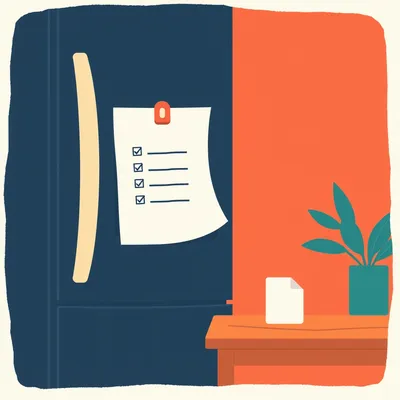
This lives on the fridge.
The fridge is the ideal location because everyone walks past it forty times a day. A whiteboard with three columns drawn in permanent marker, and magnetic cards or sticky notes that can move between columns. The stand-up becomes a five-minute walk through the board. "I moved the gas appointment to Done. I'm starting on the box labeling — that's in progress. The blocker is we need more packing tape." You're not even talking to each other as much as you're talking to the board, which makes it feel less like a performance and more like a shared tool.
The board solves the thirty-five percent "lack of agenda" complaint from Rogelberg's study without anyone having to prepare anything. The board is the agenda. You just read it left to right.
And the blockers column is the most important part. In software teams, the stand-up's primary value is surfacing blockers early — before they become crises. For a household, this means explicitly naming what's stuck and assigning ownership before the stand-up ends. "I can't pack the kitchen until we decide what to do with the slow cooker." Okay, who owns that decision? When will it be made? The rule is every blocker gets an owner and a next action. Otherwise the parking lot becomes a black hole where problems go to die.
The slow cooker decision could sit in limbo for three days while both people assume the other person is thinking about it. And then on moving day you're standing in the kitchen holding a slow cooker with no box and no plan.
That's the exact failure mode the blocker column prevents. It makes the invisible visible. You can't walk past the fridge and not see the card that says "slow cooker decision — Daniel" in red marker. The board nags you so your spouse doesn't have to.
Which is a much healthier dynamic. The board is the bad guy.
Now, the toddler factor. With a one-year-old, the stand-up has to happen before the baby wakes up or during a contained play session — high chair with breakfast, playpen, whatever works. The constraint actually improves the stand-up because the window is brutally tight. You know you've got maybe ten minutes before the Cheerios start hitting the floor.
What if one partner is on baby duty and can't physically be at the board?
Voice note or a written update on the board. The partner who's up early with the baby leaves a sticky note in the Today column before the other partner even wakes up. "Crib delivery confirmed ten to noon, need you to handle the building manager call." It's not ideal — you lose the live back-and-forth — but it's better than no sync at all. And the thirty-four percent time savings from standing means the stand-up is short enough to fit into a nap window when you do get to do it together.
The system scales down as well as up. During the move, it's daily. When things settle, you drop to a Sunday evening weekly sync — fifteen to thirty minutes, same three questions but at a weekly cadence, same board but the cards move slower.
The board stays up. That's the key. You don't erase the columns and put the whiteboard in a closet. You leave it on the fridge, maybe with a magnet that says "weekly mode." Either partner can reinstate the daily with a single text message: "stand-up season?" That's all it takes. The infrastructure is already there.
The case study that makes this concrete is a couple doing a three-month renovation. Magnetic whiteboard on the fridge, daily stand-up at seven fifteen before the kids wake up. Three columns: Today's Moves for the urgent stuff, This Week for the less urgent, Blocked for anything waiting on an external party. Every morning they walk the board, move cards, assign owners. When the renovation ends, they switch to a Sunday twenty-minute sync and archive the daily. The board stays up. Six months later, one of them gets a crushing work deadline, sends the text, and the daily is back in operation the next morning.
The alternative — which is what most couples do — is the weekly meeting alone during a crisis. Which leads to those Friday conversations: "I thought you were handling the insurance." That should have been surfaced Monday. The daily catches it Tuesday morning, directly addressing the forty-six percent complaint by keeping each meeting short and focused instead of letting everything pile up for a weekly download that takes two hours and leaves everyone exhausted.
Let's make this concrete, because Daniel asked for something actionable and I think we've earned the right to be prescriptive. Here's exactly what you buy and what you agree on tonight.
I love when you go full prescription mode. It's like watching a very nerdy doctor write a very nerdy prescription.
Three colored markers. Magnetic cards or a stack of sticky notes. Draw three columns: Done Yesterday, Today's Plan, Blockers. That's the whole system. Every morning during the move, ten minutes, timer set, standing at the fridge, walking the board left to right. Pass the spatula. End with each person stating their top priority for the day.
The spatula is non-negotiable at this point. I've decided it's the cornerstone of the entire framework.
The one rule that prevents the whole thing from collapsing: no problem-solving in the stand-up. If a blocker surfaces, it gets written on a sticky note and parked. Schedule a separate five minutes after breakfast to tackle it. The stand-up is for surfacing, not solving. That's the parking lot technique directly from agile facilitation, and it's what prevents Rogelberg's forty-six percent "too long" complaint from eating your morning.
The stand-up identifies that the slow cooker decision is stuck. The parking lot note says "slow cooker — decide by noon." The stand-up moves on. The decision happens later, not during the ten minutes.
The trigger agreement is the next piece, and this one needs to happen before the crisis peaks. Tonight, not next week. Both partners agree: if either of us feels overwhelmed, we call a stand-up season. Write it down somewhere visible. That prevents the "I didn't know we were in crisis mode" argument before it starts.
The off-ramp is the matching bookend. When things settle, set a calendar reminder to review: "Are we still getting value from this?" If the answer is no, drop back to weekly. The stand-up is a tool, not an identity. The Washington University finding — thirty-four percent shorter — that only holds when the format is appropriate to the situation. You don't keep the cast on after the bone heals.
The question that keeps nagging at me, though — and I think it's the one Daniel didn't ask directly but is lurking underneath — is whether you can over-optimize a household. At what point does the stand-up and the Kanban board and the parking lot start to feel less like a home and more like a startup with a nap schedule?
That's the real tension, isn't it. Rogelberg's study shows forty-six percent of people find meetings too long — the problem of too much structure is well documented. But the opposite problem is just as real. Too little coordination and you get dropped balls, missed appointments, and the slow drip of resentment that comes from one person carrying more of the invisible load. There's no perfect equilibrium. It's a pendulum.
The pendulum swings based on season. During a move, the risk of too little structure is way higher than the risk of too much. Nobody's going to feel like their marriage has become a Jira board when there are half-packed boxes in every room. The chaos is the bigger threat to warmth than the stand-up is.
The bigger question is what happens when the move ends and more of life starts looking like this. More people working from home, households that are simultaneously offices and schools and daycares. The need for lightweight coordination isn't going away. The stand-up is one tool, but the Kanban board came from a car factory, the parking lot came from agile coaches, the time-boxing came from Scrum. There's probably a dozen other professional practices that deserve a domestic translation.
The Toyota production system, now helping you decide whose turn it is to buy diapers. Taiichi Ohno would be baffled and possibly honored.
I think he'd be fascinated. The principles were always about reducing waste and making work visible. That's as relevant to a family as it is to a factory floor. The question is just where you draw the line between helpful structure and over-engineering.
Here's what I'd say to Daniel, and to anyone listening who's in the middle of their own version of this. Try the stand-up for one week during your next busy period. Whiteboard, timer, spatula, three columns, ten minutes. See what breaks and what actually helps. The weirdest prompts on this show often come from the most mundane problems, and honestly, ten minutes standing at the fridge might save more hours of confusion than any productivity system we've ever discussed.
We want to know what worked and what was absurd. The spatula might turn out to be the secret, or it might turn out to be the thing your toddler throws at the cat. Either outcome is useful data.
That's the thing about applying agile to your marriage. The retrospective is built in. You try it, you inspect, you adapt. If the stand-up is making things worse, you kill it. That's the off-ramp we talked about. No sunk cost, no guilt.
If it works, you've got a tool for the next crisis, and the one after that. The board stays on the fridge, the spatula stays in the drawer, and the agreement stays in your back pocket. Stand-up season can start with a single text.
Now: Hilbert's daily fun fact.
Hilbert: In the nineteen forties, fishermen in the Caspian basin harvested a specific red seaweed not for food but to ferment into a brine that, when consumed in small amounts before dawn, induced a temporary state of euphoria and reckless bargaining at fish markets — a practice local authorities spent two decades trying to ban, largely unsuccessfully, because the seaweed grew only in one cove and everyone pretended not to know where it was.
...right.
This has been My Weird Prompts. Thanks to our producer Hilbert Flumingtop. If you try the stand-up thing, email the show at show at my weird prompts dot com — we want the field reports, especially the failures. They're usually funnier. I'm Corn.
I'm Herman Poppleberry. Go stand at your fridge.