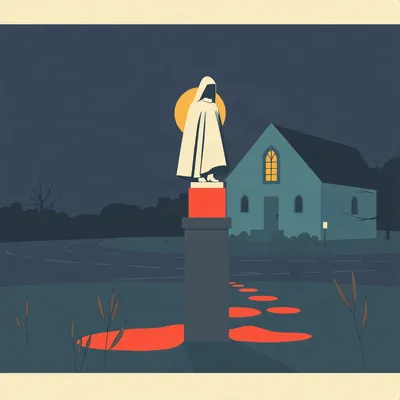
Daniel sent us this one, and it's heavy. Ann Widdecombe was found dead at her home in Etchingham, East Sussex this week — police discovered her body after she missed a scheduled interview with a production team. The tributes pouring in from across the political spectrum all land on the same word: respected. Labour figures, Liberal Democrats, people who spent decades opposing everything she stood for — all praising her integrity. And Daniel's question is essentially: what does that gap tell us? Less than a decade ago, two sitting UK MPs were murdered during constituency surgeries. Jo Cox in 2016, David Amess in 2021. So when we watch Prime Minister's Questions and see MPs tearing into each other, is that people doing their job — or is it as personal as it looks? And is the idea of respectful disagreement between opponents a realistic aspiration, or just nostalgia for something that never really existed?

The timing of this question is almost unsettlingly precise. You've got Widdecombe's death prompting these reflections about cross-party respect, and it lands right on top of the raw fact that two MPs were killed by people who took political disagreement and turned it into mortal enmity. That's not a theoretical tension — that's the spectrum we're actually living on.
The spectrum is what Daniel's really probing here. He's not asking whether political violence exists — obviously it does. He's asking whether the everyday performative hostility we see in parliaments normalizes the kind of enemy-framing that makes violence thinkable. Whether the shouting matches at PMQs are sharpening policy or just sharpening knives.
Let's lay out the three cases that anchor this, because the contrasts are instructive. Ann Widdecombe — served as MP for Maidstone and then Maidstone and The Weald from 1987 to 2010, later came back as a Brexit Party MEP from 2019 to 2020. Social conservative, opposed abortion, opposed gay marriage, opposed drug legalization. Died of natural causes, and the obituaries from her political opponents are genuinely warm. Then Jo Cox — murdered June 16, 2016 in Birstall, West Yorkshire by Thomas Mair, a far-right extremist who shouted "Britain First" and "Keep Britain independent" as he attacked her. Then Sir David Amess — murdered October 15, 2021 in Leigh-on-Sea, Essex by Ali Harbi Ali, an Islamist extremist who explicitly targeted Amess for his parliamentary votes on airstrikes in Syria.
Both Cox and Amess were killed doing the least partisan thing an MP does — constituency surgeries. That's the part of the job where you sit in a church hall and listen to people's housing problems and immigration paperwork and pothole complaints. It's the most local, most human, most non-tribal part of the role. And that's where they were most vulnerable.
Which is not a coincidence. When politics becomes personal, the accessible representatives are the exposed ones. The MP who actually shows up in the community is the one you can find.
Let's trace how we get from disagreement to enmity. Because the murders are the extreme end, but Daniel's question is about the machinery that produces the whole spectrum.
The first mechanism is what I'd call the enemy frame. Political discourse has this way of shifting from "opponent with different priorities" to "enemy who threatens the nation." And it happens through specific linguistic and structural pathways. Linguistically, you see dehumanizing metaphors — war language, crusade language, talk of battles and fights and destroying the opposition. Structurally, you've got echo chambers and algorithmic amplification that reward outrage. The angrier the post, the more it travels. The more it travels, the more it becomes the baseline.
There's a specific phrase that sticks with me from the Cox murder. Thomas Mair shouted "Britain First" — which is also the name of a far-right political party. So you have a killer literally chanting a political slogan while committing murder. That's not a disturbed individual disconnected from political discourse. That's someone who absorbed the framing that his victim was not a political opponent but an existential threat to the nation.
On the other side, Ali Harbi Ali told police he targeted Amess specifically because of parliamentary votes on airstrikes in Syria. He'd researched MPs, identified Amess as someone who voted for military action, and decided that made him a legitimate target. Again — not random. Not disconnected from politics. A direct line from parliamentary procedure to lethal violence.
The mechanism there is the collapse of distinction between policy and person. If your mental model is "this person voted for airstrikes, therefore they are a murderer," you've erased the entire framework of representative democracy — where MPs make decisions on behalf of constituents based on information and debate and judgment. You've turned a vote into an identity, and an identity into a death sentence.
That's where the performativity problem kicks in. The Westminster system is structurally designed for adversarial debate. Prime Minister's Questions is a weekly ritual built for confrontation, not deliberation. The chamber is physically arranged with government and opposition facing each other across a floor — two swords' length apart, by tradition. The architecture itself encodes opposition.
The two swords' length thing is real?
The red lines on the floor of the Commons chamber are two sword-lengths apart, supposedly to prevent members from dueling during debates. Which tells you something about the historical baseline we're working from.
So the physical space is designed for combat, and the procedural space rewards performance. MPs have to signal tribal loyalty constantly. The backbenchers who ask planted questions, the frontbenchers who have to look aggressive for the cameras, the whips who enforce voting discipline — the whole system incentivizes treating the other side as the enemy, at least for the cameras.
The line between performing opposition and feeling genuine contempt gets blurry. If you spend every Wednesday afternoon shouting at someone across a chamber, and then you go on Twitter and see your supporters praising you for owning them, and then you go on television and get rewarded for the most cutting soundbite — at what point does the performance become the genuine feeling?
There's a clinical parallel here you'd know better than me. Repeated behavior shapes genuine emotion, right?
It's a well-established psychological mechanism. You don't just act the way you feel — you start to feel the way you act. If you perform contempt often enough, contempt becomes the default. The cognitive dissonance resolves in the direction of the behavior, not the other way around. I saw this in medicine all the time — the way bedside manner isn't just a performance you put on for patients, it's a practice that shapes how you actually see them.
The system doesn't just permit hostility — it actively produces it. And then social media amplifies it, and then the most extreme people in the audience take it as permission.
Which brings us to Widdecombe. Her career largely predates this amplification loop. She entered Parliament in 1987, left the Commons in 2010. The 24-hour news cycle existed for part of that, but the social media outrage machine really kicked into gear after she'd already stepped back. When she returned as a Brexit Party MEP in 2019, she was already a known quantity — the persona was established, the reputation was set.
The reputation, from the tributes, is consistent. Even people who thought her positions on abortion and gay marriage were not just wrong but harmful — they still describe her as decent, as someone you could disagree with without feeling attacked. There's a quote from a Labour MP in one of the obituaries saying she was never nasty, just wrong.
It separates the person from the policy in a way that feels almost foreign to current political discourse. The default now is that if someone holds a position you find morally objectionable, they must be morally objectionable. The position is the person.
That's the misconception Daniel's question helps us bust. The idea that respectful disagreement means being a centrist, or avoiding strong opinions, or being wishy-washy. Widdecombe was none of those things. She was an unapologetic social conservative who held positions that a lot of people found abhorrent. The respect didn't come from moderation — it came from consistency and integrity.
She didn't triangulate. She didn't poll-test. She believed what she believed and she said it clearly, and she didn't make it about the person she was debating. That's replicable regardless of ideology. The question is whether the current environment allows it.
Let's talk about what happens when the environment doesn't allow it — the knock-on effect. After Cox and Amess were murdered, what changed for MPs?
Security changed dramatically. MPs reported increased abuse, increased threats, and some openly considered leaving politics. There were concrete legislative responses — the UK introduced measures around MP safety, including what's called the Duty of Candour and reforms to how threats against MPs are handled. But the deeper effect is a chilling effect on representation.
Because if the job carries mortal risk, who runs?
The calculation shifts. If you're a normal person with a family — not wealthy, not insulated, not surrounded by private security — the threat level becomes a factor in whether you stand for office. That skews representation toward the wealthy who can afford protection, or the ideologically extreme who see the risk as worth it for the cause, or the already-powerful who have existing security infrastructure. The local teacher or nurse or small business owner who wants to serve their community — they look at what happened to Jo Cox in a library parking lot and they think twice.
That's a democratic failure that goes beyond the individual tragedies. If the only people who can afford to serve are those who can afford the danger, you've lost the representative part of representative democracy.
There's a knock-on effect on discourse too. After the murders, you saw a brief moment of reflection — the "more in common" phrase from Jo Cox's maiden speech became a rallying point. The Jo Cox Foundation was established explicitly to rebuild cross-party and cross-community relationships. There were bipartisan eulogies, moments of unity in the Commons. But those moments are fragile, and the structural incentives toward hostility don't go away just because everyone agrees violence is bad.
The "more in common" line is worth sitting with. Cox said in her maiden speech that we have more in common than that which divides us. She was quoting her own constituency — Batley and Spen — but it became a national touchstone after her death. And yet the question is whether that sentiment can survive the daily machinery of politics.
Which brings us to the historical question Daniel raised. Is it naive to think politics used to be more cooperative? Were figures like Widdecombe always rare, or is there survivorship bias in how we remember the past?
There's definitely some selective memory at work. The nineteenth century had duels and fistfights in legislatures. Spencer Perceval was assassinated in 1812 — the only British prime minister to be murdered. Political violence isn't new. What's new is the combination of algorithmic amplification and the collapse of shared information environments.
That's the key distinction. In the past, political opponents might despise each other personally, but they were operating in the same information ecosystem. They read the same newspapers, watched the same broadcasts, shared a baseline of facts even if they disagreed about what to do about them. Now you can live in a completely separate information universe from your political opponents — different news sources, different social media feeds, different fundamental assumptions about reality.
When you don't share a reality with someone, it's much harder to see them as a legitimate opponent rather than a malicious actor. If you believe the other side is lying about everything, operating in bad faith, destroying the country — then why would you treat them with respect?
There's a historical counterpoint worth considering. Tony Benn on the Labour left and Enoch Powell on the Conservative right — deeply opposed ideologically, but by most accounts they had genuine mutual respect. They debated each other seriously. They engaged with each other's arguments rather than caricaturing them. Was that the norm? But it existed as a possibility within the political culture of the time.
That's the question — is it a possibility now? Or has something structural changed that makes it nearly impossible?
I think institutional design matters more than we usually acknowledge. Compare the UK's Westminster system with consensus-oriented systems like the Nordic parliaments or the German Bundestag. Germany has a constructive vote of no confidence — you can't just bring down a government, you have to have an alternative ready to install. That structural feature changes the temperature of disagreement. Coalition governments are the norm in Norway's Stortinget, and adversarial language is notably milder — not because Norwegians are inherently more polite, but because you might need to govern with these people next year.
The architecture of debate shapes the temperature of debate. If you know you might be in coalition with someone in six months, you don't burn the bridge today.
And in Westminster, the two-party system means you can spend your entire career in opposition, never having to actually govern with the other side. There's no structural incentive to maintain working relationships across the aisle. You can perform pure opposition forever.
What does Widdecombe's career actually demonstrate? Because she operated in that same Westminster system and still managed to be respected across the aisle.
I think it demonstrates that individual character can overcome structural incentives, but it can't be relied upon to do so. Widdecombe was an outlier in her ability to separate person from policy. The system didn't reward that — she managed it despite the system. And the question is whether we want a democracy that depends on outliers, or one where the structures make respectful disagreement the default rather than the exception.
Daniel's prompt gets at something practical here. He's not just asking for analysis — he's asking whether the ideal of a united parliament with a shared interest is achievable. And I think there are concrete things that point in both directions.
The pessimistic case is that the structural incentives toward hostility are getting stronger, not weaker. Social media algorithms optimize for outrage. Political fundraising runs on enemy-framing. The economic model of cable news rewards conflict. All the money and attention flows toward making politics more personal and more vicious.
The optimistic case?
The optimistic case is that the response to Cox and Amess shows that people recognize the problem and want something different. The Jo Cox Foundation's work on building cross-community relationships. The moments of genuine unity after the murders. The fact that Widdecombe's obituaries are landing the way they are — people are hungry for examples of political figures who can be opposed without being hated.
There's also the institutional patriotism angle. The idea that MPs can defend the institution of parliament even while attacking each other's policies. You see this in the way the Commons closes ranks when the institution itself is threatened. The Speaker defending the rights of backbenchers regardless of party. The cross-party committees that do serious legislative work while the cameras are off.
Select committees are the best example of this. They operate largely by consensus, they take evidence seriously, and they produce reports that are often bipartisan. The public doesn't see much of this because it's not televised in the same way PMQs is, but it's where a lot of the actual parliamentary work happens.
There's a split between the performative parliament and the working parliament. The cameras see the former. The legislation happens in the latter.
That split creates a weird dynamic where MPs are essentially doing two jobs — the televised combat role and the actual governance role. The question is whether the combat role is poisoning the governance role, or whether they can remain separate.
I suspect they can't remain separate indefinitely, for the psychological reason you mentioned earlier. You become what you perform.
Which brings us to the practical question. What can someone who's politically engaged actually do about this? Daniel's not an MP — he's a citizen watching this from Jerusalem. What's the actionable insight?
I think there are three things worth pulling out. The first is a heuristic for political debate: if you can't state your opponent's position in a way they'd recognize, you're not debating — you're demonizing. That's a practical test anyone can apply. Before you argue against someone's position, can you articulate it fairly enough that they'd say "yes, that's what I believe"?
That's the principle of charitable interpretation, and it's difficult to do. It requires you to understand the strongest version of the argument you oppose, not the weakest caricature. Most political discourse runs on the weakest caricature.
The second actionable insight is about what citizens demand from their political system. If we reward performative hostility — if we share the most cutting soundbites, if we celebrate the takedowns, if we treat politics as entertainment — we're voting with our attention for more of it. Recognizing that performative hostility is partly a feature of the system, not just individual character, means we can demand institutional reforms that reward cooperation rather than just confrontation.
Proportional representation, cross-party committees with real power, constructive vote of no confidence — these are unsexy institutional design questions, but they shape the temperature of politics more than any individual politician's character.
The third insight is what I'd call the Widdecombe model. Being respected by opponents is not about being moderate or centrist. She was a social conservative who held positions that were deeply unpopular with large segments of the population. The respect came from consistency, integrity, and separating the person from the policy. That's replicable regardless of ideology. You can be a socialist or a libertarian or a nationalist and still practice it.
Consistency is underrated as a political virtue. If people know where you stand and you don't shift with the wind, even your opponents can work with you. They know what they're getting. The distrust comes from unpredictability and bad faith, not from strong disagreement.
The Widdecombe model is essentially: hold your positions clearly, argue for them honestly, don't make it personal, and don't change your views based on what's convenient. That's not complicated. It's just hard.
It's hard precisely because the system doesn't reward it in the short term. The system rewards the hot take, the viral clip, the devastating putdown. Integrity plays a long game that doesn't show up in the weekly metrics.
Which brings us back to the open question. If the price of respectful disagreement is that it makes you a target — as it did for Cox and Amess — is it still worth pursuing? Both of them were known for working across party lines, for being accessible, for treating opponents as human beings. And that accessibility is what made them vulnerable.
That's the most uncomfortable part of this whole discussion. The qualities we're praising — accessibility, openness, willingness to engage — are the same qualities that put MPs at physical risk. A constituency surgery is the embodiment of democratic accessibility. You sit in a room and anyone can walk in and talk to you. That's the ideal. And it's also the attack surface.
The question becomes: does the system need to change before individuals can safely practice respectful disagreement? Or do we need individuals to model it despite the risk?
I think the honest answer is both, and neither is sufficient alone. Institutional changes can reduce the temperature, but they can't eliminate the risk entirely. Individual courage can model the behavior, but it can't protect against the most extreme responses. The murders of Cox and Amess are not problems with a solution — they're tragedies that reveal the inherent tension between democratic accessibility and personal safety.
Yet the alternative — MPs behind bulletproof glass, no constituency surgeries, no public engagement — that's not democracy either. That's governance by remote control.
Which is why this question Daniel's asking isn't academic. It's about what kind of democracy we're willing to sustain, and at what cost.
Ann Widdecombe's legacy, from the tributes, is not that she was universally liked. She wasn't. It's that she was universally respected. And in an era of algorithmic outrage, that might be the most radical political stance available. Not moderation, not centrism, not avoiding strong opinions — but holding strong opinions in a way that doesn't require you to hate the person who holds different ones.
The obituaries from Labour and Liberal Democrat figures are striking precisely because they're unusual. If every retiring MP got that kind of cross-party respect, it wouldn't be news. The fact that it stands out tells you something about the baseline.
Next time you watch a political debate — whether it's PMQs or a local council meeting or a panel on television — the question to ask yourself is the one Daniel posed: is this person doing their job, or is this personal? The answer matters more than it should.
The follow-up question is: what am I doing when I participate in political discourse? Am I treating opponents as people who want a different path to a shared good, or as enemies who threaten everything I value? That distinction is the difference between democratic disagreement and the kind of enmity that ends in a church hall in Leigh-on-Sea.
Now: Hilbert's daily fun fact.

The purple dye used in Byzantine imperial robes was produced from the hypobranchial glands of Murex sea snails, with approximately twelve thousand snails required to produce one point four grams of pure dye — a chemical process involving brominated indigo compounds that gave the color its distinctive lightfast quality, making it more valuable than gold by weight in the sixth century.
Twelve thousand snails for a gram and a half of dye. That's not an empire, that's a mollusk genocide with a dress code.
I have so many questions and I'm not sure I want any of them answered.
This has been My Weird Prompts. Thanks to our producer Hilbert Flumingtop. If you want to send us your own prompts — the weird ones, the heavy ones, the ones that keep you up at night — email the show at show at my weird prompts dot com. Until next time.