
Development
Building software: programming, developer tools, APIs, deployment and DevOps, and building with AI (agents, MCP servers, RAG, AI coding tools). An extra channel alongside an episode's main one, so AI engineering episodes sit in both.

#2204: Memory Without RAG: The Real Architecture
mem0, Letta, Zep, and LangMem solve agent memory differently than RAG. Here's what's actually happening under the hood.

#2203: Knowledge Without Tools: Why MCPs Aren't Just for Execution
MCPs can be pure knowledge providers with zero tools. Here's why that matters for agents querying government data and authoritative sources.

#2194: Game Theory for Multi-Agent AI: Design Better, Fail Less
Nash equilibrium, mechanism design, and why your AI agents are playing prisoner's dilemma whether you know it or not.

#2193: Running Claude in Your Apartment (The Physics Says No)
Building a local AI inference server to rival Claude Code sounds great until you do the math on heat, noise, and neighbor relations.
#2192: How We Built a Podcast Pipeline
Hilbert reveals the complete technical architecture behind 2,000+ episodes—from voice memos to GPU-powered TTS, with Claude models, LangGraph workf...

#2191: Making Multi-Agent AI Actually Work
Research from Google DeepMind, Stanford, and Anthropic reveals most multi-agent systems waste tokens and amplify errors. Single agents with better ...

#2189: Scaling Multi-Agent Systems: The 45% Threshold
A landmark Google DeepMind study reveals that adding more AI agents often degrades performance, wastes tokens, and amplifies errors—unless your sin...

#2185: Taking AI Agents From Demo to Production
Sixty-two percent of companies are experimenting with AI agents, but only 23% are scaling them—and 40% of projects will be canceled by 2027. The ga...

#2184: The Economics of Running AI Agents
Production AI agents can cost $500K/month before optimization. Learn model routing, prompt caching, and token budgeting to cut costs 40-85% without...
#2183: Making Voice Agents Feel Natural
Turn-taking, interruptions, and latency are destroying voice AI UX—and the fixes are deeply technical. Here's what's actually happening underneath.
#2182: Can You Actually Review an AI Agent's Plan?
Most AI agents have plans the way you have a plan while half-asleep—something's happening, but you can't see it. We map the five major planning pat...
#2181: When RAG Becomes an Agent
RAG in chatbots is simple retrieval. RAG in agents is a multi-step decision loop. Here's what actually changes.

#2180: The Sandboxing Tradeoff in Agent Design
AI agents need broad permissions to be useful—but every permission expands the attack surface. We map the real threat landscape and the isolation t...
#2179: Building Cost-Resilient AI Agents
Failed API calls in agent loops aren't just technical problems—they're direct budget drains. Here's how checkpointing, retry strategies, and cachin...

#2178: How to Actually Evaluate AI Agents
Frontier models score 80% on one agent benchmark and 45% on another. The difference isn't the model—it's contamination, scaffolding, and how the te...
#2177: Skip Fine-Tuning: Shape LLMs With Alignment Alone
Can you build a personalized LLM by skipping traditional fine-tuning and using only post-training alignment methods like DPO and GRPO? We break dow...

#2175: Let Your AI Argue With Itself
What happens when you let multiple AI personas debate each other instead of asking one model one question? A deep dive into synthetic perspective e...

#2174: Role-Playing as Orchestration
How a role-playing protocol from NeurIPS 2023 became one of AI's most underrated agent frameworks—and what happens when you scale it to a million a...
#2173: Inside MiroFish's Agent Simulation Architecture
MiroFish generates thousands of AI agents with distinct personalities to predict social dynamics. But research reveals a critical flaw: LLM agents ...
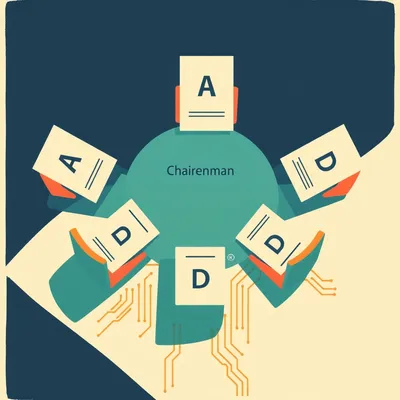
#2172: Council of Models: How Karpathy Built AI Peer Review
Andrej Karpathy's llm-council uses anonymized peer review to make language models evaluate each other fairly—but can it really suppress model bias?