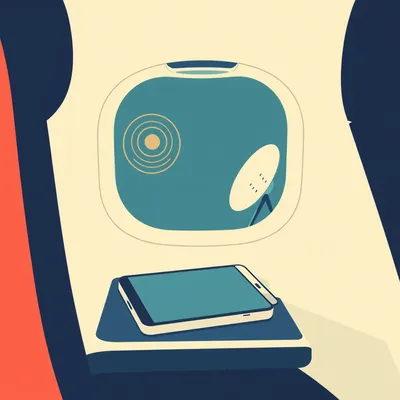
Welcome to My Weird Prompts, episode two hundred and one. Here's a contradiction you've probably lived through a hundred times: the cabin crew tells you to put your phone in airplane mode because it might interfere with the plane's navigation. Meanwhile, the plane itself is bristling with antennas — Wi-Fi, satellite links, sometimes an entire cell tower in the ceiling. Daniel wrote in asking the obvious question: if the aircraft can carry its own Starlink terminal and GSM base station, why is the iPhone in your pocket still treated like a threat? So let's unpack that paradox. On one hand, the FAA says your phone is a threat. On the other, the plane is flying with a Starlink dish on top. How can both things be true?

They can both be true because one system is certified and the other is not. And that sounds like a bureaucratic dodge, but it's actually the whole story. The onboard equipment — the picocells, the satellite terminals — goes through a testing regime that costs millions of dollars and takes months per aircraft type. Your phone went through FCC certification for use on the ground, not inside an aluminum tube at thirty-five thousand feet with a hundred other phones all screaming for towers they can't reach.
The difference isn't physics, it's paperwork.
It's physics plus paperwork. The physics is real, just small. The paperwork is what locks it in place. To understand the contradiction, we need to start with the physics — what actually happens when a phone transmits inside a metal tube at altitude, and why the people who study this for a living keep coming back to the same conclusion: the risk is tiny but not zero, and takeoff and landing are when tiny risks matter most.
Alright, walking encyclopedia — walk me through the actual interference mechanism. What is a phone supposedly doing to a plane's navigation system?
The core concern is electromagnetic interference, EMI. Every electronic device emits some amount of electromagnetic radiation. For a phone that's actively transmitting — trying to reach a cell tower, or pinging for one — the emissions are deliberate and relatively powerful. The worry is that these emissions can couple into the aircraft's wiring and show up as noise in the navigation receivers.
Couple into the wiring.
Imagine the aircraft's wiring harness as a long antenna. It runs through the fuselage, sometimes near passenger seats. When your phone transmits, it creates an electromagnetic field. That field can induce tiny currents in nearby conductors — and those conductors might be the cables carrying the signal from the instrument landing system antenna to the receiver in the avionics bay. The phenomenon is called aperture coupling — the field sneaks in through windows, through seams in the fuselage, through any gap in what you might imagine is a perfect Faraday cage but absolutely is not.
The cabin isn't a Faraday cage.
Not even close. A Faraday cage requires continuous conductive enclosure with no gaps larger than the wavelength of the signal you're trying to block. An aircraft fuselage has windows, doors, access panels, drain holes. At the frequencies we're talking about — gigahertz range for phones, but also their harmonics — those gaps are enormous. The skin effect helps at higher frequencies, where current travels only on the surface of the conductor, but seams and apertures still leak.
The navigation frequencies are way down in the VHF band.
The instrument landing system localizer operates at a hundred and eight to a hundred and twelve megahertz. VOR navigation is at a hundred and eight to a hundred and eighteen megahertz. Those are nowhere near where your phone's transmitter is tuned. Your phone is transmitting at eight hundred megahertz, nineteen hundred megahertz, two point four gigahertz depending on the band. So if you're just comparing frequencies, you'd say there's no problem — they're in completely different parts of the spectrum.
That's not where the story ends.
It's where the story begins. The real concern is harmonics and intermodulation products. Any transmitter produces harmonics — integer multiples of the fundamental frequency. A phone transmitting at eight hundred megahertz will also emit some energy at sixteen hundred megahertz, twenty-four hundred megahertz, and so on. Those harmonics are much weaker than the fundamental, but they exist. More importantly, when you have multiple transmitters in close proximity — say, a hundred passengers' phones all trying to connect — their signals can mix nonlinearly in any semiconductor junction they encounter, producing intermodulation products at sums and differences of the original frequencies. Some of those products can fall right into the navigation bands.
It's not your phone alone. It's the cumulative effect of a cabin full of phones creating a soup of unintended frequencies.
And that's what the original research was trying to quantify. In nineteen ninety-two, the RTCA — that's the Radio Technical Commission for Aeronautics — published a document called DO dash two thirty-three. They instrumented commercial flights and found measurable interference events on roughly one in twenty thousand flights. Measurable, not necessarily dangerous. The report explicitly stated that no causal link between PED emissions and any aircraft malfunction had been established. But they recommended the ban anyway, as a precaution.
One in twenty thousand. That's the kind of number that makes a regulator's life easy — it's rare enough that you can't point to a smoking gun, but frequent enough that you can't say it never happens.
Precisely the bind. And once the ban was in place, removing it required proving a negative — proving that interference can never happen under any conceivable combination of devices and conditions. That's essentially impossible.
The nineteen ninety-two precaution calcified into permanent regulation.
With one significant update. In twenty fourteen, the RTCA published DO dash three oh seven A — a two hundred and eighty-seven page document that reassessed the whole question. The FAA used it to relax the rules for the cruise phase of flight. Gate-to-gate use of devices in airplane mode, and even Wi-Fi and Bluetooth, became permitted. But the takeoff and landing ban stayed.
Why are takeoff and landing the critical phases? Beyond the obvious — you're closer to the ground, less time to react.
First, navigation receivers are working hardest during approach. The ILS glideslope capture happens at three degrees — the system is providing precision vertical and lateral guidance, and any degradation matters more when you're two hundred feet above the threshold. Second, pilot workload is highest during takeoff and landing — there's less cognitive bandwidth to diagnose and compensate for an instrument anomaly. Third, and this is the one most people miss, redundancy is reduced. On a twin-engine aircraft, if you lose an engine during cruise, you've got time and altitude to manage it. On takeoff, during the initial climb-out on a single engine, the margins are razor thin. The last thing you want in that moment is a navigation display flickering because someone in seat fourteen C is trying to download a podcast.
That's a vivid image. And it connects to something the RTCA documents emphasize — it's not about any single phone causing a problem. It's about the aggregate risk in the worst-case scenario.
The safety case isn't "this phone will crash the plane." The safety case is "in a hundred thousand flights, if one in twenty thousand has a measurable event, and some fraction of those events coincide with an engine failure or wind shear during approach, the outcome could be catastrophic." Aviation safety is built on Swiss cheese models — layers of protection. The PED ban is one layer. You don't remove a layer just because the holes in the other layers are small.
Okay, so the physics says the risk is real but small. Now let's look at the systems that are allowed — the picocells and satellite terminals — and ask why they get a pass.
This is where the story gets genuinely interesting. Let's start with the GSM picocell. When an airline installs onboard cellular service — think AeroMobile or OnAir — they're putting a femtocell, essentially a miniature cell tower, in the aircraft ceiling. This device operates at a maximum of two hundred and fifty milliwatts. That's a quarter of a watt. It connects to the aircraft's satellite backhaul, not to towers on the ground. And here's the key: it actively manages the transmit power of every phone connected to it.
It tells the phones to turn down.
A phone searching for a ground tower — which is what your phone does if you forget to enable airplane mode — transmits at up to two watts peak power for GSM. That's eight times the picocell's own output. And it's doing that repeatedly, pinging every few seconds, trying to find a tower that might be seven miles below and moving at five hundred knots. The phone is screaming into the void at maximum volume. When connected to a picocell three feet away, the phone is told "I can hear you fine, reduce power" and it drops to maybe a few milliwatts.
The onboard cell tower is actually reducing the total RF energy in the cabin, compared to what a hundred unmanaged phones would be emitting.
And the certification process proves it. When Airbus certified AeroMobile for the A three eighty in twenty fourteen, they spent eighteen months testing. The picocell emissions measured at the fuselage interior were negative sixty decibel-milliwatts per square meter. That's forty decibels below the RTCA's threshold for concern. Forty decibels is a factor of ten thousand in power terms. The system isn't just safe — it's absurdly safe.
That certification was for one aircraft type. The A three eighty.
That's the catch. Every aircraft type — A three twenty, seven three seven, seven eight seven, A three fifty — requires its own certification. The wiring harnesses are routed differently, the avionics bays are in different locations, the fuselage construction varies. What's safe on an A three eighty isn't automatically safe on a seven three seven. Airlines have to go through the process for each type, and each variant within the type.
Which brings us to Starlink. That's a whole different beast — a phased-array antenna bolted to the top of the fuselage, beaming data to satellites.
The Starlink Aero Terminal. The FCC authorized it in twenty twenty-one, and EASA issued a Supplemental Type Certificate for A three twenty-one neo installations in twenty twenty-four. The terminal's effective isotropic radiated power — EIRP — is thirty-eight decibel-watts. That's about six kilowatts of effective radiated power. It sounds terrifying until you understand two things.
First, the antenna is mounted on the top of the fuselage and radiates upward at forty to sixty degrees elevation. The beam is directed at the sky, not at the cabin or the avionics. Second, and this is the elegant part, the phased array uses beamforming nulls — it deliberately creates zones of minimal radiation in the direction of the aircraft body. The antenna can shape its radiation pattern to put a "hole" in the beam where the fuselage is. The combination of physical orientation and electronic nulling means the energy reaching the navigation receivers is negligible.
This was all verified during certification.
When Emirates announced their Starlink rollout on fifty A three eighties in twenty twenty-four, the installation process required three weeks per aircraft for EMI testing and certification. They're not just bolting a dish on and hoping for the best. They're measuring emissions across the full flight envelope, in every conceivable configuration, with margin built in.
Three weeks per plane. That's a lot of revenue lost to ground time.
Which tells you how seriously they take it, and how rigorous the process is. But also — and this is the part that connects back to your phone — the Starlink terminal is a single device, with known characteristics, that the airline controls. Your phone is an unknown device, possibly damaged, possibly with a malfunctioning power amplifier, possibly a counterfeit model with no meaningful emissions testing, and there could be two hundred of them on board.
The regulatory logic is: we can certify what we control, and we ban what we can't.
That's the entire story in one sentence. And it's not irrational. It's conservative, it's expensive, it creates absurd-looking contradictions — but it's not irrational.
Let's talk about the five G C-band controversy, because that was a different flavor of the same problem, and it happened recently enough that people remember it.
This was the twenty twenty-one to twenty twenty-four saga where AT and T and Verizon rolled out five G service in the three point seven to three point nine eight gigahertz band. The problem was that radar altimeters — the instruments that tell pilots exactly how far above the ground they are — operate at four point two to four point four gigahertz. That's adjacent to the five G band, not overlapping, but close enough that poorly designed altimeter receivers could be desensitized by strong five G signals.
Adjacent-band interference, not harmonics.
Different mechanism from the PED issue. A radar altimeter transmits a signal downward and listens for the reflection. If a powerful five G transmitter nearby is splattering energy into the altimeter's receive band, the altimeter can't hear its own echo. The FAA's response was a directive requiring retrofits on roughly fifty percent of the US commercial fleet by mid twenty twenty-three. Total cost: over five hundred million dollars.
Half a billion dollars because cellular networks and altimeters were operating a few hundred megahertz apart.
The altimeters were designed decades ago, when the spectrum above four gigahertz was quiet. The engineers who designed those altimeters in the nineteen seventies and eighties never imagined a world where every rooftop and cell tower would be blasting out signals just below their operating band. The filters on the receiver front end weren't sharp enough.
The five G crisis was a real interference problem, solved with real money and real hardware retrofits. But it's often conflated with the phone-on-a-plane debate.
They're different problems. The five G issue was about ground-based transmitters at known frequencies interfering with a specific instrument through a known mechanism. The PED issue is about unknown devices at unknown frequencies creating unknown intermodulation products that might couple through unknown paths into multiple navigation systems. One is a defined engineering problem. The other is a risk-management problem.
That distinction is worth underlining. The five G altimeter problem had a clear fix: install better filters. The PED problem has no clear fix because you can't filter out interference from inside the cabin without redesigning the entire avionics architecture of every aircraft ever built.
Even if you did, you'd have to recertify everything. The cost would be astronomical, for a risk that — as the RTCA data shows — has never caused a confirmed accident.
Which brings us to the misconception corner of this episode. There are a few ideas about this topic that are widely believed and mostly wrong. First one: the ban is completely outdated and has no technical basis.
That's an oversimplification. There is a real, though small, risk of EMI, particularly from phones transmitting at full power during critical flight phases. The risk hasn't been disproven — it's been quantified as very unlikely, and the regulatory response has been to maintain the precaution. Calling it "completely outdated" ignores the physics.
Second misconception: onboard Wi-Fi and cellular systems use the same frequencies as phones, so the ban is hypocritical.
Onboard systems are certified, tested, and power-controlled. Passenger phones are none of those things. The frequencies may overlap, but the emission characteristics are completely different. It's like comparing a professional fireworks display with someone throwing lit matches — both involve fire, but the control and predictability are worlds apart.
Third: airplane mode is just for battery saving.
It's primarily for interference prevention. Battery saving is a side benefit. And if you've ever forgotten to enable airplane mode and watched your phone drain itself trying to find a tower at thirty-five thousand feet, you know that side benefit is real.
Fourth: the ban exists because of proven incidents.
No commercial aviation accident has ever been conclusively linked to PED interference. There have been anecdotal reports — pilots saying "my instrument flickered and a passenger had a phone on" — but the investigations that followed never established causation. The two thousand three British Airways incident, where a phone was suspected of interfering with the autopilot, was investigated by the AAIB and they found no evidence linking the phone to the anomaly. It was correlation without causation.
The ban persists despite a complete absence of smoking-gun evidence. That's path dependency in action. The nineteen ninety-two precaution became the default, and the default became locked in by certification costs.
By the asymmetry of incentives. If a regulator removes the ban and an accident happens — even one where PED interference is only suspected — the regulator will be eviscerated. If they keep the ban and nothing happens, nobody blames them for being too cautious. The political economy of aviation safety strongly favors maintaining existing restrictions.
Let's go deeper on something you mentioned earlier — the picocell versus the unmanaged phone. You said the picocell actively manages phone transmit power. How does that actually work?
It's part of the GSM and LTE protocols. When a phone connects to a base station, the base station continuously measures the received signal strength and sends power control commands telling the phone to adjust its output. The goal is to maintain just enough signal for reliable communication without wasting power or creating unnecessary interference. When the base station is three feet away in the aircraft ceiling, the required transmit power is tiny — often below ten milliwatts.
Whereas a phone searching for a ground tower is transmitting blind.
It's shouting "is anyone there?" at maximum volume, over and over. And because the aircraft is moving fast, the phone keeps seeing new towers appear and disappear, triggering fresh connection attempts. It's the worst-case scenario for EMI — multiple phones, maximum power, rapid cycling.
If every passenger left their phone in normal mode, the cabin RF environment would actually be worse than if everyone was connected to the picocell.
The picocell is an interference mitigation strategy, not an interference source. But explaining that in a thirty-second cabin announcement is impossible, so we get "turn off your phones" instead.
Let's talk about the international dimension. You mentioned some countries ban in-flight cellular entirely.
India and China are the big ones. They prohibit in-flight cellular for reasons that are not primarily technical. In some cases it's spectrum licensing — the frequencies used by the picocell might be allocated differently in those countries' airspace. In other cases it's security-related — some governments don't want uncontrolled cellular communications traversing their territory. The regulatory friction means that even though the technology exists and is certified, airlines can't offer the service everywhere.
A passenger flying from London to Delhi might have onboard cellular over Europe and the Middle East, but it gets switched off as they enter Indian airspace.
And that's a regulatory handoff problem, not an engineering one. Each country's aviation authority has to certify the system for use in its airspace. The European Aviation Safety Agency and the FAA have done so, but many others haven't.
Which loops back to the core insight: the ban is a risk-management artifact, not a physics inevitability. The picocell is proof that when you control the variables, the physics can be managed.
The Starlink terminal is proof that even high-power systems can be integrated safely with enough engineering. The phased array's beamforming nulls are a elegant solution — they don't just reduce emissions toward the aircraft, they actively cancel them in specific directions.
How precise are those nulls?
A modern phased array can create nulls that are thirty to forty decibels deep in specific directions, and the null can be steered dynamically. If the antenna detects that its orientation relative to the fuselage has changed — say, the aircraft banks — it can adjust the null placement in real time. The technology comes out of military radar and electronic warfare systems, where the ability to suppress radiation in certain directions is literally a survival feature.
Military tech keeping your in-flight Netflix stable.
The glockenspiel of corporate approachability, applied to electronic warfare.
I'm going to pretend I understood that.
You understood it perfectly.
Given all this, what should a savvy traveler actually do? And what does the future hold for the airplane mode ritual?
The practical takeaway is straightforward. If you want to use your phone on a plane, use the airline's Wi-Fi calling or picocell service where available. It's actually safer than leaving the phone searching for ground towers at maximum power. The ban is not going away soon, because changing it would require recertifying every aircraft type — a multi-year, multi-million-dollar process with no clear safety benefit. No airline is going to volunteer for that.
The regulators aren't going to push for it.
Regulators have exactly zero incentive to revisit this. The current rules work, in the sense that there's no evidence of harm. Changing them introduces uncertainty. In aviation, uncertainty is the enemy.
We're stuck with the ritual. The cabin crew announcement, the scramble to enable airplane mode, the vague guilt about whether you remembered.
But something interesting is coming. Satellite direct-to-device services are rolling out — AST SpaceMobile, T-Mobile's partnership with Starlink. These operate in the L-band, around one point nine gigahertz. That's right in the sensitive zone for aircraft navigation harmonics.
The question becomes: when every phone can connect to a satellite directly, and those satellites are beaming signals through the cabin, does the airplane mode ban become untenable?
It becomes a completely different problem. Right now, the ban addresses phones transmitting to ground towers. When phones are communicating with satellites, the transmission is upward, through the fuselage, at frequencies that are closer to navigation bands. The interference scenario changes. And regulators are going to have to address it, because you can't tell passengers to put their phones in airplane mode when the phone's satellite connection is what's providing the aircraft's own connectivity.
That's the airplane mode two point zero scenario — phones automatically handing off to the aircraft's picocell or satellite terminal, with the manual ban becoming obsolete.
The technology exists. The protocols exist. What doesn't exist is the regulatory framework and the certification appetite. But as direct-to-device satellite services become ubiquitous — and that's happening now, in twenty twenty-six and twenty twenty-seven — the pressure to resolve this contradiction will become overwhelming.
Because the contradiction will be visible to everyone. The flight attendant tells you to turn off your phone's radio, but your phone is what's keeping the plane's internet working.
Passengers will notice. They'll ask the obvious question. The one Daniel asked us.
Which brings us to the real story. The next time a flight attendant tells you to put your phone away, you'll know what's actually happening. It's not about your phone being dangerous. It's about a thirty-year-old regulatory architecture that can't keep up with the technology. The ban was a reasonable precaution in nineteen ninety-two. It became locked in by certification costs and regulatory inertia. And now we're all living inside that decision, handing our phones to the ceiling picocell while pretending they're in airplane mode.
The ban is rational. But not for the stated reason. The stated reason is "your phone might interfere with navigation." The real reason is "changing the rule costs more than keeping it, and nobody wants to be the one who changed it if something goes wrong.
That's a story about how safety culture works in practice. It's conservative, it's expensive, it creates absurd-looking contradictions — and it has also made commercial aviation the safest form of transportation in human history.
The Swiss cheese model again. The PED ban is one slice. It might be the thinnest slice. It might have holes you can drive a truck through. But nobody wants to be the person who removed it.
To wrap this up for anyone who's been listening and wondering what to actually do: put your phone in airplane mode during takeoff and landing because the flight attendant told you to, and being a decent person on a plane means following the rules. But know that the rule exists because of a nineteen ninety-two study that found one questionable event per twenty thousand flights, and because the cost of proving the rule unnecessary is higher than the cost of keeping it.
If you want connectivity in the air, use the systems the airline provides. They're safer, they're more efficient, and they won't drain your battery screaming at towers that can't hear you.
One open question to leave you with: as satellite direct-to-device services become standard, will the airplane mode ritual survive? Or will we finally get the handoff architecture that makes the ban obsolete? Send us your weird prompts at myweirdprompts dot com — maybe someone out there is already working on this.
Now: Hilbert's daily fun fact.

In the late Victorian period, a French zoologist studying bats in Niger discovered that a single greater mouse-tailed bat emits echolocation clicks at a hundred and thirty decibels — equivalent to a military jet taking off from fifty feet away, but at frequencies too high for human hearing. The bat's inner ear muscles contract a millisecond before each click to prevent self-deafening, a mechanism that engineers later borrowed for naval sonar squelch circuits.
Bats invented the squelch knob.
Nature got there first.
This has been My Weird Prompts. Thanks to our producer Hilbert Flumingtop. If you enjoyed this episode, leave us a review wherever you get your podcasts — it helps people find the show. I'm Corn.
I'm Herman Poppleberry. We'll catch you next time.